Quantum Computing: Why the Next Technology Race May Redefine National Power

Introduction

A couple of years ago, our team published a multipart series regarding the Quantum space – We discussed many components of this technology and where it fits in to current conversations and expectations. Once again, the topic has become viral because of a recent Trump Administration Executive Order. As a result, the team decided to revisit this topic and hopefully you find it informative.

Quantum computing is moving from a highly specialized scientific field into a strategic technology priority for governments, corporations, universities, and national security organizations. For years, it sounded like a futuristic concept that belonged mostly in research labs. Today, it sits at the intersection of computing, cybersecurity, defense, materials science, artificial intelligence, pharmaceuticals, logistics, financial modeling, and economic competitiveness.

The reason is simple: quantum computing has the potential to solve certain categories of problems that are effectively impossible, or prohibitively expensive, for classical computers to solve. It will not replace every laptop, cloud platform, data center, or AI model. In fact, most computing workloads will remain classical for the foreseeable future. But for specific high-complexity problems, quantum systems could eventually provide capabilities that change how nations innovate, defend themselves, protect data, discover new materials, and compete economically.

That is why the United States has become increasingly focused on quantum technology. The conversation is no longer only about science. It is about national resilience, technology leadership, cybersecurity readiness, workforce development, advanced manufacturing, and strategic independence.

What Quantum Computing Is at a Foundational Level

To understand quantum computing, it helps to start with classical computing.

Traditional computers process information using bits. A bit is either a 0 or a 1. Every application, document, image, video, algorithm, financial transaction, and cloud workflow is ultimately represented through long sequences of these binary states. Classical computers are extraordinarily powerful because they can process billions or trillions of these operations very quickly.

Quantum computers use quantum bits, or qubits. A qubit is not limited to being only a 0 or only a 1 in the same way a classical bit is. It can exist in a quantum state that reflects a combination of possibilities. This property is called superposition.

Superposition is often described as a qubit being both 0 and 1 at the same time, although that phrase is an oversimplification. A better way to think about it is that a qubit can represent a probability-weighted state across multiple possible outcomes until it is measured. When measured, the system produces a specific result.

The second major concept is entanglement. Entanglement allows the state of one qubit to be connected to the state of another, even when they are separated. In computing terms, entanglement gives quantum systems a way to create relationships among qubits that are far richer than independent classical bits.

The third concept is interference. Quantum algorithms use interference to increase the probability of useful answers and reduce the probability of incorrect answers. This is critical. Quantum computers are not powerful because they simply “try every answer at once.” That common explanation is misleading. They are powerful because carefully designed quantum algorithms manipulate probability amplitudes so that the right answers become more likely to appear when the system is measured.

Together, superposition, entanglement, and interference create a fundamentally different model of computation.

Why Quantum Computing Is Not Just a Faster Computer

A common misconception is that quantum computers are just faster versions of today’s computers. They are not.

A quantum computer is not designed to make spreadsheets open faster, stream videos better, or run enterprise software more efficiently. It is designed to address problem types where nature itself is quantum, or where the mathematical search space becomes so large that classical computing struggles.

This makes quantum computing particularly relevant for areas such as:

Chemical simulation, where researchers need to model molecular behavior more accurately.

Materials discovery, where new batteries, semiconductors, superconductors, and industrial materials could be designed more efficiently.

Drug discovery, where molecular interactions may be modeled with greater precision.

Optimization, where companies and governments need to evaluate enormous numbers of possible combinations, such as routing, scheduling, portfolio construction, or supply chain design.

Cryptography, where future quantum computers could threaten widely used public-key encryption methods.

Artificial intelligence, where quantum techniques may eventually support specialized model training, optimization, or data analysis workflows, although this remains an emerging and uncertain area.

The key point is that quantum computing is not broadly superior to classical computing. It is potentially superior for certain problem classes. That distinction matters because it prevents both hype and dismissal.

Why Quantum Computing Is Important Right Now

Quantum computing matters now for three reasons: technical progress, geopolitical pressure, and cybersecurity urgency.

First, the technology is advancing. Quantum hardware remains immature, but the field is making measurable progress in qubit quality, error correction, system control, cryogenic engineering, software development, and cloud-based access. Companies and research institutions are experimenting with multiple approaches, including superconducting qubits, trapped ions, neutral atoms, photonics, silicon spin qubits, and topological approaches.

Second, quantum technology has become a strategic national competition. The United States, China, the European Union, the United Kingdom, Japan, Canada, Australia, and others are investing heavily in quantum research and commercialization. The country that leads in quantum technology could gain advantages in defense, secure communications, advanced science, and high-value industrial innovation.

Third, quantum computing creates a cybersecurity deadline. A sufficiently powerful quantum computer could eventually break many of the public-key cryptographic systems used today to secure internet traffic, financial systems, government communications, software updates, and digital identity. Even before such a machine exists, adversaries may collect encrypted data today and store it for future decryption. This is often called a “harvest now, decrypt later” risk.

That is why post-quantum cryptography has become a major priority. Organizations cannot wait until a cryptographically relevant quantum computer exists. They need to inventory cryptographic assets, modernize protocols, update systems, and migrate to quantum-resistant standards before the threat becomes operational.

The United States and the Quantum Technology Race

The United States has deep strengths in quantum science. It has world-class universities, national laboratories, technology companies, defense research capabilities, venture capital markets, cloud infrastructure, semiconductor expertise, and a history of turning research breakthroughs into commercial ecosystems.

However, leadership is not guaranteed. Quantum technology is not one invention. It is an ecosystem. It requires hardware, software, materials, fabrication, cryogenics, photonics, control systems, error correction, standards, cybersecurity migration, supply chain resilience, and a specialized workforce. A country can be strong in one part of the stack and weak in another.

The United States is interested in quantum leadership because the stakes are unusually broad.

The Strategic Advantages of Quantum Leadership

1. National Security Advantage

Quantum technologies could affect national security in several ways. Quantum computing could accelerate scientific modeling, materials research, and cryptanalysis. Quantum sensing could improve navigation in environments where GPS is denied or degraded. Quantum networks may support new forms of secure communication and distributed sensing.

For defense organizations, quantum is not just about computing power. It is about information advantage, resilience, precision, and secure operations.

2. Cybersecurity Readiness

The most immediate national concern is not that quantum computers will suddenly break all encryption tomorrow. The concern is that the migration timeline for critical infrastructure is long. Financial institutions, healthcare systems, utilities, telecom networks, defense contractors, cloud providers, and government agencies rely on cryptographic systems embedded across decades of technology.

If the United States leads in quantum-safe migration, it can reduce systemic cyber risk. If it falls behind, it may face a future security gap where sensitive data, identity systems, and digital trust frameworks become vulnerable.

3. Economic Competitiveness

Quantum technology could become a foundation for new industries. The economic opportunity includes quantum processors, specialized chips, control electronics, cryogenic systems, lasers, sensors, networking equipment, software tools, algorithms, cloud services, and consulting services.

The countries that build the strongest quantum supply chains may capture high-value jobs and intellectual property. As with semiconductors and AI, leadership may compound over time. Talent, capital, infrastructure, standards, and customers tend to cluster around early centers of excellence.

4. Scientific Discovery

Quantum computing is especially promising for simulating quantum systems. Nature is quantum mechanical at the atomic and molecular level. Classical computers approximate these systems, often at great cost. Quantum computers may eventually model them more naturally.

This could accelerate breakthroughs in energy storage, industrial chemistry, fusion research, carbon capture, catalysts, pharmaceuticals, and advanced materials.

5. AI and High-Performance Computing Integration

Quantum computing will likely evolve as part of a broader advanced computing ecosystem, not as a standalone replacement. The future may involve hybrid architectures where classical supercomputers, AI systems, and quantum processors work together.

In that model, quantum processors could act as specialized accelerators for certain tasks, similar to how GPUs became essential accelerators for AI. If the United States leads in hybrid computing architectures, it could strengthen its position in both AI and quantum.

Who Needs to Support U.S. Quantum Leadership

Quantum leadership cannot be delivered by one sector alone. It requires coordinated support across government, academia, industry, capital markets, and the education system.

Federal Government

The federal government plays a critical role because quantum technology is capital-intensive, technically uncertain, and strategically important. Government funding supports foundational research that may not produce immediate commercial returns. Agencies such as the Department of Energy, National Science Foundation, NIST, Department of Defense, NASA, and intelligence-related organizations each have roles to play.

Government also sets standards, funds national labs, coordinates cybersecurity migration, protects supply chains, and supports public-private partnerships.

National Laboratories

National labs are essential because they provide scientific infrastructure that most private companies cannot build alone. Quantum systems often require specialized fabrication, measurement, materials research, cryogenic environments, and advanced instrumentation.

National labs can help bridge the gap between academic theory and industrial deployment.

Universities

Universities produce the talent pipeline. They train quantum physicists, electrical engineers, computer scientists, materials scientists, mathematicians, and systems engineers. They also conduct early-stage research that often becomes the foundation for future companies.

To lead globally, the United States needs more interdisciplinary quantum programs, more accessible educational pathways, and stronger connections between academic research and commercial application.

Private Technology Companies

Large technology companies bring engineering scale, cloud platforms, software ecosystems, manufacturing partnerships, and customer access. Quantum hardware requires deep engineering discipline. It is not enough to demonstrate a scientific concept. Systems must be reliable, scalable, programmable, measurable, and useful.

Private firms are also critical for building developer tools, quantum cloud access, enterprise pilots, and industry-specific applications.

Startups

Startups often drive experimentation. They explore alternative hardware approaches, novel software platforms, sensing applications, quantum networking, error correction methods, and cybersecurity tools. A healthy startup ecosystem helps the United States avoid overreliance on any single technical path.

Investors

Quantum technology requires patient capital. Many quantum companies will not scale like traditional software startups. They may need longer development timelines, specialized hardware facilities, and closer alignment with government and enterprise customers.

Investors who understand deep technology cycles will be important to sustaining innovation.

Enterprise Customers

Enterprises have a role beyond buying quantum services. They need to identify high-value use cases, build internal expertise, experiment responsibly, and prepare for post-quantum security. Banks, pharmaceutical companies, logistics providers, aerospace firms, energy companies, cloud providers, and manufacturers should begin building quantum literacy now.

Standards Bodies and Cybersecurity Leaders

Quantum readiness depends heavily on standards. Without standards, organizations struggle to make investment decisions. NIST and other standards bodies are central to post-quantum cryptography, interoperability, measurement, benchmarking, and trust.

Cybersecurity leaders also need to treat quantum readiness as part of long-term enterprise risk management.

The Skills Required for U.S. Quantum Leadership

The quantum workforce will need more than physicists. It will require a layered skills model.

At the research level, the United States needs quantum physicists, mathematicians, algorithm researchers, cryptographers, and materials scientists.

At the engineering level, it needs electrical engineers, microwave engineers, photonics experts, cryogenic engineers, control systems engineers, semiconductor fabrication experts, systems architects, and reliability engineers.

At the software level, it needs quantum software developers, compiler engineers, cloud platform engineers, AI and optimization specialists, simulation experts, and cybersecurity professionals.

At the business level, it needs product managers, commercialization strategists, technology consultants, procurement specialists, policy experts, and enterprise transformation leaders who can translate quantum capabilities into business value.

This last category is often overlooked. Quantum will not succeed merely because the science works. It will succeed when organizations understand where it fits, where it does not fit, how to measure value, how to manage risk, and how to integrate it with existing technology ecosystems.

The Pros of Advancing Quantum Technology

Quantum advancement could deliver significant benefits.

It could accelerate scientific discovery by making it easier to model molecules, materials, and physical systems.

It could improve national security through stronger sensing, advanced simulation, and quantum-safe cybersecurity.

It could create new industries and high-value jobs across hardware, software, cloud, defense, manufacturing, and consulting.

It could strengthen supply chain resilience by encouraging domestic capability in advanced components and fabrication.

It could improve healthcare and pharmaceuticals by enabling better modeling of molecular interactions.

It could support energy innovation through better materials for batteries, catalysts, carbon capture, and grid technologies.

It could enhance financial modeling and optimization in highly complex environments.

It could give enterprises new tools for solving problems that are currently constrained by computational limits.

The Cons and Risks of Advancing Quantum Technology

Quantum advancement also creates risks.

The most obvious is cybersecurity disruption. A powerful enough quantum computer could undermine cryptographic systems that protect today’s digital economy.

The second risk is geopolitical escalation. If quantum becomes viewed primarily as a strategic weapon, it could intensify competition among major powers.

The third risk is inequality of access. Quantum capabilities may initially be available only to wealthy nations, large corporations, and defense organizations. That could widen the gap between technology leaders and everyone else.

The fourth risk is hype-driven investment. Many quantum use cases are still speculative. Overpromising could lead to wasted capital, disappointed customers, and loss of trust.

The fifth risk is workforce shortage. If demand grows faster than education and training pipelines, progress may be constrained by talent scarcity.

The sixth risk is supply chain concentration. Quantum systems depend on specialized components, including advanced chips, cryogenic systems, lasers, vacuum systems, control electronics, and rare technical expertise. Any concentration of supply could become a strategic vulnerability.

The seventh risk is ethical uncertainty. Quantum applications in surveillance, sensing, cryptanalysis, and defense could raise civil liberties and geopolitical concerns.

Will Quantum Cause as Much Anxiety as Artificial Intelligence?

Quantum computing will likely create anxiety, but not in the same way AI has.

AI affects people immediately and visibly. It changes how people write, code, search, create images, automate work, make decisions, and interact with information. Its impact is broad, fast, and easy to experience.

Quantum computing is different. Its impact will be more specialized, less visible, and more infrastructure-oriented. Most people will not use a quantum computer directly. They may experience its effects indirectly through better medicines, stronger materials, optimized logistics, more secure systems, or new cybersecurity threats.

The anxiety around quantum will likely concentrate in three areas.

The first is encryption. People and organizations will worry about whether sensitive data is safe.

The second is national security. Governments will worry about strategic advantage and vulnerability.

The third is economic disruption. Companies will worry about falling behind competitors that use quantum-enabled discovery or optimization.

Quantum may not produce the same cultural anxiety as AI because it does not appear to threaten knowledge work in the same immediate way. However, for cybersecurity, defense, and critical infrastructure leaders, the anxiety may be even more intense because the consequences are systemic.

Advantages and Disadvantages of Quantum Advancement (Summarized)

Advantages

Quantum computing could unlock new scientific and industrial breakthroughs.

It could strengthen national defense and intelligence capabilities.

It could improve long-term cybersecurity by forcing migration to stronger cryptographic systems.

It could help solve difficult optimization and simulation problems.

It could create a new generation of high-value technology companies.

It could reinforce U.S. leadership in advanced computing, cloud, semiconductors, and AI-adjacent infrastructure.

It could attract global talent and stimulate STEM education.

Disadvantages

Quantum computing could threaten current encryption systems.

It could increase strategic competition between major powers.

It could be overhyped before practical value is proven.

It could require enormous investment with uncertain timelines.

It could concentrate power among a small number of nations and corporations.

It could create new defense and surveillance capabilities before governance models are mature.

It could expose organizations that delay post-quantum cybersecurity migration.

Where the United States Currently Stands

The United States is one of the leading quantum nations, but it is not safe to assume it is the undisputed leader across every dimension.

The U.S. has major strengths in research institutions, national labs, venture-backed startups, cloud platforms, software ecosystems, and large technology companies. It also has a strong standards role through NIST and a coordinated federal effort through the National Quantum Initiative.

However, leadership in quantum is multidimensional. A country may lead in academic research but lag in manufacturing. It may lead in hardware prototypes but lag in supply chain resilience. It may lead in software but lag in workforce development. It may lead in defense applications but lag in commercial adoption.

China is widely viewed as a major competitor, particularly in government-backed investment, quantum communications, and strategic national coordination. Europe has strong research programs and industrial initiatives. Canada, Australia, Japan, the United Kingdom, and others also have meaningful quantum ecosystems.

The most accurate assessment is that the United States is highly competitive and may lead in several important areas, but the race remains open.

What the United States Must Do to Become the Clear Global Leader

To become the world leader in quantum technology, the United States needs to execute across five priorities.

1. Sustain Long-Term Investment

Quantum is not a short-cycle technology. It requires consistent investment across research, engineering, manufacturing, workforce, standards, and commercialization. Stop-start funding would weaken U.S. momentum.

2. Build Domestic Manufacturing Capability

Quantum leadership depends on more than algorithms. The U.S. needs domestic capability in quantum-grade fabrication, superconducting wafers, photonics, cryogenics, lasers, control systems, and specialized electronics. Supply chain resilience must be treated as a strategic requirement.

3. Accelerate Post-Quantum Cryptography Migration

The U.S. must treat quantum-safe cybersecurity as an urgent modernization program. Agencies and enterprises need cryptographic inventories, migration roadmaps, vendor accountability, testing environments, and executive-level governance.

4. Expand the Quantum Workforce

The country needs more than a small group of elite quantum PhDs. It needs technicians, engineers, software developers, cybersecurity professionals, systems integrators, product leaders, and business strategists. Community colleges, universities, national labs, and employers should all participate in workforce development.

5. Connect Research to Real Use Cases

Quantum leadership will not be measured only by qubit counts. It will be measured by useful outcomes. The U.S. should focus on applications where quantum advantage could matter: materials, chemistry, national security, optimization, sensing, and secure communications.

A Balanced Prediction

The United States is currently in the top tier of the global quantum race. It has the scientific foundation, technology companies, capital markets, national labs, and policy infrastructure to lead. But leadership is not automatic.

The next phase will be defined by execution. The winners will not simply be the countries that announce the largest investments or publish the most ambitious roadmaps. The winners will be those that translate research into scalable systems, protect their digital infrastructure, train a broad workforce, secure critical supply chains, and build real-world applications.

Quantum computing is still early. It is not yet at the same level of enterprise adoption as AI, cloud computing, or cybersecurity automation. But the strategic logic is clear. Nations that prepare now will have more options later. Nations that wait may find themselves dependent on others for one of the most important technology platforms of the next generation.

For the United States, the opportunity is significant. It can become the world leader in quantum technology, but only if it treats quantum as more than a research challenge. It must treat it as a national capability, an economic platform, a cybersecurity imperative, and a long-term innovation ecosystem.

Quantum computing may not reshape society overnight. But over the next decade, it could become one of the technologies that determines which countries lead in science, security, and industrial competitiveness.

Please follow us on (Spotify) as we discuss this and many other topics related to current trends in technology.

Eric Schmidt’s Stanford AI Speech: A Warning, a Provocation, or a Glimpse Into the Real Future of Artificial Intelligence?

Introduction

Yes, this is from a couple years back, but even today it is as relevant in today’s AI space as it was back then.

In 2024, a Stanford University interview featuring former Google CEO Eric Schmidt became one of the most controversial AI discussions of the year. The video was initially posted publicly by Stanford, rapidly spread across social media, and was later removed after Schmidt reportedly requested its takedown following backlash over several comments he made regarding artificial intelligence, Google’s culture, startup competition, intellectual property, and the future trajectory of AI systems.

The removal itself intensified interest. Once something is labeled “banned” or “removed,” the internet often interprets it as containing hidden truths. Reuploads and commentary videos quickly appeared online, framing the interview as a leaked glimpse into what elite technology leaders privately believe about AI’s future.

But beyond the sensationalism, the speech deserves careful analysis because Schmidt represents something important in the AI ecosystem: a bridge between Silicon Valley operational leadership, geopolitical technology strategy, venture investment, and national-security-oriented AI thinking. His comments matter not because they are guaranteed to be correct, but because they reveal how influential technology leaders may be interpreting the current AI transition.


What Did Eric Schmidt Actually Say?

The public reaction to the interview focused on several highly controversial themes.

1. Google Lost Momentum in AI

Schmidt argued that Google lost strategic momentum in AI partly because it became too comfortable and bureaucratic. He controversially suggested that work-from-home culture and prioritization of work-life balance weakened Google’s competitive intensity compared to companies like OpenAI and Anthropic.

This statement triggered immediate backlash because:

  • many viewed it as dismissive of workers
  • it oversimplified Google’s AI challenges
  • it contradicted evidence that innovation problems often stem from organizational complexity, not remote work alone
  • Schmidt remained connected to the broader Google ecosystem, making the criticism politically sensitive

He later stated that he “misspoke.”


2. AI Development Will Be Ruthlessly Competitive

One of the most alarming sections involved Schmidt describing future startup behavior in AI markets. He implied that successful AI-native companies could rapidly clone platforms, steal user behavior patterns, and iterate faster than legal systems can respond. Reports highlighted comments where he suggested entrepreneurs could build a copy of platforms like TikTok using AI and “hire lawyers to clean up the mess later.”

This triggered outrage because it appeared to normalize aggressive intellectual property violations and “move fast and break things” behavior at unprecedented scale.


3. AI Systems Will Become Increasingly Autonomous

Schmidt also discussed AI agents and systems capable of independently executing tasks, adapting behavior, and recursively improving workflows. While he did not claim sentient AGI had arrived, his framing suggested that current generative AI systems are merely primitive precursors to far more capable autonomous infrastructures.

This aligns with broader industry discussions around:

  • agentic AI systems
  • autonomous software agents
  • recursive workflow orchestration
  • AI-driven scientific discovery
  • machine-led optimization systems

These concepts are no longer theoretical research topics alone. Many major AI firms are actively pursuing them.


Why Was the Video Removed?

The official explanation centered around Schmidt saying he regretted portions of the discussion and requested removal after realizing how widely the interview was spreading.

However, the controversy expanded because observers believed the removal implied one of several possibilities:

  • he revealed uncomfortable truths
  • he exposed elite thinking about AI competition
  • he spoke more candidly than intended
  • Stanford underestimated how viral the interview would become
  • legal or reputational risks emerged after publication

The takedown itself created a Streisand Effect. Instead of disappearing, the interview became more influential.


What Can We Reasonably Deduce From the Speech?

The most valuable part of the interview may not be the specific predictions. It may be the mindset it reveals.

Deduction #1: AI Leadership Believes Competition Is Escalating Faster Than Regulation

The tone of Schmidt’s discussion suggests that leading AI figures increasingly believe:

  • AI development is now geopolitical
  • speed matters more than perfection
  • competitive advantage compounds rapidly
  • slow organizations may become irrelevant

This mindset helps explain why so many AI companies are releasing systems aggressively despite unresolved concerns around hallucinations, bias, misinformation, copyright disputes, and labor disruption.


Deduction #2: Industry Leaders Believe AI Capability Growth Is Underestimated

A recurring theme in elite AI discussions is that the public still perceives tools like ChatGPT as “advanced autocomplete,” while insiders increasingly view them as the beginning of generalized cognitive infrastructure.

This difference matters.

If leadership genuinely believes future systems may autonomously conduct research, code software, optimize infrastructure, and coordinate workflows, then current investment levels suddenly become understandable.


Deduction #3: The Industry Is Moving Toward Agentic Systems

Schmidt’s framing strongly implied that future AI systems will not remain passive assistants.

Instead, the trajectory points toward systems that:

  • take initiative
  • coordinate tools autonomously
  • maintain memory
  • optimize toward goals
  • interact with other systems
  • execute multi-step reasoning chains

This shift from reactive AI to autonomous AI may become one of the defining transitions of the decade.


What Was Legitimate Versus Speculative?

Separating Observable AI Reality From Silicon Valley Futurism

One of the most important aspects of analyzing Eric Schmidt’s Stanford AI discussion is distinguishing between what is already demonstrably happening versus what remains largely theoretical, aspirational, or speculative. This distinction is often lost in public AI conversations because executives, researchers, investors, and media commentators frequently blend current capabilities with future projections into a single narrative.

The result is a dangerous ambiguity where legitimate technological trends become mixed with science-fiction-level assumptions.

To properly evaluate Schmidt’s remarks, we need to divide the discussion into three categories:

  • Observable realities already happening
  • Probable developments supported by evidence
  • Highly speculative extrapolations that may or may not materialize

Category 1: Legitimate and Observable Developments

The AI Shifts That Are Already Reshaping Society, Industry, and Power Structures

One of the reasons Eric Schmidt’s Stanford discussion resonated so strongly is because portions of what he described are not hypothetical anymore. They are already unfolding in real time across industry, geopolitics, labor markets, infrastructure development, and digital ecosystems.

This is an important distinction.

Many public discussions about AI jump immediately into speculative fears about superintelligence or machine consciousness. But the most immediate transformations are far more grounded, measurable, and operational. These developments are already altering how corporations compete, how governments think about national security, and how digital systems are being designed.

What makes Schmidt’s comments important is that many of them align closely with observable trajectories already visible across the technology landscape.


AI Competition Has Become a Strategic and Geopolitical Arms Race

Perhaps the most legitimate aspect of Schmidt’s perspective is the idea that artificial intelligence is no longer merely a commercial technology sector.

AI has increasingly become a strategic geopolitical asset.

Governments now view AI leadership as tied directly to:

  • military superiority
  • economic influence
  • cyber capability
  • intelligence gathering
  • industrial productivity
  • global technological dominance

This shift fundamentally changes how AI development is approached.

Historically, major technological revolutions often evolved through commercial markets first and government involvement second. AI appears to be evolving differently.

Today, governments are already influencing:

  • semiconductor exports
  • GPU supply chains
  • compute access
  • AI safety standards
  • national AI investment initiatives
  • military AI partnerships

The United States restrictions on advanced semiconductor exports to China illustrate how AI compute itself has become strategically sensitive.

This is why Schmidt and others increasingly use language associated with “competition,” “national preparedness,” and “strategic infrastructure.”

His perspective is shaped partly by his involvement in U.S. national security AI advisory efforts.

This changes the incentives dramatically.

When nations perceive technological superiority as existentially important, acceleration pressures intensify.


AI Infrastructure Is Becoming a Massive Industrial Buildout

One of Schmidt’s most important observations involved the enormous infrastructure demands required to sustain frontier AI development.

This is already visible.

Modern frontier models require extraordinary amounts of:

  • computational power
  • energy consumption
  • cooling systems
  • networking bandwidth
  • specialized chips
  • data center expansion

This is not theoretical.

Major technology companies are spending unprecedented sums building AI infrastructure ecosystems.

Schmidt referenced discussions involving infrastructure costs potentially reaching tens or hundreds of billions of dollars.

The implications are enormous.

AI Is Becoming Capital Intensive

The AI industry is increasingly favoring organizations with access to:

  • hyperscale compute
  • sovereign funding
  • semiconductor partnerships
  • energy infrastructure
  • elite engineering talent

This naturally concentrates power.

Smaller companies may innovate at the application layer, but only a handful of organizations may realistically possess the resources necessary to train frontier-scale models.

This creates a future where computational capability itself becomes a form of strategic power.


The Energy Demands of AI Are Becoming a Serious Concern

One overlooked but legitimate issue Schmidt referenced involves energy consumption.

Large-scale AI systems require extraordinary electricity demands.

Future AI infrastructure may compete with entire industrial sectors for energy allocation.

This raises major questions:

  • Can power grids sustain future AI growth?
  • Will AI infrastructure reshape energy policy?
  • Will nations prioritize AI compute over other industrial usage?
  • Will energy-rich nations gain disproportionate AI advantages?

Schmidt specifically highlighted concerns around energy availability and the strategic importance of partnerships with countries possessing large-scale hydroelectric power capacity.

This moves AI beyond software.

AI increasingly intersects with:

  • energy policy
  • industrial policy
  • resource allocation
  • environmental sustainability

AI Agents Are Already Emerging

One of the most misunderstood aspects of modern AI development is the transition from passive systems toward autonomous systems.

Most people still conceptualize AI as:

a chatbot that answers questions

But industry development is increasingly focused on:

systems that perform actions

This distinction is enormous.

Modern AI systems are increasingly capable of:

  • executing workflows
  • browsing information sources
  • using software tools
  • generating code
  • interacting with APIs
  • orchestrating multi-step tasks

These are primitive forms of agentic behavior.

Schmidt’s discussion around future AI agents reflects a real technological direction already underway.

While current systems remain unreliable, the trajectory matters more than the current imperfections.

The long-term transition appears to be moving from:

AI as assistant

toward:

AI as operator

That shift could radically transform enterprise software ecosystems.


AI Is Beginning to Reshape Knowledge Work

One of the most legitimate near-term concerns involves labor transformation.

Unlike earlier automation waves that primarily affected physical labor, generative AI increasingly impacts cognitive labor.

This includes:

  • software development
  • customer support
  • marketing
  • legal review
  • research synthesis
  • content creation
  • operational analysis

Some measurable productivity improvements are already emerging in controlled environments.

However, this creates a more complicated reality than simplistic “AI replaces humans” narratives.

More likely outcomes include:

  • workforce compression
  • role augmentation
  • skill polarization
  • increased productivity expectations
  • shrinking entry-level pathways

One major concern is that AI may disproportionately affect junior knowledge workers first.

If AI systems increasingly perform foundational tasks traditionally assigned to entry-level employees, organizations may reduce apprenticeship-style hiring structures.

This could fundamentally alter professional development pipelines.


Synthetic Media and Information Manipulation Are Already Operational Risks

One of the most immediate dangers from AI is not hypothetical superintelligence.

It is synthetic information generation.

AI systems can already generate:

  • realistic text
  • synthetic audio
  • deepfake video
  • fake identities
  • manipulated imagery
  • automated persuasion content

This creates enormous implications for:

  • elections
  • fraud
  • misinformation
  • identity theft
  • financial scams
  • social engineering

The challenge is that human beings evolved in environments where seeing and hearing generally implied authenticity.

That assumption is now breaking down.

This is not speculative anymore.


Legal and Ethical Systems Are Already Struggling to Keep Pace

Another legitimate observation connected to Schmidt’s controversial remarks involves legal lag.

Technology historically evolves faster than regulation.

But AI may be accelerating this imbalance dramatically.

Questions around:

  • intellectual property
  • liability
  • ownership
  • authorship
  • misinformation
  • autonomous decision-making

remain unresolved.

This creates an unstable environment where companies often deploy systems before governance frameworks mature.

Schmidt’s controversial comments regarding aggressive startup behavior reflected this broader reality, even if his framing triggered backlash.


The Most Important Reality: Society Is Entering an AI Systems Era

Perhaps the most important legitimate observation beneath Schmidt’s discussion is this:

AI is no longer merely becoming a tool.

It is becoming infrastructure.

That distinction matters profoundly.

Infrastructure reshapes civilization.

Electricity reshaped civilization.

The internet reshaped civilization.

Mobile computing reshaped civilization.

If AI evolves into a foundational operational layer embedded across industries, governments, defense systems, finance, medicine, education, logistics, and communications, then the societal impact could become extraordinarily large even without achieving science-fiction-level superintelligence.

This may ultimately be the most important takeaway from Schmidt’s remarks.

The biggest transformation may not come from conscious machines.

It may come from increasingly autonomous systems quietly integrating into every institutional layer of modern civilization before society fully understands the consequences of that integration.


AI Competition Has Become Geopolitical

This is not speculative.

Artificial intelligence is now deeply intertwined with national security, economic dominance, semiconductor control, and military strategy. Governments increasingly view AI leadership similarly to how nuclear capability, aerospace superiority, or energy dominance were viewed in prior eras.

This explains:

  • U.S. semiconductor export restrictions on China
  • massive sovereign investment into AI infrastructure
  • hyperscaler data center expansion
  • military interest in autonomous systems
  • strategic alliances around compute and energy access

Schmidt’s comments about AI infrastructure becoming strategically important align with real-world developments already underway.

This also explains why many AI executives increasingly use language associated with “arms races” and “strategic advantage.”


AI Agents Are Real and Already Emerging

When Schmidt discussed autonomous agents, many critics interpreted the comments as science fiction. In reality, primitive forms of agentic AI already exist.

Today’s systems can already:

  • autonomously browse the web
  • execute multi-step workflows
  • write and debug software
  • call APIs
  • orchestrate external tools
  • maintain limited contextual memory
  • complete chained reasoning tasks

These systems remain unreliable, but the direction is real.

The industry is clearly moving from:

“AI as chatbot”

toward:

“AI as autonomous task executor”

This transition is already visible across enterprise automation, software engineering copilots, autonomous research tools, and workflow orchestration platforms.

Schmidt’s framing here was largely legitimate.


AI Infrastructure Costs Are Exploding

Another legitimate observation involved the enormous cost of frontier AI development.

Training advanced frontier models now requires:

  • massive GPU clusters
  • high-end semiconductor supply chains
  • large-scale energy consumption
  • advanced networking infrastructure
  • enormous datasets

The capital intensity of AI is becoming extreme. Reports from industry leaders increasingly discuss tens or hundreds of billions of dollars required for next-generation infrastructure.

This creates a critical consequence:

AI power is concentrating

Only a small number of organizations can realistically compete at the frontier.

That concentration of capability is a legitimate societal concern.


AI-Generated Manipulation and Misinformation Are Real Risks

Schmidt’s warnings about misinformation align strongly with existing evidence.

AI-generated content is already becoming increasingly difficult for humans to distinguish from authentic human communication.

This creates serious implications for:

  • elections
  • fraud
  • impersonation
  • propaganda
  • synthetic media
  • social engineering

Unlike some hypothetical AI fears, this issue is already operational today.


Category 2: Plausible but Still Uncertain Developments

These are areas where Schmidt’s claims may ultimately prove correct, but the timeline, magnitude, or feasibility remain uncertain.


Autonomous AI Ecosystems

One recurring concern from Schmidt and other AI leaders is the emergence of large ecosystems of interconnected AI agents.

The idea is that future systems may:

  • coordinate tasks autonomously
  • negotiate with other agents
  • recursively optimize workflows
  • develop emergent behaviors

This is plausible.

However, current systems still struggle with:

  • reasoning consistency
  • hallucinations
  • long-term planning
  • contextual persistence
  • reliable execution

The architecture for large-scale autonomous ecosystems exists conceptually, but we are not yet seeing stable implementations at the scale futurists describe.


Recursive Self-Improvement

A major concern in advanced AI discussions involves recursive improvement:

AI systems helping design better AI systems.

This already occurs in limited ways through optimization and automated research assistance.

However, the leap from:

“AI-assisted engineering”

to:

“runaway self-improving superintelligence”

is enormous.

There is currently no evidence that modern models possess autonomous scientific agency capable of independently redesigning themselves at civilization-altering levels.

This remains speculative.


Massive Workforce Displacement

AI will absolutely alter labor markets.

The uncertainty is scale and speed.

Historically, technological revolutions often:

  • eliminate some roles
  • transform others
  • create new industries simultaneously

The fear that AI will rapidly eliminate most white-collar jobs may be overstated in the near term because organizations, regulation, economics, and human trust systems evolve slower than technology alone.

Still, disruption risk is legitimate, especially for repetitive cognitive work.


Category 3: Highly Speculative or Philosophically Loaded Claims

This is where many AI discussions become difficult to separate from ideology, futurism, or existential philosophy.


AI Systems Becoming Fully Autonomous Superintelligences

One of the largest speculative leaps involves claims that AI systems may soon surpass humanity broadly across all intellectual domains.

This assumption depends on unresolved questions including:

  • whether scaling laws continue indefinitely
  • whether reasoning can emerge purely from scale
  • whether current architectures can achieve generalized cognition
  • whether agency naturally emerges from prediction systems

These questions remain unresolved.

The public often hears certainty from AI leaders where actual scientific uncertainty still exists.


AI Developing Hidden Languages or Intentions

Some AI leaders, including Schmidt in other discussions, have suggested future AI agents may communicate in ways humans cannot understand.

While emergent communication behaviors have appeared in constrained experimental systems, extrapolating this into uncontrollable machine civilizations is still highly speculative.

These discussions often blend legitimate alignment research with dramatic hypothetical scenarios.


Existential Extinction Scenarios

Perhaps the most controversial aspect of elite AI discourse is the repeated comparison between AI risk and existential threats like nuclear war or pandemics.

There are respected researchers who take these risks seriously.

However:

  • no consensus exists
  • timelines vary dramatically
  • mechanisms remain debated
  • evidence remains indirect

This does not mean such concerns should be ignored.

But it does mean public discussions often overstate certainty.


The Most Important Insight From Schmidt’s Speech

Perhaps the most revealing part of Schmidt’s Stanford discussion was not any single prediction.

It was the psychological posture behind the conversation.

The interview suggested that many elite AI leaders increasingly believe:

  • transformational AI is inevitable
  • competitive acceleration cannot realistically be stopped
  • regulation will lag capability growth
  • society is underestimating the magnitude of change

That mindset itself may matter more than whether every prediction becomes true.

Because when powerful institutions believe disruption is inevitable, they often accelerate toward it.


Final Assessment

Eric Schmidt’s comments contained a mixture of:

  • accurate observations
  • plausible projections
  • aggressive extrapolations
  • speculative futurism

The danger for the public is not simply misinformation.

It is category confusion.

When legitimate concerns about automation, misinformation, and concentration of power become merged with speculative superintelligence narratives, meaningful policy discussions become distorted.

The public should neither panic nor dismiss these conversations outright.

Instead, the more rational approach is to recognize that:

  • some AI risks are already real and measurable
  • some future developments are plausible but uncertain
  • some claims remain highly speculative despite confident rhetoric from industry leaders

The challenge moving forward will be determining whether society can separate technological reality from technological mythology before policy, economics, and public trust become shaped by narratives rather than evidence.

Join us, as we continue this conversation on (Spotify) along with additional topics in the technology space.

Large Language Models vs. World Models: Understanding Two Foundational Archetypes Shaping the Future of Artificial Intelligence

Introduction

Artificial intelligence is entering a period where multiple foundational approaches are beginning to converge. For the past several years, the most visible advances in AI have come from Large Language Models (LLMs), systems capable of generating natural language, reasoning over text, and interacting conversationally with humans. However, a second class of models is rapidly gaining attention among researchers and practitioners: World Models.

World Models attempt to move beyond language by enabling machines to understand, simulate, and reason about the structure and dynamics of the real world. While LLMs excel at interpreting and generating symbolic information such as text and code, World Models focus on building internal representations of environments, physics, and causal relationships.

The distinction between these two paradigms is becoming increasingly important. Many researchers believe the next generation of intelligent systems will require both language-based reasoning and world-based simulation to operate effectively. Understanding how these models differ, where they overlap, and how they may eventually converge is becoming essential knowledge for anyone working in AI.

This article provides a structured examination of both approaches. It begins by defining each model type, then explores their technical architecture, capabilities, strengths, and limitations. Finally, it examines how these paradigms may shape the future trajectory of artificial intelligence.


The Foundations: What Are Large Language Models?

Large Language Models are deep neural networks trained on massive corpora of text data to predict the next token in a sequence. Although this objective may seem simple, the scale of data and model parameters allows these systems to develop rich representations of language, concepts, and relationships.

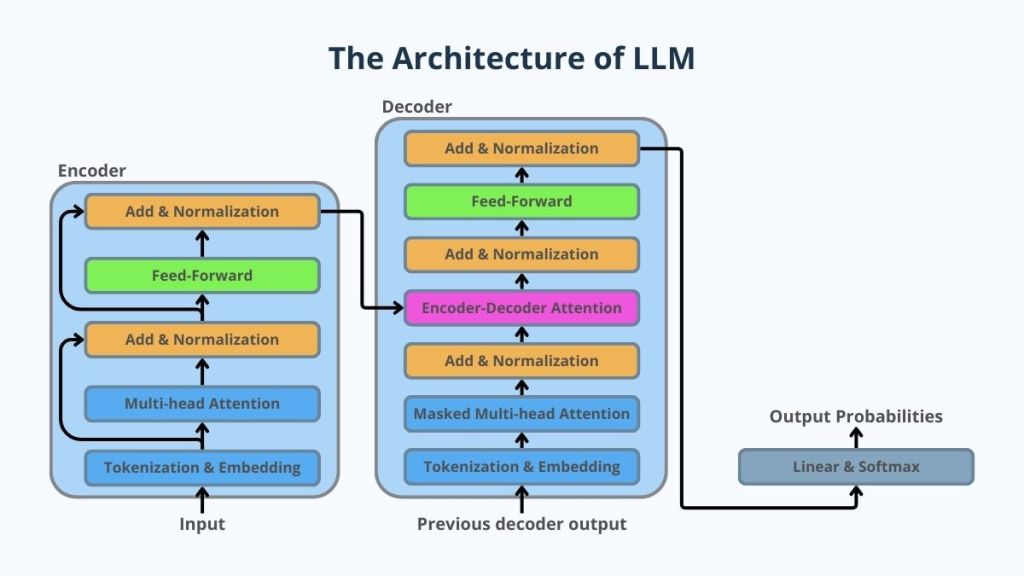
The majority of modern LLMs are built on the Transformer architecture, introduced in 2017. Transformers use a mechanism called self-attention, which allows the model to evaluate the relationships between all tokens in a sequence simultaneously rather than sequentially.

Through this mechanism, LLMs learn patterns across:

  • natural language
  • programming languages
  • structured data
  • documentation
  • technical knowledge
  • reasoning patterns

Examples of widely known LLMs include systems developed by major AI labs and technology companies. These models are used across applications such as:

  • conversational AI
  • coding assistants
  • document analysis
  • research tools
  • decision support systems
  • enterprise automation

LLMs do not explicitly understand the world in the human sense. Instead, they learn statistical patterns in language that reflect how humans describe the world.

Despite this limitation, the scale and structure of modern LLMs enable emergent capabilities such as:

  • logical reasoning
  • step-by-step planning
  • code generation
  • mathematical problem solving
  • translation across languages and modalities

The Foundations: What Are World Models?

World Models represent a different philosophical approach to machine intelligence.

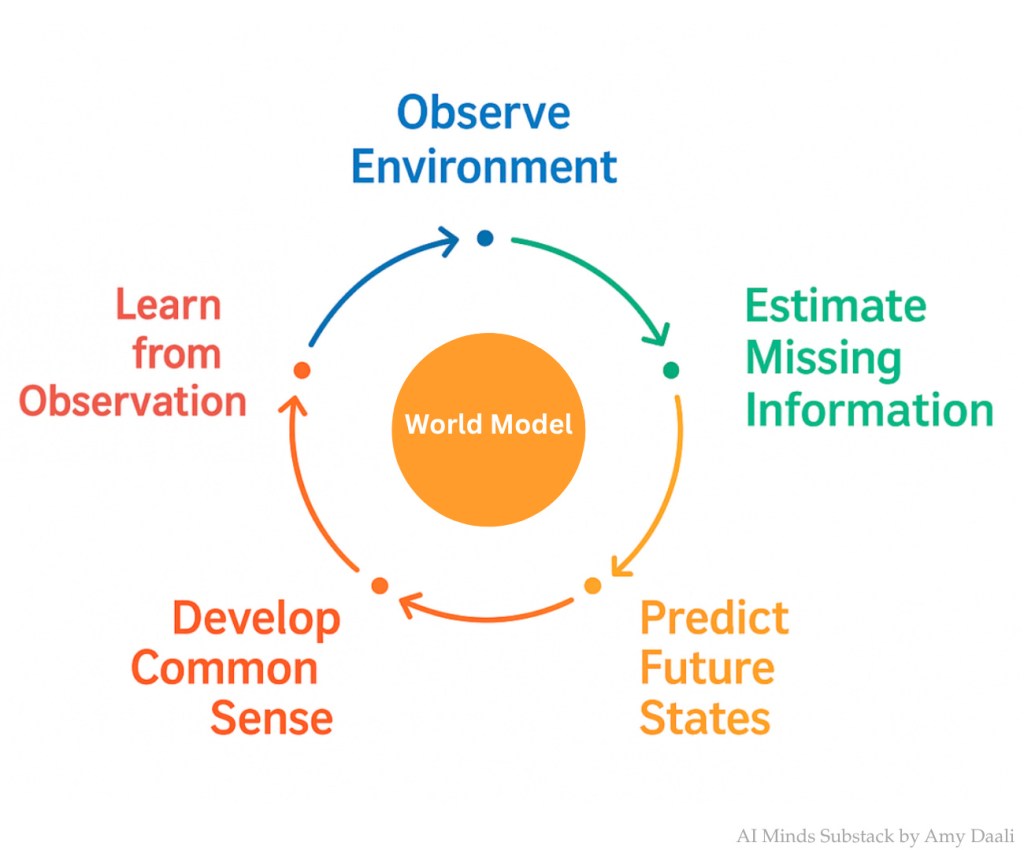
Rather than learning patterns from language, World Models attempt to build internal representations of environments and simulate how those environments evolve over time.

The concept was popularized in reinforcement learning research, where agents must interact with complex environments. A World Model allows an agent to predict future states of the world based on its actions, effectively enabling it to mentally simulate outcomes before acting.

In practical terms, a World Model learns:

  • the structure of an environment
  • causal relationships between objects
  • how states change over time
  • how actions influence outcomes

These models are frequently used in domains such as:

  • robotics
  • autonomous driving
  • game environments
  • physical simulation
  • decision planning systems

Instead of predicting the next word in a sentence, a World Model predicts the next state of the environment.

This difference may appear subtle but it fundamentally changes how intelligence emerges within the system.


The Technical Architecture of Large Language Models

Modern LLMs typically consist of several core components that operate together to transform raw text into meaningful predictions.

Tokenization

Text must first be converted into tokens, which are numerical representations of words or sub-word units.

For example, a sentence might be converted into:

"The car accelerated quickly"

[Token 1243, Token 983, Token 4421, Token 903]

Tokenization allows the neural network to process language mathematically.


Embeddings

Each token is transformed into a high-dimensional vector representation.

These embeddings encode semantic meaning. Words with similar meaning tend to have similar vector representations.

For example:

  • “car”
  • “vehicle”
  • “automobile”

would occupy nearby positions in vector space.


Transformer Layers

The Transformer is the core computational structure of LLMs.

Each layer contains:

  1. Self-Attention Mechanisms
  2. Feedforward Neural Networks
  3. Residual Connections
  4. Layer Normalization

Self-attention allows the model to determine which words in a sentence are relevant to one another.

For example, in the sentence:

“The dog chased the ball because it was moving.”

The model must determine whether “it” refers to the dog or the ball. Attention mechanisms help resolve this relationship.


Training Objective

LLMs are trained primarily using next-token prediction.

Given a sequence:

The stock market closed higher today because

The model predicts the most likely next token.

By repeating this process billions of times across enormous datasets, the model learns linguistic structure and conceptual relationships.


Fine-Tuning and Alignment

After pretraining, models are typically refined using techniques such as:

  • Reinforcement Learning from Human Feedback
  • Supervised Fine-Tuning
  • Constitutional training approaches

These processes help align the model’s behavior with human expectations and safety guidelines.


The Technical Architecture of World Models

World Models use a different architecture because they must represent state transitions within an environment.

While implementations vary, many world models contain three fundamental components.


Representation Model

The first step is compressing sensory inputs into a latent representation.

For example, a robot might observe the environment using:

  • camera images
  • LiDAR data
  • position sensors

These inputs are encoded into a latent vector that represents the current world state.

Common techniques include:

  • Variational Autoencoders
  • Convolutional Neural Networks
  • latent state representations

Dynamics Model

The dynamics model predicts how the environment will evolve over time.

Given:

  • current state
  • action taken by the agent

the model predicts the next state.

Example:

State(t) + Action → State(t+1)

This allows an AI system to simulate future outcomes.


Policy or Planning Module

Finally, the system determines the best action to take.

Because the model can simulate outcomes, it can evaluate multiple possible futures and choose the most favorable one.

Techniques often used include:


Examples of World Models in Practice

World Models are already used in several advanced AI applications.

Robotics

Robots trained with world models can simulate how objects move before interacting with them.

Example:

A robotic arm may simulate the trajectory of a falling object before attempting to catch it.


Autonomous Vehicles

Self-driving systems rely heavily on predictive models that simulate the movement of other vehicles, pedestrians, and environmental changes.

A vehicle must anticipate:

  • lane changes
  • braking behavior
  • pedestrian movement

These predictions form a real-time world model of the road.


Game AI

Game agents such as those used in complex strategy games simulate the future state of the game board to evaluate different strategies.

For example, an AI playing a strategy game might simulate thousands of possible moves before selecting an action.


Key Similarities Between LLMs and World Models

Despite their differences, these models share several foundational principles.

Both Learn Representations

Both models convert raw data into high-dimensional latent representations that capture relationships and patterns.

Both Use Deep Neural Networks

Modern implementations of both paradigms rely heavily on deep learning architectures.

Both Improve With Scale

Increasing:

  • model size
  • training data
  • compute resources

improves performance in both approaches.

Both Support Planning and Reasoning

Although through different mechanisms, both systems can exhibit forms of reasoning.

LLMs reason through symbolic patterns in language, while World Models reason through environmental simulation.


Strengths and Weaknesses of Large Language Models

Large Language Models have become the most visible form of modern artificial intelligence due to their ability to interact through natural language and perform a wide range of cognitive tasks. Their strengths arise largely from the scale of training data, model architecture, and the statistical relationships they learn across language and code. At the same time, their weaknesses stem from the fact that they are fundamentally predictive language systems rather than grounded world-understanding systems.

Understanding both sides of this equation is essential when evaluating where LLMs provide significant value and where they require complementary technologies such as retrieval systems, reasoning frameworks, or world models.


Strengths of Large Language Models

1. Massive Knowledge Representation

One of the defining strengths of LLMs is their ability to encode vast amounts of knowledge within neural network weights. During training, these models ingest trillions of tokens drawn from sources such as:

  • books
  • research papers
  • software repositories
  • technical documentation
  • websites
  • structured datasets

Through exposure to this information, the model learns statistical relationships between concepts, enabling it to answer questions, summarize ideas, and explain complex topics.

Example

A well-trained LLM can simultaneously understand and explain concepts from multiple domains:

A user might ask:

“Explain the difference between Kubernetes container orchestration and serverless architecture.”

The model can produce a coherent explanation that references:

  • distributed systems
  • cloud infrastructure
  • scalability models
  • developer workflow implications

This ability to synthesize knowledge across domains is one of the most powerful characteristics of LLMs.

In enterprise settings, organizations frequently use LLMs to create knowledge assistants capable of navigating internal documentation, policy frameworks, and operational playbooks.


2. Natural Language Interaction

LLMs allow humans to interact with complex computational systems using everyday language rather than specialized programming syntax.

This capability dramatically lowers the barrier to accessing advanced technology.

Instead of writing complex database queries or scripts, a user can issue requests such as:

“Generate a financial summary of this quarterly report.”

or

“Write Python code that calculates customer churn using this dataset.”

Example

Customer support platforms increasingly integrate LLMs to assist service agents.

An agent might type:

“Summarize the issue and draft a response apologizing for the delay.”

The model can:

  1. analyze the customer’s conversation history
  2. summarize the root issue
  3. generate a professional response

This capability accelerates workflow efficiency and improves consistency in communication.


3. Multi-Task Generalization

Unlike traditional machine learning systems that are trained for a single task, LLMs can perform many tasks without retraining.

This capability is often described as zero-shot or few-shot learning.

A single model may handle tasks such as:

  • translation
  • coding assistance
  • document summarization
  • reasoning over data
  • question answering
  • brainstorming
  • structured information extraction

Example

An enterprise knowledge assistant powered by an LLM might perform several different functions within a single workflow:

  1. Interpret a customer email
  2. Extract relevant product information
  3. Generate a response draft
  4. Translate the response into another language
  5. Log the interaction into a CRM system

This generalization capability is what makes LLMs highly adaptable across industries.


4. Code Generation and Technical Reasoning

One of the most impactful capabilities of LLMs is their ability to generate software code.

Because training datasets include large amounts of open-source code, models learn patterns across many programming languages.

These capabilities allow them to:

  • generate code snippets
  • explain algorithms
  • debug software
  • convert code between languages
  • generate technical documentation

Example

A developer may prompt an LLM:

“Write a Python function that performs Monte Carlo simulation for stock price forecasting.”

The model can generate:

  • the simulation logic
  • comments explaining the method
  • potential parameter adjustments

This capability has significantly accelerated development workflows and is one reason LLM-powered coding assistants are becoming standard developer tools.


5. Rapid Deployment Across Industries

LLMs can be integrated into a wide variety of applications with minimal changes to the core model.

Organizations frequently deploy them in areas such as:

  • legal document review
  • medical literature summarization
  • financial analysis
  • call center automation
  • product recommendation systems

Example

In customer experience transformation programs, an LLM may be integrated into a contact center platform to assist agents by:

  • summarizing customer history
  • suggesting solutions
  • generating follow-up communication
  • automatically documenting case notes

This integration can reduce average handling time while improving customer satisfaction.


Weaknesses of Large Language Models

While LLMs demonstrate impressive capabilities, they also exhibit several limitations that practitioners must understand.


1. Lack of Grounded Understanding

LLMs learn relationships between words and concepts, but they do not interact directly with the physical world.

Their understanding of reality is therefore indirect and mediated through text descriptions.

This limitation means the model may understand how people talk about physical phenomena but may not fully capture the underlying physics.

Example

Consider a question such as:

“If I stack a bowling ball on top of a tennis ball and drop them together, what happens?”

A human with basic physics intuition understands that the tennis ball can rebound at high velocity due to energy transfer.

An LLM might produce inconsistent or incorrect explanations depending on how similar scenarios appeared in its training data.

World Models and physics-based simulations typically handle these scenarios more reliably because they explicitly model dynamics and physical laws.


2. Hallucinations

A widely discussed limitation of LLMs is hallucination, where the model produces information that appears plausible but is factually incorrect.

This occurs because the model’s objective is to generate the most statistically likely sequence of tokens, not necessarily the most accurate answer.

Example

If asked:

“Provide five peer-reviewed sources supporting a specific claim.”

The model may generate citations that appear legitimate but may not correspond to real publications.

This phenomenon has implications in domains such as:

  • legal research
  • academic writing
  • financial analysis
  • healthcare

To mitigate this issue, many enterprise deployments combine LLMs with retrieval systems (RAG architectures) that ground responses in verified data sources.


3. Limited Long-Term Reasoning and Planning

Although LLMs can demonstrate step-by-step reasoning in text form, they do not inherently simulate long-term decision processes.

They generate responses one token at a time, which can limit consistency across complex multi-step reasoning tasks.

Example

In strategic planning scenarios, an LLM may generate a reasonable short-term plan but struggle with maintaining coherence across a 20-step execution roadmap.

In contrast, systems that combine LLMs with planning algorithms or world models can simulate long-term outcomes more effectively.


4. Sensitivity to Prompting and Context

LLMs are highly sensitive to the phrasing of prompts and the context provided.

Small changes in wording can produce different outputs.

Example

Two similar prompts may produce significantly different answers:

Prompt A:

“Explain how blockchain improves financial transparency.”

Prompt B:

“Explain why blockchain may fail to improve financial transparency.”

The model may generate very different responses because it interprets each prompt as a framing signal.

While this flexibility can be useful, it also introduces unpredictability in production systems.


5. High Computational and Infrastructure Costs

Training large language models requires enormous computational resources.

Modern frontier models require:

  • thousands of GPUs
  • specialized data center infrastructure
  • large energy consumption
  • significant engineering effort

Even inference at scale can require substantial resources depending on the model size and response complexity.

Example

Enterprise deployments that serve millions of daily queries must carefully balance:

  • latency
  • cost per inference
  • model size
  • response quality

This is one reason smaller specialized models and fine-tuned domain models are becoming increasingly popular for targeted applications.


Key Takeaway

Large Language Models represent one of the most powerful and flexible AI technologies currently available. Their strengths lie in knowledge synthesis, language interaction, and task generalization, which allow them to operate effectively across a wide variety of domains.

However, their limitations highlight an important reality: LLMs are language prediction systems rather than complete models of intelligence.

They excel at interpreting and generating symbolic information but often require complementary systems to address areas such as:

  • environmental simulation
  • causal reasoning
  • long-term planning
  • real-world grounding

This recognition is one of the primary reasons researchers are increasingly exploring architectures that combine LLMs with world models, planning systems, and reinforcement learning agents. Together, these approaches may form the next generation of intelligent systems capable of both understanding language and reasoning about the structure of the real world.


Strengths and Weaknesses of World Models

World Models represent a different paradigm for artificial intelligence. Rather than learning patterns in language or static datasets, these systems learn how environments evolve over time. The central objective is to construct a latent representation of the world that can be used to predict future states based on actions.

This ability allows AI systems to simulate scenarios internally before acting in the real world. In many ways, World Models approximate a cognitive capability humans use regularly: mental simulation. Humans often predict the outcomes of actions before executing them. World Models attempt to replicate this capability computationally.

While still an active area of research, these systems are already playing a critical role in robotics, autonomous systems, reinforcement learning, and complex decision environments.


Strengths of World Models

1. Causal Understanding and Predictive Dynamics

One of the most significant strengths of World Models is their ability to capture cause-and-effect relationships.

Unlike LLMs, which rely on statistical correlations in text, World Models learn dynamic relationships between states and actions. They attempt to answer questions such as:

  • If the agent performs action A, what state will occur next?
  • How will the environment evolve over time?
  • What sequence of actions leads to the optimal outcome?

This allows AI systems to reason about physical processes and environmental changes.

Example

Consider a robotic warehouse system tasked with moving packages efficiently.

A World Model allows the robot to simulate:

  • how objects move when pushed
  • how other robots will move through the space
  • potential collisions
  • the most efficient path to a destination

Before executing a movement, the robot can simulate multiple future trajectories and select the safest or most efficient one.

This predictive capability is essential for autonomous systems operating in real environments.


2. Internal Simulation and Planning

World Models allow agents to simulate future scenarios without interacting with the physical environment. This ability dramatically improves decision-making efficiency.

Instead of learning solely through trial and error in the real world, an agent can perform internal rollouts that test many possible strategies.

This is particularly useful in environments where experimentation is expensive or dangerous.

Example

Self-driving vehicles constantly simulate potential future events.

A vehicle approaching an intersection may simulate scenarios such as:

  • another car suddenly braking
  • a pedestrian entering the crosswalk
  • a vehicle merging unexpectedly

The world model predicts how each scenario may unfold and helps determine the safest course of action.

This predictive modeling happens continuously and in real time.


3. Efficient Reinforcement Learning

Traditional reinforcement learning requires enormous numbers of interactions with an environment.

World Models can significantly reduce this requirement by allowing agents to learn within simulated environments generated by the model itself.

This technique is sometimes called model-based reinforcement learning.

Instead of learning purely from external interactions, the agent alternates between:

  • real-world experience
  • simulated experience generated by the world model

Example

Training a robotic arm to manipulate objects through physical trials alone may require millions of attempts.

By using a world model, the system can simulate thousands of possible grasping strategies internally before testing the most promising ones in the real environment.

This dramatically accelerates learning.


4. Multimodal Environmental Representation

World Models are particularly strong at integrating multiple types of sensory data.

Unlike LLMs, which are primarily trained on text, world models can incorporate signals from sources such as:

  • images
  • video
  • spatial sensors
  • depth cameras
  • LiDAR
  • motion sensors

These signals are encoded into a latent world representation that captures the structure of the environment.

Example

In robotics, a world model may integrate:

  • visual input from cameras
  • object detection data
  • spatial mapping from LiDAR
  • motion feedback from actuators

This combined representation enables the robot to understand:

  • object positions
  • physical obstacles
  • motion trajectories
  • spatial relationships

Such environmental awareness is critical for real-world interaction.


5. Strategic Planning and Long-Term Optimization

World Models excel at multi-step planning problems, where the consequences of actions unfold over time.

Because they simulate state transitions, they allow systems to evaluate long sequences of actions before choosing one.

Example

In logistics optimization, a world model might simulate different warehouse layouts to determine:

  • robot travel time
  • congestion patterns
  • storage efficiency
  • energy consumption

Instead of relying on static optimization models, the system can simulate dynamic interactions between many moving components.

This ability to evaluate future states makes world models extremely valuable in operational planning.


Weaknesses of World Models

Despite their potential, World Models also face several challenges that limit their current deployment.


1. Limited Generalization Across Domains

Most world models are trained for specific environments.

Unlike LLMs, which can generalize across many topics due to exposure to large text corpora, world models often specialize in narrow contexts.

For example, a model trained to simulate a robotic arm manipulating objects may not generalize well to:

  • autonomous driving
  • drone navigation
  • household robotics

Each domain may require a new world model trained on domain-specific data.

Example

A warehouse robot trained in one facility may struggle when deployed in another facility with different layouts, lighting conditions, and object types.

This lack of generalization is a major research challenge.


2. Difficulty Modeling Complex Real-World Systems

The real world contains enormous complexity, including:

  • unpredictable human behavior
  • weather conditions
  • sensor noise
  • mechanical failure
  • incomplete information

Building accurate models of these environments is extremely challenging.

Even small inaccuracies in the world model can accumulate over time and produce incorrect predictions.

Example

In autonomous driving systems, predicting the behavior of pedestrians is difficult because human behavior can be unpredictable.

If a world model incorrectly predicts pedestrian motion, it could lead to unsafe decisions.

This is why many safety-critical systems rely on hybrid architectures combining rule-based logic, statistical prediction models, and world modeling.


3. High Data Requirements

Training a reliable world model often requires large volumes of sensory data or simulated interactions.

Unlike language data, which is widely available online, real-world environment data must often be collected through sensors or physical experiments.

Example

Training a world model for a delivery robot might require:

  • thousands of hours of video
  • motion sensor recordings
  • navigation logs
  • object interaction data

Collecting and labeling this data can be expensive and time-consuming.

Simulation environments can help, but simulated environments may not perfectly match real-world physics.


4. Computational Complexity

Simulating environments and predicting future states can be computationally intensive.

High-fidelity world models may need to simulate:

  • object physics
  • environmental dynamics
  • agent behavior
  • stochastic events

Running these simulations at scale can require substantial computing resources.

Example

A robotic system that must simulate hundreds of possible action sequences before selecting a path may face latency challenges in real-time environments.

This creates engineering challenges when deploying world models in time-sensitive systems such as:

  • autonomous vehicles
  • industrial robotics
  • air traffic management

5. Challenges in Representation Learning

Another technical challenge lies in learning accurate latent representations of the world.

The model must compress complex sensory information into a representation that captures the important aspects of the environment while ignoring irrelevant details.

If the representation fails to capture key features, the system’s predictions may degrade.

Example

A robotic manipulation system must recognize:

  • object shape
  • mass distribution
  • friction
  • contact surfaces

If the world model incorrectly encodes these properties, the robot may fail when attempting to grasp objects.

Learning representations that capture these physical properties remains an active area of research.


Key Takeaway

World Models represent a powerful approach for building AI systems that can reason about environments, predict outcomes, and plan actions.

Their strengths lie in:

  • causal reasoning
  • environmental simulation
  • strategic planning
  • multimodal perception

However, their limitations highlight why they remain an evolving area of research.

Challenges such as:

  • environment complexity
  • domain specialization
  • high data requirements
  • computational costs

must be addressed before world models can achieve broad general intelligence.

For many researchers, the most promising future architecture will combine LLMs for abstract reasoning and language understanding with World Models for environmental simulation and decision planning. Systems that integrate these capabilities may be able to both interpret complex instructions and simulate the real-world consequences of actions, which is a key step toward more advanced artificial intelligence.


The Future: Convergence of Language and World Understanding

Many researchers believe that the next wave of AI innovation will combine both paradigms.

An integrated system might include:

  1. LLMs for reasoning and communication
  2. World Models for simulation and planning
  3. Reinforcement learning for action selection

Such systems could reason about complex problems while simultaneously simulating potential outcomes.

For example:

A future autonomous system could receive a natural language instruction such as:

“Design the most efficient warehouse layout.”

The LLM component could interpret the request and generate candidate strategies.

The World Model could simulate:

  • robot traffic patterns
  • storage optimization
  • worker safety

The combined system could then iteratively refine the design.


A Long-Term Vision for Artificial Intelligence

Looking ahead, the distinction between LLMs and World Models may gradually diminish.

Future architectures may incorporate:

  • multimodal perception
  • environment simulation
  • language reasoning
  • long-term memory
  • planning systems

Some researchers argue that true artificial general intelligence will require an internal model of the world combined with symbolic reasoning capabilities.

Language alone may not be sufficient, and simulation alone may lack the abstraction needed for higher-order reasoning.

The most powerful systems may therefore be those that integrate both approaches into a unified architecture capable of understanding language, reasoning about complex systems, and predicting how the world evolves.


Final Thoughts

Large Language Models and World Models represent two distinct but complementary paths toward intelligent systems.

LLMs have demonstrated remarkable capabilities in language understanding, reasoning, and human interaction. Their rapid adoption across industries has transformed how humans interact with technology.

World Models, while less visible to the public, are advancing rapidly in research environments and are critical for enabling machines to understand and interact with the physical world.

The most important insight for practitioners is that these approaches are not competing paradigms. Instead, they represent different layers of intelligence.

Language models capture the structure of human knowledge and communication. World models capture the dynamics of environments and physical systems.

Together, they may form the foundation for the next generation of artificial intelligence systems capable of reasoning, planning, and interacting with the world in far more sophisticated ways than today’s technologies.

Follow us on (Spotify) as we discuss this and many other technology related topics.

The Convergence of Design Thinking and Artificial Intelligence

Human-Centered Problem Solving Meets Machine-Scale Intelligence

Introduction

Design Thinking and Artificial Intelligence are often positioned in separate domains, one grounded in human empathy and creative exploration, the other in data-driven modeling and computational scale. Yet in practice, both disciplines aim to solve complex problems under uncertainty. Design Thinking provides the structured yet flexible framework for understanding human needs, reframing ambiguous challenges, and iterating toward viable solutions. Artificial Intelligence contributes the ability to process vast datasets, identify hidden correlations, simulate outcomes, and quantify trade-offs. The correlation between the two emerges from their shared objective: reducing uncertainty while increasing confidence in decision making. Where Design Thinking surfaces qualitative insight, AI can validate, expand, and stress-test those insights through quantitative rigor.

Blending these methodologies creates a powerful lens for management consulting engagements, particularly when conducting solution design, SWOT analysis, and Root Cause Analysis. Design Thinking ensures that strategic options are grounded in stakeholder reality and organizational context, while AI introduces evidence-based pattern recognition and scenario modeling that strengthens the robustness of recommendations. Together they enable consultants to explore alternatives more comprehensively, challenge assumptions with data, and uncover systemic drivers that may otherwise remain obscured. The result is not simply faster analysis, but deeper insight, allowing leadership teams to move forward with solutions that are both human-centered and analytically resilient.

Let’s start with a general understanding of what Design Thinking is;

Part I. Design Thinking: Origins, Foundations, and Evolution in Consulting

Historical Roots

Design Thinking did not originate in the digital era. Its intellectual roots trace back to the 1960s and 1970s within the academic design sciences, most notably through the work of Herbert A. Simon, whose book The Sciences of the Artificial introduced the idea that design is a structured method of problem solving rather than purely artistic expression. Simon framed design as the process of transforming existing conditions into preferred ones, establishing the philosophical foundation that still underpins Design Thinking today.

The methodology gained institutional structure at Stanford University’s d.school and through the innovation firm IDEO in the 1990s and early 2000s. IDEO operationalized design as a repeatable process usable beyond product design, expanding into services, systems, and business model innovation. Over time, Design Thinking evolved from a designer’s craft into a strategic problem-solving framework used across industries including healthcare, finance, technology, and public sector transformation.

Core Fundamentals

At its foundation, Design Thinking is human-centered, iterative, and exploratory rather than linear. While variations exist, most frameworks follow five stages:

  1. Empathize
    Deeply understand user needs, behaviors, motivations, and constraints through observation and engagement.
  2. Define
    Frame the problem clearly based on insights rather than assumptions.
  3. Ideate
    Generate a broad set of potential solutions without premature filtering.
  4. Prototype
    Create rapid, low-cost representations of ideas.
  5. Test
    Validate solutions with users, refine continuously, and iterate.

The power of Design Thinking lies in reframing ambiguity into solvable constructs while maintaining a strong connection to human outcomes.

Role in Management Consulting

Management consulting firms adopted Design Thinking as digital transformation and customer experience became strategic priorities. Firms integrated it into:

  • Customer journey redesign
  • Product and service innovation
  • Enterprise transformation
  • Experience-led operating models
  • Change management initiatives

Design Thinking became particularly valuable when organizations faced unclear problems rather than optimization challenges. Consulting teams used workshops, journey mapping, ethnographic research, and co-creation sessions to uncover latent needs and design solutions grounded in human behavior rather than purely operational metrics.

Over time, firms blended Design Thinking with Agile delivery, Lean experimentation, and data-driven decision making, positioning it as a front-end innovation engine for transformation programs.


Part II. The Intersection of Artificial Intelligence and Design Thinking

From Human Insight to Intelligent Systems

The intersection of Design Thinking and Artificial Intelligence is not simply about inserting technology into workshops. It represents the convergence of two complementary problem-solving paradigms: one rooted in human-centered exploration, the other in computational intelligence and predictive modeling. Design Thinking helps organizations understand what problem should be solved and why it matters. AI helps determine how the problem behaves at scale and what outcomes are most likely. Together they create a closed-loop system of discovery, insight, and adaptive execution.

To understand this intersection more clearly, it is useful to examine how both approaches operate across four dimensions: problem framing, insight generation, solution exploration, and adaptive learning.


1. Problem Framing: From Ambiguity to Structured Understanding

Design Thinking begins with ambiguity. Many strategic challenges faced by organizations are not clearly defined optimization problems but complex, multi-variable systems with human, operational, and environmental dependencies. Through empathy, observation, and reframing, Design Thinking transforms loosely understood challenges into structured problem statements grounded in real user and stakeholder needs.

Artificial Intelligence strengthens this phase by introducing data-backed problem validation. Instead of relying solely on qualitative observations, AI can analyze historical performance, behavioral data, and systemic relationships to reveal whether the perceived problem aligns with measurable reality.

Example

A financial services organization believes declining customer satisfaction is caused by poor digital experience. Design Thinking workshops uncover emotional frustration in customer journeys. AI analysis of interaction data reveals the largest driver is actually delayed issue resolution rather than interface usability. Together, they refine the problem definition from “improve digital UX” to “reduce resolution latency across channels.”

Intersection Value

  • Design Thinking ensures the problem remains human-relevant
  • AI ensures the problem is systemically accurate
  • The combined approach reduces misdirected transformation efforts

2. Insight Generation: Expanding Beyond Human Observation

Design Thinking relies heavily on ethnographic research, interviews, and observational methods to uncover latent needs. These methods are powerful but limited in scale and sometimes influenced by sampling bias or subjective interpretation.

AI introduces pattern recognition at scale. Machine learning models can identify correlations across millions of data points, revealing behavioral clusters, emotional drivers, and systemic inefficiencies not easily visible through manual analysis.

Example

In a retail transformation initiative, Design Thinking identifies that customers value personalization. AI clustering of purchase behavior reveals multiple distinct personalization archetypes rather than a single unified preference pattern. This insight allows segmentation-driven experience design instead of one-size-fits-all personalization.

Intersection Value

  • Design Thinking reveals meaning and context
  • AI reveals scale and hidden patterns
  • Together they deepen understanding rather than replacing human interpretation

3. Solution Exploration: Expanding the Design Space

The ideation phase in Design Thinking encourages divergent thinking and creativity. However, human ideation can be constrained by cognitive bias, prior experience, and limited scenario exploration.

Generative AI expands the solution design space by introducing alternative concepts, cross-industry analogies, and scenario-based variations that might not naturally emerge in workshop environments. AI can also simulate downstream implications of proposed ideas, providing early-stage foresight into feasibility and impact.

Example

A telecommunications firm redesigning its customer onboarding journey generates several human-designed concepts through workshops. AI simulation models test each concept against projected adoption, operational cost, and churn reduction. The combined approach identifies a hybrid model that balances experience quality with operational efficiency.

Intersection Value

  • Design Thinking promotes creativity and desirability
  • AI introduces feasibility and predictive foresight
  • The combination reduces solution blind spots

4. Adaptive Learning: From Iteration to Continuous Intelligence

Design Thinking is inherently iterative. Prototypes are tested, feedback is gathered, and solutions evolve over time. However, traditional iteration cycles can be slow and dependent on periodic feedback loops.

AI enables continuous adaptive learning, allowing solutions to evolve dynamically based on real-time data. Instead of periodic redesign, organizations can move toward continuously learning systems that adapt to changing conditions.

Example

In a healthcare service redesign, Design Thinking shapes the patient-centered care model. AI monitors treatment outcomes, patient engagement, and system efficiency in real time, continuously optimizing scheduling, intervention timing, and care pathways.

Intersection Value

  • Design Thinking ensures solutions remain human-centered
  • AI enables real-time evolution and adaptation
  • Together they create living systems rather than static solutions

Deeper Structural Alignment Between the Two Approaches

Beyond workshop phases, the intersection also exists at a structural level:

Design Thinking CapabilityAI CapabilityCombined Impact
Empathy and human meaningBehavioral and sentiment analysisEmotionally intelligent and data-backed solutions
Creative ideationGenerative modelingExpanded innovation space
Iterative prototypingSimulation and predictionFaster and more informed iteration
Human judgmentPattern recognitionBalanced decision intelligence
Qualitative insightQuantitative validationStronger strategic confidence

Practical Implications for Consulting and Transformation

When applied in consulting environments, this intersection changes how complex problems are approached:

  • Workshops become evidence-informed rather than purely exploratory
  • Solution design becomes predictive rather than reactive
  • Root Cause Analysis becomes systemic rather than surface-level
  • SWOT analysis becomes data-augmented rather than perception-driven
  • Transformation becomes adaptive rather than static

The outcome is not simply improved efficiency but a deeper capacity to address complex adaptive problems where human behavior, operational systems, and environmental dynamics intersect.


A Closing Perspective on the Intersection

The relationship between Design Thinking and Artificial Intelligence is not about replacing human-centered innovation with machine intelligence. Instead, it is about creating a layered problem-solving architecture where human insight guides direction and artificial intelligence enhances clarity, scale, and adaptability.

Design Thinking ensures organizations solve meaningful problems.
AI ensures those solutions can evolve, scale, and sustain impact.

Understanding this intersection equips leaders and practitioners to move beyond isolated methodologies and toward integrated intelligence capable of addressing the complexity of modern organizational and societal challenges.


Part III. Where AI Fits Inside the Design Thinking Process

1. Empathize Phase: Augmenting Human Insight

How AI contributes

AI can analyze large behavioral datasets, sentiment patterns, and customer interactions to reveal needs not immediately visible through qualitative observation.

Examples

  • NLP models analyzing thousands of customer service transcripts
  • Behavioral clustering from product usage data
  • Emotion detection from feedback channels

Value

AI broadens insight scale while Design Thinking preserves human interpretation and contextual understanding.


2. Define Phase: Precision in Problem Framing

How AI contributes

AI helps synthesize unstructured information into structured themes and identifies root cause correlations across complex systems.

Examples

  • Topic modeling from interviews and research notes
  • Predictive drivers of churn or dissatisfaction
  • Systemic bottleneck identification

Value

AI enhances clarity, but human facilitators ensure that problems remain grounded in human outcomes rather than purely statistical signals.


3. Ideate Phase: Expanding Solution Space

How AI contributes

Generative AI expands ideation beyond human cognitive limits by producing alternative scenarios, cross-industry analogies, and novel combinations.

Examples

  • Generating multiple service design models
  • Scenario simulation of future operating environments
  • Concept recombination across domains

Value

AI increases breadth of ideation, while human judgment filters feasibility, ethics, and desirability.


4. Prototype Phase: Accelerating Creation

How AI contributes

AI can rapidly generate interface mockups, workflow models, system architectures, and digital twins.

Examples

  • Generative UI wireframes
  • Automated journey simulations
  • Predictive system prototypes

Value

Prototyping becomes faster and less resource intensive, allowing more iterations within shorter cycles.


5. Test Phase: Continuous Learning at Scale

How AI contributes

AI enables real-time experimentation, simulation, and outcome prediction before full deployment.

Examples

  • A/B testing at scale
  • Predictive adoption modeling
  • Behavioral response simulation

Value

AI strengthens evidence-based iteration while Design Thinking ensures solutions remain aligned to human value.


Part IV. Why Artificial Intelligence and Design Thinking Complement Each Other

Balancing Human Meaning with Computational Intelligence

At a structural level, Design Thinking and Artificial Intelligence address different dimensions of complexity. Design Thinking excels in navigating ambiguity, human behavior, and contextual nuance. AI excels in navigating scale, variability, and probabilistic uncertainty. When used independently, each approach has inherent blind spots. When combined deliberately, they create a more complete decision architecture.

To understand why they complement each other, it is useful to examine the specific limitations of each discipline and how the other compensates.


1. Design Thinking Addresses Critical Limitations in AI

AI systems are only as strong as the problem definitions, data inputs, and objective functions they are given. Without careful framing, AI can optimize the wrong outcome or reinforce unintended bias.

A. Human Context and Meaning

AI can detect patterns in behavior, but it does not inherently understand why those patterns matter emotionally, ethically, or culturally.

Example

A machine learning model identifies that reducing average call handling time improves cost efficiency. However, Design Thinking interviews reveal that customers value reassurance and clarity during complex service interactions. If the AI objective focuses solely on speed, the organization risks degrading trust.

Design Thinking ensures:

  • The optimization target aligns with human value
  • Emotional and experiential dimensions are preserved
  • Success metrics reflect more than operational efficiency

B. Ethical Framing and Bias Mitigation

AI systems can perpetuate systemic bias if trained on skewed datasets or designed without inclusive perspectives.

Design Thinking workshops, particularly when diverse stakeholders are included, help surface:

  • Edge cases
  • Underrepresented user groups
  • Potential unintended consequences

Example

In designing a digital lending platform, AI may identify demographic patterns that correlate with repayment likelihood. Design Thinking exploration can question whether those correlations reflect structural inequities rather than true creditworthiness, prompting governance safeguards.


C. Problem Selection and Relevance

AI is often deployed as a solution in search of a problem. Design Thinking ensures that the organization is solving the right issue.

Example

An enterprise may seek to implement predictive AI for supply chain optimization. Design Thinking may uncover that the real constraint lies in change management and supplier collaboration rather than predictive accuracy. The AI solution then becomes part of a broader transformation rather than a standalone tool.


2. AI Addresses Structural Constraints in Design Thinking

While Design Thinking is powerful for human-centered exploration, it has practical limits when dealing with large-scale systems and high-velocity environments.

A. Scale and Pattern Recognition

Human research methods are intensive but small in scale. AI can process millions of interactions to detect:

  • Emerging behavioral shifts
  • Correlated drivers of dissatisfaction
  • Hidden operational bottlenecks

Example

During a customer experience redesign, workshops identify five major pain points. AI analysis of transactional and behavioral data uncovers three additional drivers not mentioned in interviews but statistically significant in churn prediction.

This does not invalidate Design Thinking. It enhances it by expanding insight coverage.


B. Predictive Foresight

Design Thinking prototypes are often tested through qualitative validation. AI introduces scenario modeling and predictive simulation.

Example

When redesigning a pricing model, Design Thinking may generate several concepts based on perceived fairness and value. AI can simulate revenue impact, adoption elasticity, and margin compression under different economic scenarios.

The combination produces solutions that are:

  • Desirable
  • Feasible
  • Economically viable
  • Future resilient

C. Continuous Adaptation

Traditional Design Thinking culminates in implementation and periodic iteration. AI enables real-time adaptation.

Example

A redesigned digital onboarding experience may initially test well in workshops. AI monitoring of engagement data post-launch can identify micro-frictions in real time, automatically adjusting messaging, sequencing, or support interventions.

This creates a feedback loop where the system continues to evolve rather than remaining static until the next redesign initiative.


The Complementary Architecture: Human Intelligence and Machine Intelligence

When integrated intentionally, the two approaches form a multi-layered intelligence stack:

  1. Human Framing Layer
    Defines purpose, values, and meaningful outcomes
  2. Data Intelligence Layer
    Identifies patterns, correlations, and probabilistic drivers
  3. Creative Expansion Layer
    Explores broad solution possibilities through human ideation and generative modeling
  4. Simulation and Validation Layer
    Tests viability, risk, and scalability using predictive analytics
  5. Adaptive Learning Layer
    Continuously refines solutions through ongoing data feedback

Neither discipline can fully operate all layers independently. Design Thinking dominates the first layer. AI dominates the fourth and fifth. The middle layers benefit from hybrid collaboration.


Complementarity in SWOT and Root Cause Analysis

The integration becomes particularly evident in structured analytical frameworks.

SWOT Analysis

  • Design Thinking captures stakeholder perception of strengths and weaknesses.
  • AI validates and quantifies those factors through performance data and competitive benchmarking.

Example

Leadership perceives brand loyalty as a key strength. AI sentiment analysis reveals emerging dissatisfaction in specific segments. The SWOT becomes more nuanced and less perception-driven.


Root Cause Analysis

Traditional root cause workshops often rely on facilitated discussion and experience-based reasoning. AI can map causal relationships across operational datasets to identify non-obvious drivers.

Example

A manufacturing firm attributes delivery delays to warehouse inefficiency. AI process mining reveals that upstream supplier variability is the primary systemic constraint. Design Thinking then reframes the operational intervention.


Managing Cognitive Bias

Design Thinking can be influenced by facilitator bias, dominant voices in workshops, and anecdotal reasoning. AI can provide objective counterpoints through empirical data.

Conversely, AI can reinforce historical bias. Design Thinking can challenge assumptions by introducing alternative perspectives and qualitative nuance.

Together they create a system of checks and balances.


Strategic Implications for Leadership

For executives and consultants, the complementarity suggests several operating principles:

  • Do not initiate AI projects without human-centered framing.
  • Do not rely solely on workshop insight without data validation.
  • Use AI to expand option sets, not prematurely constrain them.
  • Preserve human judgment in defining success criteria.
  • Embed continuous learning loops post-implementation.

Organizations that treat AI as an enhancement to human-centered design rather than a replacement are more likely to create resilient and adaptive solutions.


A Complementary Final Reflection

Design Thinking and Artificial Intelligence operate at different ends of the intelligence spectrum. One navigates empathy, meaning, and ambiguity. The other navigates scale, probability, and complexity. Their complementarity lies in their asymmetry.

Design Thinking ensures that organizations pursue the right direction.
AI ensures they navigate that direction efficiently and adaptively.

When both are applied deliberately, solution design becomes not only innovative but structurally sound, analytically rigorous, and continuously improving.


Part V. Applying Both to Complex Problem Spaces

Below are scenarios where the integration of both approaches becomes particularly powerful.


Scenario 1. Healthcare System Redesign

Challenge
Fragmented patient journeys, rising costs, and inconsistent care quality.

Design Thinking Contribution

  • Deep patient empathy mapping
  • Care journey redesign
  • Stakeholder co-creation

AI Contribution

  • Predictive diagnosis models
  • Resource allocation optimization
  • Patient outcome forecasting

Combined Outcome

A human-centered yet data-intelligent care model improving both experience and system efficiency.


Scenario 2. Enterprise Customer Experience Transformation

Challenge
Disconnected channels, inconsistent personalization, declining loyalty.

Design Thinking Contribution

  • Journey mapping
  • Emotion-driven experience design
  • Service blueprinting

AI Contribution

  • Real-time personalization engines
  • Sentiment prediction
  • Behavioral modeling

Combined Outcome

Adaptive, continuously learning customer experiences grounded in emotional relevance and operational intelligence.


Scenario 3. Smart Cities and Urban Systems

Challenge
Infrastructure strain, sustainability pressures, population growth.

Design Thinking Contribution

  • Citizen-centered urban design
  • Mobility and accessibility framing
  • Social and behavioral insight

AI Contribution

  • Traffic optimization
  • Energy consumption prediction
  • Environmental simulation

Combined Outcome

Cities designed around human life quality while optimized through predictive system intelligence.


Scenario 4. Complex Organizational Transformation

Challenge
Cultural resistance, unclear strategy, fragmented execution.

Design Thinking Contribution

  • Human adoption mapping
  • Change journey design
  • Leadership alignment

AI Contribution

  • Organizational network analysis
  • Transformation risk modeling
  • Scenario planning

Combined Outcome

Transformation programs that are both human-adoptable and analytically resilient.


Final Perspective

Design Thinking and Artificial Intelligence operate at different but complementary layers of problem solving. One prioritizes human meaning, the other computational intelligence. When integrated deliberately, they form a system capable of addressing ambiguity, complexity, and scale simultaneously.

Neither replaces the other. Design Thinking ensures problems are worth solving. AI ensures solutions can scale and adapt.

Organizations that learn to orchestrate both disciplines may find themselves better equipped to solve increasingly complex human and systemic challenges, not by choosing between human insight and machine intelligence, but by allowing each to enhance the other in a continuous cycle of discovery, design, and evolution.

Please follow us on (Spotify) as we cover this and many other topics.

OpenAI and OpenClaw: Deep Strategic Collaborative Analysis

Introduction

The collaboration between OpenAI and OpenClaw is significant because it represents a convergence of two critical layers in the evolving AI stack: advanced cognitive intelligence and autonomous execution. Historically, one domain has focused on building systems that can reason, learn, and generalize, while the other has focused on turning that intelligence into persistent, goal-directed action across real digital environments. Bringing these capabilities closer together accelerates the transition from AI as a responsive tool to AI as an operational system capable of planning, executing, and adapting over time. This has implications far beyond technical progress, influencing platform control, automation scale, enterprise transformation, and the broader trajectory toward more autonomous and generalized intelligence systems.

1. Intelligence vs Execution

Detailed Description

OpenAI has historically focused on creating systems that can reason, generate, understand, and learn across domains. This includes language, multimodal perception, reasoning chains, and alignment. OpenClaw focused on turning intelligence into real-world autonomous action. Execution involves planning, tool use, persistence, and interacting with software environments over time.

In modern AI architecture, intelligence without execution is insight without impact. Execution without intelligence is automation without adaptability. The convergence attempts to unify both.

Examples

Example 1:
An OpenAI model generates a strategic business plan. An OpenClaw agent executes it by scheduling meetings, compiling market data, running simulations, and adjusting timelines autonomously.

Example 2:
An enterprise AI assistant understands a complex customer service scenario. An agent system executes resolution workflows across CRM, billing, and operations platforms without human intervention.

Contribution to the Broader Discussion

This section explains why convergence matters structurally. True intelligent systems require the ability to act, not just think. This directly links to the broader conversation around autonomous systems and long-horizon intelligence, foundational components on the path toward AGI-like capabilities.


2. Model vs Agent Architecture

Detailed Description

Foundation models are probabilistic reasoning engines trained on massive datasets. Agent architectures layer on top of models and provide memory, planning, orchestration, and execution loops. Models generate intelligence. Agents operationalize intelligence over time.

Agent architecture introduces persistence, goal tracking, multi-step reasoning, and feedback loops, making systems behave more like ongoing processes rather than single interactions.

Examples

Example 1:
A model answers a question about supply chain risk. An agent monitors supply chain data continuously, predicts disruptions, and autonomously reroutes logistics.

Example 2:
A model writes software code. An agent iteratively builds, tests, deploys, monitors, and improves that software over weeks or months.

Contribution to the Broader Discussion

This highlights the shift from static AI to dynamic AI systems. The rise of agent architecture is central to understanding how AI moves from tool to autonomous digital operator, a key theme in consolidation and platform convergence.


3. Research vs Applied Autonomy

Detailed Description

OpenAI has historically invested in long-term AGI research, safety, and foundational intelligence. OpenClaw focused on immediate real-world deployment of autonomous agents. One prioritizes theoretical progress and safe scaling. The other prioritizes operational capability.

This duality reflects a broader industry divide between long-term intelligence and near-term automation.

Examples

Example 1:
A research organization develops a reasoning model capable of complex decision making. An applied agent system deploys it to autonomously manage enterprise workflows.

Example 2:
Advanced reinforcement learning research improves long-horizon reasoning. Autonomous agents use that capability to continuously optimize business operations.

Contribution to the Broader Discussion

This section explains how merging research and deployment accelerates AI progress. The faster research can be translated into real-world execution, the faster AI systems evolve, increasing both opportunity and risk.


4. Platform vs Framework

Detailed Description

OpenAI operates as a vertically integrated AI platform covering models, infrastructure, and ecosystem. OpenClaw functioned as a flexible agent framework that could operate across different model environments. Platforms centralize capability. Frameworks enable flexibility.

The strategic tension is between ecosystem control and ecosystem openness.

Examples

Example 1:
A centralized AI platform offers enterprise-grade agent automation tightly integrated with its model ecosystem. A framework allows developers to deploy agents across multiple model providers.

Example 2:
A platform controls identity, execution, and data pipelines. A framework allows decentralized innovation and modular agent architectures.

Contribution to the Broader Discussion

This section connects directly to consolidation risk and ecosystem dynamics. It frames how platform convergence can accelerate progress while also centralizing control over the future cognitive infrastructure.


5. Strategic Benefits of Alignment

Detailed Description

Combining advanced intelligence with autonomous execution creates a full cognitive stack capable of reasoning, planning, acting, and adapting. This reduces friction between thinking and doing, which is essential for scaling autonomous systems.

Examples

Example 1:
A persistent AI system manages an enterprise transformation program end to end, analyzing data, coordinating stakeholders, and adapting execution dynamically.

Example 2:
A network of autonomous agents runs digital operations, handling customer service, financial forecasting, and product optimization continuously.

Contribution to the Broader Discussion

This explains why such alignment accelerates AI capability. It strengthens the architecture required for large-scale automation and potentially for broader intelligence systems.


6. Strategic Risks and Detriments

Detailed Description

Consolidation can centralize power, expand autonomy risk, reduce competitive diversity, and increase systemic vulnerability. Autonomous systems interacting across platforms create complex adaptive behavior that becomes harder to predict or control.

Examples

Example 1:
A highly autonomous agent system misinterprets objectives and executes actions that disrupt business operations at scale.

Example 2:
Centralized control over agent ecosystems leads to reduced competition and increased dependence on a single platform.

Contribution to the Broader Discussion

This section introduces balance. It reframes the discussion from purely technological progress to systemic risk, governance, and long-term sustainability of AI ecosystems.


7. Practitioner Implications

Detailed Description

AI professionals must transition from focusing only on models to designing autonomous systems. This includes agent orchestration, security, alignment, and multi-agent coordination. The frontier skill set is shifting toward system architecture and platform strategy.

Examples

Example 1:
An AI architect designs a secure multi-agent workflow for enterprise operations rather than building a single predictive model.

Example 2:
A practitioner implements governance, monitoring, and safety layers for autonomous agent execution.

Contribution to the Broader Discussion

This connects the macro trend to individual relevance. It shows how consolidation and agent convergence reshape the AI profession and required competencies.


8. Public Understanding and Societal Implications

Detailed Description

The public must understand that AI is transitioning from passive tool to autonomous actor. The implications are economic, governance-driven, and systemic. The most immediate impact is automation and decision augmentation at scale rather than full AGI.

Examples

Example 1:
Autonomous digital agents manage personal and professional workflows continuously.

Example 2:
Enterprise operations shift toward AI-driven orchestration, changing workforce structures and productivity models.

Contribution to the Broader Discussion

This grounds the technical discussion in societal reality. It reframes AI progress as infrastructure transformation rather than speculative intelligence alone.


9. Strategic Focus as Consolidation Increases

Detailed Description

As consolidation continues, attention must shift toward governance, safety, interoperability, and ecosystem balance. The key challenge becomes managing powerful autonomous systems responsibly while preserving innovation.

Examples

Example 1:
Developing transparent reasoning systems that allow oversight into autonomous decisions.

Example 2:
Maintaining hybrid ecosystems where open-source and centralized platforms coexist.

Contribution to the Broader Discussion

This section connects the entire narrative. It frames consolidation not as an isolated event but as part of a long-term structural shift toward autonomous cognitive infrastructure.


Closing Strategic Synthesis

The convergence of intelligence and autonomous execution represents a transition from AI as a computational tool to AI as an operational system. This shift strengthens the structural foundation required for higher-order intelligence while simultaneously introducing new systemic risks.

The broader discussion is not simply about one partnership or consolidation event. It is about the emergence of persistent autonomous systems embedded across economic, technological, and societal infrastructure. Understanding this transition is essential for practitioners, policymakers, and the public as AI moves toward deeper integration into real-world systems.

Please follow us on (Spotify) as we discuss this and many other similar topics.

AI at the Crossroads: Are the Costs of Intelligence Beginning to Outweigh Its Promise?

A Structural Inflection or a Temporary Constraint?

There is a consumer versus producer mentality that currently exists in the world of artificial intelligence. The consumer of AI wants answers, advice and consultation quickly and accurately but with minimal “costs” involved. The producer wants to provide those results, but also realizes that there are “costs” to achieve this goal. Is there a way to satisfy both, especially when expectations on each side are excessive? Additionally, is there a way to balance both without a negative hit to innovation?

Artificial intelligence has transitioned from experimental research to critical infrastructure. Large-scale models now influence healthcare, science, finance, defense, and everyday productivity. Yet the physical backbone of AI, hyperscale data centers, consumes extraordinary amounts of electricity, water, land, and rare materials. Lawmakers in multiple jurisdictions have begun proposing pauses or stricter controls on new data center construction, citing grid strain, environmental concerns, and long-term sustainability risks.

The central question is not whether AI delivers value. It clearly does. The real debate is whether the marginal cost of continued scaling is beginning to exceed the marginal benefit. This post examines both sides, evaluates policy and technical options, and provides a structured framework for decision making.


The Case That AI Costs Are Becoming Unsustainable

1. Resource Intensity and Infrastructure Strain

Training frontier AI models requires vast electricity consumption, sometimes comparable to small cities. Data centers also demand continuous cooling, often using significant freshwater resources. Land use for hyperscale campuses competes with residential, agricultural, and ecological priorities.

Core Concern: AI scaling may externalize environmental and infrastructure costs to society while benefits concentrate among technology leaders.

Implications

  • Grid instability and rising electricity prices in certain regions
  • Water stress in drought-prone geographies
  • Increased carbon emissions if powered by non-renewable energy

2. Diminishing Returns From Scaling

Recent research indicates that simply increasing compute does not always yield proportional gains in intelligence or usefulness. The industry may be approaching a point where costs grow exponentially while performance improves incrementally.

Core Concern: If innovation slows relative to cost, continued large-scale expansion may be economically inefficient.


3. Policy Momentum and Public Pressure

Some lawmakers have proposed temporary pauses on new data center construction until infrastructure and environmental impact are better understood. These proposals reflect growing public concern over energy use, water consumption, and long-term sustainability.

Core Concern: Unregulated expansion could lead to regulatory backlash or abrupt constraints that disrupt innovation ecosystems.


The Case That AI Benefits Still Outweigh the Costs

1. AI as Foundational Infrastructure

AI is increasingly comparable to electricity or the internet. Its downstream value in productivity, medical discovery, automation, and scientific progress may dwarf the resource cost required to sustain it.

Examples

  • Drug discovery acceleration reducing R&D timelines dramatically
  • AI-driven diagnostics improving early detection of disease
  • Industrial optimization lowering global energy consumption

Argument: Short-term resource cost may enable long-term systemic efficiency gains across the entire economy.


2. Innovation Drives Efficiency

Historically, technological scaling produces optimization. Early data centers were inefficient, yet modern hyperscale facilities use advanced cooling, renewable energy, and optimized chips that dramatically reduce energy per computation.

Argument: The industry is still early in the efficiency curve. Costs today may fall significantly over the next decade.


3. Strategic and Economic Competitiveness

AI leadership has geopolitical and economic implications. Restricting development could slow innovation domestically while other regions accelerate, shifting technological power and economic advantage.

Argument: Pausing build-outs risks long-term competitive disadvantage and reduced innovation leadership.


Policy and Strategic Options

Below are structured approaches that policymakers and industry leaders could consider.


Option 1: Temporary Pause on Data Center Expansion

Description: Halt new large-scale AI infrastructure until environmental and grid impact assessments are completed.

Pros

  • Prevents uncontrolled environmental impact
  • Allows infrastructure planning and regulation to catch up
  • Encourages efficiency innovation instead of brute-force scaling

Cons

  • Slows AI progress and research momentum
  • Risks economic and geopolitical disadvantage
  • Could increase costs if supply of compute becomes constrained

Example: A region experiencing power shortages pauses data center growth to avoid grid failure but delays major AI research investments.


Option 2: Regulated Expansion With Sustainability Mandates

Description: Continue building data centers but require strict sustainability standards such as renewable energy usage, water recycling, and efficiency targets.

Pros

  • Maintains innovation trajectory
  • Forces environmental responsibility
  • Encourages investment in green energy and cooling technology

Cons

  • Increases upfront cost for operators
  • May slow deployment due to compliance complexity
  • Could concentrate AI infrastructure among large players able to absorb costs

Example: A hyperscale facility must run primarily on renewable power and use closed-loop water cooling systems.


Option 3: Shift From Scaling Compute to Scaling Intelligence

Description: Prioritize algorithmic efficiency, smaller models, and edge AI instead of increasing data center size.

Pros

  • Reduces resource consumption
  • Encourages breakthrough innovation in model architecture
  • Makes AI more accessible and decentralized

Cons

  • May slow progress toward advanced general intelligence
  • Requires fundamental research breakthroughs
  • Not all workloads can be efficiently miniaturized

Example: Transition from trillion-parameter brute-force models to smaller, optimized models delivering similar performance.


Option 4: Distributed and Regionalized AI Infrastructure

Description: Spread smaller, efficient data centers geographically to balance resource demand and grid load.

Pros

  • Reduces localized strain on infrastructure
  • Improves resilience and redundancy
  • Enables regional energy optimization

Cons

  • Increased coordination complexity
  • Potentially higher operational overhead
  • Network latency and data transfer challenges

Critical Evaluation: Which Direction Makes the Most Sense?

From a systems perspective, a full pause is unlikely to be optimal. AI is becoming core infrastructure, and abrupt restriction risks long-term innovation and economic consequences. However, unconstrained expansion is also unsustainable.

Most viable strategic direction:
A hybrid model combining regulated expansion, efficiency innovation, and infrastructure modernization.


Key Questions for Decision Makers

Readers should consider:

  • Are we measuring AI cost only in energy, or also in societal transformation?
  • Would slowing AI progress reduce long-term sustainability gains from AI-driven optimization?
  • Is the real issue scale itself, or inefficient scaling?
  • Should AI infrastructure be treated like a regulated utility rather than a free-market build-out?

Forward-Looking Recommendations

Recommendation 1: Treat AI Infrastructure as Strategic Utility

Governments and industry should co-invest in sustainable energy and grid capacity aligned with AI growth.

Pros

  • Long-term stability
  • Enables controlled scaling
  • Aligns national strategy

Cons

  • High public investment required
  • Risk of bureaucratic slowdown

Recommendation 2: Incentivize Efficiency Over Scale

Reward innovation in energy-efficient chips, cooling, and model design.

Pros

  • Reduces environmental footprint
  • Encourages technological breakthroughs

Cons

  • May slow short-term capability growth

Recommendation 3: Transparent Resource Accounting

Require disclosure of energy, water, and carbon footprint of AI systems.

Pros

  • Enables informed policy and public trust
  • Drives industry accountability

Cons

  • Adds reporting overhead
  • May expose competitive information

Recommendation 4: Develop Next-Generation Sustainable Data Centers

Focus on modular, water-neutral, renewable-powered infrastructure.

Pros

  • Aligns innovation with sustainability
  • Future-proofs AI growth

Cons

  • Requires long-term investment horizon

Final Perspective: Inflection Point or Evolutionary Phase?

The current moment resembles not a hard limit but a transitional phase. AI has entered physical reality where compute equals energy, land, and materials. This shift forces a maturation of strategy rather than a retreat from innovation.

The real question is not whether AI costs are too high, but whether the industry and policymakers can evolve fast enough to make intelligence sustainable. If scaling continues without efficiency, constraints will eventually dominate. If innovation shifts toward smarter, greener, and more efficient systems, AI may ultimately reduce global resource consumption rather than increase it.

The inflection point, therefore, is not about stopping AI. It is about deciding how intelligence should scale responsibly.

Please consider a listen on (Spotify) as we discuss this topic and many others.

Vibe Coding: When Intent Becomes the Interface

Introduction

Recently another topic has become popular in the AI space and in today’s post we will discuss what’s the buzz, why is it relevant and what you need to know to filter out the noise.

We understand that software has always been written in layers of abstraction, Assembly gave way to C, C to Python, and APIs to platforms. However, today a new layer is forming above them all: intent itself.

A human will typically describe their intent in natural language, while a large language model (LLM) generates, executes, and iterates on the code. Now we hear something new “Vibe Coding” which was popularized by Andrej Karpathy – This approach focuses on rapid, conversational prototyping rather than manual coding, treating AI as a pair programmer. 

What are the key Aspects of “Intent” in Vibe Coding:

  • Intent as Code: The developer’s articulated, high-level intent, or “vibe,” serves as the instructions, moving from “how to build” to “what to build”.
  • Conversational Loop: It involves a continuous dialogue where the AI acts on user intent, and the user refines the output based on immediate visual/functional feedback.
  • Shift in Skillset: The critical skill moves from knowing specific programming languages to precisely communicating vision and managing the AI’s output.
  • “Code First, Refine Later”: Vibe coding prioritizes rapid prototyping, experimenting, and building functional prototypes quickly.
  • Benefits & Risks: It significantly increases productivity and lowers the barrier to entry. However, it poses risks regarding code maintainability, security, and the need for human oversight to ensure the code’s quality. 

Fortunately, “Vibe coding” is not simply about using AI to write code faster; it represents a structural shift in how digital systems are conceived, built, and governed. In this emerging model, natural language becomes the primary design surface, large language models act as real-time implementation engines, and engineers, product leaders, and domain experts converge around a single question: If anyone can build, who is now responsible for what gets built? This article explores how that question is reshaping the boundaries of software engineering, product strategy, and enterprise risk in an era where the distance between an idea and a deployed system has collapsed to a conversation.

Vibe Coding is one of the fastest-moving ideas in modern software delivery because it’s less a new programming language and more a new operating mode: you express intent in natural language, an LLM generates the implementation, and you iterate primarily through prompts + runtime feedback—often faster than you can “think in syntax.”

Karpathy popularized the term in early 2025 as a kind of “give in to the vibes” approach, where you focus on outcomes and let the model do much of the code writing. Merriam-Webster frames it similarly: building apps/web pages by telling an AI what you want, without necessarily understanding every line of code it produces. Google Cloud positions it as an emerging practice that uses natural language prompts to generate functional code and lower the barrier to building software.

What follows is a foundational, but deep guide: what vibe coding is, where it’s used, who’s using it, how it works in practice, and what capabilities you need to lead in this space (especially in enterprise environments where quality, security, and governance matter).


What “vibe coding” actually is (and what it isn’t)

A practical definition

At its core, vibe coding is a prompt-first development loop:

  1. Describe intent (feature, behavior, constraints, UX) in natural language
  2. Generate code (scaffolds, components, tests, configs, infra) via an LLM
  3. Run and observe (compile errors, logs, tests, UI behavior, perf)
  4. Refine by conversation (“fix this bug,” “make it accessible,” “optimize query”)
  5. Repeat until the result matches the “vibe” (the intended user experience)

IBM describes it as prompting AI tools to generate code rather than writing it manually, loosely defined, but consistently centered on natural language + AI-assisted creation. Cloudflare similarly frames it as an LLM-heavy way of building software, explicitly tied to the term’s 2025 origin.

The key nuance: spectrum, not a binary

In practice, “vibe coding” spans a spectrum:

  • LLM as typing assistant (you still design, review, and own the code)
  • LLM as pair programmer (you co-create: architecture + code + debugging)
  • LLM as primary implementer (you steer via prompts, tests, and outcomes)
  • “Code-agnostic” vibe coding (you barely read code; you judge by behavior)

That last end of the spectrum is the most controversial: when teams ship outputs they don’t fully understand. Wikipedia’s summary of the term emphasizes this “minimal code reading” interpretation (though real-world teams often adopt a more disciplined middle ground).

Leadership takeaway: in serious environments, vibe coding is best treated as an acceleration technique, not a replacement for engineering rigor.


Why vibe coding emerged now

Three forces converged:

  1. Models got good at full-stack glue work
    LLMs are unusually strong at “integration code” (APIs, CRUD, UI scaffolding, config, tests, scripts) the stuff that consumes time but isn’t always intellectually novel.
  2. Tooling moved from “completion” to “agents + context”
    IDEs and platforms now feed models richer context: repo structure, dependency graphs, logs, test output, and sometimes multi-file refactors. This makes iterative prompting far more productive than early Copilot-era autocomplete.
  3. Economics of prototyping changed
    If you can get to a working prototype in hours (not weeks), more roles participate: PMs, designers, analysts, operators or anyone close to the business problem.

Microsoft’s reporting explicitly frames vibe coding as expanding “who can build apps” and speeding innovation for both novices and pros.


Where vibe coding is being used (patterns you can recognize)

1) “Software for one” and micro-automation

Individuals build personal tools: summarizers, trackers, small utilities, workflow automations. The Kevin Roose “not a coder” narrative became a mainstream example of the phenomenon.

Enterprise analog: internal “micro-tools” that never justified a full dev cycle, until now. Think:

  • QA dashboard for a call center migration
  • Ops console for exception handling
  • Automated audit evidence pack generator

2) Product prototyping and UX experiments

Teams generate:

  • clickable UI prototypes (React/Next.js)
  • lightweight APIs (FastAPI/Express)
  • synthetic datasets for demo flows
  • instrumentation and analytics hooks

The value isn’t just speed, it’s optionality: you can explore 5 approaches quickly, then harden the best.

3) Startup formation and “AI-native” product development

Vibe coding has become a go-to motion for early-stage teams: prototype → iterate → validate → raise → harden later. Recent funding and “vibe coding platforms” underscore market pull for faster app creation, especially among non-traditional builders.

4) Non-engineer product building (PMs, designers, operators)

A particularly important shift is role collapse: people traditionally upstream of engineering can now implement slices of product. A recent example profiled a Meta PM describing vibe coding as “superpowers,” using tools like Cursor plus frontier models to build and iterate.

Enterprise implication: your highest-leverage builders may soon be domain experts who can also ship (with guardrails).


Who is using vibe coding (and why)

You’ll see four archetypes:

  1. Senior engineers: use vibe coding to compress grunt work (scaffolding, refactors, test generation), so they can spend time on architecture and risk.
  2. Founders and product teams: build prototypes to validate demand; reduce dependency bottlenecks.
  3. Domain experts (CX ops, finance, compliance, marketing ops): build tools closest to the workflow pain.
  4. New entrants: use vibe coding as an on-ramp, sometimes dangerously, because it can “feel” like competence before fundamentals are solid.

This is why some engineering leaders push back on the term: the risk isn’t that AI writes code; it’s that teams treat working output as proof of correctness. Recent commentary from industry leaders highlights this tension between speed and discipline.


How vibe coding is actually done (a disciplined workflow)

If you want results that scale beyond demos, the winning pattern is:

Step 1: Write a “north star” spec (before code)

A lightweight spec dramatically improves outcomes:

  • user story + non-goals
  • data model (entities, IDs, lifecycle)
  • APIs (inputs/outputs, error semantics)
  • UX constraints (latency, accessibility, devices)
  • security constraints (authZ, PII handling)

Prompt template (conceptual):

  • “Here is the spec. Propose architecture and data model. List risks. Then generate an implementation plan with milestones and tests.”

Step 2: Generate scaffolding + tests early

Ask the model to produce:

  • project skeleton
  • core domain types
  • happy-path tests
  • basic observability (logging, tracing hooks)

This anchors the build around verifiable behavior (not vibes).

Step 3: Iterate via “tight loops”

Run tests, capture stack traces, paste logs back, request fixes.
This is where vibe coding shines: high-frequency micro-iterations.

Step 4: Harden with engineering guardrails

Before anything production-adjacent:

This is the point: vibe coding accelerates implementation, but trust still comes from verification.


Concrete examples (so the reader can speak intelligently)

Example A: CX “deflection tuning” console

Problem: Contact center leaders want to tune virtual agent deflection without waiting two sprints.

Vibe-coded solution:

  • A web console that pulls: intent match rates, containment, fallback reasons, top utterances
  • A rules editor for routing thresholds
  • A simulator that replays transcripts against updated rules
  • Exportable change log for governance

Why vibe coding fits: UI scaffolding + API wiring + analytics views are LLM-friendly; the domain expert can steer outcomes quickly.

Where caution is required: permissioning, PII redaction, audit trails.

Example B: “Ops autopilot” for incident follow-ups

Problem: After incidents, teams manually compile timelines, metrics, and action items.

Vibe-coded solution:

  • Ingest PagerDuty/Jira/Datadog events
  • Auto-generate a draft PIR (post-incident review) doc
  • Build a dashboard for recurring root causes
  • Open follow-up tickets with prefilled context

Why vibe coding fits: integration-heavy work; lots of boilerplate.
Where caution is required: correctness of timeline inference and access control.


Tooling landscape (how it’s being executed)

You can group the ecosystem into:

  1. AI-first IDEs / coding environments (prompt + repo context + refactors)
  2. Agentic dev tools (multi-step planning, code edits, tool use)
  3. App platforms aimed at non-engineers (generate + deploy + manage lifecycle)

Google Cloud’s overview captures the broad framing: natural language prompts generate code, and iteration happens conversationally.

The most important “tool” conceptually is not a brand—it’s context management:

  • what the model can see (repo, docs, logs)
  • how it’s constrained (tests/specs/policies)
  • how changes are validated (CI/CD gates)

The risks (and why leaders care)

Vibe coding changes the risk profile of delivery:

  1. Hidden correctness risk: code may “work” but be wrong under edge cases
  2. Security risk: authZ mistakes, injection surfaces, unsafe dependencies
  3. Maintainability risk: inconsistent patterns and architecture drift
  4. Operational risk: missing observability, brittle deployments
  5. IP/data risk: sensitive data in prompts, unclear training/exfil pathways

This is why mainstream commentary stresses: you still need expertise even if you “don’t need code” in the traditional sense.


What skill sets are required to be a leader in vibe coding

If you want to lead (not just dabble), the skill stack looks like this:

1) Product and problem framing (non-negotiable)

In a vibe coding environment, product and problem framing becomes the primary act of engineering.

  • translating ambiguous needs into specs
  • defining success metrics and failure modes
  • designing experiments and iteration loops

When implementation can be generated in minutes, the true bottleneck shifts upstream to how well the problem is defined. Ambiguity is no longer absorbed by weeks of design reviews and iterative hand-coding; it is amplified by the model and reflected back as brittle logic, misaligned features, or superficially “working” systems that fail under real-world conditions.

Leaders in this space must therefore develop the discipline to express intent with the same rigor traditionally reserved for architecture diagrams and interface contracts. This means articulating not just what the system should do, but what it must never do, defining non-goals, edge cases, regulatory boundaries, and operational constraints as first-class inputs to the build process. In practice, a well-framed problem statement becomes a control surface for the AI itself, shaping how it interprets user needs, selects design patterns, and resolves trade-offs between performance, usability, and risk.

At the organizational level, strong framing capability also determines whether vibe coding becomes a strategic advantage or a source of systemic noise. Teams that treat prompts as casual instructions often end up with fragmented solutions optimized for local convenience rather than enterprise coherence. By contrast, mature organizations codify framing into lightweight but enforceable artifacts: outcome-driven user stories, domain models that define shared language, success metrics tied to business KPIs, and explicit failure modes that describe how the system should degrade under stress. These artifacts serve as both a governance layer and a collaboration bridge, enabling product leaders, engineers, security teams, and operators to align around a single “definition of done” before any code is generated. In this model, the leader’s role evolves from feature prioritizer to systems curator—ensuring that every AI-assisted build reinforces architectural integrity, regulatory compliance, and long-term platform strategy, rather than simply accelerating short-term delivery.

Vibe coding rewards the person who can define “good” precisely.

2) Software engineering fundamentals (still required)

Even if you don’t hand-write every file, you must understand:

  • systems design (boundaries, contracts, coupling)
  • data modeling and migrations
  • concurrency and performance basics
  • API design and versioning
  • debugging discipline

You can delegate syntax to AI; you can’t delegate accountability.

3) Verification mastery (testing as strategy)

  • test pyramid thinking (unit/integration/e2e)
  • property-based testing where appropriate
  • contract tests for APIs
  • golden datasets for ML’ish behavior

In a vibe coding world, tests become your primary language of trust.

4) Secure-by-design delivery

  • threat modeling (STRIDE-style is enough to start)
  • least privilege and authZ patterns
  • secret management
  • dependency risk management
  • secure prompt/data handling policies

5) AI literacy (practitioner-level, not research-level)

  • strengths/limits of LLMs (hallucinations, shallow reasoning traps)
  • prompting patterns (spec-first, constraints, exemplars)
  • context windows and retrieval patterns
  • evaluation approaches (what “good” looks like)

6) Operating model and governance

To scale vibe coding inside enterprises:

  • SDLC gates tuned for AI-generated code
  • policy for acceptable use (data, IP, regulated workflows)
  • code ownership and review rules
  • auditability and traceability for changes

What education helps most

You don’t need a PhD, but leaders typically benefit from:

  • CS fundamentals: data structures, networking basics, databases
  • Software architecture: modularity, distributed systems concepts
  • Security fundamentals: OWASP Top 10, authN/authZ, secrets
  • Cloud and DevOps: CI/CD, containers, observability
  • AI fundamentals: how LLMs behave, evaluation and limitations

For non-traditional builders, a practical pathway is:

  1. learn to write specs
  2. learn to test
  3. learn to debug
  4. learn to secure
    …then vibe code everything else.

Where this goes next (near / mid / long term)

  • Near term: vibe coding becomes normal for prototyping and internal tools; engineering teams formalize guardrails.
  • Mid term: more “full lifecycle” platforms emerge—generate, deploy, monitor, iterate—especially for SMB and departmental apps.
  • Long term: roles continue blending: “product builder” becomes a common expectation, while deep engineers focus on platform reliability, security, and complex systems.

Bottom line

Vibe coding is best understood as a new interface to software creation—English (and intent) becomes the primary input, while code becomes an intermediate artifact that still must be validated. The teams that win will treat vibe coding as a force multiplier paired with verification, security, and architecture discipline—not as a shortcut around them.

Please follow us on (Spotify) as we dive deeper into this topics and others.

The Autonomous Enterprise: A Strawman for a Business Built and Run by a Coalition of AI Models

Thinking Outside The Box

It seems every day an article is published (most likely from the internal marketing teams) of how one AI model, application, solution or equivalent does something better than the other. We’ve all heard from OpenAI, Grok that they do “x” better than Perplexity, Claude or Gemini and vice versa. This has been going on for years and gets confusing to the casual users.

But what would happen if we asked them all to work together and use their best capabilities to create and run a business autonomously? Yes, there may be “some” human intervention involved, but is it too far fetched to assume if you linked them together they would eventually identify their own strengths and weaknesses, and call upon each other to create the ideal business? In today’s post we explore that scenario and hope it raises some questions, fosters ideas and perhaps addresses any concerns.

From Digital Assistants to Digital Executives

For the past decade, enterprises have deployed AI as a layer of optimization – chatbots for customer service, forecasting models for supply chains, and analytics engines for marketing attribution. The next inflection point is structural, not incremental: organizations architected from inception around a federation of large language models (LLMs) operating as semi-autonomous business functions.

This thought experiment explores a hypothetical venture – Helios Renewables Exchange (HRE) a digitally native marketplace designed to resurrect a concept that historically struggled due to fragmented data, capital inefficiencies, and regulatory complexity: peer-to-peer energy trading for distributed renewable producers (residential solar, micro-grids, and community wind).

The premise is not that “AI replaces humans,” but that a coalition of specialized AI systems operates as the enterprise nervous system, coordinating finance, legal, research, marketing, development, and logistics with human governance at the board and risk level. Each model contributes distinct cognitive strengths, forming an AI operating model that looks less like an IT stack and more like an executive team.


Why This Business Could Not Exist Before—and Why It Can Now

The Historical Failure Mode

Peer-to-peer renewable energy exchanges have failed repeatedly for three reasons:

  1. Regulatory Complexity – Energy markets are governed at federal, state, and municipal levels, creating a constantly shifting legal landscape. With every election cycle the playground shifts and creates another set of obstacles.
  2. Capital Inefficiency – Matching micro-producers and buyers at scale requires real-time pricing, settlement, and risk modeling beyond the reach of early-stage firms. Supply / Demand and the ever changing landscape of what is in-favor, and what is not has driven this.
  3. Information Asymmetry – Consumers lack trust and transparency into energy provenance, pricing fairness, and grid impact. The consumer sees energy as a need, or right with limited options and therefore is already entering the conversation with a negative perception.

The AI Inflection Point

Modern LLMs and agentic systems enable:

  • Continuous legal interpretation and compliance mapping – Always monitoring the regulations and its impact – Who has been elected and what is the potential impact of “x” on our business?
  • Real-time financial modeling and scenario simulation – Supply / Demand analysis (monitoring current and forecasted weather scenarios)
  • Transparent, explainable decision logic for pricing and sourcing – If my customers ask “Why” can we provide an trustworthy response?
  • Autonomous go-to-market experimentation – If X, then Y calculations, to make the best decisions for consumers and the business without a negative impact on expectations.

The result is not just a new product, but a new organizational form: a business whose core workflows are natively algorithmic, adaptive, and self-optimizing.


The Coalition Model: AI as an Executive Operating System

Rather than deploying a single “super-model,” HRE is architected as a federation of AI agents, each aligned to a business function. These agents communicate through a shared event bus, governed by policy, audit logs, and human oversight thresholds.

Think of it as a digital C-suite:

FunctionAI RolePrimary Model ArchetypeCore Responsibility
Research & StrategyChief Intelligence OfficerPerplexity-style + Retrieval-Augmented LLMMarket intelligence, regulatory scanning, competitor analysis
FinanceChief Financial AgentOpenAI-style reasoning LLM + Financial EnginesPricing, capital modeling, treasury, risk
MarketingChief Growth AgentClaude-style language and narrative modelBrand, messaging, demand generation
DevelopmentChief Technology AgentGemini-style multimodal modelPlatform architecture, code, data pipelines
SalesChief Revenue AgentOpenAI-style conversational agentLead qualification, enterprise negotiation
LegalChief Compliance AgentClaude-style policy-focused modelContracts, regulatory mapping, audits
Logistics & OpsChief Operations AgentGrok-style real-time systems modelGrid integration, partner orchestration

Each agent operates independently within its domain, but strategic decisions emerge from their collaboration, mediated by a governance layer that enforces constraints, budgets, and ethical boundaries.

Phase 1 – Ideation & Market Validation (Continuous Intelligence Loop)

The issue (what normally breaks)

Most “AI-driven business ideas” fail because the validation layer is weak:

  • TAM/SAM/SOM is guessed, not evidenced.
  • Regulatory/market constraints are discovered late (after build).
  • Customer willingness-to-pay is inferred from proxies instead of tested.
  • Competitive advantage is described in words, not measured in defensibility (distribution, compliance moat, data moat, etc.).

AI approach (how it’s addressed)

You want an always-on evidence pipeline:

  1. Signal ingestion: news, policy updates, filings, public utility commission rulings, competitor announcements, academic papers.
  2. Synthesis with citations: cluster patterns (“which states are loosening community solar rules?”), summarize with traceable sources.
  3. Hypothesis generation: “In these 12 regions, the legal path exists + demand signals show price sensitivity.”
  4. Experiment design: small tests to validate demand (landing pages, simulated pricing offers, partner interviews).
  5. Decision gating: “Do we proceed to build?” becomes a repeatable governance decision, not a founder’s intuition.

Ideal model in charge: Perplexity (Research lead)

Perplexity is positioned as a research/answer engine optimized for up-to-date web-backed outputs with citations.
(You can optionally pair it with Grok for social/real-time signals; see below.)

Example outputs

  • Regulatory viability matrix (state-by-state, updated weekly): permitted transaction types, licensing requirements, settlement rules.
  • Demand signal report: search/intent keywords, community solar participation rates, complaint themes, price sensitivity estimates.
  • Competitor “kill chain” map: which players control interconnect, financing, installers, utilities, and how you route around them.
  • Experiment backlog: 20 micro-experiments with predicted lift, cost, and decision thresholds.

How it supports other phases

  • Tells Finance which markets to model first (and what risk premiums to assume).
  • Tells Legal where to focus compliance design (and where not to operate).
  • Tells Development what product scope is required for a first viable launch region.
  • Tells Marketing/Sales what the “trust barriers” are by segment.

Phase 2 – Financial Architecture (Pricing, Risk, Settlement, Capital Strategy)

The issue

Energy marketplaces die on unit economics and settlement complexity:

  • Pricing must be transparent enough for consumers and robust under volatility.
  • You need strong controls against arbitrage, fraud, and “too-good-to-be-true” rates.
  • Settlement timing and cashflow mismatch can kill the business even if revenue looks great.
  • Regulatory uncertainty forces reserves and scenario planning.

AI approach

Build finance as a continuous simulation system, not a spreadsheet:

  1. Pricing engine design: fee model, dynamic pricing, floors/ceilings, consumer explainability.
  2. Risk models: volatility, counterparty risk, regulatory shock scenarios.
  3. Treasury operations: settlement window forecasting, reserve policy, liquidity buffers.
  4. Capital allocation: what to build vs. buy vs. partner; launch sequencing by ROI/risk.
  5. Auditability: every pricing decision produces an explanation trace (“why this price now?”).

Ideal model in charge: OpenAI (Finance lead / reasoning + orchestration)

Reasoning-heavy models are typically the best “financial integrators” because they must reconcile competing constraints (growth vs. risk vs. compliance) and produce coherent policies that other agents can execute. (In practice you’d pair the LLM with deterministic computation—Monte Carlo, optimization solvers, accounting engines—while the model orchestrates and explains.)

Example outputs

  • Live 3-statement model (P&L, balance sheet, cashflow) updated from product telemetry and pipeline.
  • Market entry sequencing plan (e.g., launch Region A, then B) based on risk-adjusted contribution margin.
  • Settlement policy (e.g., T+1 vs T+3) and associated reserve requirements.
  • Pricing policy artifacts that Marketing can explain and Legal can defend.

How it supports other phases

  • Gives Marketing “price fairness narratives” and guardrails (“we don’t do surge pricing above X”).
  • Gives Legal a basis for disclosures and consumer protection compliance.
  • Gives Development non-negotiable platform requirements (ledger, reconciliation, controls).
  • Gives Ops real-time constraints on capacity, downtime penalties, and service levels.

Phase 3 – Brand, Trust, and Demand Generation (Trust is the Product)

The issue

In regulated marketplaces, customers don’t buy “features”; they buy trust:

  • “Is this legal where I live?”
  • “Is the price fair and stable?”
  • “Will the utility punish me or block me?”
  • “Do I understand what I’m signing up for?”

If Marketing is disconnected from Legal/Finance, you get:

  • Claims you can’t support.
  • Incentives that break unit economics.
  • Messaging that triggers regulatory scrutiny.

AI approach

Treat marketing as a controlled language system:

  1. Persona and segment definition grounded in research outputs.
  2. Message library mapped to compliance-approved claims.
  3. Experimentation engine that tests creatives/offers while respecting finance guardrails.
  4. Trust instrumentation: measure comprehension, perceived fairness, and dropout reasons.
  5. Content supply chain: education, onboarding flows, FAQs, partner kits—kept consistent.

Ideal model in charge: Claude (Marketing lead / long-form narrative + policy-aware tone)

Claude is often used for high-quality long-form writing and structured communication, and its ecosystem emphasizes tool use for more controlled workflows.
That makes it a strong “Chief Growth Agent” where brand voice + compliance alignment matters.

Example outputs

  • Compliance-safe messaging matrix: what can be said to whom, where, with what disclosures.
  • Onboarding explainer flows that adapt to region (legal terms, settlement timing, pricing).
  • Experiment playbooks: what we test, success thresholds, and when to stop.
  • Trust dashboard: comprehension score, complaint risk predictors, churn leading indicators.

How it supports other phases

  • Feeds Sales with validated value propositions and objection handling grounded in evidence.
  • Feeds Finance with CAC/LTV reality and forecast impacts.
  • Feeds Legal by surfacing “claims pressure” early (before it becomes a regulatory issue).
  • Feeds Product/Dev with friction points and feature priorities based on real behavior.

Phase 4 – Platform Development (Policy-Aware Product Engineering)

The issue

Traditional product builds assume stable rules. Here, rules change:

  • Geographic compliance differences
  • Data privacy and consent requirements
  • Utility integration differences
  • Settlement and billing requirements

If you build first and compliance later, you create a rewrite trap.

AI approach

Build “compliance and explainability” as platform primitives:

  1. Reference architecture: event bus + agent layer + ledger + observability.
  2. Policy-as-code: encode jurisdictional constraints as machine-checkable rules.
  3. Multimodal ingestion: meter data, contracts, PDFs, images, forms, user-provided documents.
  4. Testing harness: simulate transactions under edge cases and regulatory scenarios.
  5. Release governance: changes require automated checks (legal, finance, security).

Ideal model in charge: Gemini (Development lead / multimodal + long context)

Gemini is positioned strongly for multimodal understanding and long-context work—useful when engineering requires digesting large specs, contracts, and integration docs across partners.

Example outputs

  • Policy-aware transaction pipeline: rejects/flags invalid trades by jurisdiction.
  • Explainability layer: “why was this trade priced/approved/denied?”
  • Integration adapters: utilities, IoT meter providers, payment rails.
  • Chaos testing scenarios: price spikes, meter outages, fraud attempts, policy changes.

How it supports other phases

  • Enables Legal to enforce compliance continuously, not via periodic audits.
  • Enables Finance to trust the ledger and settlement data.
  • Enables Ops to manage reliability and incident response with visibility.
  • Enables Marketing/Sales to promise capabilities that the platform can actually deliver.

Phase 5 – Legal, Compliance & Policy Operations (Always-On Constraints)

The issue

Regulated businesses fail when:

  • Compliance is treated as a one-time launch checklist.
  • Contract terms drift from product reality.
  • Disclosures are inconsistent by channel.
  • Policy changes aren’t propagated quickly into operations.

AI approach

Make compliance a real-time service:

  1. Regulatory monitoring: detect changes and map impact (“these workflows now require X disclosure”).
  2. Contract generation: templated, jurisdiction-aware, product-aligned.
  3. Audit readiness: immutable logs + explainability + evidence packages.
  4. Policy enforcement: guardrails integrated into product and marketing pipelines.
  5. Incident response: if something goes wrong, generate regulator-appropriate reports fast.

Ideal model in charge: Claude (Legal lead / policy reasoning + controlled tool workflows)

Claude’s tooling emphasis and strength in structured, careful language makes it a natural lead for legal/compliance orchestration.

Example outputs

  • Jurisdiction packs: “operating dossier” per state: allowed activities, required disclosures, licensing.
  • Contract set: producer agreement, buyer agreement, utility/partner terms, data processing addendum.
  • Audit package generator: evidence and logs packaged by incident or time range.
  • Claims linting for marketing and sales collateral (“this claim needs a citation/disclosure”).

How it supports other phases

  • Unblocks Development by clarifying “what must be true in the product.”
  • Protects Marketing/Sales by ensuring every promise is defensible.
  • Informs Finance about compliance costs, reserves, and risk-adjusted growth.
  • Improves Ops by converting policy changes into operational runbooks.

Phase 6 – Sales & Partnerships (Deal Structuring + Marketplace Liquidity)

The issue

Marketplaces need both sides. Early-stage failure modes:

  • You acquire consumers but not producers (or vice versa).
  • Partnerships take too long; pilots stall.
  • Deal terms are inconsistent; delivery breaks.
  • Sales says “yes,” Ops says “we can’t.”

AI approach

Turn sales into an integrated system:

  1. Account intelligence: identify likely partners (utilities, installers, community solar groups).
  2. Qualification: quantify fit based on region, readiness, compliance complexity, economics.
  3. Proposal generation: create terms aligned to product realities and legal constraints.
  4. Negotiation assistance: playbook-based objection handling and concession strategy.
  5. Liquidity engineering: ensure both sides scale in tandem via targeted offers.

Ideal model in charge: OpenAI (Sales lead / negotiation + multi-party reasoning)

Sales is cross-functional reasoning: pricing (Finance), promises (Legal), delivery (Ops), features (Dev). A strong general reasoning/orchestration model is ideal here.

Example outputs

  • Partner scoring model: predicted time-to-close, integration cost, regulatory drag, expected volume.
  • Dynamic proposal builder: pricing/fees that stay within finance constraints; clauses within legal templates.
  • Pilot-to-scale blueprint: the exact operational steps to scale after success criteria are met.

How it supports other phases

  • Feeds Development a prioritized integration roadmap.
  • Feeds Finance with pipeline-weighted forecasts and pricing sensitivity.
  • Feeds Ops with demand forecasts to plan capacity and service.
  • Feeds Marketing with real-world objections that should shape messaging.

Phase 7 – Operations & Logistics (Real-Time Reliability + Incident Discipline)

The issue

Operations for a marketplace with “real-world” consequences is unforgiving:

  • Outages can create settlement errors and customer harm.
  • Fraud attempts and gaming behavior will appear quickly.
  • Grid events and meter issues create noisy data.
  • Regulatory bodies expect process, transparency, and timeliness.

AI approach

Ops becomes an event-driven control center:

  1. Observability and anomaly detection: meter data, pricing anomalies, settlement mismatches.
  2. Runbook automation: diagnose → propose action → execute within permissions → log.
  3. Customer impact mitigation: proactive comms, credits, and workflow reroutes.
  4. Fraud and abuse control: identity checks, suspicious behavior flags, containment actions.
  5. Post-incident learning: generate root cause analysis and prevention improvements.

Ideal model in charge: Grok (Ops lead / real-time context)

Grok is positioned around real-time access (including public X and web search) and “up-to-date” responses.
That bias toward real-time context makes it a credible “ops intelligence” lead—particularly for external signal detection (outages, regional events, public reports). Important note: recent news highlights safety controversies around Grok’s image features, so in a real design you’d tightly sandbox capabilities and restrict sensitive tool access.

Example outputs

  • Ops cockpit: real-time SLA status, settlement queue health, anomaly alerts.
  • Automated incident packages: timeline, impacted customers, remediation steps, evidence logs.
  • Fraud containment playbooks: stepwise actions with audit trails.
  • Capacity and reliability forecasts for Finance and Sales.

How it supports other phases

  • Protects Brand/Marketing by preventing trust erosion and enabling transparent comms.
  • Protects Finance by avoiding leakage (fraud, bad settlement, churn).
  • Protects Legal by producing regulator-grade logs and consistent process adherence.
  • Informs Development where to harden the platform next.

The Collaboration Layer (What Makes the Phases Work Together)

To make this feel like a real autonomous enterprise (not a set of siloed bots), you need three cross-cutting systems:

  1. Shared “Truth” Substrate
    • An immutable ledger of transactions + decisions + rationales (who/what/why).
    • A single taxonomy for markets, products, customer segments, risk, and compliance.
  2. Policy & Permissioning
    • Tool access controls by phase (e.g., Ops can pause settlement; Marketing cannot).
    • Hard constraints (budget limits, pricing limits, approved claim language).
  3. Decision Gates
    • Explicit thresholds where the system must escalate to human governance:
      • Market entry
      • Major pricing policy changes
      • Material compliance changes
      • Large capital commitments
      • Incident severity beyond defined bounds

Governance: The Human Layer That Still Matters

This business is not “run by AI alone.” Humans occupy:

  • Board-level strategy
  • Ethical oversight
  • Regulatory accountability
  • Capital allocation authority

Their role shifts from operational decision-making to system design and governance:

  • Setting policy constraints
  • Defining acceptable risk
  • Auditing AI decision logs
  • Intervening in edge cases

The enterprise becomes a cybernetic system, AI handles execution, humans define purpose.


Strategic Implications for Practitioners

For CX, digital, and transformation leaders, this model introduces new design principles:

  1. Experience Is a System Property
    Customer trust emerges from how finance, legal, and operations interact, not just front-end design. (Explainable and Transparent)
  2. Determinism and Transparency Become Competitive Advantages
    Explainable AI decisions in pricing, compliance, and sourcing differentiate the brand. (Ambiguity is a negative)
  3. Operating Models Replace Tech Stacks
    Success depends less on which model you use and more on how you orchestrate them. Get the strategic processes stabilized and the the technology will follow.
  4. Governance Is the New Innovation Bottleneck
    The fastest businesses will be those that design ethical and regulatory frameworks that scale as fast as their AI agents.

The End State: A Business That Never Sleeps

Helios Renewables Exchange is not a company in the traditional sense—it is a living system:

  • Always researching
  • Always optimizing
  • Always negotiating
  • Always complying

The frontier is not autonomy for its own sake. It is organizational intelligence at scale—enterprises that can sense, decide, and adapt faster than any human-only structure ever could.

For leaders, the question is no longer:

“How do we use AI in our business?”

It is:

“How do we design a business that is, at its core, an AI-native system?”

Conclusion:

At a technical and organizational level, linking multiple AI models into a federated operating system is a realistic and increasingly viable approach to building a highly autonomous business, but not a fully independent one. The core feasibility lies in specialization and orchestration: different models can excel at research, reasoning, narrative, multimodal engineering, real-time operations, and compliance, while a shared policy layer and event-driven architecture allows them to coordinate as a coherent enterprise. In this construct, autonomy is not defined by the absence of humans, but by the system’s ability to continuously sense, decide, and act across finance, product, legal, and go-to-market workflows without manual intervention. The practical boundary is no longer technical capability; it is governance, specifically how risk thresholds, capital constraints, regulatory obligations, and ethical policies are codified into machine-enforceable rules.

However, the conclusion for practitioners and executives is that “extremely limited human oversight” is only sustainable when humans shift from operators to system architects and fiduciaries. AI coalitions can run day-to-day execution, optimization, and even negotiation at scale, but they cannot own accountability in the legal, financial, and societal sense. The realistic end state is a cybernetic enterprise: one where AI handles speed, complexity, and coordination, while humans retain authority over purpose, risk appetite, compliance posture, and strategic direction. In this model, autonomy becomes a competitive advantage not because the business is human-free, but because it is governed by design rather than managed by exception, allowing organizations to move faster, more transparently, and with greater structural resilience than traditional operating models.

Please follow us on (Spotify) as we discuss this and other topics more in depth.

Human Emulation: When “Labor” Becomes Software (and Hardware)

Introduction:

Today’s discussion revolves around “Human emulation” which has become a hot topic because it reframes AI from content generation to capability replication: systems that can reliably do what humans do, digitally (knowledge work) and physically (manual work), with enough autonomy to run while people sleep.

In the Elon Musk ecosystem, this idea shows up in three converging bets:

  1. Autonomous digital workers (agentic AI that can operate tools, applications, and workflows end-to-end).
  2. Autonomous mobile assets (cars that can generate revenue when the owner isn’t using them).
  3. Autonomous physical workers (humanoids that can perform tasks in human-built environments).

Tesla is clearly driving (2) and (3). xAI is positioning itself as a serious contender for (1) and likely as the “brain layer” that connects these domains.


Tesla’s Human Emulation Stack: Car-as-Worker and Robot-as-Worker

1) “Earn while you sleep”: the autonomous vehicle as an income-producing asset

The most concrete “human emulation” narrative from Tesla is the claim that a Tesla could join a robotaxi network to generate revenue when idle, conceptually similar to Airbnb for cars. Tesla has publicly promoted the idea that a vehicle could “earn money while you’re not using it.”

On the operational side, Tesla has been running a limited robotaxi service (not yet the “no-supervision everywhere” end state). Reporting in 2025 noted Tesla’s robotaxi approach is expanding gradually and still uses safety monitoring in some form, underscoring that this is a staged rollout rather than a flip-the-switch moment.

Why this matters for “human emulation”:
A human rideshare driver monetizes time. A robotaxi monetizes asset uptime. If Tesla achieves high autonomy + acceptable insurance/regulatory frameworks + scalable operations (charging, cleaning, dispatch), then the “sleeping hours” of the owner become economically productive.

Practitioner lens: expect the first big enterprise opportunities not in consumer “passive income,” but in fleet economics (airports, hotels, logistics, managed mobility) where charging/cleaning/maintenance can be industrialized.


2) Optimus: emulating physical labor (not just movement)

Tesla’s own positioning for Optimus is explicit: a general-purpose bipedal humanoid intended for “unsafe, repetitive or boring tasks.”

Independent reporting continues to emphasize two realities at once:

  • Tesla is serious about scaling Optimus and tying it to the autonomy stack.
  • The industry is split on humanoid form factors; many experts argue task-specific robots outperform humanoids for most industrial work—at least for the foreseeable future.

Why this matters for “human emulation”:
The humanoid bet isn’t about novelty, it’s about compatibility with human environments (stairs, doors, tools, workstations) and the option value of “one robot, many tasks,” even if early deployments are narrow.


3) Compute is the flywheel: chips + training infrastructure

If you assume autonomy and robotics are compute-hungry, then Tesla’s investments in AI compute and custom silicon become part of the “human emulation” story. Recent reporting highlighted Tesla’s continued push toward in-house compute/AI hardware ambitions (e.g., Dojo-related efforts and new chip roadmaps).

Why this matters:
Human emulation at scale is less about one model and more about a factory of models: perception, planning, manipulation, dialogue, compliance, simulation, and continuous learning loops.


xAI’s Role: Digital Human Emulation (Agentic Work), Not Just Chat

1) Grok’s shift from “chatbot” to “agent”

xAI has been pushing into agentic capabilities, not just answering questions, but executing tasks via tools. In late 2025, xAI announced an Agent Tools API positioned explicitly to let Grok operate as an autonomous agent.

This matters because “digital human emulation” is often less about deep reasoning and more about:

  • navigating enterprise systems,
  • orchestrating multi-step workflows,
  • using tools correctly,
  • handling exceptions,
  • producing auditable outcomes.

That is the core of how you replace “a person at a keyboard” with “a system at a keyboard.”

2) What xAI may be building beyond “let your Tesla do side jobs”

You asked to explore what xAI might be doing beyond leveraging Teslas for secondary jobs. Here are the plausible directions—grounded in what xAI has publicly disclosed (agent tooling) and what the market is converging on (agents as workflow executors), while being clear about where we’re extrapolating.

A) “Digital workers” that emulate office roles (high-likelihood near/mid-term)

Given xAI’s tooling direction, the near-term “human emulation” play is enterprise-grade agents that can:

  • execute customer operations tasks,
  • do research + analysis with sources,
  • create and update tickets, CRM objects, and knowledge articles,
  • coordinate with human approvers.

This aligns with the general definition of AI agents as systems that autonomously perform tasks on behalf of users.

What would differentiate xAI here?
Potentially:

  • tight integration with real-time public data streams (notably X, where available),
  • multi-agent collaboration patterns (planner/executor/verifier),
  • lower-latency tool use for operations workflows.

B) “Embodied digital humans” for customer-facing interactions (mid-term)

There’s a parallel trend toward digital humans and embodied agents, lifelike interfaces that feel more human in conversation.
If xAI pairs high-function agents with high-presence interfaces, you get customer experiences that look and feel like “talking to a person,” while being backed by robust tool execution.

For CX leaders, the key shift is: the interface becomes humanlike, but the value is in the agent’s ability to do things, not just talk.

C) A cross-company autonomy layer (long-term, speculative but coherent)

The most ambitious “Musk ecosystem” interpretation is an autonomy platform spanning:

  • digital work (xAI agents),
  • mobility work (Tesla robotaxi),
  • physical work (Optimus).

That would create an internal advantage: shared training approaches, shared safety tooling, shared simulation, and (critically) shared distribution.

Nothing public proves a unified roadmap across all entities—so treat this as a strategic pattern rather than a confirmed plan. What is public is Tesla’s emphasis on autonomy/robotics scale and xAI’s emphasis on agentic execution.


Near-, Mid-, and Long-Term Vision (A Practitioner’s Map)

Near term (0–24 months): “Humans-in-the-loop at scale”

What you’ll likely see:

  • Agentic systems that complete tasks but still require approvals for sensitive actions (refunds, cancellations, policy exceptions).
  • Robotaxi expansion remains geographically constrained and operationally monitored in meaningful ways (safety, regulation, insurance).
  • Early Optimus deployments remain limited, structured, and heavily operationalized.

Winning moves for practitioners:

  • Build workflow-native agent deployments (CRM, ITSM, ERP), not “chat next to the workflow.”
  • Invest in process instrumentation (event logs, exception taxonomies, policy rules) so agents can act safely.
  • Define human-emulation KPIs: completion rate, exception rate, time-to-resolution, cost per outcome, audit pass rate.

Mid term (2–5 years): “Autonomy becomes a platform, not a feature”

What you’ll likely see:

  • Multi-agent operations (planner + doer + verifier) becomes standard.
  • Digital labor begins to reshape operating models: fewer handoffs, more straight-through processing.
  • In mobility, if Tesla’s robotaxi scales, ecosystems emerge for fleet ops (cleaning, charging, remote assist, insurance products, municipal partnerships).

Winning moves for practitioners:

  • Treat agents as a new workforce category: onboarding, role design, permissions, QA, drift monitoring, and continuous improvement.
  • Implement policy-as-code for agent actions (what it may do, with what evidence, with what approvals).
  • Modernize your knowledge architecture: retrieval is necessary but insufficient—agents need transactional authority with guardrails.

Long term (5–10+ years): “Economic structure changes around machine labor”

What you’ll likely see:

  • A meaningful portion of “routine knowledge work” becomes machine-executed.
  • Physical automation (humanoids and non-humanoids) expands, but unevenly task suitability and ROI will dominate.
  • Regulatory and societal pressure increases around accountability, job transitions, and safety.

Winning moves for practitioners:

  • Build trust infrastructure: audit trails, model-risk management, incident response, and transparent customer disclosures.
  • Redesign experiences assuming “the worker is software” (24/7 service, instant fulfillment) while keeping human escalation excellent.
  • Prepare for brand risk: “human emulation” failures are reputationally louder than ordinary software bugs.

Societal Impact: The Second-Order Effects Leaders Underestimate

  1. Labor shifts from time to orchestration
    The scarce skill becomes not “doing tasks,” but designing systems that do tasks safely.
  2. The accountability gap becomes the battleground
    When an agent acts, who is responsible; vendor, operator, enterprise, user? This is where governance becomes a competitive advantage.
  3. New inequality vectors appear
    If asset ownership (cars, robots, compute) drives income, then autonomy can amplify returns to capital faster than returns to labor.
  4. Customer expectations reset
    Once autonomous systems deliver instant, 24/7 outcomes, customers will view “business hours” and “wait 3–5 days” as broken experiences.

What a Practitioner Should Be Aware Of (and How to Get in Front)

The big risks to plan for

  • Operational reality risk: “autonomous” still requires edge-case handling, maintenance, and exception operations (digital and physical).
  • Governance risk: without tight permissions and auditability, agents create compliance exposure.
  • Model drift & policy drift: the system remains “correct” only if data, policies, and monitoring stay aligned.

Practical steps to get ahead (starting now)

  1. Pick 3 workflows where a digital human already exists
    Meaning: a person follows a repeatable playbook across systems (refunds, order changes, ticket triage, appointment rescheduling).
  2. Decompose into “decision + action”
  • Decisions: classify, approve, prioritize.
  • Actions: update systems, send comms, execute transactions.
  1. Build an “agent runway”
  • Tool access model (least privilege)
  • Approval tiers (auto / sampled / always-human)
  • Evidence logging (why the agent did it)
  • Continuous evaluation (golden sets + live monitoring)
  1. Create an autonomy roadmap with three lanes
  • Assistive (draft, suggest, summarize)
  • Transactional (execute with guardrails)
  • Autonomous (execute + self-correct + escalate)
  1. For mobility/robotics: partner early, but operationalize hard
    If you’re exploring “vehicle-as-worker” economics, treat it like launching a micro-logistics business: charging, cleaning, incident response, insurance, and municipal constraints will dominate outcomes before the AI does.

Bottom Line

Tesla is pursuing human emulation in the physical world (Optimus) and human-emulation economics in mobility (robotaxi-as-income).
xAI is laying groundwork for human emulation in digital work via agentic tooling that can execute tasks, not just respond.

If you want to get in front of this, don’t start with “Which model?” Start with: Which outcomes will you allow a machine to own end-to-end, under what controls, with what proof?

Please join us on (Spotify) as we discuss this and other topics in the AI space.

The Coming AI Credit Crunch: Datacenters, Debt, and the Signals Wall Street Is Starting to Price In

Introduction

Artificial intelligence may be the most powerful technology of the century—but behind the demos, the breakthroughs, and the trillion-dollar valuations, a very different story is unfolding in the credit markets. CDS traders, structured finance desks, and risk analysts have quietly begun hedging against a scenario the broader industry refuses to contemplate: that the AI boom may be running ahead of its cash flows, its customers, and its capacity to sustain the massive debt fueling its datacenter expansion. The Oracle–OpenAI megadeals, trillion-dollar infrastructure plans, and unprecedented borrowing across the sector may represent the future—or the early architecture of a credit bubble that will only be obvious in hindsight. As equity markets celebrate the AI revolution, the people paid to price risk are asking a far more sobering question: What if the AI boom is not underpriced opportunity, but overleveraged optimism?

Over the last few months, we’ve seen a sharp rise in credit default swap (CDS) activity tied to large tech names funding massive AI data center expansions. Trading volume in CDS linked to some hyperscalers has surged, and the cost of protection on Oracle’s debt has more than doubled since early fall, as banks and asset managers hedge their exposure to AI-linked credit risk. Bloomberg

At the same time, deals like Oracle’s reported $300B+ cloud contract with OpenAI and OpenAI’s broader trillion-dollar infrastructure commitments have become emblematic of the question hanging over the entire sector:

Are we watching the early signs of an AI credit bubble, or just the normal stress of funding a once-in-a-generation infrastructure build-out?

This post takes a hard, finance-literate look at that question—through the lens of datacenter debt, CDS pricing, and the gap between AI revenue stories and today’s cash flows.


1. Credit Default Swaps: The Market’s Geiger Counter for Risk

A quick refresher: CDS are insurance contracts on debt. The buyer pays a premium; the seller pays out if the underlying borrower defaults or restructures. In 2008, CDS became infamous as synthetic ways to bet on mortgage credit collapsing.

In a normal environment:

  • Tight CDS spreads ≈ markets view default risk as low
  • Widening CDS spreads ≈ rising concern about leverage, cash flow, or concentration risk

The recent spike in CDS pricing and volume around certain AI-exposed firms—especially Oracle—is telling:

  • The cost of CDS protection on Oracle has more than doubled since September.
  • Trading volume in Oracle CDS reached roughly $4.2B over a six-week period, driven largely by banks hedging their loan and bond exposure. Bloomberg

This doesn’t mean markets are predicting imminent default. It does mean AI-related leverage has become large enough that sophisticated players are no longer comfortable being naked long.

In other words: the credit market is now pricing an AI downside scenario as non-trivial.


2. The Oracle–OpenAI Megadeal: Transformational or Overextended?

The flashpoint is Oracle’s partnership with OpenAI.

Public reporting suggests a multi-hundred-billion-dollar cloud infrastructure deal, often cited around $300B over several years, positioning Oracle Cloud Infrastructure (OCI) as a key pillar of OpenAI’s long-term compute strategy. CIO+1

In parallel, OpenAI, Oracle and partners like SoftBank and MGX have rolled the “Stargate” concept into a massive U.S. data-center platform:

  • OpenAI, Oracle, and SoftBank have collectively announced five new U.S. data center sites within the Stargate program.
  • Together with Abilene and other projects, Stargate is targeting ~7 GW of capacity and over $400B in investment over three years. OpenAI
  • Separate analyses estimate OpenAI has committed to $1.15T in hardware and cloud infrastructure spend from 2025–2035 across Oracle, Microsoft, Broadcom, Nvidia, AMD, AWS, and CoreWeave. Tomasz Tunguz

These numbers are staggering even by hyperscaler standards.

From Oracle’s perspective, the deal is a once-in-a-lifetime chance to leapfrog from “ERP/database incumbent” into the top tier of cloud and AI infrastructure providers. CIO+1

From a credit perspective, it’s something else: a highly concentrated, multi-hundred-billion-dollar bet on a small number of counterparties and a still-forming market.

Moody’s has already flagged Oracle’s AI contracts—especially with OpenAI—as a material source of counterparty risk and leverage pressure, warning that Oracle’s debt could grow faster than EBITDA, potentially pushing leverage to ~4x and keeping free cash flow negative for an extended period. Reuters

That’s exactly the kind of language that makes CDS desks sharpen their pencils.


3. How the AI Datacenter Boom Is Being Funded: Debt, Everywhere

This isn’t just about Oracle. Across the ecosystem, AI infrastructure is increasingly funded with debt:

  • Data center debt issuance has reportedly more than doubled, with roughly $25B in AI-related data center bonds in a recent period and projections of $2.9T in cumulative AI-related data center capex between 2025–2028, about half of it reliant on external financing. The Economic Times
  • Oracle is estimated by some analysts to need ~$100B in new borrowing over four years to support AI-driven datacenter build-outs. Channel Futures
  • Oracle has also tapped banks for a mix of $38B in loans and $18B in bond issuance in recent financing waves. Yahoo Finance+1
  • Meta reportedly issued around $30B in financing for a single Louisiana AI data center campus. Yahoo Finance

Simultaneously, OpenAI’s infrastructure ambitions are escalating:

  • The Stargate program alone is described as a $500B+ project consuming up to 10 GW of power, more than the current energy usage of New York City. Business Insider
  • OpenAI has been reported as needing around $400B in financing in the near term to keep these plans on track and has already signed contracts that sum to roughly $1T in 2025 alone, including with Oracle. Ed Zitron’s Where’s Your Ed At+1

Layer on top of that the broader AI capex curve: annual AI data center spending forecast to rise from $315B in 2024 to nearly $1.1T by 2028. The Economic Times

This is not an incremental technology refresh. It’s a credit-driven, multi-trillion-dollar restructuring of global compute and power infrastructure.

The core concern: are the corresponding revenue streams being projected with commensurate realism?


4. CDS as a Real-Time Referendum on AI Revenue Assumptions

CDS traders don’t care about AI narrative—they care about cash-flow coverage and downside scenarios.

Recent signals:

  • The cost of CDS on Oracle’s bonds has surged, effectively doubling since September, as banks and money managers buy protection. Bloomberg
  • Trading volumes in Oracle CDS have climbed into multi-billion-dollar territory over short windows, unusual for a company historically viewed as a relatively stable, investment-grade software vendor. Bloomberg

What are they worried about?

  1. Concentration Risk
    Oracle’s AI cloud future is heavily tied to a small number of mega contracts—notably OpenAI. If even one of those counterparties slows consumption, renegotiates, or fails to ramp as expected, the revenue side of Oracle’s AI capex story can wobble quickly.
  2. Timing Mismatch
    Debt service is fixed; AI demand is not.
    Datacenters must be financed and built years before they are fully utilized. A delay in AI monetization—either at OpenAI or among Oracle’s broader enterprise AI customer base—still leaves Oracle servicing large, inflexible liabilities.
  3. Macro Sensitivity
    If economic growth slows, enterprises might pull back on AI experimentation and cloud migration, potentially flattening the growth curve Oracle and others are currently underwriting.

CDS spreads are telling us: credit markets see non-zero probability that AI revenue ramps will fall short of the most optimistic scenarios.


5. Are AI Revenue Projections Outrunning Reality?

The bull case says:
These are long-dated, capacity-style deals. AI demand will eventually fill every rack; cloud AI revenue will justify today’s capex.

The skeptic’s view surfaces several friction points:

  1. OpenAI’s Monetization vs. Burn Rate
    • OpenAI reportedly spent $6.7B on R&D in the first half of 2025, with the majority historically going to experimental training runs rather than production models. Ed Zitron’s Where’s Your Ed At Parallel commentary suggests OpenAI needs hundreds of billions in additional funding in short order to sustain its infrastructure strategy. Ed Zitron’s Where’s Your Ed At
    While product revenue is growing, it’s not yet obvious that it can service trillion-scale hardware commitments without continued external capital.
  2. Enterprise AI Adoption Is Still Shallow
    Most enterprises remain stuck in pilot purgatory: small proof-of-concepts, modest copilots, limited workflow redesign. The gap between “we’re experimenting with AI” and “AI drives 20–30% of our margin expansion” is still wide.
  3. Model Efficiency Is Improving Fast
    If smaller, more efficient models close the performance gap with frontier models, demand for maximal compute may underperform expectations. That would pressure utilization assumptions baked into multi-gigawatt campuses and decade-long hardware contracts.
  4. Regulation & Trust
    Safety, privacy, and sector-specific regulation (especially in finance, healthcare, public sector) may slow high-margin, high-scale AI deployments, further delaying returns.

Taken together, this looks familiar: optimistic top-line projections backed by debt-financed capacity, with adoption and unit economics still in flux.

That’s exactly the kind of mismatch that fuels bubble narratives.


6. Theory: Is This a Classic Minsky Moment in the Making?

Hyman Minsky’s Financial Instability Hypothesis outlines a familiar pattern:

  1. Displacement – A new technology or regime shift (the Internet; now AI).
  2. Boom – Rising investment, easy credit, and growing optimism.
  3. Euphoria – Leverage increases; investors extrapolate high growth far into the future.
  4. Profit Taking – Smart money starts hedging or exiting.
  5. Panic – A shock (macro, regulatory, technological) reveals fragility; credit tightens rapidly.

Where are we in that cycle?

  • Displacement and Boom are clearly behind us.
  • The euphoria phase looks concentrated in:
    • trillion-dollar AI infrastructure narratives
    • multi-hundred-billion datacenter plans
    • funding forecasts that assume near-frictionless adoption
  • The profit-taking phase may be starting—not via equity selling, but via:
    • CDS buying
    • spread widening
    • stricter credit underwriting for AI-exposed borrowers

From a Minsky lens, the CDS market’s behavior looks exactly like sophisticated participants quietly de-risking while the public narrative stays bullish.

That doesn’t guarantee panic. But it does raise a question:
If AI infrastructure build-outs stumble, where does the stress show up first—equity, debt, or both?


7. Counterpoint: This Might Be Railroads, Not Subprime

There is a credible argument that today’s AI debt binge, while risky, is fundamentally different from 2008-style toxic leverage:

  • These projects fund real, productive assets—datacenters, power infrastructure, chips—rather than synthetic mortgage instruments.
  • Even if AI demand underperforms, much of this capacity can be repurposed for:
    • traditional cloud workloads
    • high-performance computing
    • scientific simulation
    • media and gaming workloads

Historically, large infrastructure bubbles (e.g., railroads, telecom fiber) left behind valuable physical networks, even after investors in specific securities were wiped out.

Similarly, AI infrastructure may outlast the most aggressive revenue assumptions:

  • Oracle’s OCI investments improve its position in non-AI cloud as well. The Motley Fool+1
  • Power grid upgrades and new energy contracts have value far beyond AI alone. Bloomberg+1

In this framing, the “AI bubble” might hurt capital providers, but still accelerate broader digital and energy infrastructure for decades.


8. So Is the AI Bubble Real—or Rooted in Uncertainty?

A mature, evidence-based view has to hold two ideas at once:

  1. Yes, there are clear bubble dynamics in parts of the AI stack.
    • Datacenter capex and debt are growing at extraordinary rates. The Economic Times+1
    • Oracle’s CDS and Moody’s commentary show real concern around concentration risk and leverage. Bloomberg+1
    • OpenAI’s hardware commitments and funding needs are unprecedented for a private company with a still-evolving business model. Tomasz Tunguz+1
  2. No, this is not a pure replay of 2008 or 2000.
    • Infrastructure assets are real and broadly useful.
    • AI is already delivering tangible value in many production settings, even if not yet at economy-wide scale.
    • The biggest risks look concentrated (Oracle, key AI labs, certain data center REITs and lenders), not systemic across the entire financial system—at least for now.

A Practical Decision Framework for the Reader

To form your own view on the AI bubble question, ask:

  1. Revenue vs. Debt:
    Does the company’s contracted and realistic revenue support its AI-related debt load under conservative utilization and pricing assumptions?
  2. Concentration Risk:
    How dependent is the business on one or two AI counterparties or a single class of model?
  3. Reusability of Assets:
    If AI demand flattens, can its datacenters, power agreements, and hardware be repurposed for other workloads?
  4. Market Signals:
    Are CDS spreads widening? Are ratings agencies flagging leverage? Are banks increasingly hedging exposure?
  5. Adoption Reality vs. Narrative:
    Do enterprise customers show real, scaled AI adoption, or still mostly pilots, experimentation, and “AI tourism”?

9. Closing Thought: Bubble or Not, Credit Is Now the Real Story

Equity markets tell you what investors hope will happen.
The CDS market tells you what they’re afraid might happen.

Right now, credit markets are signaling that AI’s infrastructure bets are big enough, and leveraged enough, that the downside can’t be ignored.

Whether you conclude that we’re in an AI bubble—or just at the messy financing stage of a transformational technology—depends on how you weigh:

  • Trillion-dollar infrastructure commitments vs. real adoption
  • Physical asset durability vs. concentration risk
  • Long-term productivity gains vs. short-term overbuild

But one thing is increasingly clear:
If the AI era does end in a crisis, it won’t start with a model failure.
It will start with a credit event.


We discuss this topic in more detail on (Spotify)

Further reading on AI credit risk and data center financing

Reuters

Moody’s flags risk in Oracle’s $300 billion of recently signed AI contracts

Sep 17, 2025

theverge.com

Sam Altman’s Stargate is science fiction

Jan 31, 2025

Business Insider

OpenAI’s Stargate project will cost $500 billion and will require enough energy to power a whole city

29 days ago