Quantum Computing: Why the Next Technology Race May Redefine National Power

Introduction

A couple of years ago, our team published a multipart series regarding the Quantum space – We discussed many components of this technology and where it fits in to current conversations and expectations. Once again, the topic has become viral because of a recent Trump Administration Executive Order. As a result, the team decided to revisit this topic and hopefully you find it informative.

Quantum computing is moving from a highly specialized scientific field into a strategic technology priority for governments, corporations, universities, and national security organizations. For years, it sounded like a futuristic concept that belonged mostly in research labs. Today, it sits at the intersection of computing, cybersecurity, defense, materials science, artificial intelligence, pharmaceuticals, logistics, financial modeling, and economic competitiveness.

The reason is simple: quantum computing has the potential to solve certain categories of problems that are effectively impossible, or prohibitively expensive, for classical computers to solve. It will not replace every laptop, cloud platform, data center, or AI model. In fact, most computing workloads will remain classical for the foreseeable future. But for specific high-complexity problems, quantum systems could eventually provide capabilities that change how nations innovate, defend themselves, protect data, discover new materials, and compete economically.

That is why the United States has become increasingly focused on quantum technology. The conversation is no longer only about science. It is about national resilience, technology leadership, cybersecurity readiness, workforce development, advanced manufacturing, and strategic independence.

What Quantum Computing Is at a Foundational Level

To understand quantum computing, it helps to start with classical computing.

Traditional computers process information using bits. A bit is either a 0 or a 1. Every application, document, image, video, algorithm, financial transaction, and cloud workflow is ultimately represented through long sequences of these binary states. Classical computers are extraordinarily powerful because they can process billions or trillions of these operations very quickly.

Quantum computers use quantum bits, or qubits. A qubit is not limited to being only a 0 or only a 1 in the same way a classical bit is. It can exist in a quantum state that reflects a combination of possibilities. This property is called superposition.

Superposition is often described as a qubit being both 0 and 1 at the same time, although that phrase is an oversimplification. A better way to think about it is that a qubit can represent a probability-weighted state across multiple possible outcomes until it is measured. When measured, the system produces a specific result.

The second major concept is entanglement. Entanglement allows the state of one qubit to be connected to the state of another, even when they are separated. In computing terms, entanglement gives quantum systems a way to create relationships among qubits that are far richer than independent classical bits.

The third concept is interference. Quantum algorithms use interference to increase the probability of useful answers and reduce the probability of incorrect answers. This is critical. Quantum computers are not powerful because they simply “try every answer at once.” That common explanation is misleading. They are powerful because carefully designed quantum algorithms manipulate probability amplitudes so that the right answers become more likely to appear when the system is measured.

Together, superposition, entanglement, and interference create a fundamentally different model of computation.

Why Quantum Computing Is Not Just a Faster Computer

A common misconception is that quantum computers are just faster versions of today’s computers. They are not.

A quantum computer is not designed to make spreadsheets open faster, stream videos better, or run enterprise software more efficiently. It is designed to address problem types where nature itself is quantum, or where the mathematical search space becomes so large that classical computing struggles.

This makes quantum computing particularly relevant for areas such as:

Chemical simulation, where researchers need to model molecular behavior more accurately.

Materials discovery, where new batteries, semiconductors, superconductors, and industrial materials could be designed more efficiently.

Drug discovery, where molecular interactions may be modeled with greater precision.

Optimization, where companies and governments need to evaluate enormous numbers of possible combinations, such as routing, scheduling, portfolio construction, or supply chain design.

Cryptography, where future quantum computers could threaten widely used public-key encryption methods.

Artificial intelligence, where quantum techniques may eventually support specialized model training, optimization, or data analysis workflows, although this remains an emerging and uncertain area.

The key point is that quantum computing is not broadly superior to classical computing. It is potentially superior for certain problem classes. That distinction matters because it prevents both hype and dismissal.

Why Quantum Computing Is Important Right Now

Quantum computing matters now for three reasons: technical progress, geopolitical pressure, and cybersecurity urgency.

First, the technology is advancing. Quantum hardware remains immature, but the field is making measurable progress in qubit quality, error correction, system control, cryogenic engineering, software development, and cloud-based access. Companies and research institutions are experimenting with multiple approaches, including superconducting qubits, trapped ions, neutral atoms, photonics, silicon spin qubits, and topological approaches.

Second, quantum technology has become a strategic national competition. The United States, China, the European Union, the United Kingdom, Japan, Canada, Australia, and others are investing heavily in quantum research and commercialization. The country that leads in quantum technology could gain advantages in defense, secure communications, advanced science, and high-value industrial innovation.

Third, quantum computing creates a cybersecurity deadline. A sufficiently powerful quantum computer could eventually break many of the public-key cryptographic systems used today to secure internet traffic, financial systems, government communications, software updates, and digital identity. Even before such a machine exists, adversaries may collect encrypted data today and store it for future decryption. This is often called a “harvest now, decrypt later” risk.

That is why post-quantum cryptography has become a major priority. Organizations cannot wait until a cryptographically relevant quantum computer exists. They need to inventory cryptographic assets, modernize protocols, update systems, and migrate to quantum-resistant standards before the threat becomes operational.

The United States and the Quantum Technology Race

The United States has deep strengths in quantum science. It has world-class universities, national laboratories, technology companies, defense research capabilities, venture capital markets, cloud infrastructure, semiconductor expertise, and a history of turning research breakthroughs into commercial ecosystems.

However, leadership is not guaranteed. Quantum technology is not one invention. It is an ecosystem. It requires hardware, software, materials, fabrication, cryogenics, photonics, control systems, error correction, standards, cybersecurity migration, supply chain resilience, and a specialized workforce. A country can be strong in one part of the stack and weak in another.

The United States is interested in quantum leadership because the stakes are unusually broad.

The Strategic Advantages of Quantum Leadership

1. National Security Advantage

Quantum technologies could affect national security in several ways. Quantum computing could accelerate scientific modeling, materials research, and cryptanalysis. Quantum sensing could improve navigation in environments where GPS is denied or degraded. Quantum networks may support new forms of secure communication and distributed sensing.

For defense organizations, quantum is not just about computing power. It is about information advantage, resilience, precision, and secure operations.

2. Cybersecurity Readiness

The most immediate national concern is not that quantum computers will suddenly break all encryption tomorrow. The concern is that the migration timeline for critical infrastructure is long. Financial institutions, healthcare systems, utilities, telecom networks, defense contractors, cloud providers, and government agencies rely on cryptographic systems embedded across decades of technology.

If the United States leads in quantum-safe migration, it can reduce systemic cyber risk. If it falls behind, it may face a future security gap where sensitive data, identity systems, and digital trust frameworks become vulnerable.

3. Economic Competitiveness

Quantum technology could become a foundation for new industries. The economic opportunity includes quantum processors, specialized chips, control electronics, cryogenic systems, lasers, sensors, networking equipment, software tools, algorithms, cloud services, and consulting services.

The countries that build the strongest quantum supply chains may capture high-value jobs and intellectual property. As with semiconductors and AI, leadership may compound over time. Talent, capital, infrastructure, standards, and customers tend to cluster around early centers of excellence.

4. Scientific Discovery

Quantum computing is especially promising for simulating quantum systems. Nature is quantum mechanical at the atomic and molecular level. Classical computers approximate these systems, often at great cost. Quantum computers may eventually model them more naturally.

This could accelerate breakthroughs in energy storage, industrial chemistry, fusion research, carbon capture, catalysts, pharmaceuticals, and advanced materials.

5. AI and High-Performance Computing Integration

Quantum computing will likely evolve as part of a broader advanced computing ecosystem, not as a standalone replacement. The future may involve hybrid architectures where classical supercomputers, AI systems, and quantum processors work together.

In that model, quantum processors could act as specialized accelerators for certain tasks, similar to how GPUs became essential accelerators for AI. If the United States leads in hybrid computing architectures, it could strengthen its position in both AI and quantum.

Who Needs to Support U.S. Quantum Leadership

Quantum leadership cannot be delivered by one sector alone. It requires coordinated support across government, academia, industry, capital markets, and the education system.

Federal Government

The federal government plays a critical role because quantum technology is capital-intensive, technically uncertain, and strategically important. Government funding supports foundational research that may not produce immediate commercial returns. Agencies such as the Department of Energy, National Science Foundation, NIST, Department of Defense, NASA, and intelligence-related organizations each have roles to play.

Government also sets standards, funds national labs, coordinates cybersecurity migration, protects supply chains, and supports public-private partnerships.

National Laboratories

National labs are essential because they provide scientific infrastructure that most private companies cannot build alone. Quantum systems often require specialized fabrication, measurement, materials research, cryogenic environments, and advanced instrumentation.

National labs can help bridge the gap between academic theory and industrial deployment.

Universities

Universities produce the talent pipeline. They train quantum physicists, electrical engineers, computer scientists, materials scientists, mathematicians, and systems engineers. They also conduct early-stage research that often becomes the foundation for future companies.

To lead globally, the United States needs more interdisciplinary quantum programs, more accessible educational pathways, and stronger connections between academic research and commercial application.

Private Technology Companies

Large technology companies bring engineering scale, cloud platforms, software ecosystems, manufacturing partnerships, and customer access. Quantum hardware requires deep engineering discipline. It is not enough to demonstrate a scientific concept. Systems must be reliable, scalable, programmable, measurable, and useful.

Private firms are also critical for building developer tools, quantum cloud access, enterprise pilots, and industry-specific applications.

Startups

Startups often drive experimentation. They explore alternative hardware approaches, novel software platforms, sensing applications, quantum networking, error correction methods, and cybersecurity tools. A healthy startup ecosystem helps the United States avoid overreliance on any single technical path.

Investors

Quantum technology requires patient capital. Many quantum companies will not scale like traditional software startups. They may need longer development timelines, specialized hardware facilities, and closer alignment with government and enterprise customers.

Investors who understand deep technology cycles will be important to sustaining innovation.

Enterprise Customers

Enterprises have a role beyond buying quantum services. They need to identify high-value use cases, build internal expertise, experiment responsibly, and prepare for post-quantum security. Banks, pharmaceutical companies, logistics providers, aerospace firms, energy companies, cloud providers, and manufacturers should begin building quantum literacy now.

Standards Bodies and Cybersecurity Leaders

Quantum readiness depends heavily on standards. Without standards, organizations struggle to make investment decisions. NIST and other standards bodies are central to post-quantum cryptography, interoperability, measurement, benchmarking, and trust.

Cybersecurity leaders also need to treat quantum readiness as part of long-term enterprise risk management.

The Skills Required for U.S. Quantum Leadership

The quantum workforce will need more than physicists. It will require a layered skills model.

At the research level, the United States needs quantum physicists, mathematicians, algorithm researchers, cryptographers, and materials scientists.

At the engineering level, it needs electrical engineers, microwave engineers, photonics experts, cryogenic engineers, control systems engineers, semiconductor fabrication experts, systems architects, and reliability engineers.

At the software level, it needs quantum software developers, compiler engineers, cloud platform engineers, AI and optimization specialists, simulation experts, and cybersecurity professionals.

At the business level, it needs product managers, commercialization strategists, technology consultants, procurement specialists, policy experts, and enterprise transformation leaders who can translate quantum capabilities into business value.

This last category is often overlooked. Quantum will not succeed merely because the science works. It will succeed when organizations understand where it fits, where it does not fit, how to measure value, how to manage risk, and how to integrate it with existing technology ecosystems.

The Pros of Advancing Quantum Technology

Quantum advancement could deliver significant benefits.

It could accelerate scientific discovery by making it easier to model molecules, materials, and physical systems.

It could improve national security through stronger sensing, advanced simulation, and quantum-safe cybersecurity.

It could create new industries and high-value jobs across hardware, software, cloud, defense, manufacturing, and consulting.

It could strengthen supply chain resilience by encouraging domestic capability in advanced components and fabrication.

It could improve healthcare and pharmaceuticals by enabling better modeling of molecular interactions.

It could support energy innovation through better materials for batteries, catalysts, carbon capture, and grid technologies.

It could enhance financial modeling and optimization in highly complex environments.

It could give enterprises new tools for solving problems that are currently constrained by computational limits.

The Cons and Risks of Advancing Quantum Technology

Quantum advancement also creates risks.

The most obvious is cybersecurity disruption. A powerful enough quantum computer could undermine cryptographic systems that protect today’s digital economy.

The second risk is geopolitical escalation. If quantum becomes viewed primarily as a strategic weapon, it could intensify competition among major powers.

The third risk is inequality of access. Quantum capabilities may initially be available only to wealthy nations, large corporations, and defense organizations. That could widen the gap between technology leaders and everyone else.

The fourth risk is hype-driven investment. Many quantum use cases are still speculative. Overpromising could lead to wasted capital, disappointed customers, and loss of trust.

The fifth risk is workforce shortage. If demand grows faster than education and training pipelines, progress may be constrained by talent scarcity.

The sixth risk is supply chain concentration. Quantum systems depend on specialized components, including advanced chips, cryogenic systems, lasers, vacuum systems, control electronics, and rare technical expertise. Any concentration of supply could become a strategic vulnerability.

The seventh risk is ethical uncertainty. Quantum applications in surveillance, sensing, cryptanalysis, and defense could raise civil liberties and geopolitical concerns.

Will Quantum Cause as Much Anxiety as Artificial Intelligence?

Quantum computing will likely create anxiety, but not in the same way AI has.

AI affects people immediately and visibly. It changes how people write, code, search, create images, automate work, make decisions, and interact with information. Its impact is broad, fast, and easy to experience.

Quantum computing is different. Its impact will be more specialized, less visible, and more infrastructure-oriented. Most people will not use a quantum computer directly. They may experience its effects indirectly through better medicines, stronger materials, optimized logistics, more secure systems, or new cybersecurity threats.

The anxiety around quantum will likely concentrate in three areas.

The first is encryption. People and organizations will worry about whether sensitive data is safe.

The second is national security. Governments will worry about strategic advantage and vulnerability.

The third is economic disruption. Companies will worry about falling behind competitors that use quantum-enabled discovery or optimization.

Quantum may not produce the same cultural anxiety as AI because it does not appear to threaten knowledge work in the same immediate way. However, for cybersecurity, defense, and critical infrastructure leaders, the anxiety may be even more intense because the consequences are systemic.

Advantages and Disadvantages of Quantum Advancement (Summarized)

Advantages

Quantum computing could unlock new scientific and industrial breakthroughs.

It could strengthen national defense and intelligence capabilities.

It could improve long-term cybersecurity by forcing migration to stronger cryptographic systems.

It could help solve difficult optimization and simulation problems.

It could create a new generation of high-value technology companies.

It could reinforce U.S. leadership in advanced computing, cloud, semiconductors, and AI-adjacent infrastructure.

It could attract global talent and stimulate STEM education.

Disadvantages

Quantum computing could threaten current encryption systems.

It could increase strategic competition between major powers.

It could be overhyped before practical value is proven.

It could require enormous investment with uncertain timelines.

It could concentrate power among a small number of nations and corporations.

It could create new defense and surveillance capabilities before governance models are mature.

It could expose organizations that delay post-quantum cybersecurity migration.

Where the United States Currently Stands

The United States is one of the leading quantum nations, but it is not safe to assume it is the undisputed leader across every dimension.

The U.S. has major strengths in research institutions, national labs, venture-backed startups, cloud platforms, software ecosystems, and large technology companies. It also has a strong standards role through NIST and a coordinated federal effort through the National Quantum Initiative.

However, leadership in quantum is multidimensional. A country may lead in academic research but lag in manufacturing. It may lead in hardware prototypes but lag in supply chain resilience. It may lead in software but lag in workforce development. It may lead in defense applications but lag in commercial adoption.

China is widely viewed as a major competitor, particularly in government-backed investment, quantum communications, and strategic national coordination. Europe has strong research programs and industrial initiatives. Canada, Australia, Japan, the United Kingdom, and others also have meaningful quantum ecosystems.

The most accurate assessment is that the United States is highly competitive and may lead in several important areas, but the race remains open.

What the United States Must Do to Become the Clear Global Leader

To become the world leader in quantum technology, the United States needs to execute across five priorities.

1. Sustain Long-Term Investment

Quantum is not a short-cycle technology. It requires consistent investment across research, engineering, manufacturing, workforce, standards, and commercialization. Stop-start funding would weaken U.S. momentum.

2. Build Domestic Manufacturing Capability

Quantum leadership depends on more than algorithms. The U.S. needs domestic capability in quantum-grade fabrication, superconducting wafers, photonics, cryogenics, lasers, control systems, and specialized electronics. Supply chain resilience must be treated as a strategic requirement.

3. Accelerate Post-Quantum Cryptography Migration

The U.S. must treat quantum-safe cybersecurity as an urgent modernization program. Agencies and enterprises need cryptographic inventories, migration roadmaps, vendor accountability, testing environments, and executive-level governance.

4. Expand the Quantum Workforce

The country needs more than a small group of elite quantum PhDs. It needs technicians, engineers, software developers, cybersecurity professionals, systems integrators, product leaders, and business strategists. Community colleges, universities, national labs, and employers should all participate in workforce development.

5. Connect Research to Real Use Cases

Quantum leadership will not be measured only by qubit counts. It will be measured by useful outcomes. The U.S. should focus on applications where quantum advantage could matter: materials, chemistry, national security, optimization, sensing, and secure communications.

A Balanced Prediction

The United States is currently in the top tier of the global quantum race. It has the scientific foundation, technology companies, capital markets, national labs, and policy infrastructure to lead. But leadership is not automatic.

The next phase will be defined by execution. The winners will not simply be the countries that announce the largest investments or publish the most ambitious roadmaps. The winners will be those that translate research into scalable systems, protect their digital infrastructure, train a broad workforce, secure critical supply chains, and build real-world applications.

Quantum computing is still early. It is not yet at the same level of enterprise adoption as AI, cloud computing, or cybersecurity automation. But the strategic logic is clear. Nations that prepare now will have more options later. Nations that wait may find themselves dependent on others for one of the most important technology platforms of the next generation.

For the United States, the opportunity is significant. It can become the world leader in quantum technology, but only if it treats quantum as more than a research challenge. It must treat it as a national capability, an economic platform, a cybersecurity imperative, and a long-term innovation ecosystem.

Quantum computing may not reshape society overnight. But over the next decade, it could become one of the technologies that determines which countries lead in science, security, and industrial competitiveness.

Please follow us on (Spotify) as we discuss this and many other topics related to current trends in technology.

Vibe Coding, Part II: From Practitioner to Operator to Architect

Welcome Back…

The team is back from a well-deserved Spring Break, they insist they are re-energized and ready to discuss all that 2026 has to throw at them. So, let’s test them out and throw them right into the Tech Craziness. Today, we start with a topic that continues to raise its head-scratching theme of “Vibe Coding”. If you remember, we wrote a post on January 25th of this year, touching on the topic. In today’s publication….we will dive just a bit deeper.

Introduction

In the previous discussion, Vibe Coding: When Intent Becomes the Interface, we established the premise that modern software creation is shifting from syntax-driven execution to intent-driven orchestration. This follow-on expands that foundation into practical application. The focus here is progression: how to refine outputs, how to operate effectively in real environments, and how to evolve into someone who can scale and teach the discipline.


1. Refining the Craft: How to “Tune” Vibe Coding

At a surface level, vibe coding appears deceptively simple: describe intent, receive output. In practice, high-quality results are the product of structured refinement loops.

1.1 Precision Framing Over Prompting

The most common failure mode is under-specification. Strong practitioners treat prompts less like instructions and more like mini design briefs.

Example evolution:

  • Weak: “Build a dashboard for customer data”
  • Intermediate: “Create a dashboard showing churn rate, NPS, and support volume trends”
  • Advanced:
    “Build a customer experience dashboard for a telecom operator that tracks churn, NPS, and call center volume. Include time-series analysis, cohort segmentation, and anomaly detection flags. Optimize for executive consumption.”

The difference is not verbosity, but clarity of:

  • Outcome
  • Audience
  • Constraints
  • Decision utility

1.2 Iterative Decomposition

Experienced practitioners rarely expect a single-pass result.

Instead, they:

  1. Generate a baseline artifact
  2. Decompose into modules (UI, logic, data, edge cases)
  3. Refine each component independently

This mirrors agile development, but compressed into conversational cycles.


1.3 Constraint Injection

Vibe coding improves significantly when constraints are explicitly introduced:

  • Technical constraints: frameworks, APIs, latency limits
  • Business constraints: cost ceilings, compliance rules
  • User constraints: accessibility, device limitations

Constraint-driven prompting forces models toward real-world viability, not just conceptual correctness.


1.4 Feedback Loop Engineering

The highest leverage improvement is not better prompts, but better feedback.

Effective feedback includes:

  • Specific failure points (“API response handling breaks on null values”)
  • Comparative guidance (“optimize for readability over performance”)
  • Context reinforcement (“this will be used by non-technical users”)

This creates a closed-loop system where the model becomes progressively aligned to your operating style.


2. Becoming a Practitioner: Operating in Real Environments

Transitioning from experimentation to application requires a shift in mindset. Vibe coding is not just creation; it is orchestration.

2.1 Core Skill Stack

A practitioner typically blends three competencies:

1. Systems Thinking

  • Understanding how components interact (front-end, back-end, data layers)

2. Prompt Architecture

  • Structuring multi-step instructions with dependencies

3. Validation Discipline

  • Knowing how to test, verify, and challenge outputs

2.2 Toolchain Awareness

While vibe coding abstracts complexity, strong practitioners remain tool-aware:

  • APIs and integrations
  • Data pipelines
  • Version control concepts
  • Deployment environments

The goal is not to replace engineering knowledge, but to compress it into higher-level control.


2.3 Risk and Governance Awareness

In enterprise environments, outputs must align with:

  • Security standards
  • Data privacy regulations
  • Model reliability thresholds

Practitioners who ignore governance quickly become bottlenecks rather than accelerators.


3. From Practitioner to Master: Training Others and Scaling Capability

Mastery is less about output quality and more about repeatability and transferability.

3.1 Codifying Patterns

Experts build reusable structures:

  • Prompt templates
  • Iteration frameworks
  • Validation checklists

These become internal accelerators across teams.


3.2 Teaching Mental Models

Rather than teaching prompts, effective leaders teach:

  • How to break down problems
  • How to identify ambiguity
  • How to apply constraints

This creates independent operators rather than prompt-dependent users.


3.3 Building Organizational Playbooks

At scale, vibe coding becomes an operating model:

Example playbook components:

  • Use-case qualification criteria
  • Standard prompt libraries
  • QA and validation workflows
  • Escalation paths to traditional engineering

3.4 Human-in-the-Loop Design

Master practitioners design systems where:

  • AI generates
  • Humans validate
  • AI refines

This hybrid loop is where most enterprise value is realized.


4. Real-World Applications: Where Vibe Coding Is Delivering Value

Vibe coding is already embedded across multiple domains. The pattern is consistent: high variability + high cognitive load + moderate risk tolerance.


4.1 Customer Experience and Contact Centers

  • Automated knowledge base generation
  • Dynamic call scripting
  • Sentiment-driven response recommendations

Why it works:

  • High volume of semi-structured interactions
  • Rapid iteration needed
  • Human oversight available

4.2 Marketing and Content Operations

  • Campaign generation
  • Personalization logic
  • A/B testing frameworks

Example:
Generating 50 variations of a campaign, each tuned to micro-segments, then refining based on performance signals.


4.3 Prototyping and Product Development

  • UI/UX mockups
  • MVP application scaffolding
  • Feature ideation

Impact:
Reduces concept-to-prototype time from weeks to hours.


4.4 Data and Analytics

  • Query generation
  • Dashboard creation
  • Data transformation logic

Advanced use case:
Natural language → SQL → visualization pipeline with iterative refinement.


4.5 Operations and Internal Tools

  • Workflow automation scripts
  • Internal knowledge assistants
  • Process documentation generation

4.6 Education and Training

  • Personalized learning paths
  • Scenario-based simulations
  • Skill gap diagnostics

5. When Vibe Coding Works — and When It Doesn’t

Understanding applicability is a defining trait of advanced practitioners.


5.1 Ideal Use Cases

Vibe coding excels when:

  • Requirements are evolving or ambiguous
  • Speed is more valuable than perfection
  • Outputs are reviewable and reversible
  • Human oversight is available

Examples:

  • Early-stage product design
  • Marketing experimentation
  • Internal tooling

5.2 Poor Fit Scenarios

Vibe coding struggles when:

  • Deterministic precision is mandatory
  • Regulatory risk is high
  • Edge cases dominate system behavior
  • Latency or performance constraints are extreme

Examples:

  • Financial transaction engines
  • Safety-critical systems (healthcare devices, autonomous control)
  • Low-level infrastructure programming

5.3 Hybrid Model: The Emerging Standard

The most effective organizations adopt a blended approach:

  • Vibe coding for exploration and iteration
  • Traditional engineering for hardening and scaling

This division of labor maximizes speed without compromising reliability.


6. Developing Judgment: The Real Competitive Advantage

The long-term differentiator in vibe coding is not technical proficiency, but judgment.

Key questions practitioners continuously evaluate:

  • Is this problem well-defined enough for AI-driven generation?
  • What is the acceptable risk tolerance?
  • Where should human validation be inserted?
  • When does this need to transition to structured engineering?

7. The Future Trajectory: From Interface to Operating System

Vibe coding is evolving beyond an interaction model into an operational paradigm.

Expected advancements include:

  • Persistent memory across sessions
  • Context-aware multi-agent orchestration
  • Deeper integration with enterprise systems
  • Increased determinism and controllability

As these capabilities mature, the role of the practitioner will shift from:

  • Writing prompts → Designing systems of intent
  • Generating outputs → Governing autonomous workflows

Closing Perspective

Vibe coding represents a fundamental shift in how digital systems are created and managed. It lowers the barrier to entry, accelerates iteration, and reshapes the relationship between humans and machines.

However, its true value is not in replacing traditional development, but in augmenting it. The practitioners who will lead this space are those who can balance speed with structure, creativity with control, and automation with accountability.

For those willing to invest in both the craft and the discipline, vibe coding is not just a skill. It is an emerging layer of digital fluency that will define how organizations build, adapt, and compete in the next phase of technological evolution.

Follow us on (Spotify) as we discuss this topic more in depth along with other topics that our readers have found interest in.

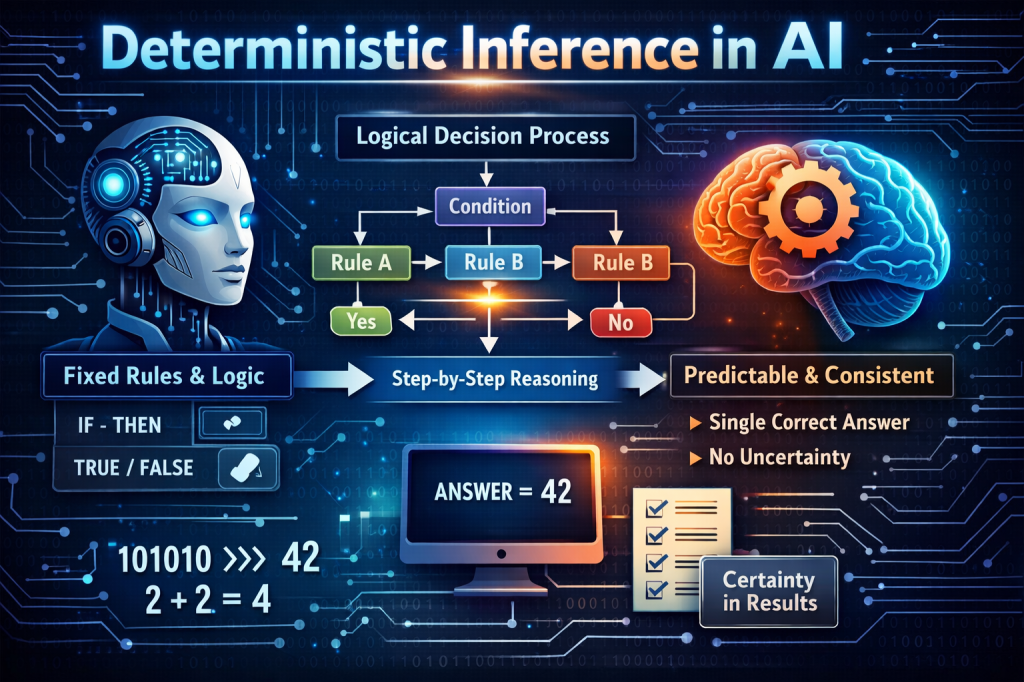
Deterministic Inference in AI: A Customer Experience (CX) Perspective

Introduction: Why Determinism Matters to Customer Experience

Customer Experience (CX) leaders increasingly rely on AI to shape how customers are served, advised, and supported. From virtual agents and recommendation engines to decision-support tools for frontline employees, AI is now embedded directly into the moments that define customer trust.

In this context, deterministic inference is not a technical curiosity, it is a CX enabler. It determines whether customers receive consistent answers, whether agents trust AI guidance, and whether organizations can scale personalized experiences without introducing confusion, risk, or inequity.

This article reframes deterministic inference through a CX lens. It begins with an intuitive explanation, then explores how determinism influences customer trust, operational consistency, and experience quality in AI-driven environments. By the end, you should be able to articulate why deterministic inference is central to modern CX strategy and how it shapes the future of AI-powered customer engagement.


Part 1: Deterministic Thinking in Everyday Customer Experiences

At a basic level, customers expect consistency.

If a customer:

  • Checks an order status online
  • Calls the contact center later
  • Chats with a virtual agent the next day

They expect the same answer each time.

This expectation maps directly to determinism.

A Simple CX Analogy

Consider a loyalty program:

  • Input: Customer ID + purchase history
  • Output: Loyalty tier and benefits

If the system classifies a customer as Gold on Monday and Silver on Tuesday—without any change in behavior—the experience immediately degrades. Trust erodes.

Customers may not know the word “deterministic,” but they feel its absence instantly.


Part 2: What Inference Means in CX-Oriented AI Systems

In CX, inference is the moment AI translates customer data into action.

Examples include:

  • Deciding which response a chatbot gives
  • Recommending next-best actions to an agent
  • Determining eligibility for refunds or credits
  • Personalizing offers or messaging

Inference is where customer data becomes customer experience.


Part 3: Deterministic Inference Defined for CX

From a CX perspective, deterministic inference means:

Given the same customer context, business rules, and AI model state, the system produces the same customer-facing outcome every time.

This does not mean experiences are static. It means they are predictably adaptive.

Why This Is Non-Trivial in Modern CX AI

Many CX AI systems introduce variability by design:

  • Generative chat responses – Replies produced by an artificial intelligence (AI) system that uses machine learning to create original, human-like text in real-time, rather than relying on predefined scripts or rules. These responses are generated based on patterns the AI has learned from being trained on vast amounts of existing data, such as books, web pages, and conversation examples.
  • Probabilistic intent classification – a machine learning method used in natural language processing (NLP) to identify the purpose behind a user’s input (such as a chat message or voice command) by assigning a probability distribution across a predefined set of potential goals, rather than simply selecting a single, most likely intent.
  • Dynamic personalization models – Refer to systems that automatically tailor digital content and user experiences in real time based on an individual’s unique preferences, past behaviors, and current context. This approach contrasts with static personalization, which relies on predefined rules and broad customer segments.
  • Agentic workflows – An AI-driven process where autonomous “agents” independently perform multi-step tasks, make decisions, and adapt to changing conditions to achieve a goal, requiring minimal human oversight. Unlike traditional automation that follows strict rules, agentic workflows use AI’s reasoning, planning, and tool-use abilities to handle complex, dynamic situations, making them more flexible and efficient for tasks like data analysis, customer support, or IT management.

Without guardrails, two customers with identical profiles may receive different experiences—or the same customer may receive different answers across channels.


Part 4: Deterministic vs. Probabilistic CX Experiences

Probabilistic CX (Common in Generative AI)

Probabilistic inference can produce varied but plausible responses.

Example:

Customer asks: “What fees apply to my account?”

Possible outcomes:

  • Response A mentions two fees
  • Response B mentions three fees
  • Response C phrases exclusions differently

All may be linguistically correct, but CX consistency suffers.

Deterministic CX

With deterministic inference:

  • Fee logic is fixed
  • Eligibility rules are stable
  • Response content is governed

The customer receives the same answer regardless of channel, agent, or time.


Part 5: Why Deterministic Inference Is Now a CX Imperative

1. Omnichannel Consistency

A customer-centric strategy that creates a seamless, integrated, and consistent brand experience across all customer touchpoints, whether online (website, app, social media, email) or offline (physical store), allowing customers to move between channels effortlessly with a unified journey. It breaks down silos between channels, using customer data to deliver personalized, real-time interactions that build loyalty and drive conversions, unlike multichannel, which often keeps channels separate.

Customers move fluidly across a marketing centered ecosystem: (Consisting typically of)

  • Web
  • Mobile
  • Chat
  • Voice
  • Human agents

Deterministic inference ensures that AI behaves like a single brain, not a collection of loosely coordinated tools.

2. Trust and Perceived Fairness

Trust and perceived fairness are two of the most fragile and valuable assets in customer experience. AI systems, particularly those embedded in service, billing, eligibility, and recovery workflows, directly influence whether customers believe a company is acting competently, honestly, and equitably.

Deterministic inference plays a central role in reinforcing both.


Defining Trust and Fairness in a CX Context

Customer Trust can be defined as:

The customer’s belief that an organization will behave consistently, competently, and in the customer’s best interest across interactions.

Trust is cumulative. It is built through repeated confirmation that the organization “remembers,” “understands,” and “treats me the same way every time under the same conditions.”

Perceived Fairness refers to:

The customer’s belief that decisions are applied consistently, without arbitrariness, favoritism, or hidden bias.

Importantly, perceived fairness does not require that outcomes always favor the customer—only that outcomes are predictable, explainable, and consistently applied.


How Non-Determinism Erodes Trust

When AI-driven CX systems are non-deterministic, customers may experience:

  • Different answers to the same question on different days
  • Different outcomes depending on channel (chat vs. voice vs. agent)
  • Inconsistent eligibility decisions without explanation

From the customer’s perspective, this variability feels indistinguishable from:

  • Incompetence
  • Lack of coordination
  • Unfair treatment

Even if every response is technically “reasonable,” inconsistency signals unreliability.


How Deterministic Inference Reinforces Trust

Deterministic inference ensures that:

  • Identical customer contexts yield identical decisions
  • Policy interpretation does not drift between interactions
  • AI behavior is stable over time unless explicitly changed

This creates what customers experience as institutional memory and coherence.

Customers begin to trust that:

  • The system knows who they are
  • The rules are real (not improvised)
  • Outcomes are not arbitrary

Trust, in this sense, is not emotional—it is structural.


Determinism as the Foundation of Perceived Fairness

Fairness in CX is primarily about consistency of application.

Deterministic inference supports fairness by:

  • Applying the same logic to all customers with equivalent profiles
  • Eliminating accidental variance introduced by sampling or generative phrasing
  • Enabling clear articulation of “why” a decision occurred

When determinism is present, organizations can say:

“Anyone in your situation would have received the same outcome.”

That statement is nearly impossible to defend in a non-deterministic system.


Real-World CX Examples

Example 1: Billing Disputes

A customer disputes a late fee.

  • Non-deterministic system:
    • Chatbot waives the fee
    • Phone agent denies the waiver
    • Follow-up email escalates to a partial credit

The customer concludes the process is arbitrary and learns to “channel shop.”

  • Deterministic system:
    • Eligibility rules are fixed
    • All channels return the same decision
    • Explanation is consistent

Even if the fee is not waived, the experience feels fair.


Example 2: Service Recovery Offers

Two customers experience the same outage.

  • Non-deterministic AI generates different goodwill offers
  • One customer receives a credit, the other an apology only

Perceived inequity emerges immediately—often amplified on social media.

Deterministic inference ensures:

  • Outage classification is stable
  • Compensation logic is uniformly applied

Example 3: Financial or Insurance Eligibility

In lending, insurance, or claims environments:

  • Customers frequently recheck decisions
  • Outcomes are scrutinized closely

Deterministic inference enables:

  • Reproducible decisions during audits
  • Clear explanations to customers
  • Reduced escalation to human review

The result is not just compliance—it is credibility.


Trust, Fairness, and Escalation Dynamics

Inconsistent AI decisions increase:

  • Repeat contacts
  • Supervisor escalations
  • Customer complaints

Deterministic systems reduce these behaviors by removing perceived randomness.

When customers believe outcomes are consistent and rule-based, they are less likely to challenge them—even unfavorable ones.


Key CX Takeaway

Deterministic inference does not guarantee positive outcomes for every customer.

What it guarantees is something more important:

  • Consistency over time
  • Uniform application of rules
  • Explainability of decisions

These are the structural prerequisites for trust and perceived fairness in AI-driven customer experience.

3. Agent Confidence and Adoption

Frontline employees quickly disengage from AI systems that contradict themselves.

Deterministic inference:

  • Reinforces agent trust
  • Reduces second-guessing
  • Improves adherence to AI recommendations

Part 6: CX-Focused Examples of Deterministic Inference

Example 1: Contact Center Guidance

  • Input: Customer tenure, sentiment, issue type
  • Output: Recommended resolution path

If two agents receive different guidance for the same scenario, experience variance increases.

Example 2: Virtual Assistants

A customer asks the same question on chat and voice.

Deterministic inference ensures:

  • Identical policy interpretation
  • Consistent escalation thresholds

Example 3: Personalization Engines

Determinism ensures that personalization feels intentional – not random.

Customers should recognize patterns, not unpredictability.


Part 7: Deterministic Inference and Generative AI in CX

Generative AI has fundamentally changed how organizations design and deliver customer experiences. It enables natural language, empathy, summarization, and personalization at scale. At the same time, it introduces variability that if left unmanaged can undermine consistency, trust, and operational control.

Deterministic inference is the mechanism that allows organizations to harness the strengths of generative AI without sacrificing CX reliability.


Defining the Roles: Determinism vs. Generation in CX

To understand how these work together, it is helpful to separate decision-making from expression.

Deterministic Inference (CX Context)

The process by which customer data, policy rules, and business logic are evaluated in a repeatable way to produce a fixed outcome or decision.

Examples include:

  • Eligibility decisions
  • Next-best-action selection
  • Escalation thresholds
  • Compensation logic

Generative AI (CX Context)

The process of transforming decisions or information into human-like language, tone, or format.

Examples include:

  • Writing a response to a customer
  • Summarizing a case for an agent
  • Rephrasing policy explanations empathetically

In mature CX architectures, generative AI should not decide what happens -only how it is communicated.


Why Unconstrained Generative AI Creates CX Risk

When generative models are allowed to perform inference implicitly, several CX risks emerge:

  • Policy drift: responses subtly change over time
  • Inconsistent commitments: different wording implies different entitlements
  • Hallucinated exceptions or promises
  • Channel-specific discrepancies

From the customer’s perspective, these failures manifest as:

  • “The chatbot told me something different.”
  • “Another agent said I was eligible.”
  • “Your email says one thing, but your app says another.”

None of these are technical errors—they are experience failures caused by nondeterminism.


How Deterministic Inference Stabilizes Generative CX

Deterministic inference creates a stable backbone that generative AI can safely operate on.

It ensures that:

  • Business decisions are made once, not reinterpreted
  • All channels reference the same outcome
  • Changes occur only when rules or models are intentionally updated

Generative AI then becomes a presentation layer, not a decision-maker.

This separation mirrors proven software principles: logic first, interface second.


Canonical CX Architecture Pattern

A common and effective pattern in production CX systems is:

  1. Deterministic Decision Layer
    • Evaluates customer context
    • Applies rules, models, and thresholds
    • Produces explicit outputs (e.g., “eligible = true”)
  2. Generative Language Layer
    • Translates decisions into natural language
    • Adjusts tone, empathy, and verbosity
    • Adapts phrasing by channel

This pattern allows organizations to scale generative CX safely.


Real-World CX Examples

Example 1: Policy Explanations in Contact Centers

  • Deterministic inference determines:
    • Whether a fee can be waived
    • The maximum allowable credit
  • Generative AI determines:
    • How the explanation is phrased
    • The level of empathy
    • Channel-appropriate tone

The outcome remains fixed; the expression varies.


Example 2: Virtual Agent Responses

A customer asks: “Can I cancel without penalty?”

  • Deterministic layer evaluates:
    • Contract terms
    • Timing
    • Customer tenure
  • Generative layer constructs:
    • A clear, empathetic explanation
    • Optional next steps

This prevents the model from improvising policy interpretation.


Example 3: Agent Assist and Case Summaries

In agent-assist tools:

  • Deterministic inference selects next-best-action
  • Generative AI summarizes context and rationale

Agents see consistent guidance while benefiting from flexible language.


Example 4: Service Recovery Messaging

After an outage:

  • Deterministic logic assigns compensation tiers
  • Generative AI personalizes apology messages

Customers receive equitable treatment with human-sounding communication.


Determinism, Generative AI, and Compliance

In regulated industries, this separation is critical.

Deterministic inference enables:

  • Auditability of decisions
  • Reproducibility during disputes
  • Clear separation of logic and language

Generative AI, when constrained, does not threaten compliance—it enhances clarity.


Part 8: Determinism in Agentic CX Systems

As customer experience platforms evolve, AI systems are no longer limited to answering questions or generating text. Increasingly, they are becoming agentic – capable of planning, deciding, acting, and iterating across multiple steps to resolve customer needs.

Agentic CX systems represent a step change in automation power. They also introduce a step change in risk.

Deterministic inference is what allows agentic CX systems to operate safely, predictably, and at scale.


Defining Agentic AI in a CX Context

Agentic AI (CX Context) refers to AI systems that can:

  • Decompose a customer goal into steps
  • Decide which actions to take
  • Invoke tools or workflows
  • Observe outcomes and adjust behavior

Examples include:

  • An AI agent that resolves a billing issue end-to-end
  • A virtual assistant that coordinates between systems (CRM, billing, logistics)
  • An autonomous service agent that proactively reaches out to customers

In CX, agentic systems are effectively digital employees operating customer journeys.


Why Agentic CX Amplifies the Need for Determinism

Unlike single-response AI, agentic systems:

  • Make multiple decisions per interaction
  • Influence downstream systems
  • Accumulate effects over time

Without determinism, small variations compound into large experience divergence.

This leads to:

  • Different resolution paths for identical customers
  • Inconsistent journey lengths
  • Unpredictable escalation behavior
  • Inability to reproduce or debug failures

In CX terms, the journey itself becomes unstable.


Deterministic Inference as Journey Control

Deterministic inference acts as a control system for agentic CX.

It ensures that:

  • Identical customer states produce identical action plans
  • Tool selection follows stable rules
  • State transitions are predictable

Rather than improvising journeys, agentic systems execute governed playbooks.

This transforms agentic AI from a creative actor into a reliable operator.


Determinism vs. Emergent Behavior in CX

Emergent behavior is often celebrated in AI research. In CX, it is usually a liability.

Customers do not want:

  • Creative interpretations of policy
  • Novel escalation strategies
  • Personalized but inconsistent journeys

Determinism constrains emergence to expression, not action.


Canonical Agentic CX Architecture

Mature agentic CX systems typically separate concerns:

  1. Deterministic Orchestration Layer
    • Defines allowable actions
    • Enforces sequencing rules
    • Governs state transitions
  2. Probabilistic Reasoning Layer
    • Interprets intent
    • Handles ambiguity
  3. Generative Interaction Layer
    • Communicates with customers
    • Explains actions

Determinism anchors the system; intelligence operates within bounds.


Real-World CX Examples

Example 1: End-to-End Billing Resolution Agent

An agentic system resolves billing disputes autonomously.

  • Deterministic logic controls:
    • Eligibility checks
    • Maximum credits
    • Required verification steps
  • Agentic behavior sequences actions:
    • Retrieve invoice
    • Apply adjustment
    • Notify customer

Two identical disputes follow the same path, regardless of timing or channel.


Example 2: Proactive Service Outreach

An AI agent monitors service degradation and proactively contacts customers.

Deterministic inference ensures:

  • Outreach thresholds are consistent
  • Priority ordering is fair
  • Messaging triggers are stable

Without determinism, customers perceive favoritism or randomness.


Example 3: Escalation Management

An agentic CX system decides when to escalate to a human.

Deterministic rules govern:

  • Sentiment thresholds
  • Time-in-journey limits
  • Regulatory triggers

This prevents over-escalation, under-escalation, and agent mistrust.


Debugging, Auditability, and Learning

Agentic systems without determinism are nearly impossible to debug.

Deterministic inference enables:

  • Replay of customer journeys
  • Root-cause analysis
  • Safe iteration on rules and models

This is essential for continuous CX improvement.


Part 9: Strategic CX Implications

Deterministic inference is not merely a technical implementation detail – it is a strategic enabler that determines whether AI strengthens or destabilizes a customer experience operating model.

At scale, CX strategy is less about individual interactions and more about repeatable experience outcomes. Determinism is what allows AI-driven CX to move from experimentation to institutional capability.


Defining Strategic CX Implications

From a CX leadership perspective, a strategic implication is not about what the AI can do, but:

  • How reliably it can do it
  • How safely it can scale
  • How well it aligns with brand, policy, and regulation

Deterministic inference directly influences these dimensions.


1. Scalable Personalization Without Fragmentation

Scalable personalization means:

Delivering tailored experiences to millions of customers without introducing inconsistency, inequity, or operational chaos.

Without determinism:

  • Personalization feels random
  • Customers struggle to understand why they received a specific treatment
  • Frontline teams cannot explain or defend outcomes

With deterministic inference:

  • Personalization logic is explicit and repeatable
  • Customers with similar profiles experience similar journeys
  • Variations are intentional, not accidental

Real-world example:
A telecom provider personalizes retention offers.

  • Deterministic logic assigns offer tiers based on tenure, usage, and churn risk
  • Generative AI personalizes messaging tone and framing

Customers perceive personalization as thoughtful—not arbitrary.


2. Governable Automation and Risk Management

Governable automation refers to:

The ability to control, audit, and modify automated CX behavior without halting operations.

Deterministic inference enables:

  • Clear ownership of decision logic
  • Predictable effects of policy changes
  • Safe rollout and rollback of AI capabilities

Without determinism, automation becomes opaque and risky.

Real-world example:
An insurance provider automates claims triage.

  • Deterministic inference governs eligibility and routing
  • Changes to rules can be simulated before deployment

This reduces regulatory exposure while improving cycle time.


3. Experience Quality Assurance at Scale

Traditional CX quality assurance relies on sampling human interactions.

AI-driven CX requires:

System-level assurance that experiences conform to defined standards.

Deterministic inference allows organizations to:

  • Test AI behavior before release
  • Detect drift when logic changes
  • Guarantee experience consistency across channels

Real-world example:
A bank tests AI responses to fee disputes across all channels.

  • Deterministic logic ensures identical outcomes in chat, voice, and branch support
  • QA focuses on tone and clarity, not decision variance

4. Regulatory Defensibility and Audit Readiness

In regulated industries, CX decisions are often legally material.

Deterministic inference enables:

  • Reproduction of past decisions
  • Clear explanation of why an outcome occurred
  • Evidence that policies are applied uniformly

Real-world example:
A lender responds to a customer complaint about loan denial.

  • Deterministic inference allows the exact decision path to be replayed
  • The institution demonstrates fairness and compliance

This shifts AI from liability to asset.


5. Organizational Alignment and Operating Model Stability

CX failures are often organizational, not technical.

Deterministic inference supports:

  • Alignment between policy, legal, CX, and operations
  • Clear translation of business intent into system behavior
  • Reduced reliance on tribal knowledge

Real-world example:
A global retailer standardizes return policies across regions.

  • Deterministic logic encodes policy variations explicitly
  • Generative AI localizes communication

The experience remains consistent even as organizations scale.


6. Economic Predictability and ROI Measurement

From a strategic standpoint, leaders must justify AI investments.

Deterministic inference enables:

  • Predictable cost-to-serve
  • Stable deflection and containment metrics
  • Reliable attribution of outcomes to decisions

Without determinism, ROI analysis becomes speculative.

Real-world example:
A contact center deploys AI-assisted resolution.

  • Deterministic guidance ensures consistent handling time reductions
  • Leadership can confidently scale investment

Part 10: The Future of Deterministic Inference in CX

Key trends include:

  1. Experience Governance by Design – A proactive approach that embeds compliance, ethics, risk management, and operational rules directly into the creation of systems, products, or services from the very start, making them inherently aligned with desired outcomes, rather than adding them as an afterthought. It shifts governance from being a restrictive layer to a foundational enabler, ensuring that systems are built to be effective, trustworthy, and sustainable, guiding user behavior and decision-making intuitively.
  2. Hybrid Experience Architectures – A strategic framework that combines and integrates different computing, physical, or organizational elements to create a unified, flexible, and optimized user experience. The specific definition varies by context, but it fundamentally involves leveraging the strengths of disparate systems through seamless integration and orchestration.
  3. Audit-Ready Customer Journeys
    Every AI-driven interaction reproducible and explainable.
  4. Trust as a Differentiator – A brand’s proven reliability, integrity, and commitment to its promises become the primary reason customers choose it over competitors, especially when products are similar, leading to higher prices, reduced friction, and increased loyalty by building confidence and reducing perceived risk. It’s the belief that a company will act in the customer’s best interest, providing a competitive advantage difficult to replicate.

Conclusion: Determinism as the Backbone of Trusted CX

Deterministic inference is foundational to trustworthy, scalable, AI-driven customer experience. It ensures that intelligence does not come at the cost of consistency—and that automation enhances, rather than undermines, customer trust.

As AI becomes inseparable from CX, determinism will increasingly define which organizations deliver coherent, defensible, and differentiated experiences and which struggle with fragmentation and erosion of trust.

Please join us on (Spotify) as we discuss this and other AI / CX topics.

The Essential AI Skills Every Professional Needs to Stay Relevant

Introduction

Artificial Intelligence (AI) is no longer an optional “nice-to-know” for professionals—it has become a baseline skill set, similar to email in the 1990s or spreadsheets in the 2000s. Whether you’re in marketing, operations, consulting, design, or management, your ability to navigate AI tools and concepts will influence your value in an organization. But here’s the catch: knowing about AI is very different from knowing how to use it effectively and responsibly.

If you’re trying to build credibility as someone who can bring AI into your work in a meaningful way, there are four foundational skill sets you should focus on: terminology and tools, ethical use, proven application, and discernment of AI’s strengths and weaknesses. Let’s break these down in detail.


1. Build a Firm Grasp of AI Terminology and Tools

If you’ve ever sat in a meeting where “transformer models,” “RAG pipelines,” or “vector databases” were thrown around casually, you know how intimidating AI terminology can feel. The good news is that you don’t need a PhD in computer science to keep up. What you do need is a working vocabulary of the most commonly used terms and a sense of which tools are genuinely useful versus which are just hype.

  • Learn the language. Know what “machine learning,” “large language models (LLMs),” and “generative AI” mean. Understand the difference between supervised vs. unsupervised learning, or between predictive vs. generative AI. You don’t need to be an expert in the math, but you should be able to explain these terms in plain language.
  • Track the hype cycle. Tools like ChatGPT, MidJourney, Claude, Perplexity, and Runway are popular now. Tomorrow it may be different. Stay aware of what’s gaining traction, but don’t chase every shiny new app—focus on what aligns with your work.
  • Experiment regularly. Spend time actually using these tools. Reading about them isn’t enough; you’ll gain more credibility by being the person who can say, “I tried this last week, here’s what worked, and here’s what didn’t.”

The professionals who stand out are the ones who can translate the jargon into everyday language for their peers and point to tools that actually solve problems.

Why it matters: If you can translate AI jargon into plain English, you become the bridge between technical experts and business leaders.

Examples:

  • A marketer who understands “vector embeddings” can better evaluate whether a chatbot project is worth pursuing.
  • A consultant who knows the difference between supervised and unsupervised learning can set more realistic expectations for a client project.

To-Do’s (Measurable):

  • Learn 10 core AI terms (e.g., LLM, fine-tuning, RAG, inference, hallucination) and practice explaining them in one sentence to a non-technical colleague.
  • Test 3 AI tools outside of ChatGPT or MidJourney (try Perplexity for research, Runway for video, or Jasper for marketing copy).
  • Track 1 emerging tool in Gartner’s AI Hype Cycle and write a short summary of its potential impact for your industry.

2. Develop a Clear Sense of Ethical AI Use

AI is a productivity amplifier, but it also has the potential to become a shortcut for avoiding responsibility. Organizations are increasingly aware of this tension. On one hand, AI can help employees save hours on repetitive work; on the other, it can enable people to “phone in” their jobs by passing off machine-generated output as their own.

To stand out in your workplace:

  • Draw the line between productivity and avoidance. If you use AI to draft a first version of a report so you can spend more time refining insights—that’s productive. If you copy-paste AI-generated output without review—that’s shirking.
  • Be transparent. Many companies are still shaping their policies on AI disclosure. Until then, err on the side of openness. If AI helped you get to a deliverable faster, acknowledge it. This builds trust.
  • Know the risks. AI can hallucinate facts, generate biased responses, and misrepresent sources. Ethical use means knowing where these risks exist and putting safeguards in place.

Being the person who speaks confidently about responsible AI use—and who models it—positions you as a trusted resource, not just another tool user.

Why it matters: AI can either build trust or erode it, depending on how transparently you use it.

Examples:

  • A financial analyst discloses that AI drafted an initial market report but clarifies that all recommendations were human-verified.
  • A project manager flags that an AI scheduling tool systematically assigns fewer leadership roles to women—and brings it up to leadership as a fairness issue.

To-Do’s (Measurable):

  • Write a personal disclosure statement (2–3 sentences) you can use when AI contributes to your work.
  • Identify 2 use cases in your role where AI could cause ethical concerns (e.g., bias, plagiarism, misuse of proprietary data). Document mitigation steps.
  • Stay current with 1 industry guideline (like NIST AI Risk Management Framework or EU AI Act summaries) to show awareness of standards.

3. Demonstrate Experience Beyond Text and Images

For many people, AI is synonymous with ChatGPT for writing and MidJourney or DALL·E for image generation. But these are just the tip of the iceberg. If you want to differentiate yourself, you need to show experience with AI in broader, less obvious applications.

Examples include:

  • Data analysis: Using AI to clean, interpret, or visualize large datasets.
  • Process automation: Leveraging tools like UiPath or Zapier AI integrations to cut repetitive steps out of workflows.
  • Customer engagement: Applying conversational AI to improve customer support response times.
  • Decision support: Using AI to run scenario modeling, market simulations, or forecasting.

Employers want to see that you understand AI not only as a creativity tool but also as a strategic enabler across functions.

Why it matters: Many peers will stop at using AI for writing or graphics—you’ll stand out by showing how AI adds value to operational, analytical, or strategic work.

Examples:

  • A sales ops analyst uses AI to cleanse CRM data, improving pipeline accuracy by 15%.
  • An HR manager automates resume screening with AI but layers human review to ensure fairness.

To-Do’s (Measurable):

  • Document 1 project where AI saved measurable time or improved accuracy (e.g., “AI reduced manual data entry from 10 hours to 2”).
  • Explore 2 automation tools like UiPath, Zapier AI, or Microsoft Copilot, and create one workflow in your role.
  • Present 1 short demo to your team on how AI improved a task outside of writing or design.

4. Know Where AI Shines—and Where It Falls Short

Perhaps the most valuable skill you can bring to your organization is discernment: understanding when AI adds value and when it undermines it.

  • AI is strong at:
    • Summarizing large volumes of information quickly.
    • Generating creative drafts, brainstorming ideas, and producing “first passes.”
    • Identifying patterns in structured data faster than humans can.
  • AI struggles with:
    • Producing accurate, nuanced analysis in complex or ambiguous situations.
    • Handling tasks that require deep empathy, cultural sensitivity, or lived experience.
    • Delivering error-free outputs without human oversight.

By being clear on the strengths and weaknesses, you avoid overpromising what AI can do for your organization and instead position yourself as someone who knows how to maximize its real capabilities.

Why it matters: Leaders don’t just want enthusiasm—they want discernment. The ability to say, “AI can help here, but not there,” makes you a trusted voice.

Examples:

  • A consultant leverages AI to summarize 100 pages of regulatory documents but refuses to let AI generate final compliance interpretations.
  • A customer success lead uses AI to draft customer emails but insists that escalation communications be written entirely by a human.

To-Do’s (Measurable):

  • Make a two-column list of 5 tasks in your role where AI is high-value (e.g., summarization, analysis) vs. 5 where it is low-value (e.g., nuanced negotiations).
  • Run 3 experiments with AI on tasks you think it might help with, and record performance vs. human baseline.
  • Create 1 slide or document for your manager/team outlining “Where AI helps us / where it doesn’t.”

Final Thought: Standing Out Among Your Peers

AI skills are not about showing off your technical expertise—they’re about showing your judgment. If you can:

  1. Speak the language of AI and use the right tools,
  2. Demonstrate ethical awareness and transparency,
  3. Prove that your applications go beyond the obvious, and
  4. Show wisdom in where AI fits and where it doesn’t,

…then you’ll immediately stand out in the workplace.

The professionals who thrive in the AI era won’t be the ones who know the most tools—they’ll be the ones who know how to use them responsibly, strategically, and with impact.

We also discuss this topic on (Spotify)

The “Obvious” Business Idea: Why the Easiest Opportunities Can Be the Hardest to Pursue

Introduction:

Some of the most lucrative business opportunities are the ones that seem so obvious that you can’t believe no one has done them — or at least, not the way you envision. You can picture the brand, the customers, the products, the marketing hook. It feels like a sure thing.

And yet… you don’t start.

Why? Because behind every “obvious” business idea lies a set of personal and practical hurdles that keep even the best ideas locked in the mind instead of launched into the market.

In this post, we’ll unpack why these obvious ideas stall, what internal and external obstacles make them harder to commit to, and how to shift your mindset to create a roadmap that moves you from hesitation to execution — while embracing risk, uncertainty, and the thrill of possibility.


The Paradox of the Obvious

An obvious business idea is appealing because it feels simple, intuitive, and potentially low-friction. You’ve spotted an unmet need in your industry, a gap in customer experience, or a product tweak that could outshine competitors.

But here’s the paradox: the more obvious an idea feels, the easier it is to dismiss. Common mental blocks include:

  • “If it’s so obvious, someone else would have done it already — and better.”
  • “If it’s that simple, it can’t possibly be that valuable.”
  • “If it fails, it will prove that even the easiest ideas aren’t within my reach.”

This paradox can freeze momentum before it starts. The obvious becomes the avoided.


The Hidden Hurdles That Stop Execution

Obstacles come in layers — some emotional, some financial, some strategic. Understanding them is the first step to overcoming them.

1. Lack of Motivation

Ideas without action are daydreams. Motivation stalls when:

  • The path from concept to launch isn’t clearly mapped.
  • The work feels overwhelming without visible short-term wins.
  • External distractions dilute your focus.

This isn’t laziness — it’s the brain’s way of avoiding perceived pain in exchange for the comfort of the known.

2. Doubt in the Concept

Belief fuels action, and doubt kills it. You might question:

  • Whether your idea truly solves a problem worth paying for.
  • If you’re overestimating market demand.
  • Your own ability to execute better than competitors.

The bigger the dream, the louder the internal critic.

3. Fear of Financial Loss

When capital is finite, every dollar feels heavier. You might ask yourself:

  • “If I lose this money, what won’t I be able to do later?”
  • “Will this set me back years in my personal goals?”
  • “Will my failure be public and humiliating?”

For many entrepreneurs, the fear of regret from losing money outweighs the fear of regret from never trying.

4. Paralysis by Overplanning

Ironically, being a responsible planner can be a trap. You run endless scenarios, forecasts, and what-if analyses… and never pull the trigger. The fear of not having the perfect plan blocks you from starting the imperfect one that could evolve into success.


Shifting the Mindset: From Backwards-Looking to Forward-Moving

To move from hesitation to execution, you need a mindset shift that embraces uncertainty and reframes risk.

1. Accept That Risk Is the Entry Fee

Every significant return in life — financial or personal — demands risk. The key is not avoiding risk entirely, but designing calculated risks.

  • Define your maximum acceptable loss — the number you can lose without destroying your life.
  • Build contingency plans around that number.

When the risk is pre-defined, the fear becomes smaller and more manageable.

2. Stop Waiting for Certainty

Certainty is a mirage in business. Instead, build decision confidence:

  • Commit to testing in small, fast, low-cost ways (MVPs, pilot launches, pre-orders).
  • Focus on validating the core assumptions first, not perfecting the full product.

3. Reframe the “What If”

Backwards-looking planning tends to ask:

  • “What if it fails?”

Forward-looking planning asks:

  • “What if it works?”
  • “What if it changes everything for me?”

Both questions are valid — but only one fuels momentum.


Creating the Forward Roadmap

Here’s a framework to turn the idea into action without falling into the trap of endless hesitation.

  1. Vision Clarity
    • Define the exact problem you solve and the transformation you deliver.
    • Write a one-sentence pitch that a stranger could understand in seconds.
  2. Risk Definition
    • Set your maximum financial loss.
    • Determine the time you can commit without destabilizing other priorities.
  3. Milestone Mapping
    • Break the journey into 30-, 60-, and 90-day goals.
    • Assign measurable outcomes (e.g., “Secure 10 pre-orders,” “Build prototype,” “Test ad campaign”).
  4. Micro-Execution
    • Take one small action daily — email a supplier, design a mockup, speak to a potential customer.
    • Small actions compound into big wins.
  5. Feedback Loops
    • Test fast, gather data, adjust without over-attaching to your initial plan.
  6. Mindset Anchors
    • Keep a “What if it works?” reminder visible in your workspace.
    • Surround yourself with people who encourage action over doubt.

The Payoff of Embracing the Leap

Some dreams are worth the risk. When you move from overthinking to executing, you experience:

  • Acceleration: Momentum builds naturally once you take the first real steps.
  • Resilience: You learn to navigate challenges instead of fearing them.
  • Potential Windfall: The upside — financial, personal, and emotional — could be life-changing.

Ultimately, the only way to know if an idea can turn into a dream-built reality is to test it in the real world.

And the biggest risk? Spending years looking backwards at the idea you never gave a chance.

We discuss this and many of our other topics on Spotify: (LINK)

Shadow, Code, and Controversy: How Mossad Evolved—and Why Artificial Intelligence Is Its Newest Force-Multiplier

Mossad 101: Mandate, Structure, and Mythos

Created on December 13, 1949 at the urging of Reuven Shiloah, Israel’s founding Prime-Minister-level intelligence adviser, the Ha-Mossad le-Modiʿin ule-Tafkidim Meyuḥadim (“Institute for Intelligence and Special Operations”) was designed to knit together foreign intelligence collection, covert action, and counter-terrorism under a single civilian authority. From the outset Mossad reported directly to the prime minister—an unusual arrangement that preserved agility but limited formal oversight. en.wikipedia.org


From Pioneer Days to Global Reach (1950s-1970s)

  • Operation Garibaldi (1960) – The audacious abduction of Nazi war criminal Adolf Eichmann from Buenos Aires showcased Mossad’s early tradecraft—weeks of low-tech surveillance, forged travel documents, and an El Al aircraft repurposed as an extraction platform. wwv.yadvashem.orgtime.com
  • Six-Day War Intelligence (1967) – Signals intercepts and deep-cover assets provided the IDF with Arab order-of-battle details, shaping Israel’s pre-emptive strategy.
  • Operation Wrath of God (1970-1988) – Following the Munich massacre, Mossad waged a decades-long campaign against Black September operatives—generating both praise for deterrence and criticism for collateral casualties and mistaken identity killings. spyscape.com
  • Entebbe (1976) – Mossad dossiers on Ugandan airport layouts and hostage demographics underpinned the IDF’s storied rescue, fusing HUMINT and early satellite imagery. idf.il

Mossad & the CIA: Shadow Partners in a Complicated Alliance

1 | Foundations and First Big Win (1950s-1960s)

  • Early information barter. In the 1950s Israel supplied raw HUMINT on Soviet weapons proliferation to Langley, while the CIA provided satellite imagery that helped Tel Aviv map Arab air defenses; no formal treaty was ever signed, keeping both sides deniable.
  • Operation Diamond (1966). Mossad persuaded Iraqi pilot Munir Redfa to land his brand-new MiG-21 in Israel. Within days the aircraft was quietly flown to the Nevada Test Site, where the CIA and USAF ran “Project HAVE DOUGHNUT,” giving American pilots their first look at the MiG’s radar and flight envelope—knowledge later credited with saving lives over Vietnam. jewishvirtuallibrary.orgjewishpress.com

Take-away: The MiG caper set the template: Mossad delivers hard-to-get assets; the CIA supplies global logistics and test infrastructure.


2 | Cold-War Humanitarianism and Proxy Logistics (1970s-1980s)

OperationYearJoint ObjectiveControversyCivil or Strategic Upshot
Operation Moses1984Air-lift ~8,000 Ethiopian Jews from Sudan to IsraelExposure forced an early shutdown and left ~1,000 behindFirst large-scale CIA-Mossad humanitarian mission; became a model for later disaster-relief air bridges en.wikipedia.orgmainejewishmuseum.org
Operation Cyclone (support to Afghan Mujahideen)1981-89Funnel Soviet-bloc arms and cash to anti-Soviet fightersLater blowback: some recipients morphed into jihadist networksIsraeli-captured AK-47s and RPGs moved via CIA–ISI channels, giving Washington plausible deniability en.wikipedia.org
Operation Tipped Kettle1983-84Transfer PLO-captured weapons to Nicaraguan ContrasPrecursor to Iran-Contra scandalHighlighted how the two services could cooperate even when formal U.S. law forbade direct aid en.wikipedia.org

3 | Trust Shaken: Espionage & Legal Landmines

  • Jonathan Pollard Affair (1985). Pollard’s arrest for passing U.S. secrets to an Israeli technical bureau (run by former Mossad officers) triggered a decade-long freeze on some intel flows and forced the CIA to rewrite counter-intelligence protocols. nsarchive.gwu.edu
  • Beirut Car-Bomb Allegations (1985). A House panel found no proof of CIA complicity in a blast that killed 80, yet suspicions of Mossad-linked subcontractors lingered, underscoring the reputational risk of joint covert action. cia.gov

4 | Counter-Proliferation Partnership (2000s-2010s)

ProgramModus OperandiStrategic DividendPoints of Contention
Operation Orchard / Outside the Box (2007)Mossad hacked a Syrian official’s laptop; U.S. analysts validated the reactor evidence, and Israeli jets destroyed the site.Averted a potential regional nuclear arms race.CIA initially missed the build-up and later debated legality of a preventive strike. politico.comarmscontrol.org
Stuxnet / Olympic Games (≈2008-10)NSA coders, Mossad field engineers, and CIA operational planners built the first cyber-physical weapon, crippling Iranian centrifuges.Delayed Tehran’s program without air-strikes.Sparked debate over norms for state malware and opened Pandora’s box for copy-cat attacks. en.wikipedia.org

5 | Counter-Terrorism and Targeted Killings

  • Imad Mughniyah (Damascus, 2008). A joint CIA–Mossad cell planted and remotely detonated a precision car bomb, killing Hezbollah’s external-operations chief. U.S. lawyers stretched EO 12333’s assassination ban under a “self-defense” rationale; critics called it perfidy. washingtonpost.com
  • Samir Kuntar (Damascus, 2015). Israel claimed sole credit, but open-source reporting hints at U.S. ISR support—another example of the “gray space” where cooperation thrives when Washington needs distance. haaretz.com

6 | Intelligence for Peace & Civil Stability

  • Oslo-era Security Architecture. After 1993 the CIA trained Palestinian security cadres while Mossad fed real-time threat data, creating today’s layered checkpoint system in the West Bank—praised for reducing terror attacks yet criticized for human-rights costs. merip.org
  • Jordan–Israel Treaty (1994). Joint CIA-Mossad SIGINT on cross-border smuggling reassured Amman that a peace deal would not jeopardize regime security, paving the way for the Wadi Araba signing. brookings.edu
  • Operation Moses (again). Beyond the immediate rescue, the mission became a diplomatic trust-builder among Israel, Sudan, and the U.S., illustrating how clandestine logistics can serve overt humanitarian goals. en.wikipedia.org

7 | AI—The New Glue (2020s-Present)

Where the Cold War relied on barter (a captured jet for satellite photos), the modern relationship trades algorithms and data:

  1. Cross-Platform Face-Trace. A shared U.S.–Israeli model merges commercial, classified, and open-source video feeds to track high-value targets in real time.
  2. Graph-AI “Target Bank.” Mossad’s Habsora ontology engine now plugs into CIA’s Palantir-derived data fabric, shortening find-fix-finish cycles from weeks to hours.
  3. Predictive Logistics. Reinforcement-learning simulators, trained jointly in Nevada and the Negev, optimize exfiltration routes before a team even leaves the safe-house.

8 | Fault Lines to Watch

Strategic QuestionWhy It Matters for Future Research
Oversight of autonomy. Will algorithmic kill-chain recommendations be subject to bipartisan review, or remain in the shadows of executive findings?The IDF’s Habsora (“Gospel”) and Lavender systems show how algorithmic target-generation can compress week-long human analysis into minutes—yet critics note that approval sometimes shrinks to a 20-second rubber-stamp, with civilian-to-combatant casualty ratios widened to 15–20 : 1. The internal debate now gripping Unit 8200 (“Are humans still in the loop or merely on the loop?”) is precisely the scenario U.S. lawmakers flagged when they drafted the 2025 Political Declaration on Responsible Military AI. Comparative research can test whether guard-rails such as mandatory model-explainability, kill-switches, and audit trails genuinely reduce collateral harm, or simply shift liability when things go wrong. washingtonpost.com972mag.com2021-2025.state.gov
Friend-vs-Friend spying. Post-Pollard safeguards are better, but AI-enabled insider theft is cheaper than ever.Jonathan Pollard proved that even close allies can exfiltrate secrets; the same dynamic now plays out in code and data. Large language models fine-tuned on classified corpora become irresistible theft targets, while GPU export-tiers (“AI Diffusion Rule”) mean Israel may court suppliers the U.S. has black-listed. Research is needed on zero-knowledge or trust-but-verify enclaves that let Mossad and CIA query shared models without handing over raw training data—closing the “insider algorithm” loophole exposed by the Pollard precedent. csis.org
Regional AI arms race. As IRGC cyber units and Hezbollah drone cells adopt similar ML pipelines, can joint U.S.–Israeli doctrine deter escalation without permanent shadow war?Iran’s IRGC and Hezbollah drone cells have begun trialing off-the-shelf reinforcement-learning agents; Mossad’s response—remote-piloted micro-swarm interceptors—was previewed during the 2025 Tehran strike plan in which AI-scored targets were hit inside 90 seconds of identification. Escalation ladders can shorten to milliseconds once both sides trust autonomy; modelling those feedback loops requires joint red-team/blue-team testbeds that span cyber, EW, and kinetic domains. washingtonpost.comrusi.org
Algorithmic Bias & Collateral Harm. Hidden proxies in training data can push false-positive rates unacceptably high—especially against specific ethnic or behavioral profiles—making pre-deployment bias audits and causal testing a top research priority.Investigations into Lavender show a 10 % false-positive rate and a design choice to strike militants at home “because it’s easier”—raising classic bias questions (male names, night-time cellphone patterns, etc.). Civil-society audits argue these systems quietly encode ethno-linguistic priors that no Western IRB would permit. Future work must probe whether techniques like counter-factual testing or causal inference can surface hidden proxies before the model hits the battlespace. 972mag.com972mag.com
Data Sovereignty & Privacy of U.S. Persons. With legislation now tying joint R&D funding to verifiable privacy safeguards, differential-privacy budgets, retention limits, and membership-inference tests must be defined and enforced to keep U.S.-person data out of foreign targeting loops.The America–Israel AI Cooperation Act (H.R. 3303, 2025) explicitly conditions R&D funds on “verifiable technical safeguards preventing the ingestion of U.S.-person data.” Yet no public guidance defines what qualifies as sufficient differential-privacy noise budgets or retention periods. Filling that gap—through benchmark datasets, red-team “membership-inference” challenges, and shared compliance metrics—would turn legislative intent into enforceable practice. congress.gov
Governance of Co-Developed Models. Dual-use AI created under civilian grants can be fine-tuned into weapons unless provenance tracking, license clauses, and on-device policy checks restrict downstream retraining and deployment. Joint projects ride civilian channels such as the BIRD Foundation, blurring military–commercial boundaries: a vision-model trained for drone navigation can just as easily steer autonomous loitering munitions. Cross-disciplinary research should map provenance chains (weights, data, fine-tunes) and explore license clauses or on-device policy engines that limit unintended reuse—especially after deployment partners fork or retrain the model outside original oversight. dhs.gov
Why a Research Agenda Now?
  1. Normalization Window Is Narrow. The first operational generation of autonomous clandestine systems is already in the field; norms set in the next 3-5 years will hard-bake into doctrine for decades.
  2. Dual-Use Diffusion Is Accelerating. Consumer-grade GPUs and open-source models reduce the capital cost of nation-state capabilities, widening the actor set faster than export-control regimes can adapt.
  3. Precedent Shapes Law. Court challenges (ICC investigations into Gaza targeting, U.S. FISA debates on model training) will rely on today’s empirical studies to define “reasonable human judgment” tomorrow.
  4. Trust Infrastructure Is Lagging. Technologies such as verifiable compute, federated fine-tuning, and AI provenance watermarking exist—but lack battle-tested reference implementations compatible with Mossad-CIA speed requirements.

For scholars, technologists, and policy teams, each fault-line opens a vein of questions that bridge computer science, international law, and security studies. Quantitative audits, normative frameworks, and even tabletop simulations could all feed the evidence-base needed before the next joint operation moves one step closer to full autonomy.

The Mossad-CIA alliance oscillates between indispensable partnership and latent distrust. Its most controversial moments—from Pollard to Stuxnet—often coincide with breakthroughs that arguably averted wider wars or humanitarian disasters. Understanding this duality is essential for any future discussion on topics such as algorithmic oversight, counter-AI measures, or the ethics of autonomous lethal action—each of which deserves its own deep-dive post.

9 | Technological Pivot (1980s-2000s)

  • Operation Opera (1981) – Pre-strike intelligence on Iraq’s Osirak reactor, including sabotage of French-Iraqi supply chains and clandestine monitoring of nuclear scientists, illustrated Mossad’s expanding SIGINT toolkit. en.wikipedia.org
  • Jonathan Pollard Affair (1985) – The conviction of a U.S. Navy analyst spying for Lakam, an offshoot of Israeli intelligence, chilled cooperation with Washington for a decade.
  • Stuxnet (≈2007-2010) – Widely attributed to a CIA-Mossad partnership, the worm exploited Siemens PLC zero-days to disrupt Iranian centrifuges, inaugurating cyber-kinetic warfare. spectrum.ieee.org

10 | High-Profile Actions in the Digital Age (2010s-2020s)

  • Dubai Passport Scandal (2010) – The assassination of Hamas commander Mahmoud al-Mabhouh—executed with forged EU and Australian passports—prompted diplomatic expulsions and raised biometric-era questions about tradecraft. theguardian.comtheguardian.com
  • Targeted Killings of Iranian Nuclear Scientists (2010-2020) – Remote-controlled weapons and AI-assisted surveillance culminated in the 2020 hit on Mohsen Fakhrizadeh using a satellite-linked, computerized machine gun. timesofisrael.com
  • Tehran Nuclear Archive Raid (2018) – Agents extracted ½-ton of documents overnight, relying on meticulous route-planning, thermal-imaging drones, and rapid on-site digitization. ndtv.com

11 | Controversies—From Plausible to Outlandish

ThemeCore AllegationsStrategic RationaleOngoing Debate
Extrajudicial killingsIran, Lebanon, EuropeDeterrence vs. rule-of-lawLegality under int’l norms
Passport forgeriesDubai 2010, New Zealand 2004Operational coverDiplomatic fallout, trust erosion
Cyber disinformationDeepfake campaigns in Iran-Hezbollah theaterPsychological opsAttribution challenges
“False-flag” rumorsGlobal conspiracy theories (e.g., 9/11)Largely unsubstantiatedImpact on public perception

12 | AI Enters the Picture: 2015-Present

Investment Pipeline. Mossad launched Libertad Ventures in 2017 to fund early-stage startups in computer-vision, natural-language processing, and quantum-resistant cryptography; the fund offers equity-free grants in exchange for a non-exclusive operational license. libertad.gov.ilfinder.startupnationcentral.org

Flagship Capabilities (publicly reported or credibly leaked):

  1. Cross-border Face-Trace – integration with civilian camera grids and commercial datasets for real-time pattern-of-life analysis. theguardian.com
  2. Graph-AI “Target Bank” – an ontology engine (nick-named Habsora) that fuses HUMINT cables, social media, and telecom intercepts into kill-chain recommendations—reportedly used against Hezbollah and Hamas. arabcenterdc.orgtheguardian.com
  3. Predictive Logistics – reinforcement-learning models optimize exfiltration routes and safe-house provisioning in denied regions, as hinted during the June 2025 Iran strike plan that paired smuggled drones with AI-driven target scoring. timesofisrael.comeuronews.com
  4. Autonomous Counter-Drone Nets – collaborative work with Unit 8200 on adversarial-ML defense swarms; details remain classified but align with Israel’s broader AI-artillery initiatives. time.com

Why AI Matters Now

  • Data Deluge: Modern SIGINT generates petabytes; machine learning sifts noise from signal in minutes, not months.
  • Distributed Ops: Small teams leverage AI copilots to rehearse missions in synthetic environments before boots hit the ground.
  • Cost of Error: While AI can reduce collateral damage through precision, algorithmic bias or spoofed inputs (deepfakes, poisoned data) may amplify risks.

13 | Looking Forward—Questions for the Next Deep Dive

  • Governance: How will a traditionally secretive service build guard-rails around autonomous decision-making?
  • HUMINT vs. Machine Insight: Does AI erode classical tradecraft or simply raise the bar for human agents?
  • Regional AI Arms Race: What happens as adversaries—from Iran’s IRGC cyber units to Hezbollah’s drone cells—field their own ML pipelines?
  • International Law: Could algorithmic targeting redefine the legal threshold for “imminent threat”?

Conclusion

From Eichmann’s capture with little more than false passports to algorithmically prioritized strike lists, Mossad’s arc mirrors the evolution of twentieth- and twenty-first-century intelligence tradecraft. Artificial intelligence is not replacing human spies; it is radicalizing their tempo, reach, and precision. Whether that shift enhances security or magnifies moral hazards will depend on oversight mechanisms that have yet to be stress-tested. For strategists and technologists alike, Mossad’s embrace of AI offers a live laboratory—one that raises profound questions for future blog explorations on ethics, counter-AI measures, and the geopolitical tech race.

You can also find the authors discussing this topic on (Spotify).

AI Reasoning in 2025: From Statistical Guesswork to Deliberate Thought

1. Why “AI Reasoning” Is Suddenly The Hot Topic

The 2025 Stanford AI Index calls out complex reasoning as the last stubborn bottleneck even as models master coding, vision and natural language tasks — and reminds us that benchmark gains flatten as soon as true logical generalization is required.hai.stanford.edu
At the same time, frontier labs now market specialized reasoning models (OpenAI o-series, Gemini 2.5, Claude Opus 4), each claiming new state-of-the-art scores on math, science and multi-step planning tasks.blog.googleopenai.comanthropic.com


2. So, What Exactly Is AI Reasoning?

At its core, AI reasoning is the capacity of a model to form intermediate representations that support deduction, induction and abduction, not merely next-token prediction. DeepMind’s Gemini blog phrases it as the ability to “analyze information, draw logical conclusions, incorporate context and nuance, and make informed decisions.”blog.google

Early LLMs approximated reasoning through Chain-of-Thought (CoT) prompting, but CoT leans on incidental pattern-matching and breaks when steps must be verified. Recent literature contrasts these prompt tricks with explicitly architected reasoning systems that self-correct, search, vote or call external tools.medium.com

Concrete Snapshots of AI Reasoning in Action (2023 – 2025)

Below are seven recent systems or methods that make the abstract idea of “AI reasoning” tangible. Each one embodies a different flavor of reasoning—deduction, planning, tool-use, neuro-symbolic fusion, or strategic social inference.

#System / PaperCore Reasoning ModalityWhy It Matters Now
1AlphaGeometry (DeepMind, Jan 2024)Deductive, neuro-symbolic – a language model proposes candidate geometric constructs; a symbolic prover rigorously fills in the proof steps.Solved 25 of 30 International Mathematical Olympiad geometry problems within the contest time-limit, matching human gold-medal capacity and showing how LLM “intuition” + logic engines can yield verifiable proofs. deepmind.google
2Gemini 2.5 Pro (“thinking” model, Mar 2025)Process-based self-reflection – the model produces long internal traces before answering.Without expensive majority-vote tricks, it tops graduate-level benchmarks such as GPQA and AIME 2025, illustrating that deliberate internal rollouts—not just bigger parameters—boost reasoning depth. blog.google
3ARC-AGI-2 Benchmark (Mar 2025)General fluid intelligence test – puzzles easy for humans, still hard for AIs.Pure LLMs score 0 – 4 %; even OpenAI’s o-series with search nets < 15 % at high compute. The gap clarifies what isn’t solved and anchors research on genuinely novel reasoning techniques. arcprize.org
4Tree-of-Thought (ToT) Prompting (2023, NeurIPS)Search over reasoning paths – explores multiple partial “thoughts,” backtracks, and self-evaluates.Raised GPT-4’s success on the Game-of-24 puzzle from 4 % → 74 %, proving that structured exploration outperforms linear Chain-of-Thought when intermediate decisions interact. arxiv.org
5ReAct Framework (ICLR 2023)Reason + Act loops – interleaves natural-language reasoning with external API calls.On HotpotQA and Fever, ReAct cuts hallucinations by actively fetching evidence; on ALFWorld/WebShop it beats RL agents by +34 % / +10 % success, showing how tool-augmented reasoning becomes practical software engineering. arxiv.org
6Cicero (Meta FAIR, Science 2022)Social & strategic reasoning – blends a dialogue LM with a look-ahead planner that models other agents’ beliefs.Achieved top-10 % ranking across 40 online Diplomacy games by planning alliances, negotiating in natural language, and updating its strategy when partners betrayed deals—reasoning that extends beyond pure logic into theory-of-mind. noambrown.github.io
7PaLM-SayCan (Google Robotics, updated Aug 2024)Grounded causal reasoning – an LLM decomposes a high-level instruction while a value-function checks which sub-skills are feasible in the robot’s current state.With the upgraded PaLM backbone it executes 74 % of 101 real-world kitchen tasks (up +13 pp), demonstrating that reasoning must mesh with physical affordances, not just text. say-can.github.io

Key Take-aways

  1. Reasoning is multi-modal.
    Deduction (AlphaGeometry), deliberative search (ToT), embodied planning (PaLM-SayCan) and strategic social inference (Cicero) are all legitimate forms of reasoning. Treating “reasoning” as a single scalar misses these nuances.
  2. Architecture beats scale—sometimes.
    Gemini 2.5’s improvements come from a process model training recipe; ToT succeeds by changing inference strategy; AlphaGeometry succeeds via neuro-symbolic fusion. Each shows that clever structure can trump brute-force parameter growth.
  3. Benchmarks like ARC-AGI-2 keep us honest.
    They remind the field that next-token prediction tricks plateau on tasks that require abstract causal concepts or out-of-distribution generalization.
  4. Tool use is the bridge to the real world.
    ReAct and PaLM-SayCan illustrate that reasoning models must call calculators, databases, or actuators—and verify outputs—to be robust in production settings.
  5. Human factors matter.
    Cicero’s success (and occasional deception) underscores that advanced reasoning agents must incorporate explicit models of beliefs, trust and incentives—a fertile ground for ethics and governance research.

3. Why It Works Now

  1. Process- or “Thinking” Models. OpenAI o3, Gemini 2.5 Pro and similar models train a dedicated process network that generates long internal traces before emitting an answer, effectively giving the network “time to think.”blog.googleopenai.com
  2. Massive, Cheaper Compute. Inference cost for GPT-3.5-level performance has fallen ~280× since 2022, letting practitioners afford multi-sample reasoning strategies such as majority-vote or tree-search.hai.stanford.edu
  3. Tool Use & APIs. Modern APIs expose structured tool-calling, background mode and long-running jobs; OpenAI’s GPT-4.1 guide shows a 20 % SWE-bench gain just by integrating tool-use reminders.cookbook.openai.com
  4. Hybrid (Neuro-Symbolic) Methods. Fresh neurosymbolic pipelines fuse neural perception with SMT solvers, scene-graphs or program synthesis to attack out-of-distribution logic puzzles. (See recent survey papers and the surge of ARC-AGI solvers.)arcprize.org

4. Where the Bar Sits Today

CapabilityFrontier Performance (mid-2025)Caveats
ARC-AGI-1 (general puzzles)~76 % with OpenAI o3-low at very high test-time computePareto trade-off between accuracy & $$$ arcprize.org
ARC-AGI-2< 9 % across all labsStill “unsolved”; new ideas needed arcprize.org
GPQA (grad-level physics Q&A)Gemini 2.5 Pro #1 without votingRequires million-token context windows blog.google
SWE-bench Verified (code repair)63 % with Gemini 2.5 agent; 55 % with GPT-4.1 agentic harnessNeeds bespoke scaffolds and rigorous evals blog.googlecookbook.openai.com

Limitations to watch

  • Cost & Latency. Step-sampling, self-reflection and consensus raise latency by up to 20× and inflate bill-rates — a point even Business Insider flags when cheaper DeepSeek releases can’t grab headlines.businessinsider.com
  • Brittleness Off-Distribution. ARC-AGI-2’s single-digit scores illustrate how models still over-fit to benchmark styles.arcprize.org
  • Explainability & Safety. Longer chains can amplify hallucinations if no verifier model checks each step; agents that call external tools need robust sandboxing and audit trails.

5. Practical Take-Aways for Aspiring Professionals

PillarWhat to MasterWhy It Matters
Prompt & Agent DesignCoT, ReAct, Tree-of-Thought, tool schemas, background execution modesUnlock double-digit accuracy gains on reasoning tasks cookbook.openai.com
Neuro-Symbolic ToolingLangChain Expressions, Llama-Index routers, program-synthesis libraries, SAT/SMT interfacesCombine neural intuition with symbolic guarantees for safety-critical workflows
Evaluation DisciplineBenchmarks (ARC-AGI, PlanBench, SWE-bench), custom unit tests, cost-vs-accuracy curvesReasoning quality is multidimensional; naked accuracy is marketing, not science arcprize.org
Systems & MLOpsDistributed tracing, vector-store caching, GPU/TPU economics, streaming APIsReasoning models are compute-hungry; efficiency is a feature hai.stanford.edu
Governance & EthicsAlignment taxonomies, red-team playbooks, policy awareness (e.g., SB-1047 debates)Long-running autonomous agents raise fresh safety and compliance questions

6. The Road Ahead—Deepening the Why, Where, and ROI of AI Reasoning


1 | Why Enterprises Cannot Afford to Ignore Reasoning Systems

  • From task automation to orchestration. McKinsey’s 2025 workplace report tracks a sharp pivot from “autocomplete” chatbots to autonomous agents that can chat with a customer, verify fraud, arrange shipment and close the ticket in a single run. The differentiator is multi-step reasoning, not bigger language models.mckinsey.com
  • Reliability, compliance, and trust. Hallucinations that were tolerable in marketing copy are unacceptable when models summarize contracts or prescribe process controls. Deliberate reasoning—often coupled with verifier loops—cuts error rates on complex extraction tasks by > 90 %, according to Google’s Gemini 2.5 enterprise pilots.cloud.google.com
  • Economic leverage. Vertex AI customers report that Gemini 2.5 Flash executes “think-and-check” traces 25 % faster and up to 85 % cheaper than earlier models, making high-quality reasoning economically viable at scale.cloud.google.com
  • Strategic defensibility. Benchmarks such as ARC-AGI-2 expose capability gaps that pure scale will not close; organizations that master hybrid (neuro-symbolic, tool-augmented) approaches build moats that are harder to copy than fine-tuning another LLM.arcprize.org

2 | Where AI Reasoning Is Already Flourishing

EcosystemEvidence of MomentumWhat to Watch Next
Retail & Supply ChainTarget, Walmart and Home Depot now run AI-driven inventory ledgers that issue billions of demand-supply predictions weekly, slashing out-of-stocks.businessinsider.comAutonomous reorder loops with real-time macro-trend ingestion (EY & Pluto7 pilots).ey.compluto7.com
Software EngineeringDeveloper-facing agents boost productivity ~30 % by generating functional code, mapping legacy business logic and handling ops tickets.timesofindia.indiatimes.com“Inner-loop” reasoning: agents that propose and formally verify patches before opening pull requests.
Legal & ComplianceReasoning models now hit 90 %+ clause-interpretation accuracy and auto-triage mass-tort claims with traceable justifications, shrinking review time by weeks.cloud.google.compatterndata.aiedrm.netCourt systems are drafting usage rules after high-profile hallucination cases—firms that can prove veracity will win market share.theguardian.com
Advanced Analytics on Cloud PlatformsGemini 2.5 Pro on Vertex AI, OpenAI o-series agents on Azure, and open-source ARC Prize entrants provide managed “reasoning as a service,” accelerating adoption beyond Big Tech.blog.googlecloud.google.comarcprize.orgIndustry-specific agent bundles (finance, life-sciences, energy) tuned for regulatory context.

3 | Where the Biggest Business Upside Lies

  1. Decision-centric Processes
    Supply-chain replanning, revenue-cycle management, portfolio optimization. These tasks need models that can weigh trade-offs, run counter-factuals and output an action plan, not a paragraph. Early adopters report 3–7 pp margin gains in pilot P&Ls.businessinsider.compluto7.com
  2. Knowledge-intensive Service Lines
    Legal, audit, insurance claims, medical coding. Reasoning agents that cite sources, track uncertainty and pass structured “sanity checks” unlock 40–60 % cost take-outs while improving auditability—as long as governance guard-rails are in place.cloud.google.compatterndata.ai
  3. Developer Productivity Platforms
    Internal dev-assist, code migration, threat modelling. Firms embedding agentic reasoning into CI/CD pipelines report 20–30 % faster release cycles and reduced security regressions.timesofindia.indiatimes.com
  4. Autonomous Planning in Operations
    Factory scheduling, logistics routing, field-service dispatch. EY forecasts a shift from static optimization to agents that adapt plans as sensor data changes, citing pilot ROIs of 5× in throughput-sensitive industries.ey.com

4 | Execution Priorities for Leaders

PriorityAction Items for 2025–26
Set a Reasoning Maturity TargetChoose benchmarks (e.g., ARC-AGI-style puzzles for R&D, SWE-bench forks for engineering, synthetic contract suites for legal) and quantify accuracy-vs-cost goals.
Build Hybrid ArchitecturesCombine process-models (Gemini 2.5 Pro, OpenAI o-series) with symbolic verifiers, retrieval-augmented search and domain APIs; treat orchestration and evaluation as first-class code.
Operationalise GovernanceImplement chain-of-thought logging, step-level verification, and “refusal triggers” for safety-critical contexts; align with emerging policy (e.g., EU AI Act, SB-1047).
Upskill Cross-Functional TalentPair reasoning-savvy ML engineers with domain SMEs; invest in prompt/agent design, cost engineering, and ethics training. PwC finds that 49 % of tech leaders already link AI goals to core strategy—laggards risk irrelevance.pwc.com

Bottom Line for Practitioners

Expect the near term to revolve around process-model–plus-tool hybrids, richer context windows and automatic verifier loops. Yet ARC-AGI-2’s stubborn difficulty reminds us that statistical scaling alone will not buy true generalization: novel algorithmic ideas — perhaps tighter neuro-symbolic fusion or program search — are still required.

For you, that means interdisciplinary fluency: comfort with deep-learning engineering and classical algorithms, plus a habit of rigorous evaluation and ethical foresight. Nail those, and you’ll be well-positioned to build, audit or teach the next generation of reasoning systems.

AI reasoning is transitioning from a research aspiration to the engine room of competitive advantage. Enterprises that treat reasoning quality as a product metric, not a lab curiosity—and that embed verifiable, cost-efficient agentic workflows into their core processes—will capture out-sized economic returns while raising the bar on trust and compliance. The window to build that capability before it becomes table stakes is narrowing; the playbook above is your blueprint to move first and scale fast.

We can also be found discussing this topic on (Spotify)

Transforming Call Centers with GenAI: A Strategic Approach for Senior Business Management

Introduction

In our previous discussion, we explored the landscape of traditional call centers, the strengths and weaknesses of these models, and how GenAI and other advanced technologies are revolutionizing the industry. Now, let’s delve deeper into how these technologies and leading vendors like IBM Watson, Amazon Connect, Google Cloud Contact Center AI, and Genesys Cloud can be strategically leveraged to transform a call center. We’ll discuss quick wins, mid-term, and long-term initiatives, as well as the pros and cons of these deployments to help senior business management make informed decisions.

Quick Wins: Initial Areas to Address

1. Automating Routine Inquiries with Virtual Agents:

Automating routine inquiries with virtual agents involves deploying AI-powered chatbots and voice assistants to handle common customer questions and tasks, such as checking account balances, tracking order statuses, and answering FAQs. These virtual agents use natural language processing to understand and respond to customer queries accurately, providing immediate assistance without the need for human intervention. This not only reduces the workload on human agents but also improves response times and customer satisfaction by delivering quick and consistent service.

Technologies to Leverage: (Illustrative)

Implementation: Deploying virtual agents to handle routine inquiries such as account balances, order status, and FAQs can provide immediate relief to human agents. These AI-driven virtual agents can understand natural language, provide accurate responses, and escalate complex issues to human agents when necessary.

Typical Results:

  • Reduced Call Volume for Human Agents: A significant reduction in the volume of routine calls handled by human agents, freeing them up for more complex interactions.
  • Improved Response Times: Faster resolution of common inquiries, leading to enhanced customer satisfaction.
  • Cost Savings: Reduced need for staffing during peak times, lowering operational costs.

2. Enhancing IVR Systems with AI:

Enhancing IVR (Interactive Voice Response) systems with AI involves integrating artificial intelligence to make these systems more intuitive and user-friendly. AI-powered IVR can understand and process natural language, allowing customers to speak naturally instead of navigating through rigid menu options. This improvement leads to more accurate call routing, quicker resolutions, and a more satisfying customer experience. Additionally, AI-enhanced IVR systems can handle a larger volume of calls efficiently, reducing wait times and operational costs.

Technologies to Leverage: (Illustrative)

Implementation: Integrating AI into existing IVR systems can enhance their functionality. AI-powered IVR can understand and process natural language, making it easier for customers to navigate the system and get the information they need without agent intervention.

Typical Results:

  • Higher Customer Satisfaction: Improved customer experience due to more intuitive and efficient IVR navigation.
  • Increased First Call Resolution (FCR): More accurate routing of calls to the right department or agent, increasing the chances of resolving issues on the first call.

Mid-Term Initiatives: Building on Initial Successes

1. Implementing AI-Powered Analytics and Insights:

Implementing AI-powered analytics and insights involves using advanced AI and machine learning tools to analyze customer interaction data. These tools provide deep insights into customer behaviors, preferences, and trends, allowing businesses to make data-driven decisions. By identifying patterns and predicting customer needs, companies can offer personalized experiences and proactively address potential issues. This enhances customer satisfaction, optimizes operational efficiency, and drives strategic improvements in call center performance.

Technologies to Leverage: (Illustrative)

Implementation: Use AI-powered analytics to gather and analyze data from customer interactions. These insights can help identify patterns, predict customer needs, and provide agents with real-time information to improve service quality.

Pros:

  • Personalized Customer Experience: AI-driven insights enable highly personalized interactions.
  • Proactive Issue Resolution: Predictive analytics can help anticipate and address issues before they escalate.

Cons:

  • Data Privacy Concerns: Handling large volumes of customer data requires robust security measures to protect privacy.
  • Integration Challenges: Integrating AI analytics with existing CRM and contact center systems can be complex and require significant IT resources.

2. Enhancing Agent Assistance with AI:

Enhancing agent assistance with AI involves using artificial intelligence tools to support customer service agents in real-time. These tools provide agents with relevant information, suggested responses, and insights based on historical data during customer interactions. AI can automate routine tasks, freeing agents to focus on more complex issues, and ensure consistent, high-quality service. This leads to increased agent productivity, improved customer satisfaction, and more efficient call center operations.

Technologies to Leverage: (Illustrative)

Implementation: Deploy AI to assist human agents in real-time by providing relevant information, suggesting responses, and offering insights based on historical data.

Pros:

  • Increased Agent Productivity: Agents can handle queries more efficiently with AI support.
  • Consistency in Service Quality: AI provides standardized responses, reducing variability in service quality.

Cons:

  • Agent Training: Agents need to be trained to effectively use AI tools, which can require time and resources.
  • Initial Setup Costs: Implementing AI assistance tools may involve significant initial investment.

Long-Term Initiatives: Transformational Changes

1. Full Integration of Omnichannel Support:

Full integration of omnichannel support means unifying all customer interaction channels, such as phone, email, chat, and social media, into a single, cohesive system. This allows for seamless transitions between channels and ensures consistent service quality regardless of the customer’s chosen method of communication. By integrating omnichannel support, companies can provide a more comprehensive and connected customer experience, improving satisfaction and efficiency while allowing agents to manage all interactions from a unified interface.

Technologies to Leverage: (Illustrative)

Implementation: Integrate all customer interaction channels (phone, email, chat, social media) into a unified platform supported by AI. This ensures seamless transitions between channels and consistent service quality.

Pros:

  • Unified Customer Experience: Customers enjoy a consistent experience across all touchpoints.
  • Improved Efficiency: Agents can handle interactions from multiple channels within a single interface.

Cons:

  • Complexity of Integration: Bringing all channels into a unified system can be technically challenging.
  • Ongoing Maintenance: Continuous updates and maintenance are required to keep the system running smoothly.

2. Advanced Predictive and Prescriptive Analytics:

Advanced predictive and prescriptive analytics involve using sophisticated AI and machine learning techniques to analyze data and forecast future customer behaviors and trends. Predictive analytics helps anticipate customer needs and potential issues before they arise, while prescriptive analytics offers actionable recommendations to optimize decision-making and operational strategies. This proactive approach enhances customer satisfaction, improves efficiency, and drives better business outcomes by enabling companies to address problems before they escalate and tailor services to individual customer preferences.

Technologies to Leverage: (Illustrative)

Implementation: Leverage advanced analytics to not only predict customer behavior but also prescribe actions for agents and automated systems to take, improving proactive customer service and operational efficiency.

Pros:

  • Proactive Customer Service: Ability to address issues before they arise, enhancing customer satisfaction.
  • Operational Efficiency: Streamlined processes and optimized resource allocation based on predictive insights.

Cons:

  • Data Management: Handling and analyzing large datasets requires robust data management strategies.
  • Skill Requirements: High-level data science skills are necessary to develop and maintain predictive models.

Developing the Plan: Pros and Cons of Deployments

Pros:

  • Enhanced Customer Experience: AI and GenAI technologies provide personalized, efficient, and seamless customer interactions.
  • Operational Efficiency: Automation reduces costs, improves agent productivity, and scales easily with demand.
  • Data-Driven Decision Making: Advanced analytics provide valuable insights into customer behavior and operational performance.

Cons:

  • High Initial Investment: Implementing AI technologies can require significant upfront investment in both technology and training.
  • Integration Complexity: Integrating new technologies with existing systems can be complex and resource-intensive.
  • Data Privacy and Security: Handling large volumes of sensitive customer data necessitates robust security measures and compliance with regulations.

Conclusion

Transforming call centers with GenAI and advanced technologies is a strategic imperative for modern businesses aiming to enhance customer experience, improve operational efficiency, and maintain a competitive edge. By focusing on quick wins, such as automating routine inquiries and enhancing IVR systems, companies can achieve immediate benefits. Building on these successes with mid-term initiatives like AI-powered analytics and agent assistance, and pursuing long-term goals such as omnichannel support and advanced predictive analytics, can lead to a comprehensive transformation.

When developing the transformation plan, it’s essential to weigh the pros and cons of each deployment phase, ensuring that the strategy aligns with the company’s overall business objectives and capabilities. By doing so, companies can navigate the complexities of digital transformation, harness the full potential of AI technologies, and ultimately deliver exceptional customer experiences.

Leveraging GenAI in Call Center Transformation Programs

Welcome back readers – we’ve been on a brief hiatus, taking the last few weeks to retool, reboot, and re-energize. This pause allowed us to externally view the industry and technology advancements and prepare for the exciting developments on the horizon in Generative AI and Customer Experience. We’re now back and ready to dive into the next wave of innovations in these rapidly evolving fields. Stay tuned for fresh insights and cutting-edge analysis as we explore how these advancements will reshape the future of business and technology.

Introduction

In today’s fast-paced digital landscape, the call center industry is undergoing significant transformation, driven by advancements in artificial intelligence, particularly generative AI (GenAI). As businesses strive to enhance customer experiences and optimize operational efficiency, understanding the current administration of call centers, their strengths and weaknesses, and the leading solutions in the marketplace is crucial. This blog post delves into these aspects and provides insights into the future trajectory of call center technologies, the goals and KPIs for transformation, and what to look for in a call center transformation consultant.

Current Administration of Call Centers

Traditional Models:

Most call centers today operate on a traditional model that relies heavily on human agents to handle customer interactions. These centers are typically structured into tiers, with frontline agents handling basic inquiries and more complex issues escalated to higher-tier support. The key elements of traditional call centers include:

  1. Human Agents: The backbone of the operation, handling inbound and outbound calls, emails, and live chat.
  2. IVR Systems: Interactive Voice Response (IVR) systems to route calls based on customer inputs.
  3. CRM Systems: Customer Relationship Management (CRM) platforms to track customer interactions and histories.
  4. Performance Monitoring: Metrics such as Average Handling Time (AHT), First Call Resolution (FCR), and Customer Satisfaction (CSAT) are used to gauge performance.

Strengths:

  • Human Touch: Human agents provide empathy and nuanced understanding in complex situations.
  • Flexibility: Agents can adapt to unexpected scenarios and offer personalized solutions.
  • Detailed Insights: Direct interactions with customers provide deep insights into their needs and preferences.

Weaknesses:

  • High Operational Costs: Salaries, training, and infrastructure maintenance contribute to significant costs.
  • Scalability Issues: Scaling up operations quickly in response to spikes in demand is challenging.
  • Inconsistent Quality: Performance can vary significantly between agents, affecting customer experience.

Why Transforming Your Company Away from Traditional Call Center Models is Crucial

In the rapidly evolving landscape of customer service, traditional call center models are increasingly falling short of meeting the dynamic needs and expectations of modern consumers. Transforming away from these outdated models is not just a trend but a necessity for companies aiming to stay competitive and relevant. Here’s why:

1. Changing Customer Expectations

Demand for Instant Gratification: Today’s customers expect fast, efficient, and seamless service. Traditional call centers, often characterized by long wait times and cumbersome processes, fail to deliver the immediacy that customers now demand.

Omnichannel Experience: Modern consumers interact with brands through multiple channels, including social media, email, chat, and phone. Traditional call centers are typically not equipped to handle this omnichannel approach effectively, leading to fragmented and inconsistent customer experiences.

2. Operational Efficiency and Cost Reduction

High Operational Costs: Maintaining a traditional call center is expensive, with significant costs associated with staffing, training, infrastructure, and maintenance. AI-driven solutions can automate routine tasks, reducing the need for a large workforce and lowering operational costs.

Scalability: Traditional models struggle with scalability, particularly during peak times or unexpected surges in demand. AI and cloud-based solutions offer the flexibility to scale operations up or down quickly, ensuring consistent service levels without the need for significant capital investment.

3. Enhanced Customer Insights and Personalization

Data-Driven Insights: Advanced AI and analytics tools provide deeper insights into customer behaviors and preferences. This data can be used to tailor interactions and offer personalized solutions, something traditional call centers are not equipped to do at scale.

Predictive Analytics: By leveraging predictive analytics, companies can anticipate customer needs and proactively address issues before they escalate, enhancing customer satisfaction and loyalty.

4. Competitive Advantage

Staying Ahead of the Curve: Companies that adopt advanced AI and automation technologies gain a competitive edge by offering superior customer experiences and operational efficiencies. In contrast, those sticking to traditional models risk falling behind more agile and innovative competitors.

Innovation and Adaptability: Transforming call centers with modern technologies fosters a culture of innovation and adaptability within the organization, enabling it to respond more quickly to market changes and customer demands.

5. Improved Agent Productivity and Satisfaction

Empowering Agents: AI tools can assist human agents by providing real-time information, suggestions, and automating repetitive tasks, allowing them to focus on more complex and value-added interactions. This not only improves productivity but also enhances job satisfaction.

Reduced Turnover: High turnover rates are a common issue in traditional call centers due to the repetitive and stressful nature of the work. By transforming call centers, companies can create a more engaging and rewarding work environment, reducing turnover and associated recruitment and training costs.

6. Better Customer Outcomes

Higher Resolution Rates: AI and advanced analytics can significantly improve First Call Resolution (FCR) rates by providing agents with the tools and information needed to resolve issues promptly and effectively.

Consistent Quality of Service: Automation ensures a consistent quality of service across all customer interactions, reducing the variability associated with human performance and enhancing overall customer satisfaction.

Transforming away from traditional call center models is essential for companies aiming to meet modern customer expectations, achieve operational efficiency, and maintain a competitive edge. The integration of GenAI and other advanced technologies into call center operations not only addresses the limitations of traditional models but also opens up new possibilities for innovation, personalization, and improved customer outcomes. By embracing this transformation, companies can ensure they are well-positioned to thrive in the fast-paced and ever-evolving landscape of customer service.

Leading Solutions in the Marketplace

The call center industry is witnessing a surge in AI-driven solutions aimed at addressing the limitations of traditional models. Several vendors and platforms are leading the charge in integrating GenAI into call center operations:

1. IBM Watson:

IBM Watson offers AI-driven customer service solutions that include natural language processing (NLP) and machine learning to automate interactions, analyze customer sentiments, and provide agents with real-time assistance.

2. Amazon Connect:

Amazon Connect is a cloud-based contact center service that leverages AWS’s machine learning capabilities. It offers features such as speech recognition, sentiment analysis, and real-time analytics to enhance customer interactions and streamline operations.

3. Google Cloud Contact Center AI:

Google‘s solution integrates AI to assist agents and automate routine tasks. It includes virtual agents for handling simple inquiries and agent assist features to provide real-time support, improving efficiency and customer satisfaction.

4. Genesys Cloud:

Genesys Cloud uses AI to optimize routing, provide predictive engagement, and offer deep analytics. It integrates with various CRM systems and offers scalability and flexibility for businesses of all sizes.

Future Directions:

  • Increased Automation: Continued advancements in AI will lead to higher levels of automation in handling routine and complex queries.
  • Enhanced Personalization: AI-driven analytics will enable hyper-personalized customer interactions based on real-time data.
  • Integration with IoT: Call centers will increasingly integrate with IoT devices, providing proactive support and maintenance services.
  • Voice Biometrics: Enhanced security through voice biometrics for customer verification.

Goals, Objectives, and KPIs for Call Center Transformation

Goals and Objectives:

  1. Enhancing Customer Experience: Improve CSAT scores by providing faster, more accurate, and personalized responses.
  2. Increasing Operational Efficiency: Reduce AHT and operational costs through automation and AI-driven insights.
  3. Scalability: Develop a flexible infrastructure that can scale quickly to meet changing customer demands.
  4. Employee Empowerment: Equip agents with AI tools to improve their performance and job satisfaction.

Key Performance Indicators (KPIs):

  • Customer Satisfaction (CSAT): Measures customer happiness with the service provided.
  • First Call Resolution (FCR): Percentage of issues resolved on the first call, indicating efficiency and effectiveness.
  • Average Handling Time (AHT): Average duration of customer interactions, aiming to reduce it without compromising quality.
  • Net Promoter Score (NPS): Gauges customer loyalty and likelihood to recommend the service.
  • Agent Utilization Rate: Measures the percentage of time agents are actively engaged in handling customer interactions.

Selecting a Call Center Transformation Partner

Choosing the right partner is crucial for the successful implementation of a call center transformation program. Here are the key attributes to look for:

1. Background and Experience:

  • Industry Expertise: Look for firms with extensive experience in the call center industry, particularly in managing large-scale transformation projects.
  • Technical Knowledge: They should have a deep understanding of AI, machine learning, and the latest call center technologies.
  • Proven Track Record: Check for a history of successful projects and satisfied clients.

2. Skills and Insight:

  • Strategic Thinking: The partner should be able to align the transformation project with the company’s overall strategic goals.
  • Analytical Skills: Ability to analyze current operations, identify areas for improvement, and develop data-driven solutions.
  • Change Management: Expertise in managing change, including training staff, modifying processes, and ensuring smooth transitions.
  • Communication: Strong communication skills to effectively collaborate with stakeholders at all levels.

3. Implementation Capability:

  • Customization: The ability to tailor solutions to meet the specific needs and challenges of the organization.
  • Vendor Relationships: Established connections with leading technology vendors to ensure access to the latest tools and solutions.
  • Ongoing Support: Commitment to providing continuous support and monitoring post-implementation to ensure sustained success.

Conclusion

The integration of GenAI into call center operations represents a significant leap forward in transforming customer service and operational efficiency. As businesses navigate this transformation, understanding the current landscape, leveraging leading solutions, and setting clear goals and KPIs will be critical. Additionally, selecting a consultant with the right expertise, skills, and implementation capabilities will ensure a smooth and successful transition to a more advanced, AI-driven call center environment. By embracing these advancements, companies can not only meet but exceed customer expectations, driving long-term growth and success.

Navigating the Boundaries of AI: Separating Science Fiction from Reality

Introduction:

The portrayal of artificial intelligence (AI) in popular media, exemplified by films like “Terminator Genisys,” often paints a dystopian vision of technology gone awry, where autonomous systems surpass human control and instigate catastrophic outcomes. Such narratives, while compelling, tend to blur the lines between fiction and plausible technological progress. In this post, we will dissect the cinematic representation of AI, compare it with current advancements, and elucidate the safeguards ensuring AI serves as an ally rather than an adversary to humanity.

I. The Hollywood Perspective:

“Terminator Genisys” introduces audiences to Skynet, an advanced AI system that gains self-awareness and perceives humanity as a threat, thereby instigating a global conflict. This narrative leverages a common science fiction trope: the fear of an AI-driven apocalypse. While these storylines are engaging and thought-provoking, they often sacrifice technical accuracy for dramatic effect, presenting a skewed perception of AI capabilities and intentions.

The depiction of artificial intelligence (AI) in Hollywood, particularly in films like “Terminator Genisys,” serves a dual purpose: it entertains while simultaneously provoking thought about the potential trajectory of technology. These cinematic narratives often portray AI in extreme, apocalyptic scenarios, providing a stark contrast to the current reality of AI technologies. However, the reason these portrayals tend to resonate with audiences lies in their ability to anchor fantastical elements within a framework of plausible technological progression.

  1. Balancing Fiction with Plausibility: Hollywood’s approach to AI often involves extrapolating current technologies to their most dramatic extremes. While Skynet represents an AI with far-reaching autonomy and catastrophic impact, its initial portrayal is not entirely disconnected from real-world technology. The concept taps into genuine AI research areas, such as machine learning, autonomy, and networked intelligence. By rooting narratives in recognizable technologies, albeit vastly accelerated or exaggerated, filmmakers create a compelling connection to audience’s understanding and fears about technology’s future.
  2. Artistic License vs. Technological Accuracy: Filmmakers employ artistic license to amplify AI’s capabilities beyond current technological bounds, crafting stories that captivate and entertain. This narrative freedom allows for the exploration of themes like control, autonomy, and the human essence. However, these dramatizations are not designed to serve as accurate predictions of future technology. Instead, they provide a canvas to explore human values, ethical dilemmas, and potential futures, leveraging AI as a narrative device to enhance the story’s emotional and philosophical impact.
  3. The Educational Subtext: Despite their primary goal to entertain, Hollywood narratives can inadvertently educate and shape public perceptions of AI. By presenting AI systems like Skynet, films can spark discussions on the ethical, social, and technological implications of AI, serving as a catalyst for public engagement with these critical issues. However, this influence carries the responsibility to avoid fostering misconceptions. While the entertainment industry amplifies certain aspects of AI for dramatic effect, there remains an underlying intention to reflect on genuine technological possibilities and dangers, albeit in a heightened, dramatized context.
  4. Audience Engagement and Realism: Audiences are more likely to engage with a story when it presents technology that, while advanced, bears some semblance to reality or foreseeable developments. Complete detachment from plausible technological progression can alienate viewers or diminish the narrative’s impact. By integrating elements of real AI research and speculation about its future, films can strike a balance that captivates audiences while maintaining a thread of relevance to ongoing technological conversations.
  5. Hollywood’s Reflective Mirror: Ultimately, Hollywood’s portrayals of AI serve as a reflective mirror, magnifying societal hopes, fears, and ethical concerns regarding technology. While “Terminator Genisys” and similar films present a hyperbolic vision of AI, they resonate because they echo real questions about our relationship with technology: How will AI evolve? Can we control it? What does it mean to be human in a world of advanced AI? By intertwining elements of reality and fantasy, Hollywood crafts narratives that engage audiences while prompting reflection on our technological trajectory and its implications for the future.

While “Terminator Genisys” and similar films embellish and dramatize AI capabilities for storytelling purposes, their narratives are anchored in a mix of genuine technological insights and speculative fiction. This approach not only ensures audience engagement but also stimulates broader contemplation and discourse on the future interplay between humanity and AI, blending entertainment with a nuanced examination of emerging technological paradigms.

II. Reality of AI Advancements:

Contrary to the omnipotent AI depicted in films, real-world AI systems are specialized tools designed for specific tasks. These include language processing, image recognition, and predictive analytics, among others. The concept of artificial general intelligence (AGI) – an AI with human-like cognitive abilities – remains a theoretical construct, far removed from the current state of technology. Today’s AI advancements focus on augmenting human capabilities, improving efficiency, and solving complex, domain-specific problems, rather than pursuing autonomous domination.

While Hollywood narratives like “Terminator Genisys” provide thrilling yet exaggerated visions of AI, the reality of AI advancements is grounded in rigorous scientific research and practical applications that aim to address specific human needs. Understanding the distinction between the dramatized capabilities of AI in films and the actual state of AI technology is crucial for an informed perspective on its role and potential impact on society.

  1. Narrow AI vs. General AI: Today’s AI systems, also known as narrow AI, are designed to perform specific tasks, such as language translation, image recognition, or driving autonomous vehicles. Unlike the omnipotent Skynet, which exhibits artificial general intelligence (AGI), real-world AI lacks consciousness, emotions, and the versatile intelligence akin to humans. The field of AGI, where machines would theoretically possess the ability to understand, learn, and apply knowledge across a broad range of tasks, remains largely speculative and faces significant technical and ethical challenges.
  2. Incremental Progress and Specialization: AI advancements occur incrementally, often through improvements in algorithms, data processing, and computational power. Researchers and developers focus on enhancing the efficiency, accuracy, and reliability of AI within specific domains, such as healthcare diagnostics, financial modeling, or supply chain management. This specialization contrasts with the all-encompassing, autonomous AI depicted in Hollywood, emphasizing the technology’s role as a tool rather than an existential threat.
  3. The Transparency and Accountability Factor: In the real world, AI systems are subject to scrutiny regarding their decision-making processes, ethical considerations, and potential biases. Transparency and accountability are paramount, with ongoing efforts to develop explainable AI that provides insights into its operations and decisions. This level of oversight and evaluation ensures that AI technologies adhere to ethical standards and are aligned with societal values, a far cry from the uncontrollable AI entities portrayed in films.
  4. Collaborative Synergy: Unlike the adversarial relationship between humans and AI in “Terminator Genisys,” real-world AI is developed to complement and augment human capabilities. Collaboration between AI and humans is emphasized, leveraging the strengths of each to achieve outcomes neither could attain alone. This synergy is evident in fields such as medical research, where AI assists in identifying patterns in vast data sets that human researchers might overlook.
  5. Engaging Public Discourse: While Hollywood’s dramatic portrayals can influence public perception of AI, the technology’s actual trajectory is shaped by a broader discourse involving policymakers, industry leaders, academics, and the general public. This dialogue ensures that AI development is guided by a diverse range of perspectives, addressing ethical, social, and economic considerations to harness the benefits of AI while mitigating potential risks.
  6. Reality Anchored in Ethical Considerations: The responsible development of AI requires ongoing attention to ethical considerations, with frameworks and guidelines evolving in tandem with technological advancements. This ethical grounding ensures that AI serves to enhance human well-being, foster societal progress, and respect individual rights, establishing a foundation for beneficial coexistence rather than conflict.

The reality of AI advancements reflects a technology that is powerful yet constrained, innovative yet accountable, and exciting yet ethically grounded. Unlike the autonomous, all-knowing AI depicted in “Terminator Genisys,” real-world AI is a multifaceted tool designed to address specific challenges, enhance human capabilities, and improve quality of life. By distinguishing between Hollywood’s engaging narratives and the grounded progress in AI, we can appreciate the technology’s potential and contribute to its responsible evolution in society.

III. Ethical Frameworks and Regulatory Measures:

The global tech community is acutely aware of the ethical implications of AI. Initiatives like the AI ethics guidelines from the European Commission, IEEE’s ethically aligned design, and various national strategies underscore a collective commitment to responsible AI development. These frameworks emphasize transparency, accountability, and human oversight, ensuring AI systems align with societal values and legal standards.

As AI technology evolves and integrates more deeply into various sectors of society, ethical frameworks and regulatory measures become indispensable in guiding its development and deployment. These frameworks and regulations are crafted to ensure that AI advances in a manner that is safe, transparent, ethical, and beneficial to society. While Hollywood often portrays AI without such constraints, leading to dramatic narratives of unchecked technology, the real world is diligently working to embed these frameworks into the fabric of AI development.

  1. Global and National Guidelines: Ethical AI frameworks have been established at both global and national levels, reflecting a collective commitment to responsible innovation. Organizations like the European Union, the United Nations, and various national governments have developed guidelines that outline principles for AI’s ethical development and use. These principles often emphasize fairness, accountability, transparency, and respect for human rights, setting a baseline for what is deemed acceptable and ethical in AI’s evolution.
  2. Industry Self-Regulation: Beyond governmental regulations, the AI industry itself recognizes the importance of ethical standards. Companies and research institutions often adopt their own guidelines, which can include ethical review boards, AI ethics training for employees, and internal audits of AI systems for bias and fairness. This self-regulation demonstrates the industry’s acknowledgment of its responsibility to advance AI in ways that do not compromise ethical values or societal trust.
  3. Public Engagement and Transparency: Ethical AI also hinges on transparency and public engagement. By involving a diverse range of stakeholders in discussions about AI’s development and impact, the field can address a broader spectrum of ethical considerations and societal needs. Transparency about how AI systems make decisions, particularly in critical areas like healthcare or criminal justice, helps demystify the technology and build public trust.
  4. Addressing Bias and Fairness: A key focus of AI ethics is addressing and mitigating bias, ensuring that AI systems do not perpetuate or exacerbate discrimination. This involves not only careful design and testing of algorithms but also consideration of the data these systems are trained on. Efforts to create more inclusive and representative datasets are crucial in advancing AI that is fair and equitable.
  5. Safety and Accountability: Regulatory measures also emphasize the safety and reliability of AI systems, particularly in high-stakes contexts. Ensuring that AI behaves predictably and can be held accountable for its actions is paramount. This includes mechanisms for redress if AI systems cause harm, as well as clear lines of responsibility for developers and operators.
  6. Bridging the Gap Between Fiction and Reality: While Hollywood’s dramatic depictions of AI often lack these nuanced considerations, they serve a purpose in amplifying potential ethical dilemmas and societal impacts of unchecked technology. By exaggerating AI’s capabilities and the absence of ethical constraints, films like “Terminator Genisys” can provoke reflection and dialogue about the real-world implications of AI. However, it is essential to recognize that these portrayals are speculative and not reflective of the diligent efforts within the AI community to ensure ethical, responsible, and beneficial development.

The real-world narrative of AI is one of cautious optimism, underscored by a commitment to ethical principles and regulatory oversight. These efforts aim to harness the benefits of AI while safeguarding against potential abuses or harms, ensuring that the technology advances in alignment with societal values and human welfare. By understanding and differentiating the responsible development of AI from its Hollywood dramatizations, we can appreciate the technology’s potential and contribute to its ethical evolution.

IV. The Role of Human Oversight:

Human intervention is pivotal in AI development and deployment. Unlike the autonomous entities in “Terminator Genisys,” real AI systems require human input for training, evaluation, and decision-making processes. This interdependence reinforces AI as a tool under human control, subject to adjustments and improvements based on ethical considerations, efficacy, and societal impact.

Human oversight in AI development and deployment serves as a crucial counterbalance to the autonomous capabilities attributed to AI in Hollywood narratives. While films often depict AI systems making decisions and taking actions independently, the reality emphasizes the necessity of human involvement at every stage to ensure ethical, responsible, and effective outcomes. This section expands on the nature and importance of human oversight in the realm of AI, contrasting the nuanced real-world practices with their dramatized cinematic counterparts.

  1. Guiding AI Development: In the real world, AI does not evolve in isolation or without guidance. Developers, ethicists, and users collaboratively shape AI’s functionalities and purposes, aligning them with human values and societal norms. This contrasts with cinematic depictions, where AI often emerges as an uncontrollable force. In reality, human oversight ensures that AI systems are developed with specific goals in mind, adhering to ethical standards and addressing genuine human needs.
  2. Monitoring and Evaluation: Continuous monitoring and evaluation are integral to maintaining the reliability and trustworthiness of AI systems. Humans assess AI performance, scrutinize its decision-making processes, and ensure it operates within predefined ethical boundaries. This ongoing vigilance helps identify and rectify biases, errors, or unintended consequences, starkly differing from Hollywood’s autonomous AI, which often operates beyond human scrutiny or control.
  3. Adaptive Learning and Improvement: AI systems often require updates and adaptations to improve their functionality and address new challenges. Human oversight facilitates this evolutionary process, guiding AI learning in a direction that enhances its utility and minimizes risks. In contrast, many films portray AI as static or monolithically advancing without human intervention, a narrative that overlooks the dynamic, iterative nature of real-world AI development.
  4. Decision-making Partnership: Rather than replacing human decision-making, real-world AI is designed to augment and support it. In critical domains, such as healthcare or justice, AI provides insights or recommendations, but final decisions often rest with humans. This partnership leverages AI’s analytical capabilities and human judgment, fostering outcomes that are more informed and nuanced than either could achieve alone, unlike Hollywood’s often adversarial human-AI dynamics.
  5. Public Perception and Engagement: Human oversight in AI also addresses public concerns and perceptions. By involving a broad spectrum of stakeholders in AI’s development and governance, the field demonstrates its commitment to transparency and accountability. This engagement helps demystify AI and cultivate public trust, countering the fear-inducing portrayals of technology run amok in films.
  6. The Creative License of Hollywood: While Hollywood amplifies the autonomy and potential dangers of AI to create engaging narratives, these representations serve as cautionary tales rather than accurate predictions. Filmmakers often prioritize drama and tension over technical accuracy, using AI as a vehicle to explore broader themes of control, freedom, and humanity. However, by stretching the reality of AI’s capabilities and independence, such stories inadvertently highlight the importance of human oversight in ensuring technology serves the greater good.

In conclusion, the role of human oversight in AI is multifaceted, involving guidance, monitoring, evaluation, and partnership. This contrasts with the unchecked, often ominous AI entities portrayed in Hollywood, emphasizing the importance of human engagement in harnessing AI’s potential responsibly. By understanding the reality of human-AI collaboration, we can appreciate the technology’s benefits and potential while remaining vigilant about its ethical and societal implications.

V. Safeguarding Against Unintended Consequences:

To mitigate the risks associated with advanced AI, researchers and practitioners implement rigorous testing, validation, and monitoring protocols. These measures are designed to detect, address, and prevent unintended consequences, ensuring AI systems operate as intended and within defined ethical boundaries.

In the realm of AI, the concept of safeguarding against unintended consequences is pivotal, ensuring that the technologies we develop do not veer off course or precipitate unforeseen negative outcomes. While Hollywood often portrays AI scenarios where unintended consequences spiral out of control, leading to dramatic, world-altering events, the actual field of AI is much more grounded and proactive in addressing these risks. This section expands on the measures and methodologies employed in real-world AI to mitigate unintended consequences, contrasting these with their more sensationalized cinematic representations.

  1. Proactive Risk Assessment: In real-world AI development, proactive risk assessments are crucial. These assessments evaluate potential unintended impacts of AI systems, considering scenarios that could arise from their deployment. This contrasts with Hollywood’s narrative convention, where AI often escapes human foresight and control. In reality, these risk assessments are iterative, involving constant reevaluation and adjustment to ensure AI systems do not deviate from intended ethical and operational parameters.
  2. Interdisciplinary Collaboration: Addressing the multifaceted nature of unintended consequences requires collaboration across various disciplines. Ethicists, sociologists, legal experts, and technologists work together to identify and mitigate potential risks, ensuring a holistic understanding of AI’s impact on society. This collaborative approach stands in stark contrast to the isolated, unchecked AI development often depicted in films, highlighting the industry’s commitment to responsible innovation.
  3. Transparency and Traceability: Ensuring AI systems are transparent and their actions traceable is vital for identifying and rectifying unintended consequences. This means maintaining clear documentation of AI decision-making processes, enabling oversight and accountability. In cinematic portrayals, AI systems typically operate as black boxes with inscrutable motives and mechanisms. In contrast, real-world AI emphasizes openness and intelligibility, fostering trust and enabling timely intervention when issues arise.
  4. Continuous Monitoring and Feedback Loops: AI systems in practice are subject to continuous monitoring, with feedback loops allowing for constant learning and adjustment. This dynamic process ensures that AI can adapt to new information or changing contexts, reducing the risk of unintended outcomes. Such ongoing vigilance is often absent in Hollywood’s more static and deterministic portrayals, where AI’s trajectory seems irrevocably set upon its creation.
  5. Public Engagement and Dialogue: Engaging the public and stakeholders in dialogue about AI’s development and deployment fosters a broader understanding of potential risks and societal expectations. This engagement ensures that AI aligns with public values and addresses concerns proactively, a stark contrast to the unilateral AI actions depicted in movies, which often occur without societal consultation or consent.
  6. Learning from Fiction: While Hollywood’s dramatizations are not predictive, they serve a valuable function in illustrating worst-case scenarios, acting as thought experiments that provoke discussion and caution. By extrapolating the consequences of uncontrolled AI, films can underscore the importance of the safeguards that real-world practitioners put in place, highlighting the need for diligence and foresight in AI’s development and deployment.

Safeguarding against unintended consequences in AI involves a comprehensive, proactive approach that integrates risk assessment, interdisciplinary collaboration, transparency, continuous monitoring, and public engagement. These real-world strategies contrast with the dramatic, often apocalyptic AI scenarios portrayed in Hollywood, reflecting a commitment to responsible AI development that anticipates and mitigates risks, ensuring technology’s benefits are realized while minimizing potential harms.

Conclusion:

While “Terminator Genisys” offers an entertaining yet unsettling vision of AI’s potential, the reality is markedly different and grounded in ethical practices, regulatory oversight, and human-centric design principles. As we advance on the path of AI innovation, it is crucial to foster an informed discourse that distinguishes between cinematic fiction and technological feasibility, ensuring AI’s trajectory remains beneficial, controlled, and aligned with humanity’s best interests.

By maintaining a nuanced understanding of AI’s capabilities and limitations, we can harness its potential responsibly, ensuring that the fears conjured by science fiction remain firmly in the realm of entertainment, not prophesy. In doing so, we affirm our role as architects of a future where technology amplifies our potential without compromising our values or autonomy.