
The Intersection of Neural Radiance Fields and Text-to-Video AI: A New Frontier for Content Creation

Introduction

Last week we discussed advances in Gaussian Splatting and the impact on text-to-video content creation within the rapidly evolving landscape of artificial intelligence, these technologies are making significant strides and changing the way we think about content creation. Today we will discuss another technological advancement; Neural Radiance Fields (NeRF) and its impact on text-to-video AI. When these technologies converge, they unlock new possibilities for content creators, offering unprecedented levels of realism, customization, and efficiency. In this blog post, we will delve deep into these technologies, focusing particularly on their integration in OpenAI’s latest product, Sora, and explore their implications for the future of digital content creation.

Understanding Neural Radiance Fields (NeRF)

NeRF represents a groundbreaking approach to rendering 3D scenes from 2D images with astonishing detail and photorealism. This technology uses deep learning to interpolate light rays as they travel through space, capturing the color and intensity of light at every point in a scene to create a cohesive and highly detailed 3D representation. For content creators, NeRF offers a way to generate lifelike environments and objects from a relatively sparse set of images, reducing the need for extensive 3D modeling and manual texturing.

Expanded Understanding of Neural Radiance Fields (NeRF)

Neural Radiance Fields (NeRF) is a novel framework in the field of computer vision and graphics, enabling the synthesis of highly realistic images from any viewpoint using a sparse set of 2D input images. At its core, NeRF utilizes a fully connected deep neural network to model the volumetric scene functionally, capturing the intricate play of light and color in a 3D space. This section aims to demystify NeRF for technologists, illustrating its fundamental concepts and practical applications to anchor understanding.

Fundamentals of NeRF

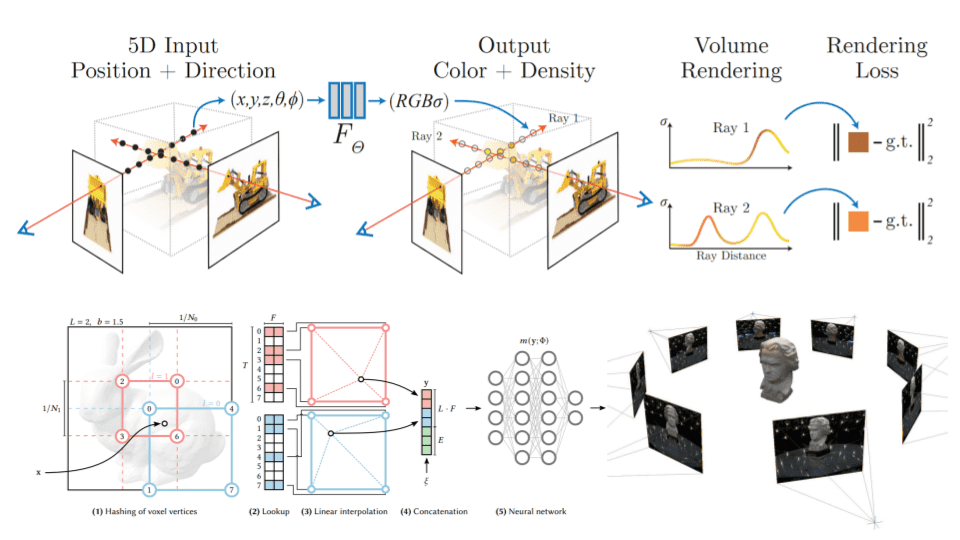
NeRF represents a scene using a continuous 5D function, where each point in space (defined by its x, y, z coordinates) and each viewing direction (defined by angles θ and φ) is mapped to a color (RGB) and a volume density. This mapping is achieved through a neural network that takes these 5D coordinates as input and predicts the color and density at that point. Here’s how it breaks down:

  • Volume Density: This measure indicates the opaqueness of a point in space. High density suggests a solid object, while low density implies empty space or transparency.
  • Color Output: The predicted color at a point, given a specific viewing direction, accounts for how light interacts with objects in the environment.

When rendering an image, NeRF integrates these predictions along camera rays, a process that simulates how light travels and scatters in a real 3D environment, culminating in photorealistic image synthesis.
Training and Rendering

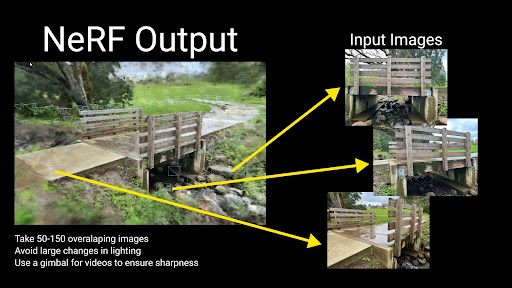
To train a NeRF model, you need a set of images of a scene from various angles, each with its corresponding camera position and orientation. The training process involves adjusting the neural network parameters until the rendered views match the training images as closely as possible. This iterative optimization enables NeRF to interpolate and reconstruct the scene with high fidelity.

During rendering, NeRF computes the color and density for numerous points along each ray emanating from the camera into the scene, aggregating this information to form the final image. This ray-marching process, although computationally intensive, results in images with impressive detail and realism.
Practical Examples and Applications

  1. Virtual Tourism: Imagine exploring a detailed 3D model of the Colosseum in Rome, created from a set of tourist photos. NeRF can generate any viewpoint, allowing users to experience the site from angles never captured in the original photos.
  2. Film and Visual Effects: In filmmaking, NeRF can help generate realistic backgrounds or virtual sets from a limited set of reference photos, significantly reducing the need for physical sets or extensive location shooting.
  3. Cultural Heritage Preservation: By capturing detailed 3D models of historical sites or artifacts from photographs, NeRF aids in preserving and studying these treasures, making them accessible for virtual exploration.
  4. Product Visualization: Companies can use NeRF to create realistic 3D models of their products from a series of photographs, enabling interactive customer experiences online, such as viewing the product from any angle or in different lighting conditions.

Key Concepts in Neural Radiance Fields (NeRF)

To understand Neural Radiance Fields (NeRF) thoroughly, it is essential to grasp its foundational concepts and appreciate how these principles translate into the generation of photorealistic 3D scenes. Below, we delve deeper into the key concepts of NeRF, providing examples to elucidate their practical significance.

Scene Representation

NeRF models a scene using a continuous, high-dimensional function that encodes the volumetric density and color information at every point in space, relative to the viewer’s perspective.

  • Example: Consider a NeRF model creating a 3D representation of a forest. For each point in space, whether on the surface of a tree trunk, within its canopy, or in the open air, the model assigns both a density (indicating whether the point contributes to the scene’s geometry) and a color (reflecting the appearance under particular lighting conditions). This detailed encoding allows for the realistic rendering of the forest from any viewpoint, capturing the nuances of light filtering through leaves or the texture of the bark on the trees.

Photorealism

NeRF’s ability to synthesize highly realistic images from any perspective is one of its most compelling attributes, driven by its precise modeling of light interactions within a scene.

  • Example: If a NeRF model is applied to replicate a glass sculpture, it would capture how light bends through the glass and the subtle color shifts resulting from its interaction with the material. The end result is a set of images so detailed and accurate that viewers might struggle to differentiate them from actual photographs of the sculpture.

Efficiency

Despite the high computational load required during the training phase, once a NeRF model is trained, it can render new views of a scene relatively quickly and with fewer resources compared to traditional 3D rendering techniques.

  • Example: After a NeRF model has been trained on a dataset of a car, it can generate new views of this car from angles not included in the original dataset, without the need to re-render the model entirely from scratch. This capability is particularly valuable for applications like virtual showrooms, where potential buyers can explore a vehicle from any angle or lighting condition, all generated with minimal delay.

Continuous View Synthesis

NeRF excels at creating smooth transitions between different viewpoints in a scene, providing a seamless viewing experience that traditional 3D models struggle to match.

  • Example: In a virtual house tour powered by NeRF, as the viewer moves from room to room, the transitions are smooth and realistic, with no abrupt changes in texture or lighting. This continuous view synthesis not only enhances the realism but also makes the virtual tour more engaging and immersive.

Handling of Complex Lighting and Materials

NeRF’s nuanced understanding of light and material interaction enables it to handle complex scenarios like transparency, reflections, and shadows with a high degree of realism.

  • Example: When rendering a scene with a pond, NeRF accurately models the reflections of surrounding trees and the sky in the water, the transparency of the water with varying depths, and the play of light and shadow on the pond’s bed, providing a remarkably lifelike representation.

The key concepts of NeRF—scene representation, photorealism, efficiency, continuous view synthesis, and advanced handling of lighting and materials—are what empower this technology to create stunningly realistic 3D environments from a set of 2D images. By understanding these concepts, technologists and content creators can better appreciate the potential applications and implications of NeRF, from virtual reality and filmmaking to architecture and beyond. As NeRF continues to evolve, its role in shaping the future of digital content and experiences is likely to expand, offering ever more immersive and engaging ways to interact with virtual worlds.

Advancements in Text-to-Video AI

Parallel to the developments in NeRF, text-to-video AI technologies are transforming the content landscape by enabling creators to generate video content directly from textual descriptions. This capability leverages advanced natural language processing and deep learning techniques to understand and visualize complex narratives, scenes, and actions described in text, translating them into engaging video content.

Integration with NeRF:

  • Dynamic Content Generation: Combining NeRF with text-to-video AI allows creators to generate realistic 3D environments that can be seamlessly integrated into video narratives, all driven by textual descriptions.
  • Customization and Flexibility: Content creators can use natural language to specify details about environments, characters, and actions, which NeRF and text-to-video AI can then bring to life with high fidelity.

OpenAI’s Sora: A Case Study in NeRF and Text-to-Video AI Convergence

OpenAI’s Sora exemplifies the integration of NeRF and text-to-video AI, illustrating the potential of these technologies to revolutionize content creation. Sora leverages NeRF to create detailed, realistic 3D environments from textual inputs, which are then animated and rendered into dynamic video content using text-to-video AI algorithms.

OpenAI Sora: SUV in The Dust

Implications for Content Creators:

  • Enhanced Realism: Sora enables the production of videos with lifelike environments and characters, raising the bar for visual quality and immersion.
  • Efficiency: By automating the creation of complex scenes and animations, Sora reduces the time and resources required to produce high-quality video content.
  • Accessibility: With Sora, content creators do not need deep technical expertise in 3D modeling or animation to create compelling videos, democratizing access to advanced content creation tools.

Conclusion

The integration of NeRF and text-to-video AI, as demonstrated by OpenAI’s Sora, marks a significant milestone in the evolution of content creation technology. It offers content creators unparalleled capabilities to produce realistic, engaging, and personalized video content efficiently and at scale.

As we look to the future, the continued advancement of these technologies will further expand the possibilities for creative expression and storytelling, enabling creators to bring even the most ambitious visions to life. For junior practitioners and seasoned professionals alike, understanding the potential and applications of NeRF and text-to-video AI is essential for staying at the forefront of the digital content creation revolution.

In conclusion, the convergence of NeRF and text-to-video AI is not just a technical achievement; it represents a new era in storytelling, where the barriers between imagination and reality are increasingly blurred. For content creators and consumers alike, this is a journey just beginning, promising a future rich with possibilities that are as limitless as our creativity.
Unveiling the Future: Gaussian Splatting in Text-to-Video AI

Introduction

In the rapidly evolving landscape of artificial intelligence, the introduction of text-to-video AI technologies marks a significant milestone. We highlighted the introduction and advancement of OpenAI’s product suite with their introduction of Sora (text-to-video) in our previous post. Embedded in these products, and typically without a lot of marketing fanfare are the technologies that continually drive this innovation and specifically one of them, Gaussian splatting, has emerged as a pivotal technique. This blog post delves into the intricacies of Gaussian splatting, its integration with current AI prompt technology, and its crucial role in enhancing content creation through text-to-video AI. Our aim is to provide a comprehensive understanding of this technology, making it accessible not only to seasoned professionals but also to junior practitioners eager to grasp the future of AI-driven content creation. Additionally, a companion technology is often discussed hand-in-hand with Gaussian splatting and that is called, Neural Radiance Fields (NeRF) and we will dive into that topic in a future post.

Understanding Gaussian Splatting

Gaussian splatting is a sophisticated technique used in the realm of computer graphics and image processing. It involves the use of Gaussian functions to simulate the effects of splatting or scattering light and particles. This method is particularly effective in creating realistic textures and effects in digital images by smoothly blending colors and intensities.

In the context of AI, Gaussian splatting plays a fundamental role in generating high-quality, realistic images and videos from textual descriptions. The technique allows for the seamless integration of various elements within a scene, ensuring that the generated visuals are not only convincing but also aesthetically pleasing.

Gaussian splatting, as a technique, is integral to many advanced computer graphics and image processing applications, particularly those involving the generation of realistic textures, lighting, and smooth transitions between visual elements. In the context of AI-driven platforms like OpenAI’s Sora, which is designed to generate video content from text prompts, Gaussian splatting and similar techniques are foundational to achieving high-quality, realistic outputs.

Is Gaussian Splatting Automatically Embedded?

In products like Sora, Gaussian splatting and other advanced image processing techniques are typically embedded within the AI models themselves. These models are trained on vast datasets that include examples of realistic textures, lighting effects, and color transitions, learning how to replicate these effects in generated content. This means that the application of Gaussian splatting is automatic and integrated into the content generation process, requiring no manual intervention from the user.

Understanding the Role of Gaussian Splatting in AI Products

For AI-driven content creation tools:

  • Automatic Application: Advanced techniques like Gaussian splatting are embedded within the AI’s algorithms, ensuring that the generated images, videos, or other visual content automatically include these effects for realism and visual appeal.
  • No Manual Requirement: Users do not need to apply Gaussian splatting or similar techniques manually. The focus is on inputting creative prompts, while the AI handles the complex task of rendering realistic outputs based on its training and built-in processing capabilities.
  • Enhanced Quality and Realism: The integration of such techniques is crucial for achieving the high quality and realism that users expect from AI-generated content. It enables the creation of visuals that are not just technically impressive but also emotionally resonant and engaging.

Expanding on Gaussian Splatting

Visually Understanding Gaussian Splatting

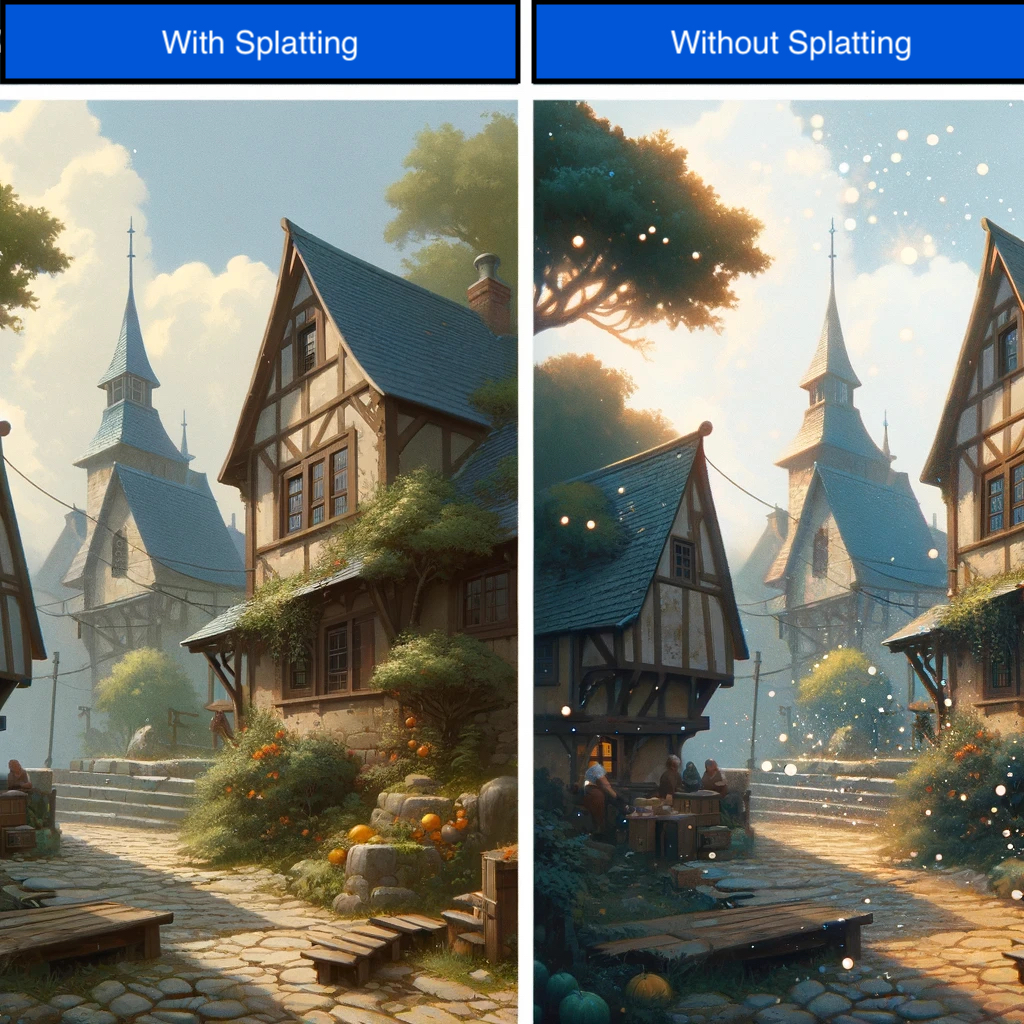
To deepen your understanding of Gaussian splatting, let’s examine an illustrative comparison. This illustration contrasts a scene with Gaussian splatting against one where Gaussian splatting is not applied. In the later, you’ll notice harsh transitions and unrealistic blending of elements, resulting in a scene that feels disjointed and artificial. Conversely, the scene employing Gaussian splatting showcases smooth color transitions and realistic effects, significantly enhancing the visual realism and aesthetic appeal.

Example: Enhancing Realism in Digital Imagery

Consider a sunset beach scene where people are walking along the shore. Without Gaussian splatting, the sunlight’s diffusion, shadows cast by the people, and the blending of the sky’s colors could appear abrupt and unnatural. The transitions between different elements of the scene might be too stark, detracting from the overall realism.

Now, apply Gaussian splatting to the same scene. This technique uses Gaussian functions to simulate the natural diffusion of light and the soft blending of colors. The result is a more lifelike representation of the sunset, with gently blended skies and realistically rendered shadows on the sand. The people walking on the beach are integrated into the scene seamlessly, with their outlines and the surrounding environment blending in a way that mimics the natural observation of such a scene.

This visual and example highlight the significance of Gaussian splatting in creating digital images and videos that are not just visually appealing but also convincingly realistic. By understanding and applying this technique, content creators can push the boundaries of digital realism, making artificial scenes indistinguishable from real-life observations.

The Advent of Text-to-Video AI

Text-to-video AI represents the next leap in content creation, enabling users to generate complex video content from simple text prompts. This technology leverages deep learning models to interpret textual descriptions and translate them into dynamic visual narratives. The process encompasses a wide range of tasks, including scene composition, object placement, motion planning, and the rendering of realistic textures and lighting effects.

Gaussian splatting becomes instrumental in this process, particularly in the rendering phase, where it ensures that the visual elements are blended naturally. It contributes to the realism and dynamism of the generated videos, making the technology invaluable for content creators seeking to produce high-quality visual content efficiently.

Integration with AI Prompt Technology

The integration of Gaussian splatting with AI prompt technology is a cornerstone of text-to-video AI systems. AI prompt technology refers to the mechanisms by which users can instruct AI models using natural language. These prompts are then interpreted by the AI to generate content that aligns with the user’s intent.

In the case of text-to-video AI, Gaussian splatting is employed to refine the visual output based on the textual prompts. For example, if a prompt describes a sunset scene with people walking on the beach, Gaussian splatting helps in creating the soft transitions of the sunset’s colors and the realistic blending of the people’s shadows on the sand. This ensures that the final video output closely matches the scene described in the prompt, with natural-looking effects and transitions.

OpenAI’s Sora: A Case Study in Innovation

OpenAI’s Sora stands as a testament to the potential of integrating Gaussian splatting with text-to-video AI. Sora is designed to offer content creators a powerful tool for generating high-quality video content directly from text descriptions. The platform utilizes advanced AI models, including those trained on Gaussian splatting techniques, to produce videos that are not only visually stunning but also deeply engaging.

The significance of Gaussian splatting in Sora’s technology stack cannot be overstated. It allows Sora to achieve a level of visual fidelity and realism that sets a new standard for AI-generated content. This makes Sora an invaluable asset for professionals in marketing, and digital content creation, who can leverage the platform to create compelling visual narratives with minimal effort.

Key Topics for Discussion and Understanding

To fully appreciate the impact of Gaussian splatting in text-to-video AI, several key topics warrant discussion:

  • Realism and Aesthetics: Understanding how Gaussian splatting contributes to the realism and aesthetic quality of AI-generated videos.
  • Efficiency in Content Creation: Exploring how this technology streamlines the content creation process, enabling faster production times without compromising on quality.
  • AI Prompt Technology: Delving into the advancements in AI prompt technology that make it possible to accurately translate text descriptions into complex visual content.
  • Applications and Implications: Considering the broad range of applications for text-to-video AI and the potential implications for industries such as marketing, entertainment, and education.

Conclusion

Gaussian splatting represents a critical technological advancement in the field of text-to-video AI, offering unprecedented opportunities for content creators. By understanding this technology and its integration with AI prompt technology, professionals can harness the power of platforms like OpenAI’s Sora to revolutionize the way visual content is created and consumed. As we look to the future, the potential of Gaussian splatting in enhancing digital transformation and customer experience through AI-driven content creation is immense, promising a new era of creativity and innovation in the digital landscape.

The Inevitable Disruption of Text-to-Video AI for Content Creators: Navigating the Future Landscape

Introduction

On Thursday 02/15/2024 we heard about the latest development from OpenAI – Sora (Text-to-Video AI). The introduction of OpenAI’s Sora into the public marketplace is set to revolutionize the content and media creation landscape over the next five years. This transformation will be driven by Sora’s advanced capabilities in generating, understanding, and processing natural language, as well as its potential for creative content generation. The impact on content creators, media professionals, and the broader ecosystem will be multifaceted, influencing production processes, content personalization, and the overall economics of the media industry.


Transformation of Content Creation Processes

Sora’s advanced AI capabilities can significantly streamline the content creation process, making it more efficient and cost-effective. For writers, journalists, and digital content creators, Sora can offer real-time suggestions, improve drafting efficiency, and provide editing assistance to enhance the quality of the output. This can lead to a reduction in the time and resources required to produce high-quality content, allowing creators to focus more on the creative and strategic aspects of their work.

Personalization and User Engagement

In the realm of media and entertainment, Sora’s ability to analyze and understand audience preferences at a granular level will enable unprecedented levels of content personalization. Media companies can leverage Sora to tailor content to individual user preferences, improving engagement and user satisfaction. This could manifest in personalized news feeds, customized entertainment recommendations, or even dynamically generated content that adapts to the user’s interests and behaviors. Such personalization capabilities are likely to redefine the standards for user experience in digital media platforms. So, let’s dive a bit deeper into how this technology can advance personalization and user engagement within the marketplace.

Examples of Personalization and User Engagement

1. Personalized News Aggregation:

  • Pros: Platforms can use Sora to curate news content tailored to the individual interests and reading habits of each user. For example, a user interested in technology and sustainability might receive a news feed focused on the latest in green tech innovations, while someone interested in finance and sports might see articles on sports economics. This not only enhances user engagement but also increases the time spent on the platform.
  • Cons: Over-personalization can lead to the creation of “filter bubbles,” where users are exposed only to viewpoints and topics that align with their existing beliefs and interests. This can narrow the diversity of content consumed and potentially exacerbate societal divisions.

2. Customized Learning Experiences:

  • Pros: Educational platforms can leverage Sora to adapt learning materials to the pace and learning style of each student. For instance, a visual learner might receive more infographic-based content, while a verbal learner gets detailed textual explanations. This can improve learning outcomes and student engagement.
  • Cons: There’s a risk of over-reliance on automated personalization, which might overlook the importance of exposing students to challenging materials that are outside their comfort zones, potentially limiting their learning scope.

3. Dynamic Content Generation for Entertainment:

  • Pros: Streaming services can use Sora to dynamically alter storylines, music, or visual elements based on user preferences. For example, a streaming platform could offer multiple storyline outcomes in a series, allowing users to experience a version that aligns with their interests or past viewing behaviors.
  • Cons: This level of personalization might reduce the shared cultural experiences that traditional media offers, as audiences fragment across personalized content paths. It could also challenge creators’ artistic visions when content is too heavily influenced by algorithms.

4. Interactive Advertising:

  • Pros: Advertisers can utilize Sora to create highly targeted and interactive ad content that resonates with the viewer’s specific interests and behaviors, potentially increasing conversion rates. For example, an interactive ad could adjust its message or product recommendations in real-time based on how the user interacts with it.
  • Cons: Highly personalized ads raise privacy concerns, as they rely on extensive data collection and analysis of user behavior. There’s also the risk of user fatigue if ads become too intrusive or overly personalized, leading to negative brand perceptions.

Navigating the Pros and Cons

To maximize the benefits of personalization while mitigating the downsides, content creators and platforms need to adopt a balanced approach. This includes:

  • Transparency and Control: Providing users with clear information about how their data is used for personalization and offering them control over their personalization settings.
  • Diversity and Exposure: Implementing algorithms that occasionally introduce content outside of the user’s usual preferences to broaden their exposure and prevent filter bubbles.
  • Ethical Data Use: Adhering to ethical standards for data collection and use, ensuring user privacy is protected, and being transparent about data handling practices.

While Sora’s capabilities in personalization and user engagement offer exciting opportunities for content and media creation, they also come with significant responsibilities. Balancing personalization benefits with the need for privacy, diversity, and ethical considerations will be key to harnessing this technology effectively.


Expansion of Creative Possibilities

Sora’s potential to generate creative content opens up new possibilities for media creators. This includes the creation of written content, such as articles, stories, and scripts, as well as the generation of artistic elements like graphics, music, and video content. By augmenting human creativity, Sora can help creators explore new ideas, themes, and formats, potentially leading to the emergence of new genres and forms of media. This democratization of content creation could also lower the barriers to entry for aspiring creators, fostering a more diverse and vibrant media landscape. We will dive a bit deeper into these creative possibilities by exploring the Pros and Cons.

Pros:

  • Enhanced Creative Tools: Sora can act as a powerful tool for creators, offering new ways to generate ideas, draft content, and even create complex narratives. For example, a novelist could use Sora to brainstorm plot ideas or develop character backstories, significantly speeding up the writing process and enhancing the depth of their stories.
  • Accessibility to Creation: With Sora, individuals who may not have traditional artistic skills or technical expertise can participate in creative endeavors. For instance, someone with a concept for a graphic novel but without the ability to draw could use Sora to generate visual art, making creative expression more accessible to a broader audience.
  • Innovative Content Formats: Sora’s capabilities could lead to the creation of entirely new content formats that blend text, visuals, and interactive elements in ways previously not possible. Imagine an interactive educational platform where content dynamically adapts to each student’s learning progress and interests, offering a highly personalized and engaging learning experience.

Cons:

  • Potential for Diminished Human Creativity: There’s a concern that over-reliance on AI for creative processes could diminish the value of human creativity. If AI-generated content becomes indistinguishable from human-created content, it could devalue original human artistry and creativity in the public perception.
  • Intellectual Property and Originality Issues: As AI-generated content becomes more prevalent, distinguishing between AI-assisted and purely human-created content could become challenging. This raises questions about copyright, ownership, and the originality of AI-assisted works. For example, if a piece of music is composed with the help of Sora, determining the rights and ownership could become complex.
  • Homogenization of Content: While AI like Sora can generate content based on vast datasets, there’s a risk that it might produce content that leans towards what is most popular or trending, potentially leading to a homogenization of content. This could stifle diversity in creative expression and reinforce existing biases in media and art.

Navigating the Pros and Cons

To harness the creative possibilities of Sora while addressing the challenges, several strategies can be considered:

  • Promoting Human-AI Collaboration: Encouraging creators to use Sora as a collaborative tool rather than a replacement for human creativity can help maintain the unique value of human artistry. This approach leverages AI to enhance and extend human capabilities, not supplant them.
  • Clear Guidelines for AI-generated Content: Developing industry standards and ethical guidelines for the use of AI in creative processes can help address issues of copyright and originality. This includes transparently acknowledging the use of AI in the creation of content.
  • Diversity and Bias Mitigation: Actively working to ensure that AI models like Sora are trained on diverse datasets and are regularly audited for bias can help prevent the homogenization of content and promote a wider range of voices and perspectives in media and art.

Impact on the Economics of Media Production

The efficiencies and capabilities introduced by Sora are likely to have profound implications for the economics of media production. Reduced production costs and shorter development cycles can make content creation more accessible and sustainable, especially for independent creators and smaller media outlets. However, this could also lead to increased competition and a potential oversaturation of content, challenging creators to find new ways to stand out and monetize their work. While this topic is always considered sensitive, if we can look at it from pro versus con perspective, perhaps we can address it with a neutral focus.

Impact on Cost Structures

Pros:

  • Reduced Production Costs: Sora can automate aspects of content creation, such as writing, editing, and even some elements of video production, reducing the need for large production teams and lowering costs. For example, a digital news outlet could use Sora to generate first drafts of articles based on input data, allowing journalists to focus on adding depth and context, thus speeding up the production process and reducing labor costs.
  • Efficiency in Content Localization: Media companies looking to expand globally can use Sora to automate the translation and localization of content, making it more cost-effective to reach international audiences. This could significantly lower the barriers to global content distribution.

Cons:

  • Initial Investment and Training: The integration of Sora into media production workflows requires upfront investment in technology and training for staff. Organizations may face challenges in adapting existing processes to leverage AI capabilities effectively, which could initially increase costs.
  • Dependence on AI: Over-reliance on AI for content production could lead to a homogenization of content, as algorithms might favor formats and topics that have historically performed well, potentially stifacing creativity and innovation.

Impact on Revenue Models

Pros:

  • New Monetization Opportunities: Sora enables the creation of personalized content at scale, opening up new avenues for monetization. For instance, media companies could offer premium subscriptions for highly personalized news feeds or entertainment content, adding a new revenue stream.
  • Enhanced Ad Targeting: The deep understanding of user preferences and behaviors facilitated by Sora can improve ad targeting, leading to higher ad revenues. For example, a streaming service could use viewer data analyzed by Sora to place highly relevant ads, increasing viewer engagement and advertiser willingness to pay.

Cons:

  • Shift in Consumer Expectations: As consumers get accustomed to personalized and AI-generated content, they might become less willing to pay for generic content offerings. This could pressure media companies to continuously invest in AI to keep up with expectations, potentially eroding profit margins.
  • Ad Blockers and Privacy Tools: The same technology that allows for enhanced ad targeting might also lead to increased use of ad blockers and privacy tools by users wary of surveillance and data misuse, potentially impacting ad revenue.

Impact on the Competitive Landscape

Pros:

  • Level Playing Field for Smaller Players: Sora can democratize content production, allowing smaller media companies and independent creators to produce high-quality content at a lower cost. This could lead to a more diverse media landscape with a wider range of voices and perspectives.
  • Innovation and Differentiation: Companies that effectively integrate Sora into their production processes can innovate faster and differentiate their offerings, capturing market share from competitors who are slower to adapt.

Cons:

  • Consolidation Risk: Larger companies with more resources to invest in AI could potentially dominate the market, leveraging Sora to produce content more efficiently and at a larger scale than smaller competitors. This could lead to consolidation in the media industry, reducing diversity in content and viewpoints.

Navigating the Pros and Cons

To effectively navigate these economic impacts, media companies and content creators need to:

  • Invest in skills and training to ensure their teams can leverage AI tools like Sora effectively.
  • Develop ethical guidelines and transparency around the use of AI in content creation to maintain trust with audiences.
  • Explore innovative revenue models that leverage the capabilities of AI while addressing consumer concerns about privacy and data use.

Ethical and Societal Considerations

As Sora influences the content and media industry, ethical and societal considerations will come to the forefront. Issues such as copyright, content originality, misinformation, and the impact of personalized content on societal discourse will need to be addressed. Media creators and platforms will have to navigate these challenges carefully, establishing guidelines and practices that ensure responsible use of AI in content creation while fostering a healthy, informed, and engaged public discourse.

Conclusion

Over the next five years, OpenAI’s Sora is poised to significantly impact the content and media creation industry by enhancing creative processes, enabling personalized experiences, and transforming the economics of content production. As these changes unfold, content and media professionals will need to adapt to the evolving landscape, leveraging Sora’s capabilities to enhance creativity and engagement while addressing the ethical and societal implications of AI-driven content creation.