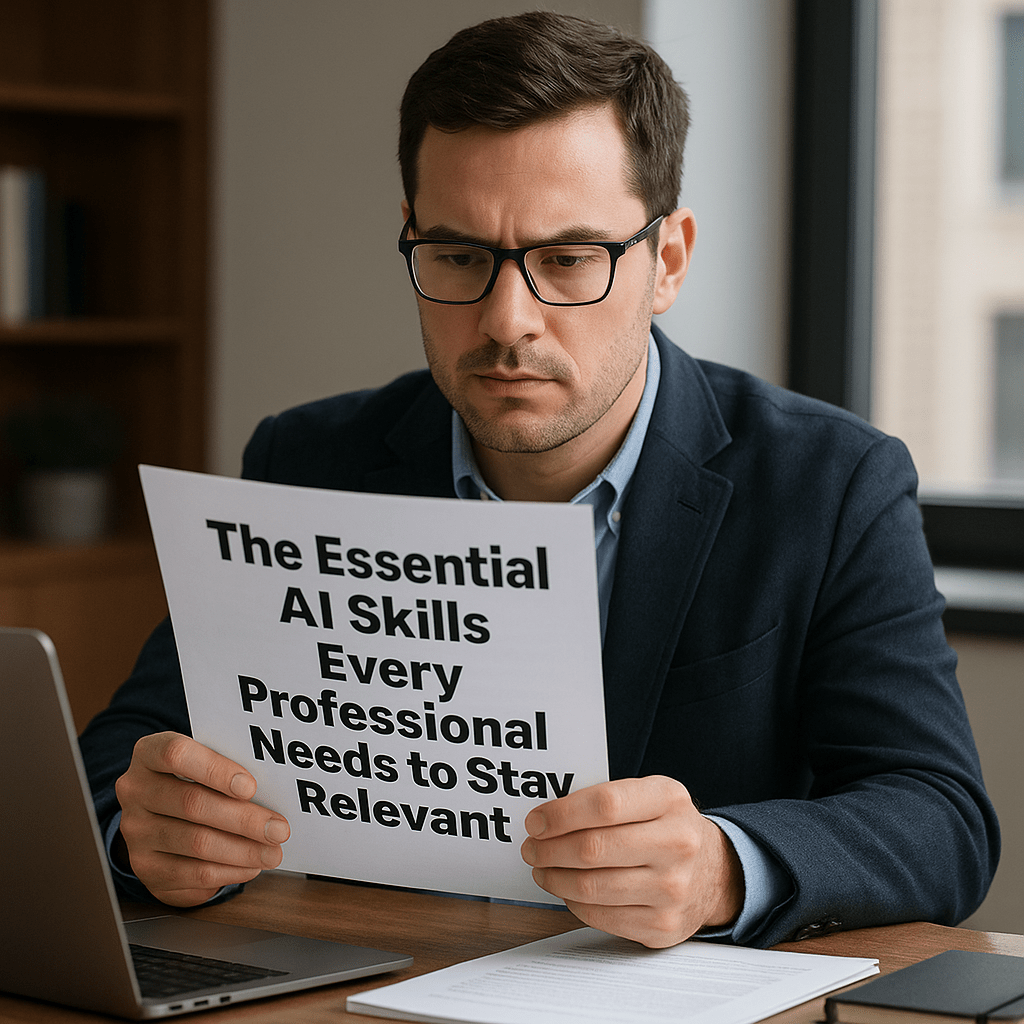
Artificial Intelligence (AI) is no longer an optional “nice-to-know” for professionals—it has become a baseline skill set, similar to email in the 1990s or spreadsheets in the 2000s. Whether you’re in marketing, operations, consulting, design, or management, your ability to navigate AI tools and concepts will influence your value in an organization. But here’s the catch: knowing about AI is very different from knowing how to use it effectively and responsibly.
If you’re trying to build credibility as someone who can bring AI into your work in a meaningful way, there are four foundational skill sets you should focus on: terminology and tools, ethical use, proven application, and discernment of AI’s strengths and weaknesses. Let’s break these down in detail.
1. Build a Firm Grasp of AI Terminology and Tools
If you’ve ever sat in a meeting where “transformer models,” “RAG pipelines,” or “vector databases” were thrown around casually, you know how intimidating AI terminology can feel. The good news is that you don’t need a PhD in computer science to keep up. What you do need is a working vocabulary of the most commonly used terms and a sense of which tools are genuinely useful versus which are just hype.
Learn the language. Know what “machine learning,” “large language models (LLMs),” and “generative AI” mean. Understand the difference between supervised vs. unsupervised learning, or between predictive vs. generative AI. You don’t need to be an expert in the math, but you should be able to explain these terms in plain language.
Track the hype cycle. Tools like ChatGPT, MidJourney, Claude, Perplexity, and Runway are popular now. Tomorrow it may be different. Stay aware of what’s gaining traction, but don’t chase every shiny new app—focus on what aligns with your work.
Experiment regularly. Spend time actually using these tools. Reading about them isn’t enough; you’ll gain more credibility by being the person who can say, “I tried this last week, here’s what worked, and here’s what didn’t.”
The professionals who stand out are the ones who can translate the jargon into everyday language for their peers and point to tools that actually solve problems.
Why it matters: If you can translate AI jargon into plain English, you become the bridge between technical experts and business leaders.
Examples:
A marketer who understands “vector embeddings” can better evaluate whether a chatbot project is worth pursuing.
A consultant who knows the difference between supervised and unsupervised learning can set more realistic expectations for a client project.
To-Do’s (Measurable):
Learn 10 core AI terms (e.g., LLM, fine-tuning, RAG, inference, hallucination) and practice explaining them in one sentence to a non-technical colleague.
Test 3 AI tools outside of ChatGPT or MidJourney (try Perplexity for research, Runway for video, or Jasper for marketing copy).
Track 1 emerging tool in Gartner’s AI Hype Cycle and write a short summary of its potential impact for your industry.
2. Develop a Clear Sense of Ethical AI Use
AI is a productivity amplifier, but it also has the potential to become a shortcut for avoiding responsibility. Organizations are increasingly aware of this tension. On one hand, AI can help employees save hours on repetitive work; on the other, it can enable people to “phone in” their jobs by passing off machine-generated output as their own.
To stand out in your workplace:
Draw the line between productivity and avoidance. If you use AI to draft a first version of a report so you can spend more time refining insights—that’s productive. If you copy-paste AI-generated output without review—that’s shirking.
Be transparent. Many companies are still shaping their policies on AI disclosure. Until then, err on the side of openness. If AI helped you get to a deliverable faster, acknowledge it. This builds trust.
Know the risks. AI can hallucinate facts, generate biased responses, and misrepresent sources. Ethical use means knowing where these risks exist and putting safeguards in place.
Being the person who speaks confidently about responsible AI use—and who models it—positions you as a trusted resource, not just another tool user.
Why it matters: AI can either build trust or erode it, depending on how transparently you use it.
Examples:
A financial analyst discloses that AI drafted an initial market report but clarifies that all recommendations were human-verified.
A project manager flags that an AI scheduling tool systematically assigns fewer leadership roles to women—and brings it up to leadership as a fairness issue.
To-Do’s (Measurable):
Write a personal disclosure statement (2–3 sentences) you can use when AI contributes to your work.
Identify 2 use cases in your role where AI could cause ethical concerns (e.g., bias, plagiarism, misuse of proprietary data). Document mitigation steps.
Stay current with 1 industry guideline (like NIST AI Risk Management Framework or EU AI Act summaries) to show awareness of standards.
3. Demonstrate Experience Beyond Text and Images
For many people, AI is synonymous with ChatGPT for writing and MidJourney or DALL·E for image generation. But these are just the tip of the iceberg. If you want to differentiate yourself, you need to show experience with AI in broader, less obvious applications.
Examples include:
Data analysis: Using AI to clean, interpret, or visualize large datasets.
Process automation: Leveraging tools like UiPath or Zapier AI integrations to cut repetitive steps out of workflows.
Customer engagement: Applying conversational AI to improve customer support response times.
Decision support: Using AI to run scenario modeling, market simulations, or forecasting.
Employers want to see that you understand AI not only as a creativity tool but also as a strategic enabler across functions.
Why it matters: Many peers will stop at using AI for writing or graphics—you’ll stand out by showing how AI adds value to operational, analytical, or strategic work.
Examples:
A sales ops analyst uses AI to cleanse CRM data, improving pipeline accuracy by 15%.
An HR manager automates resume screening with AI but layers human review to ensure fairness.
To-Do’s (Measurable):
Document 1 project where AI saved measurable time or improved accuracy (e.g., “AI reduced manual data entry from 10 hours to 2”).
Explore 2 automation tools like UiPath, Zapier AI, or Microsoft Copilot, and create one workflow in your role.
Present 1 short demo to your team on how AI improved a task outside of writing or design.
4. Know Where AI Shines—and Where It Falls Short
Perhaps the most valuable skill you can bring to your organization is discernment: understanding when AI adds value and when it undermines it.
AI is strong at:
Summarizing large volumes of information quickly.
Generating creative drafts, brainstorming ideas, and producing “first passes.”
Identifying patterns in structured data faster than humans can.
AI struggles with:
Producing accurate, nuanced analysis in complex or ambiguous situations.
Handling tasks that require deep empathy, cultural sensitivity, or lived experience.
Delivering error-free outputs without human oversight.
By being clear on the strengths and weaknesses, you avoid overpromising what AI can do for your organization and instead position yourself as someone who knows how to maximize its real capabilities.
Why it matters: Leaders don’t just want enthusiasm—they want discernment. The ability to say, “AI can help here, but not there,” makes you a trusted voice.
Examples:
A consultant leverages AI to summarize 100 pages of regulatory documents but refuses to let AI generate final compliance interpretations.
A customer success lead uses AI to draft customer emails but insists that escalation communications be written entirely by a human.
To-Do’s (Measurable):
Make a two-column list of 5 tasks in your role where AI is high-value (e.g., summarization, analysis) vs. 5 where it is low-value (e.g., nuanced negotiations).
Run 3 experiments with AI on tasks you think it might help with, and record performance vs. human baseline.
Create 1 slide or document for your manager/team outlining “Where AI helps us / where it doesn’t.”
Final Thought: Standing Out Among Your Peers
AI skills are not about showing off your technical expertise—they’re about showing your judgment. If you can:
Speak the language of AI and use the right tools,
Demonstrate ethical awareness and transparency,
Prove that your applications go beyond the obvious, and
Show wisdom in where AI fits and where it doesn’t,
…then you’ll immediately stand out in the workplace.
The professionals who thrive in the AI era won’t be the ones who know the most tools—they’ll be the ones who know how to use them responsibly, strategically, and with impact.
This week we heard that Meta Boss (Mark Zuckerberg) was all-in on AGI, while some are terrified by the concept and others simply intrigued, does the average technology enthusiast fully appreciate what this means? As part of our vision to bring readers up-to-speed on the latest technology trends, we thought a post about this topic is warranted. Artificial General Intelligence (AGI), also known as ‘strong AI,’ represents the theoretical form of artificial intelligence that can understand, learn, and apply its intelligence broadly and flexibly, akin to human intelligence. Unlike Narrow AI, which is designed to perform specific tasks (like language translation or image recognition), AGI can tackle a wide range of tasks and solve them with human-like adaptability.
Artificial General Intelligence (AGI) represents a paradigm shift in the realm of artificial intelligence. It’s a concept that extends beyond the current applications of AI, promising a future where machines can understand, learn, and apply their intelligence in an all-encompassing manner. To fully grasp the essence of AGI, it’s crucial to delve into its foundational concepts, distinguishing it from existing AI forms, and exploring its potential capabilities.
Defining AGI
At its core, AGI is the theoretical development of machine intelligence that mirrors the multi-faceted and adaptable nature of human intellect. Unlike narrow or weak AI, which is designed for specific tasks such as playing chess, translating languages, or recommending products online, AGI is envisioned to be a universal intelligence system. This means it could excel in a vast array of activities – from composing music to making scientific breakthroughs, all while adapting its approach based on the context and environment. The realization of AGI could lead to unprecedented advancements in various fields. It could revolutionize healthcare by providing personalized medicine, accelerate scientific discoveries, enhance educational methods, and even aid in solving complex global challenges such as climate change and resource management.
Key Characteristics of AGI
Adaptability:
AGI can transfer learning and adapt to new and diverse tasks without needing reprogramming.
Requirement: Dynamic Learning Systems
For AGI to adapt to a variety of tasks, it requires dynamic learning systems that can adjust and respond to changing environments and objectives. This involves creating algorithms capable of unsupervised learning and self-modification.
Development Approach:
Reinforcement Learning: AGI models could be trained using advanced reinforcement learning, where the system learns through trial and error, adapting its strategies based on feedback.
Continuous Learning: Developing models that continuously learn and evolve without forgetting previous knowledge (avoiding the problem of catastrophic forgetting).
Understanding and Reasoning:
AGI would be capable of comprehending complex concepts and reasoning through problems like a human.
Requirement: Advanced Cognitive Capabilities
AGI must possess cognitive capabilities that allow for deep understanding and logical reasoning. This involves the integration of knowledge representation and natural language processing at a much more advanced level than current AI.
Development Approach:
Symbolic AI: Incorporating symbolic reasoning, where the system can understand and manipulate symbols rather than just processing numerical data.
Hybrid Models: Combining connectionist approaches (like neural networks) with symbolic AI to enable both intuitive and logical reasoning.
Autonomous Learning:
Unlike current AI, which often requires large datasets for training, AGI would be capable of learning from limited data, much like humans do.
Requirement: Minimized Human Intervention
For AGI to learn autonomously, it must do so with minimal human intervention. This means developing algorithms that can learn from smaller datasets and generate their hypotheses and experiments.
Development Approach:
Meta-learning: Creating systems that can learn how to learn, allowing them to acquire new skills or adapt to new environments rapidly.
Self-supervised Learning: Implementing learning paradigms where the system generates its labels or learning criteria based on the intrinsic structure of the data.
Generalization and Transfer Learning:
The ability to apply knowledge gained in one domain to another seamlessly.
Requirement: Cross-Domain Intelligence
AGI must be capable of transferring knowledge and skills across various domains, a significant step beyond the capabilities of current machine learning models.
Development Approach:
Broad Data Exposure: Exposing the model to a wide range of data across different domains.
Cross-Domain Architectures: Designing neural network architectures that can identify and apply abstract patterns and principles across different fields.
Emotional and Social Intelligence:
A futuristic aspect of AGI is to understand and interpret human emotions and social cues, allowing for more natural interactions.
Requirement: Human-Like Interaction Capabilities
Developing AGI with emotional and social intelligence requires an understanding of human emotions, social contexts, and the ability to interpret these in a meaningful way.
Development Approach:
Emotion AI: Integrating affective computing techniques to recognize and respond to human emotions.
Social Simulation: Training models in simulated social environments to understand and react to complex social dynamics.
AGI vs. Narrow AI
To appreciate AGI, it’s essential to understand its contrast with Narrow AI:
Narrow AI: Highly specialized in particular tasks, operates within a pre-defined range, and lacks the ability to perform beyond its programming.
AGI: Not restricted to specific tasks, mimics human cognitive abilities, and can generalize its intelligence across a wide range of domains.
Artificial General Intelligence (AGI) and Narrow AI represent fundamentally different paradigms within the field of artificial intelligence. Narrow AI, also known as “weak AI,” is specialized and task-specific, designed to handle particular tasks such as image recognition, language translation, or playing chess. It operates within a predefined scope and lacks the ability to perform outside its specific domain. In contrast, AGI, or “strong AI,” is a theoretical form of AI that embodies the ability to understand, learn, and apply intelligence in a broad, versatile manner akin to human cognition. Unlike Narrow AI, AGI is not limited to singular or specific tasks; it possesses the capability to reason, generalize across different domains, learn autonomously, and adapt to new and unforeseen challenges. This adaptability allows AGI to perform a vast array of tasks, from artistic creation to scientific problem-solving, without needing specialized programming for each new task. While Narrow AI excels in its domain with high efficiency, AGI aims to replicate the general-purpose, flexible nature of human intelligence, making it a more universal and adaptable form of AI.
The Philosophical and Technical Challenges
AGI is not just a technical endeavor but also a philosophical one. It raises questions about the nature of consciousness, intelligence, and the ethical implications of creating machines that could potentially match or surpass human intellect. From a technical standpoint, developing AGI involves creating systems that can integrate diverse forms of knowledge and learning strategies, a challenge that is currently beyond the scope of existing AI technologies.
The pursuit of Artificial General Intelligence (AGI) is fraught with both philosophical and technical challenges that present a complex tapestry of inquiry and development. Philosophically, AGI raises profound questions about the nature of consciousness, the ethics of creating potentially sentient beings, and the implications of machines that could surpass human intelligence. This leads to debates around moral agency, the rights of AI entities, and the potential societal impacts of AGI, including issues of privacy, security, and the displacement of jobs. From a technical standpoint, current challenges revolve around developing algorithms capable of generalized understanding and reasoning, far beyond the specialized capabilities of narrow AI. This includes creating models that can engage in abstract thinking, transfer learning across various domains, and exhibit adaptability akin to human cognition. The integration of emotional and social intelligence into AGI systems, crucial for nuanced human-AI interactions, remains an area of ongoing research.
Looking to the near future, we can expect these challenges to deepen as advancements in machine learning, neuroscience, and cognitive psychology converge. As we edge closer to achieving AGI, new challenges will likely emerge, particularly in ensuring the ethical alignment of AGI systems with human values and societal norms, and managing the potential existential risks associated with highly advanced AI. This dynamic landscape makes AGI not just a technical endeavor, but also a profound philosophical and ethical journey into the future of intelligence and consciousness.
The Conceptual Framework of AGI
AGI is not just a step up from current AI systems but a fundamental leap. It involves the development of machines that possess the ability to understand, reason, plan, communicate, and perceive, across a wide variety of domains. This means an AGI system could perform well in scientific research, social interactions, and artistic endeavors, all while adapting to new and unforeseen challenges.
The Journey to Achieving AGI
The journey to achieving Artificial General Intelligence (AGI) is a multifaceted quest that intertwines advancements in methodology, technology, and psychology.
Methodologically, it involves pushing the frontiers of machine learning and AI research to develop algorithms capable of generalized intelligence, far surpassing today’s task-specific models. This includes exploring new paradigms in deep learning, reinforcement learning, and the integration of symbolic and connectionist approaches to emulate human-like reasoning and learning.
Technologically, AGI demands significant breakthroughs in computational power and efficiency, as well as in the development of sophisticated neural networks and data processing capabilities. It also requires innovations in robotics and sensor technology for AGI systems to interact effectively with the physical world.
From a psychological perspective, understanding and replicating the nuances of human cognition is crucial. Insights from cognitive psychology and neuroscience are essential to model the complexity of human thought processes, including consciousness, emotion, and social interaction. Achieving AGI requires a harmonious convergence of these diverse fields, each contributing unique insights and tools to build systems that can truly mimic the breadth and depth of human intelligence. As such, the path to AGI is not just a technical endeavor, but a deep interdisciplinary collaboration that seeks to bridge the gap between artificial and natural intelligence.
The road to AGI is complex and multi-faceted, involving advancements in various fields. Here’s a further breakdown of the key areas:
Methodology: Interdisciplinary Approach
Machine Learning and Deep Learning: The backbone of most AI systems, these methodologies need to evolve to enable more generalized learning.
Cognitive Modeling: Building systems that mimic human thought processes.
Systems Theory: Understanding how to build complex, integrated systems.
Technology: Building Blocks for AGI
Computational Power: AGI will require significantly more computational resources than current AI systems.
Neural Networks and Algorithms: Development of more sophisticated and efficient neural networks.
Robotics and Sensors: For AGI to interact with the physical world, advancements in robotics and sensory technology are crucial.
Psychology: Understanding the Human Mind
Cognitive Psychology: Insights into human learning, perception, and decision-making can guide the development of AGI.
Neuroscience: Understanding the human brain at a detailed level could provide blueprints for AGI architectures.
Ethical and Societal Considerations
AGI raises profound ethical and societal questions. Ensuring the alignment of AGI with human values, addressing the potential impact on employment, and managing the risks of advanced AI are critical areas of focus. The ethical and societal considerations surrounding the development of Artificial General Intelligence (AGI) are profound and multifaceted, encompassing a wide array of concerns and implications.
Ethically, the creation of AGI poses questions about the moral status of such entities, the responsibilities of creators, and the potential for AGI to make decisions that profoundly affect human lives. Issues such as bias, privacy, security, and the potential misuse of AGI for harmful purposes are paramount.
Societally, the advent of AGI could lead to significant shifts in employment, with automation extending to roles traditionally requiring human intelligence, thus necessitating a rethinking of job structures and economic models.
Additionally, the potential for AGI to exacerbate existing inequalities or to be leveraged in ways that undermine democratic processes is a pressing concern. There is also the existential question of how humanity will coexist with beings that might surpass our own cognitive capabilities. Hence, the development of AGI is not just a technological pursuit, but a societal and ethical undertaking that calls for comprehensive dialogue, inclusive policy-making, and rigorous ethical guidelines to ensure that AGI is developed and implemented in a manner that benefits humanity and respects our collective values and rights.
Which is More Crucial: Methodology, Technology, or Psychology?
The development of AGI is not a question of prioritizing one aspect over the other; instead, it requires a harmonious blend of all three. This topic will require additional conversation and discovery, there will be polarization towards each principle, but in the long-term all three will need to be considered if AI ethics is intended to be prioritized.
Methodology: Provides the theoretical foundation and algorithms.
Technology: Offers the practical tools and computational power.
Psychology: Delivers insights into human-like cognition and learning.
The Interconnected Nature of AGI Development
AGI development is inherently interdisciplinary. Advancements in one area can catalyze progress in another. For instance, a breakthrough in neural network design (methodology) could be limited by computational constraints (technology) or may lack the nuanced understanding of human cognition (psychology).
The development of Artificial General Intelligence (AGI) is inherently interconnected, requiring a synergistic integration of diverse disciplines and technologies. This interconnected nature signifies that advancements in one area can significantly impact and catalyze progress in others. For instance, breakthroughs in computational neuroscience can inform more sophisticated AI algorithms, while advances in machine learning methodologies can lead to more effective simulations of human cognitive processes. Similarly, technological enhancements in computing power and data storage are critical for handling the complex and voluminous data required for AGI systems. Moreover, insights from psychology and cognitive sciences are indispensable for embedding human-like reasoning, learning, and emotional intelligence into AGI.
This multidisciplinary approach also extends to ethics and policy-making, ensuring that the development of AGI aligns with societal values and ethical standards. Therefore, AGI development is not a linear process confined to a single domain but a dynamic, integrative journey that encompasses science, technology, humanities, and ethics, each domain interplaying and advancing in concert to achieve the overarching goal of creating an artificial intelligence that mirrors the depth and versatility of human intellect.
Conclusion: The Road Ahead
Artificial General Intelligence (AGI) stands at the frontier of our technological and intellectual pursuits, representing a future where machines not only complement but also amplify human intelligence across diverse domains.
AGI transcends the capabilities of narrow AI, promising a paradigm shift towards machines that can think, learn, and adapt with a versatility akin to human cognition. The journey to AGI is a confluence of advances in computational methods, technological innovations, and deep psychological insights, all harmonized by ethical and societal considerations. This multifaceted endeavor is not just the responsibility of AI researchers and developers; it invites participation and contribution from a wide spectrum of disciplines and perspectives.
Whether you are a technologist, psychologist, ethicist, policymaker, or simply an enthusiast intrigued by the potential of AGI, your insights and contributions are valuable in shaping a future where AGI enhances our world responsibly and ethically. As we stand on the brink of this exciting frontier, we encourage you to delve deeper into the world of AGI, expand your knowledge, engage in critical discussions, and become an active participant in a community that is not just witnessing but also shaping one of the most significant technological advancements of our time.
The path to AGI is as much about the collective journey as it is about the destination, and your voice and contributions are vital in steering this journey towards a future that benefits all of humanity.
In the rapidly evolving landscape of Artificial Intelligence (AI), staying abreast of the terminology is not just beneficial; it’s a necessity. Whether you’re a strategic management consultant, a tech enthusiast, or a business leader steering your organization through digital transformation, understanding AI jargon is pivotal. This comprehensive glossary serves as your guide through the intricate web of AI terminology, offering clear definitions and practical applications of each term.
Why is this important? As AI continues to redefine industries and reshape customer experiences, the language of AI becomes the language of progress. This list isn’t just a collection of terms and abbreviations; it’s a bridge connecting you to a deeper understanding of AI’s role in the modern business landscape. From fundamental concepts to advanced technologies, these terms have been meticulously chosen to enhance your conversational fluency in AI. Whether you’re engaging in strategic discussions, exploring AI solutions, or simply looking to broaden your knowledge, this glossary is an invaluable resource. By no means is this list exhaustive, but it should allow you to build a foundation on terminology and concepts that you can expand upon.
We present these terms in an alphabetized format for easy navigation. Each entry succinctly explains a key concept or technology and illustrates its relevance in real-world applications. This format is designed not only to enrich your understanding but also to be a quick reference tool in your day-to-day professional encounters with AI. As you delve into this list, we encourage you to reflect on how each term applies to your work, your strategies, and your perception of AI’s transformative power in the digital era. To enhance your comprehension of these terms and concepts, we invite you to download and save this article, then simply copy/paste and search the internet on topics that you are interested in, or better yet let the team know via our Substack site what you want us to explore in a future blog post.
AI Terminology
AGI (Artificial General Intelligence)
Definition: A concept that suggests a more advanced version of AI than we know today, where the AI teaches, learns and advances its own capabilities.
Application: AGI can learn and understand any intellectual challenge that a human can and foster advancement in areas such as predictive analytics.
AI (Artificial Intelligence)
Definition: Simulation of human intelligence in machines.
Application: Predictive analytics, chatbots, process automation.
Algorithm
Definition: A series of instructions that allows a computer program to learn and analyze data in a particular way.
Application: Computer programs can recognize patterns and learn from them to accomplish tasks on their own.
ANN (Artificial Neural Network)
Definition: Systems inspired by biological neural networks.
BERT (Bidirectional Encoder Representations from Transformers)
Definition: Transformer-based ML technique for NLP.
Application: Language model understanding.
Bias
Definition: In regards to LLMs, the bias would be errors resulting from the training data such as characteristics of certain types of races or groups based on stereotypes
Application: Practitioners will strive to remove bias from LLMs and their related training data for more accurate results
Big Data
Definition: Large data sets revealing patterns and trends.
Application: Data-driven decision-making.
Blockchain
Definition: A system of recording information that is difficult to change, hack, or cheat.
Application: Enhances AI security, data integrity, and transparency.
Chatbot
Definition: AI software simulating a conversation with users in natural language.
Application: Customer service automation, user interfaces.
CNN (Convolutional Neural Network)
Definition: Deep learning algorithm for image processing.
Application: Image recognition and classification.
Computer Vision (CV)
Definition: AI technology interpreting the visual world.
Application: Image recognition in retail, automated inspection.
CRISP-DM (Cross-Industry Standard Process for Data Mining)
Definition: Process model for data mining approaches.
Application: Structured AI/ML project planning and execution.
DaaS (Data as a Service)
Definition: Cloud-based data access and management.
Application: Streamlining data access for AI applications.
Definition: A method of ML that takes an existing piece of data, like a photo and adds random noise
Application: Diffusion models train their networks to re-engineer or recover the photo (ex. Stable Diffusion, Midjourney apps)
EDA (Event-Driven Architecture)
Definition: Design pattern for event production and reaction.
Application: Real-time data processing in AI systems.
EDA (Exploratory Data Analysis)
Definition: Analyzing data to summarize characteristics.
Application: Initial phase of data projects.
Edge Computing
Definition: Distributed computing bringing processing closer to data sources.
Application: Real-time AI processing in IoT, remote applications.
FaaS (Function as a Service)
Definition: Cloud computing service for application management.
Application: Efficient AI model deployment.
GAN (Generative Adversarial Network)
Definition: Framework with two contesting neural networks.
Application: Creating realistic images/videos.
GPU (Graphics Processing Unit)
Definition: Processor for AI/ML computations.
Application: Deep learning tasks.
Hallucination
Definition: An incorrect response from AI, but stated with confidence as if it was correct.
Application: There is no real positive application to AI hallucinations, other than to ensure that responses and results generated need to be continually validated and verified for accuracy
IoT (Internet of Things)
Definition: Network of interconnected devices sharing data.
Application: Real-time data for decision-making, inventory management.
KNN (K-Nearest Neighbors)
Definition: Algorithm for classification and regression.
Definition: Supervised learning model for analysis.
Application: Text and image classification.
Text-to-Speech (TTS)
Definition: Converting text into spoken words.
Application: Customer service automation, assistive technology.
Transfer Learning
Definition: Reusing a model on a similar problem.
Application: Quick AI solution deployment.
Unsupervised Learning
Definition: ML to find patterns in unlabeled data.
Application: Customer segmentation.
XAI (Explainable AI)
Definition: Understandable AI approaches.
Application: Compliance, trust-building in AI systems.
Conclusion
This glossary is more than just a list; it’s a compass to navigate the intricate world of AI, a field that’s constantly evolving and expanding its influence across various sectors. By familiarizing yourself with these terms, you empower yourself to engage more effectively and innovatively in the realm of AI. We hope this resource not only enhances your understanding but also sparks curiosity and inspires deeper exploration into the vast and dynamic universe of AI technologies and applications. If there are any terms or topics within this extensive domain that you wish to explore further, or if you have suggestions for additional terms that could enrich this list, please let us know at our Substack, or deliotechtrends.com. Your insights and inquiries are invaluable as we collectively journey through the ever-changing landscape of artificial intelligence.


 De Lio Tech Trends