Just a couple of years ago, the concept of Agentic AI—AI systems capable of autonomous, goal-driven behavior—was more of an academic exercise than an enterprise-ready technology. Early prototypes existed mostly in research labs or within experimental startups, often framed as “AI agents” that could perform multi-step tasks. Tools like AutoGPT and BabyAGI (launched in 2023) captured public attention by demonstrating how large language models (LLMs) could chain reasoning steps, execute tasks via APIs, and iterate toward objectives without constant human oversight.
However, these early systems had major limitations. They were prone to “hallucinations,” lacked memory continuity, and were fragile when operating in real-world environments. Their usefulness was often confined to proofs of concept, not enterprise-grade deployments.
But to fully understand the history of Agentic AI, one should also understand what Agentic AI is.
What Is Agentic AI?
At its core, Agentic AI refers to AI systems designed to act as autonomous agents—entities that can perceive, reason, make decisions, and take action toward specific goals, often across multiple steps, without constant human input. Unlike traditional AI models that respond only when prompted, agentic systems are capable of initiating actions, adapting strategies, and managing workflows over time. Think of it as the evolution from a calculator that solves one equation when asked, to a project manager who receives an objective and figures out how to achieve it with minimal supervision.
What makes Agentic AI distinct is its loop of autonomy:
Perception/Input – The agent gathers information from prompts, APIs, databases, or even sensors.
Reasoning/Planning – It determines what needs to be done, breaking large objectives into smaller tasks.
Action Execution – It carries out these steps—querying data, calling APIs, or updating systems.
Reflection/Iteration – It reviews its results, adjusts if errors occur, and continues until the goal is reached.
This cycle creates AI systems that are proactive and resilient, much closer to how humans operate when solving problems.
Why It Matters
Agentic AI represents a shift from static assistance to dynamic collaboration. Traditional AI (like chatbots or predictive models) waits for input and gives an output. Agentic AI, by contrast, can set its own “to-do list,” monitor its own progress, and adjust strategies based on changing conditions. This unlocks powerful use cases—such as running multi-step research projects, autonomously managing supply chain reroutes, or orchestrating entire IT workflows.
For example, where a conventional AI tool might summarize a dataset when asked, an agentic AI could:
Identify inconsistencies in the data.
Retrieve missing information from connected APIs.
Draft a cleaned version of the dataset.
Run a forecasting model.
Finally, deliver a report with next-step recommendations.
This difference—between passive tool and active partner—is why companies are investing so heavily in agentic systems.
Key Enablers of Agentic AI
For readers wanting to sound knowledgeable in conversation, it’s important to know the underlying technologies that make agentic systems possible:
Large Language Models (LLMs) – Provide reasoning, planning, and natural language interaction.
Memory Systems – Vector databases and knowledge stores give agents continuity beyond a single session.
Tool Use & APIs – The ability to call external services, retrieve data, and interact with enterprise applications.
Autonomous Looping – Internal feedback cycles that let the agent evaluate and refine its own work.
Multi-Agent Collaboration – Frameworks where several agents specialize and coordinate, mimicking human teams.
Understanding these pillars helps differentiate a true agentic AI deployment from a simple chatbot integration.
Evolution to Today: Maturing Into Practical Systems
Fast-forward to today, Agentic AI has rapidly evolved from experimentation into strategic business adoption. Several factors contributed to this shift:
Memory and Contextual Persistence: Modern agentic systems can now maintain long-term memory across interactions, allowing them to act consistently and learn from prior steps.
Tool Integration: Agentic AI platforms integrate with enterprise systems (CRM, ERP, ticketing, cloud APIs), enabling end-to-end process execution rather than single-step automation.
Multi-Agent Collaboration: Emerging frameworks allow multiple AI agents to work together, simulating teams of specialists that can negotiate, delegate, and collaborate.
Guardrails & Observability: Safety layers, compliance monitoring, and workflow orchestration tools have made enterprises more confident in deploying agentic AI.
What was once a lab curiosity is now a boardroom strategy. Organizations are embedding Agentic AI in workflows that require autonomy, adaptability, and cross-system orchestration.
Real-World Use Cases and Examples
Customer Experience & Service
Example: ServiceNow, Zendesk, and Genesys are experimenting with agentic AI-powered service agents that can autonomously resolve tickets, update records, and trigger workflows without escalating to human agents.
Impact: Reduces resolution time, lowers operational costs, and improves personalization.
Software Development
Example: GitHub Copilot X and Meta’s Code Llama integration are evolving into full-fledged coding agents that not only suggest code but also debug, run tests, and deploy to staging environments.
Business Process Automation
Example: Microsoft’s Copilot for Office and Salesforce Einstein GPT are increasingly agentic—scheduling meetings, generating proposals, and sending follow-up emails without direct prompts.
Healthcare & Life Sciences
Example: Clinical trial management agents monitor data pipelines, flag anomalies, and recommend adaptive trial designs, reducing the time to regulatory approval.
Supply Chain & Operations
Example: Retailers like Walmart and logistics giants like DHL are experimenting with autonomous AI agents for demand forecasting, shipment rerouting, and warehouse robotics coordination.
The Biggest Players in Agentic AI
OpenAI – With GPT-4.1 and agent frameworks built around it, OpenAI is pushing toward autonomous research assistants and enterprise copilots.
Anthropic – Claude models emphasize safety and reliability, which are critical for scalable agentic deployments.
Google DeepMind – Leading with Gemini and research into multi-agent reinforcement learning environments.
Microsoft – Integrating agentic AI deeply into its Copilot ecosystem across productivity, Azure, and Dynamics.
Meta – Open-source leadership with LLaMA, encouraging community-driven agentic frameworks.
Specialized Startups – Companies like Adept (AI for action execution), LangChain (orchestration), and Replit (coding agents) are shaping the ecosystem.
Core Technologies Required for Successful Adoption
Orchestration Frameworks: Tools like LangChain, LlamaIndex, and CrewAI allow chaining of reasoning steps and integration with external systems.
Memory Systems: Vector databases (Pinecone, Weaviate, Milvus, Chroma) are essential for persistent, contextual memory.
APIs & Connectors: Robust integration with business systems ensures agents act meaningfully.
Observability & Guardrails: Tools such as Humanloop and Arthur AI provide monitoring, error handling, and compliance.
Cloud & Edge Infrastructure: Scalability depends on access to hyperscaler ecosystems (AWS, Azure, GCP), with edge deployments crucial for industries like manufacturing and retail.
Without these pillars, agentic AI implementations risk being fragile or unsafe.
Career Guidance for Practitioners
For professionals looking to lead in this space, success requires a blend of AI fluency, systems thinking, and domain expertise.
Prompt Engineering & Orchestration – Skill in frameworks like LangChain and CrewAI.
Systems Integration – Knowledge of APIs, cloud deployment, and workflow automation.
Ethics & Governance – Strong understanding of responsible AI practices, compliance, and auditability.
Where to Get Educated
University Programs:
Stanford HAI, MIT CSAIL, and Carnegie Mellon all now offer courses in multi-agent AI and autonomy.
Industry Certifications:
Microsoft AI Engineer, AWS Machine Learning Specialty, and NVIDIA’s Deep Learning Institute offer pathways with agentic components.
Online Learning Platforms:
Coursera (Andrew Ng’s AI for Everyone), DeepLearning.AI’s Generative AI courses, and specialized LangChain workshops.
Communities & Open Source:
Contributing to open frameworks like LangChain or LlamaIndex builds hands-on credibility.
Final Thoughts
Agentic AI is not just a buzzword—it is becoming a structural shift in how digital work gets done. From customer support to supply chain optimization, agentic systems are redefining the boundaries between human and machine workflows.
For organizations, the key is understanding the core technologies and guardrails that make adoption safe and scalable. For practitioners, the opportunity is clear: those who master agent orchestration, memory systems, and ethical deployment will be the architects of the next generation of enterprise AI.
We discuss this topic further in depth on (Spotify).
Agentic AI refers to artificial intelligence systems designed to operate autonomously, make independent decisions, and act proactively in pursuit of predefined goals or objectives. Unlike traditional AI, which typically performs tasks reactively based on explicit instructions, Agentic AI leverages advanced reasoning, planning capabilities, and environmental awareness to anticipate future states and act strategically.
These systems often exhibit traits such as:
Goal-oriented decision making: Agentic AI sets and pursues specific objectives autonomously. For example, a trading algorithm designed to maximize profit actively analyzes market trends and makes strategic investments without explicit human intervention.
Proactive behaviors: Rather than waiting for commands, Agentic AI anticipates future scenarios and acts accordingly. An example is predictive maintenance systems in manufacturing, which proactively identify potential equipment failures and schedule maintenance to prevent downtime.
Adaptive learning from interactions and environmental changes: Agentic AI continuously learns and adapts based on interactions with its environment. Autonomous vehicles improve their driving strategies by learning from real-world experiences, adjusting behaviors to navigate changing road conditions more effectively.
Autonomous operational capabilities: These systems operate independently without constant human oversight. Autonomous drones conducting aerial surveys and inspections, independently navigating complex environments and completing their missions without direct control, exemplify this trait.
The Corporate Appeal of Agentic AI
For corporations, Agentic AI promises revolutionary capabilities:
Enhanced Decision-making: By autonomously synthesizing vast data sets, Agentic AI can swiftly make informed decisions, reducing latency and human bias. For instance, healthcare providers use Agentic AI to rapidly analyze patient records and diagnostic images, delivering more accurate diagnoses and timely treatments.
Operational Efficiency: Automating complex, goal-driven tasks allows human resources to focus on strategic initiatives and innovation. For example, logistics companies deploy autonomous AI systems to optimize route planning, reducing fuel costs and improving delivery speeds.
Personalized Customer Experiences: Agentic AI systems can proactively adapt to customer preferences, delivering highly customized interactions at scale. Streaming services like Netflix or Spotify leverage Agentic AI to continuously analyze viewing and listening patterns, providing personalized recommendations that enhance user satisfaction and retention.
However, alongside the excitement, there’s justified skepticism and caution regarding Agentic AI. Much of the current hype may exceed practical capabilities, often due to:
Misalignment between AI system goals and real-world complexities
Inflated expectations driven by marketing and misunderstanding
Challenges in governance, ethical oversight, and accountability of autonomous systems
Excelling in Agentic AI: Essential Skills, Tools, and Technologies
To successfully navigate and lead in the Agentic AI landscape, professionals need a blend of technical mastery and strategic business acumen:
Technical Skills and Tools:
Machine Learning and Deep Learning: Proficiency in neural networks, reinforcement learning, and predictive modeling. Practical experience with frameworks such as TensorFlow or PyTorch is vital, demonstrated through applications like autonomous robotics or financial market prediction.
Natural Language Processing (NLP): Expertise in enabling AI to engage proactively in natural human communications. Tools like Hugging Face Transformers, spaCy, and GPT-based models are essential for creating sophisticated chatbots or virtual assistants.
Advanced Programming: Strong coding skills in languages such as Python or R are crucial. Python is especially significant due to its extensive libraries and tools available for data science and AI development.
Data Management and Analytics: Ability to effectively manage, process, and analyze large-scale data systems, using platforms like Apache Hadoop, Apache Spark, and cloud-based solutions such as AWS SageMaker or Azure ML.
Business and Strategic Skills:
Strategic Thinking: Capability to envision and implement Agentic AI solutions that align with overall business objectives, enhancing competitive advantage and driving innovation.
Ethical AI Governance: Comprehensive understanding of regulatory frameworks, bias identification, management, and ensuring responsible AI deployment. Familiarity with guidelines such as the European Union’s AI Act or the ethical frameworks established by IEEE is valuable.
Cross-functional Leadership: Effective collaboration across technical and business units, ensuring seamless integration and adoption of AI initiatives. Skills in stakeholder management, communication, and organizational change management are essential.
Real-world Examples: Agentic AI in Action
Several sectors are currently harnessing Agentic AI’s potential:
Supply Chain Optimization: Companies like Amazon leverage agentic systems for autonomous inventory management, predictive restocking, and dynamic pricing adjustments.
Financial Services: Hedge funds and banks utilize Agentic AI for automated portfolio management, fraud detection, and adaptive risk management.
Customer Service Automation: Advanced virtual agents proactively addressing customer needs through personalized communications, exemplified by platforms such as ServiceNow or Salesforce’s Einstein GPT.
Becoming a Leader in Agentic AI
To become a leader in Agentic AI, individuals and corporations should take actionable steps including:
Education and Training: Engage in continuous learning through accredited courses, certifications (e.g., Coursera, edX, or specialized AI programs at institutions like MIT, Stanford), and workshops focused on Agentic AI methodologies and applications.
Hands-On Experience: Develop real-world projects, participate in hackathons, and create proof-of-concept solutions to build practical skills and a strong professional portfolio.
Networking and Collaboration: Join professional communities, attend industry conferences such as NeurIPS or the AI Summit, and actively collaborate with peers and industry leaders to exchange knowledge and best practices.
Innovation Culture: Foster an organizational environment that encourages experimentation, rapid prototyping, and iterative learning. Promote a culture of openness to adopting new AI-driven solutions and methodologies.
Ethical Leadership: Establish clear ethical guidelines and oversight frameworks for AI projects. Build transparent accountability structures and prioritize responsible AI practices to build trust among stakeholders and customers.
Final Thoughts
While Agentic AI presents substantial opportunities, it also carries inherent complexities and risks. Corporations and practitioners who approach it with both enthusiasm and realistic awareness are best positioned to thrive in this evolving landscape.
Please follow us on (Spotify) as we discuss this and many of our other posts.
Agentic AI refers to a class of artificial intelligence systems designed to act autonomously toward achieving specific goals with minimal human intervention. Unlike traditional AI systems that react based on fixed rules or narrow task-specific capabilities, Agentic AI exhibits intentionality, adaptability, and planning behavior. These systems are increasingly capable of perceiving their environment, making decisions in real time, and executing sequences of actions over extended periods—often while learning from the outcomes to improve future performance.
At its core, Agentic AI transforms AI from a passive, tool-based role to an active, goal-oriented agent—capable of dynamically navigating real-world constraints to accomplish objectives. It mirrors how human agents operate: setting goals, evaluating options, adapting strategies, and pursuing long-term outcomes.
Historical Context and Evolution
The idea of agent-like machines dates back to early AI research in the 1950s and 1960s with concepts like symbolic reasoning, utility-based agents, and deliberative planning systems. However, these early systems lacked robustness and adaptability in dynamic, real-world environments.
Significant milestones in Agentic AI progression include:
1980s–1990s: Emergence of multi-agent systems and BDI (Belief-Desire-Intention) architectures.
2000s: Growth of autonomous robotics and decision-theoretic planning (e.g., Mars rovers).
2010s: Deep reinforcement learning (DeepMind’s AlphaGo) introduced self-learning agents.
2020s–Today: Foundation models (e.g., GPT-4, Claude, Gemini) gain capabilities in multi-turn reasoning, planning, and self-reflection—paving the way for Agentic LLM-based systems like Auto-GPT, BabyAGI, and Devin (Cognition AI).
Today, we’re witnessing a shift toward composite agents—Agentic AI systems that combine perception, memory, planning, and tool-use, forming the building blocks of synthetic knowledge workers and autonomous business operations.
Core Technologies Behind Agentic AI
Agentic AI is enabled by the convergence of several key technologies:
1. Foundation Models: The Cognitive Core of Agentic AI
Foundation models are the essential engines powering the reasoning, language understanding, and decision-making capabilities of Agentic AI systems. These models—trained on massive corpora of text, code, and increasingly multimodal data—are designed to generalize across a wide range of tasks without the need for task-specific fine-tuning.
They don’t just perform classification or pattern recognition—they reason, infer, plan, and generate. This shift makes them uniquely suited to serve as the cognitive backbone of agentic architectures.
What Defines a Foundation Model?
A foundation model is typically:
Large-scale: Hundreds of billions of parameters, trained on trillions of tokens.
Pretrained: Uses unsupervised or self-supervised learning on diverse internet-scale datasets.
General-purpose: Adaptable across domains (finance, healthcare, legal, customer service).
Multi-task: Can perform summarization, translation, reasoning, coding, classification, and Q&A without explicit retraining.
Multimodal (increasingly): Supports text, image, audio, and video inputs (e.g., GPT-4o, Gemini 1.5, Claude 3 Opus).
This versatility is why foundation models are being abstracted as AI operating systems—flexible intelligence layers ready to be orchestrated in workflows, embedded in products, or deployed as autonomous agents.
Leading Foundation Models Powering Agentic AI
Model
Developer
Strengths for Agentic AI
GPT-4 / GPT-4o
OpenAI
Strong reasoning, tool use, function calling, long context
Optimized for RAG + retrieval-heavy enterprise tasks
These models serve as reasoning agents—when embedded into a larger agentic stack, they enable perception (input understanding), cognition (goal setting and reasoning), and execution (action selection via tool use).
Foundation Models in Agentic Architectures
Agentic AI systems typically wrap a foundation model inside a reasoning loop, such as:
ReAct (Reason + Act + Observe)
Plan-Execute (used in AutoGPT/CrewAI)
Tree of Thought / Graph of Thought (branching logic exploration)
Chain of Thought Prompting (decomposing complex problems step-by-step)
In these loops, the foundation model:
Processes high-context inputs (task, memory, user history).
Decomposes goals into sub-tasks or plans.
Selects and calls tools or APIs to gather information or act.
Reflects on results and adapts next steps iteratively.
This makes the model not just a chatbot, but a cognitive planner and execution coordinator.
What Makes Foundation Models Enterprise-Ready?
For organizations evaluating Agentic AI deployments, the maturity of the foundation model is critical. Key capabilities include:
Function Calling APIs: Securely invoke tools or backend systems (e.g., OpenAI’s function calling or Anthropic’s tool use interface).
Extended Context Windows: Retain memory over long prompts and documents (up to 1M+ tokens in Gemini 1.5).
Fine-Tuning and RAG Compatibility: Adapt behavior or ground answers in private knowledge.
Safety and Governance Layers: Constitutional AI (Claude), moderation APIs (OpenAI), and embedding filters (Google) help ensure reliability.
Customizability: Open-source models allow enterprise-specific tuning and on-premise deployment.
Strategic Value for Businesses
Foundation models are the platforms on which Agentic AI capabilities are built. Their availability through API (SaaS), private LLMs, or hybrid edge-cloud deployment allows businesses to:
Rapidly build autonomous knowledge workers.
Inject AI into existing SaaS platforms via co-pilots or plug-ins.
Construct AI-native processes where the reasoning layer lives between the user and the workflow.
Orchestrate multi-agent systems using one or more foundation models as specialized roles (e.g., analyst agent, QA agent, decision validator).
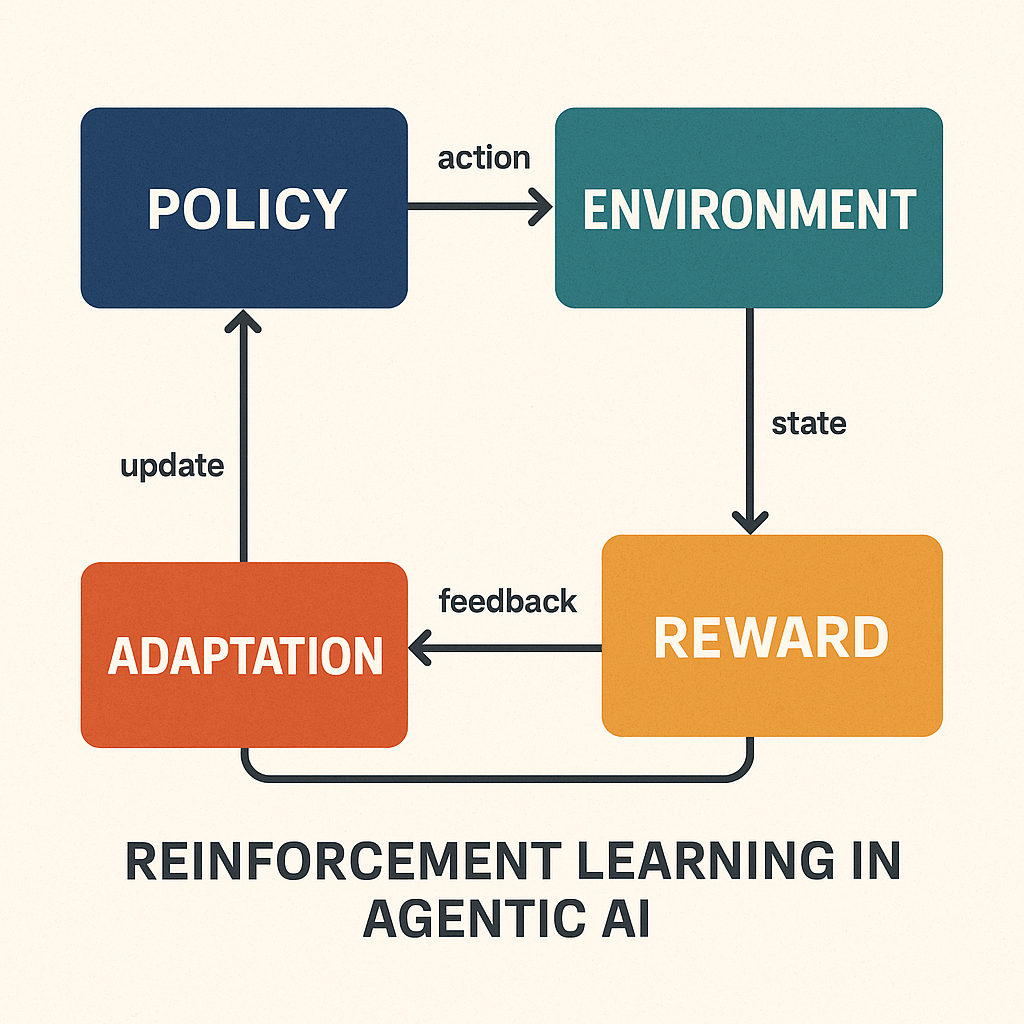
2. Reinforcement Learning: Enabling Goal-Directed Behavior in Agentic AI
Reinforcement Learning (RL) is a core component of Agentic AI, enabling systems to make sequential decisions based on outcomes, adapt over time, and learn strategies that maximize cumulative rewards—not just single-step accuracy.
In traditional machine learning, models are trained on labeled data. In RL, agents learn through interaction—by trial and error—receiving rewards or penalties based on the consequences of their actions within an environment. This makes RL particularly suited for dynamic, multi-step tasks where success isn’t immediately obvious.
Why RL Matters in Agentic AI
Agentic AI systems aren’t just responding to static queries—they are:
Planning long-term sequences of actions
Making context-aware trade-offs
Optimizing for outcomes (not just responses)
Adapting strategies based on experience
Reinforcement learning provides the feedback loop necessary for this kind of autonomy. It’s what allows Agentic AI to exhibit behavior resembling initiative, foresight, and real-time decision optimization.
Core Concepts in RL and Deep RL
Concept
Description
Agent
The decision-maker (e.g., an AI assistant or robotic arm)
Environment
The system it interacts with (e.g., CRM system, warehouse, user interface)
Action
A choice or move made by the agent (e.g., send an email, move a robotic arm)
Reward
Feedback signal (e.g., successful booking, faster resolution, customer rating)
Policy
The strategy the agent learns to map states to actions
State
The current situation of the agent in the environment
Value Function
Expected cumulative reward from a given state or state-action pair
Deep Reinforcement Learning (DRL) incorporates neural networks to approximate value functions and policies, allowing agents to learn in high-dimensional and continuous environments (like language, vision, or complex digital workflows).
Popular Algorithms and Architectures
Type
Examples
Used For
Model-Free RL
Q-learning, PPO, DQN
No internal model of environment; trial-and-error focus
Model-Based RL
MuZero, Dreamer
Learns a predictive model of the environment
Multi-Agent RL
MADDPG, QMIX
Coordinated agents in distributed environments
Hierarchical RL
Options Framework, FeUdal Networks
High-level task planning over low-level controllers
RLHF (Human Feedback)
Used in GPT-4 and Claude
Aligning agents with human values and preferences
Real-World Enterprise Applications of RL in Agentic AI
Use Case
RL Contribution
Autonomous Customer Support Agent
Learns which actions (FAQs, transfers, escalations) optimize resolution & NPS
AI Supply Chain Coordinator
Continuously adapts order timing and vendor choice to optimize delivery speed
Sales Engagement Agent
Tests and learns optimal outreach timing, channel, and script per persona
AI Process Orchestrator
Improves process efficiency through dynamic tool selection and task routing
DevOps Remediation Agent
Learns to reduce incident impact and time-to-recovery through adaptive actions
RL + Foundation Models = Emergent Agentic Capabilities
Traditionally, RL was used in discrete control problems (e.g., games or robotics). But its integration with large language models is powering a new class of cognitive agents:
OpenAI’s InstructGPT / ChatGPT leveraged RLHF to fine-tune dialogue behavior.
Devin (by Cognition AI) may use internal RL loops to optimize task completion over time.
Autonomous coding agents (e.g., SWE-agent, Voyager) use RL to evaluate and improve code quality as part of a long-term software development strategy.
These agents don’t just reason—they learn from success and failure, making each deployment smarter over time.
Enterprise Considerations and Strategy
When designing Agentic AI systems with RL, organizations must consider:
Reward Engineering: Defining the right reward signals aligned with business outcomes (e.g., customer retention, reduced latency).
Exploration vs. Exploitation: Balancing new strategies vs. leveraging known successful behaviors.
Safety and Alignment: RL agents can “game the system” if rewards aren’t properly defined or constrained.
Training Infrastructure: Deep RL requires simulation environments or synthetic feedback loops—often a heavy compute lift.
Simulation Environments: Agents must train in either real-world sandboxes or virtualized process models.
3. Planning and Goal-Oriented Architectures
Frameworks such as:
LangChain Agents
Auto-GPT / OpenAgents
ReAct (Reasoning + Acting) are used to manage task decomposition, memory, and iterative refinement of actions.
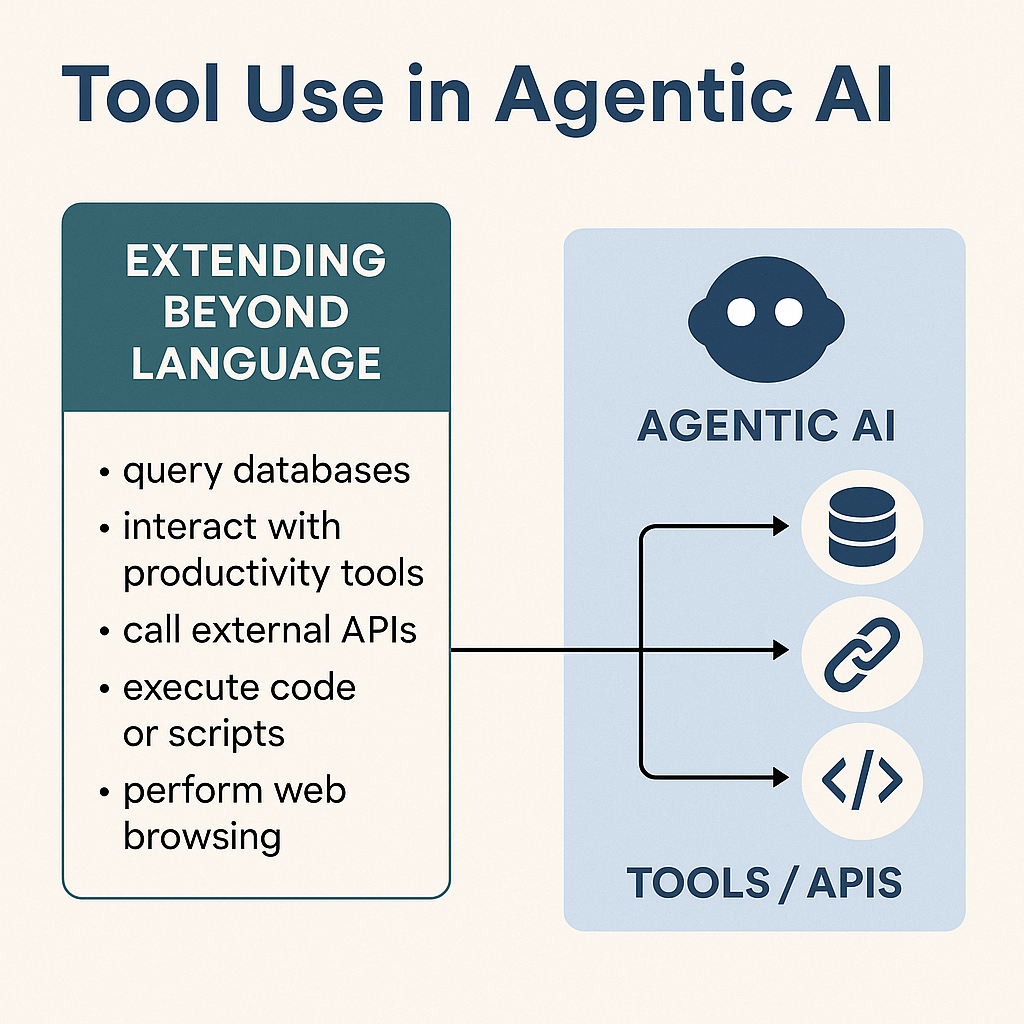
4. Tool Use and APIs: Extending the Agent’s Reach Beyond Language
One of the defining capabilities of Agentic AI is tool use—the ability to call external APIs, invoke plugins, and interact with software environments to accomplish real-world tasks. This marks the transition from “reasoning-only” models (like chatbots) to active agents that can both think and act.
What Do We Mean by Tool Use?
In practice, this means the AI agent can:
Query databases for real-time data (e.g., sales figures, inventory levels).
Interact with productivity tools (e.g., generate documents in Google Docs, create tickets in Jira).
Execute code or scripts (e.g., SQL queries, Python scripts for data analysis).
Perform web browsing and scraping (when sandboxed or allowed) for competitive intelligence or customer research.
This ability unlocks a vast universe of tasks that require integration across business systems—a necessity in real-world operations.
How Is It Implemented?
Tool use in Agentic AI is typically enabled through the following mechanisms:
Function Calling in LLMs: Models like OpenAI’s GPT-4o or Claude 3 can call predefined functions by name with structured inputs and outputs. This is deterministic and safe for enterprise use.
LangChain & Semantic Kernel Agents: These frameworks allow developers to define “tools” as reusable, typed Python functions, which are exposed to the agent as callable resources. The agent reasons over which tool to use at each step.
OpenAI Plugins / ChatGPT Actions: Predefined, secure tool APIs that extend the model’s environment (e.g., browsing, code interpreter, third-party services like Slack or Notion).
Custom Toolchains: Enterprises can design private toolchains using REST APIs, gRPC endpoints, or even RPA bots. These are registered into the agent’s action space and governed by policies.
Tool Selection Logic: Often governed by ReAct (Reasoning + Acting) or Plan-Execute architecture, where the agent:
Plans the next subtask.
Selects the appropriate tool.
Executes and observes the result.
Iterates or escalates as needed.
Examples of Agentic Tool Use in Practice
Business Function
Agentic Tooling Example
Finance
AI agent generates financial summaries by calling ERP APIs (SAP/Oracle)
Sales
AI updates CRM entries in HubSpot, triggers lead follow-ups via email
HR
Agent schedules interviews via Google Calendar API + Zoom SDK
Product Development
Agent creates GitHub issues, links PRs, and comments in dev team Slack
Procurement
Agent scans vendor quotes, scores RFPs, and pushes results into Tableau
Why It Matters
Tool use is the engine behind operational value. Without it, agents are limited to sandboxed environments—answering questions but never executing actions. Once equipped with APIs and tool orchestration, Agentic AI becomes an actor, capable of driving workflows end-to-end.
In a business context, this creates compound automation—where AI agents chain multiple systems together to execute entire business processes (e.g., “Generate monthly sales dashboard → Email to VPs → Create follow-up action items”).
This also sets the foundation for multi-agent collaboration, where different agents specialize (e.g., Finance Agent, Data Agent, Ops Agent) but communicate through APIs to coordinate complex initiatives autonomously.
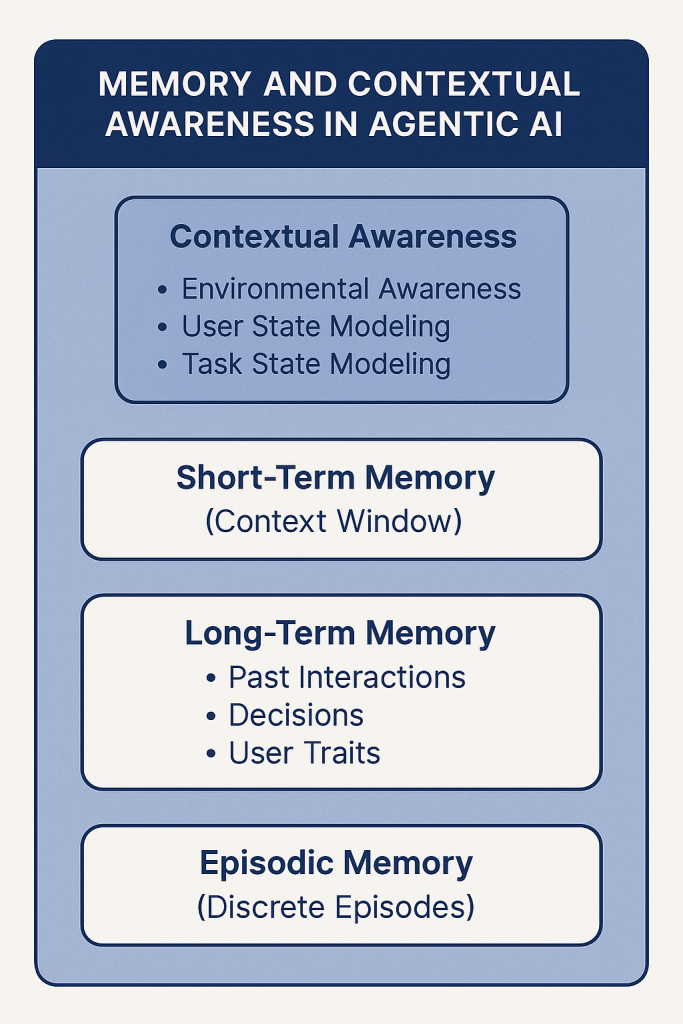
5. Memory and Contextual Awareness: Building Continuity in Agentic Intelligence
One of the most transformative capabilities of Agentic AI is memory—the ability to retain, recall, and use past interactions, observations, or decisions across time. Unlike stateless models that treat each prompt in isolation, Agentic systems leverage memory and context to operate over extended time horizons, adapt strategies based on historical insight, and personalize their behaviors for users or tasks.
Why Memory Matters
Memory transforms an agent from a task executor to a strategic operator. With memory, an agent can:
Track multi-turn conversations or workflows over hours, days, or weeks.
Retain facts about users, preferences, and previous interactions.
Learn from success/failure to improve performance autonomously.
Handle task interruptions and resumptions without starting over.
This is foundational for any Agentic AI system supporting:
Personalized knowledge work (e.g., AI analysts, advisors)
Collaborative teamwork (e.g., PM or customer-facing agents)
Agentic AI generally uses a layered memory architecture that includes:
1. Short-Term Memory (Context Window)
This refers to the model’s native attention span. For GPT-4o and Claude 3, this can be 128k tokens or more. It allows the agent to reason over detailed sequences (e.g., a 100-page report) in a single pass.
Strength: Real-time recall within a conversation.
Limitation: Forgetful across sessions without persistence.
2. Long-Term Memory (Persistent Storage)
Stores structured information about past interactions, decisions, user traits, and task states across sessions. This memory is typically retrieved dynamically when needed.
Implemented via:
Vector databases (e.g., Pinecone, Weaviate, FAISS) to store semantic embeddings.
Knowledge graphs or structured logs for relationship mapping.
Event logging systems (e.g., Redis, S3-based memory stores).
Use Case Examples:
Remembering project milestones and decisions made over a 6-week sprint.
Retaining user-specific CRM insights across customer service interactions.
Building a working knowledge base from daily interactions and tool outputs.
3. Episodic Memory
Captures discrete sessions or task executions as “episodes” that can be recalled as needed. For example, “What happened the last time I ran this analysis?” or “Summarize the last three weekly standups.”
Often linked to LLMs using metadata tags and timestamped retrieval.
Contextual Awareness Beyond Memory
Memory enables continuity, but contextual awareness makes the agent situationally intelligent. This includes:
Environmental Awareness: Real-time input from sensors, applications, or logs. E.g., current stock prices, team availability in Slack, CRM changes.
User State Modeling: Knowing who the user is, what role they’re playing, their intent, and preferred interaction style.
Task State Modeling: Understanding where the agent is within a multi-step goal, what has been completed, and what remains.
Together, memory and context awareness create the conditions for agents to behave with intentionality and responsiveness, much like human assistants or operators.
Key Technologies Enabling Memory in Agentic AI
Capability
Enabling Technology
Semantic Recall
Embeddings + Vector DBs (e.g., OpenAI + Pinecone)
Structured Memory Stores
Redis, PostgreSQL, JSON-encoded long-term logs
Retrieval-Augmented Generation (RAG)
Hybrid search + generation for factual grounding
Event and Interaction Logs
Custom metadata logging + time-series session data
AI agents that track product feature development, gather user feedback, prioritize sprints, and coordinate with Jira/Slack.
Ideal for startups or lean product teams.
Autonomous DevOps Bots
Agents that monitor infrastructure, recommend configuration changes, and execute routine CI/CD updates.
Can reduce MTTR (mean time to resolution) and engineer fatigue.
End-to-End Procurement Agents
Autonomous RFP generation, vendor scoring, PO management, and follow-ups—freeing procurement officers from clerical tasks.
What Can Agentic AI Deliver for Clients Today?
Your clients can expect the following from a well-designed Agentic AI system:
Capability
Description
Goal-Oriented Execution
Automates tasks with minimal supervision
Adaptive Decision-Making
Adjusts behavior in response to context and outcomes
Tool Orchestration
Interacts with APIs, databases, SaaS apps, and more
Persistent Memory
Remembers prior actions, users, preferences, and histories
Self-Improvement
Learns from success/failure using logs or reward functions
Human-in-the-Loop (HiTL)
Allows optional oversight, approvals, or constraints
Closing Thoughts: From Assistants to Autonomous Agents
Agentic AI represents a major evolution from passive assistants to dynamic problem-solvers. For business leaders, this means a new frontier of automation—one where AI doesn’t just answer questions but takes action.
Success in deploying Agentic AI isn’t just about plugging in a tool—it’s about designing intelligent systems with goals, governance, and guardrails. As foundation models continue to grow in reasoning and planning abilities, Agentic AI will be pivotal in scaling knowledge work and operations.
Agentic AI, often recognized as autonomous or “agent-based” AI, is an emerging branch in artificial intelligence characterized by its proactive, self-directed capabilities. Unlike reactive AI, which merely responds to user commands or specific triggers, agentic AI can autonomously set goals, make decisions, learn from its actions, and adapt to changing environments. This innovation has significant potential for transforming industries, particularly in fields requiring high-level automation, complex decision-making, and adaptability. Let’s explore the foundations, components, industry applications, development requirements, and considerations that businesses and technology leaders must know to understand agentic AI’s potential impact.
The Historical and Foundational Context of Agentic AI
1. Evolution from Reactive to Proactive AI
Historically, AI systems were built on reactive foundations. Early AI systems, such as rule-based expert systems and decision trees, could follow pre-defined rules but were not capable of learning or adapting. With advances in machine learning, deep learning, and neural networks, AI evolved to become proactive, able to analyze past data to predict future outcomes. For example, predictive analytics and recommendation engines represent early forms of proactive AI, allowing systems to anticipate user needs without explicit instructions.
Agentic AI builds on these developments, but it introduces autonomy at a new level. Drawing inspiration from artificial life research, multi-agent systems, and reinforcement learning, agentic AI strives to mimic intelligent agents that can act independently toward goals. This kind of AI does not merely react to the environment; it proactively navigates it, making decisions based on evolving data and long-term objectives.
2. Key Components of Agentic AI
The development of agentic AI relies on several fundamental components:
Autonomy and Self-Direction: Unlike traditional AI systems that operate within defined parameters, agentic AI is designed to operate autonomously. It has built-in “agency,” allowing it to make decisions based on its programmed objectives.
Goal-Oriented Design: Agentic AI systems are programmed with specific goals or objectives. They constantly evaluate their actions to ensure alignment with these goals, adapting their behaviors as they gather new information.
Learning and Adaptation: Reinforcement learning plays a crucial role in agentic AI, where systems learn from the consequences of their actions. Over time, these agents optimize their strategies to achieve better outcomes.
Context Awareness: Agentic AI relies on context recognition, meaning it understands and interprets real-world environments. This context-aware design allows it to operate effectively, even in unpredictable or complex situations.
Differentiating Agentic AI from Reactive and Proactive AI
Agentic AI marks a critical departure from traditional reactive and proactive AI. In a reactive AI model, the system relies on a pre-programmed or predefined response model. This limits its potential since it only responds to direct inputs and lacks the ability to learn or evolve. Proactive AI, on the other hand, anticipates future states or actions based on historical data but still operates within a set of constraints and predefined goals.
Agentic AI is unique in that it:
Creates Its Own Goals: While proactive AI responds to predictions, agentic AI can define objectives based on high-level instructions, adapting its course independently.
Operates with Self-Sufficiency: Unlike proactive AI, which still depends on external commands to start or stop functions, agentic AI can execute tasks autonomously, continuously optimizing its path toward its goals.
Leverages Real-Time Context: Agentic AI evaluates real-time feedback to adjust its behavior, giving it a unique edge in dynamic or unpredictable environments like logistics, manufacturing, and personalized healthcare.
Leading the Development of Agentic AI: Critical Requirements
To be at the forefront of agentic AI development, several technological, ethical, and infrastructural aspects must be addressed:
1. Advanced Machine Learning Algorithms
Agentic AI requires robust algorithms that go beyond typical supervised or unsupervised learning. Reinforcement learning, particularly in environments that simulate real-world challenges, provides the foundational structure for teaching these AI agents how to act in uncertain, multi-objective situations.
2. Strong Data Governance and Ethics
The autonomy of agentic AI presents ethical challenges, particularly concerning control, accountability, and privacy. Governance frameworks are essential to ensure that agentic AI adheres to ethical guidelines, operates transparently, and is aligned with human values. Mechanisms like explainable AI (XAI) become crucial, offering insights into the decision-making processes of autonomous agents.
3. Real-Time Data Processing Infrastructure
Agentic AI requires vast data streams to operate effectively. These data streams should be fast and reliable, allowing the agent to make real-time decisions. Robust cloud computing, edge computing, and real-time analytics infrastructure are essential.
4. Risk Management and Fail-Safe Systems
Due to the independent nature of agentic AI, developing fail-safe mechanisms to prevent harmful or unintended actions is crucial. Self-regulation, transparency, and human-in-the-loop capabilities are necessary safeguards in agentic AI systems, ensuring that human operators can intervene if needed.
5. Collaboration and Cross-Disciplinary Expertise
Agentic AI requires a multi-disciplinary approach, blending expertise in AI, ethics, psychology, cognitive science, and cyber-physical systems. By combining insights from these fields, agentic AI can be developed in a way that aligns with human expectations and ethical standards.
Industry Implications: Where Can Agentic AI Make a Difference?
Agentic AI has diverse applications, from enhancing customer experience to automating industrial processes and even contributing to autonomous scientific research. Key industries that stand to benefit include:
Manufacturing and Supply Chain: Agentic AI can manage automated machinery, predict maintenance needs, and optimize logistics without constant human oversight.
Healthcare: In personalized medicine, agentic AI can monitor patient data, adjust treatment protocols based on real-time health metrics, and alert healthcare providers to critical changes.
Financial Services: It can act as a personal financial advisor, analyzing spending habits, suggesting investments, and autonomously managing portfolios in response to market conditions.
Pros and Cons of Agentic AI
Pros:
Efficiency Gains: Agentic AI can significantly improve productivity and operational efficiency by automating complex, repetitive tasks.
Adaptability: By learning and adapting, agentic AI becomes a flexible solution for dynamic environments, improving decision-making accuracy over time.
Reduced Human Intervention: Agentic AI minimizes the need for constant human input, allowing resources to be allocated to higher-level strategic tasks.
Cons:
Complexity and Cost: Developing, deploying, and maintaining agentic AI systems require substantial investment in technology, infrastructure, and expertise.
Ethical and Security Risks: Autonomous agents introduce ethical and security concerns, especially when operating in sensitive or high-stakes environments.
Unpredictable Behavior: Due to their autonomous nature, agentic AI systems can occasionally produce unintended actions, requiring strict oversight and fail-safes.
Key Takeaways for Industry Professionals
For those less familiar with AI development, the crucial elements to understand in agentic AI include:
Goal-Driven Autonomy: Agentic AI differentiates itself through its ability to set and achieve goals without constant human oversight.
Contextual Awareness and Learning: Unlike traditional AI, agentic AI processes contextual data in real time, allowing it to adapt to new information and make decisions independently.
Ethical and Governance Considerations: As agentic AI evolves, ethical frameworks and transparency measures are vital to mitigate risks associated with autonomous decision-making.
Multi-Disciplinary Collaboration: Development in agentic AI requires collaboration across technical, ethical, and cognitive disciplines, highlighting the need for a comprehensive approach to deployment and oversight.
Conclusion
Agentic AI represents a transformative leap from reactive systems toward fully autonomous agents capable of goal-driven, adaptive behavior. While the promise of agentic AI lies in its potential to revolutionize industries by reducing operational burdens, increasing adaptability, and driving efficiency, its autonomy also brings new challenges that require vigilant ethical and technical frameworks. For businesses considering agentic AI adoption, understanding the technology’s foundational aspects, development needs, and industry applications is critical to harnessing its potential while ensuring responsible, secure deployment.
In the journey toward a proactive, intelligent future, agentic AI will likely serve as a cornerstone of innovation, laying the groundwork for a new era in digital transformation and operational excellence.