In a remarkable development that’s making waves across the customer experience management (CEM) world, today, several major companies announced the successful implementation of advanced AI-driven chatbots to revolutionize their customer support and engagement strategies.
So, what makes these AI chatbots so special, and why are they becoming an integral part of modern CEM? These intelligent virtual assistants are designed to understand natural language, learn from interactions, and provide instant, accurate responses to customer queries, all while offering personalized experiences. The result? Faster, more efficient support and dramatically improved customer satisfaction!
The benefits don’t stop there. By handling routine tasks and frequently asked questions, AI chatbots free up human agents to focus on more complex or emotionally sensitive issues, ensuring customers receive the right kind of support at the right time.
One striking example of AI chatbot success comes from a leading e-commerce platform that reported a 40% reduction in support ticket volume and a significant boost in customer satisfaction scores, all thanks to their new chatbot team members.
But it’s not just about customer support. AI chatbots are also transforming marketing and sales, helping businesses engage with prospects and customers in real-time, guiding them through the buyer’s journey with personalized recommendations and assistance.
As AI chatbot technology continues to evolve, the impact on CEM is likely to be profound. We can expect faster resolution times, more personalized experiences, and overall happier customers, all while reducing operational costs for businesses.
Join the conversation and share your thoughts on the future of AI chatbots in customer experience management. How do you see this technology reshaping the way businesses interact with their customers? Let’s explore the possibilities together! #AIChatbots #CEMTransformation
Today, the customer experience management landscape witnessed a seismic shift as Emotion AI, a cutting-edge technology, emerged as the new driving force behind exceptional customer experiences. In a move that has sent CX experts buzzing, several industry-leading brands announced their adoption of Emotion AI to revolutionize their customer interactions.
But what exactly is Emotion AI, and why is it creating such a stir? This groundbreaking technology leverages artificial intelligence to detect, interpret, and respond to human emotions through voice, facial expressions, and body language. By integrating Emotion AI into customer interactions, companies can now offer personalized, emotionally attuned experiences that foster loyalty and satisfaction like never before.
Imagine a world where customer service representatives can gauge your mood and adjust their responses accordingly, or where marketing campaigns can be tailored to evoke specific emotions, enhancing their impact. The possibilities are endless, and the potential benefits for both customers and businesses are immense.
This paradigm shift is already making waves across various industries. Retail giants are harnessing Emotion AI to provide empathetic in-store experiences, while airlines are exploring its potential to offer personalized in-flight entertainment based on passengers’ emotions.
The adoption of Emotion AI is not only an exciting development for customer experience management but also a testament to the power of innovation. By combining advanced AI capabilities with a deep understanding of human emotions, businesses can foster stronger connections with their customers, fueling growth and long-term success.
Join the conversation and share your thoughts on the potential of Emotion AI in revolutionizing customer experience management. How do you envision this technology shaping the future of customer interactions? Let’s explore the possibilities together! #EmotionAI #CXRevolution
Today, in a groundbreaking revelation, tech enthusiasts and data wizards around the world are rejoicing as a revolutionary new data storage technology has been unveiled! Say goodbye to traditional hard drives, and hello to the future of data storage: Quantum Crystal Storage (QCS)!
The team behind this phenomenal innovation, led by Dr. Evelyn Starling, has successfully demonstrated how QCS can store colossal amounts of data within a tiny crystal, no larger than a grain of sand. This extraordinary leap in technology has the potential to change the face of data storage as we know it.
So, what makes QCS so special? In a mind-blowing combination of quantum mechanics and nanotechnology, QCS harnesses the power of individual atoms within a crystalline structure to encode data. This allows for unparalleled storage capacity and astonishing retrieval speeds, all while consuming minimal energy.
Just imagine the possibilities: pocket-sized devices with the capacity to store entire libraries, lightning-fast data transfers that make current speeds seem like a crawl, and a massive reduction in energy consumption across data centers worldwide.
The unveiling of QCS has sent shockwaves through the tech world, with industry giants scrambling to incorporate this game-changing innovation into their products. The potential applications are endless, from revolutionizing cloud storage to transforming the way we interact with big data and artificial intelligence.
But it’s not just the tech industry that stands to benefit. The environment could see massive gains too. QCS’s minuscule energy requirements could significantly reduce the carbon footprint of data storage and help pave the way for a greener, more sustainable future.
Stay tuned as we dive deeper into the world of Quantum Crystal Storage, exploring its potential impact on our daily lives and the technology landscape. Don’t forget to share your thoughts and predictions for the future of data storage in the comments below! #QuantumCrystalStorage #DataRevolution
In this two-part series, I will cover the importance of understanding what, how, why and when centralized versus decentralized technology will impact how you interact with your audience / customers. The focus of messaging will be from a publish versus subscribe perspective.
As the debate over data ownership, privacy, monitoring and yes, even the freedom of speech intensifies, the dynamics and architecture of our technical platforms will become even more critical. Individuals and companies that are deciding how to develop, launch and support their products and services will need to think about their long-term vision and what type of control they (ex. Developers, Publishers, Influencers, Retailers) will require to ensure the items will be available when and where needed.
Differentiators
Centralized Technology: All users are connected to a central server that stores complete network data and user information.
Advantage: Standardization, Control, Administration and Monitoring – Usage Example: YouTube, Banking Systems
Disadvantage: Data Vulnerability (see Hackers), System Failure (Redundancy Required), Centralized (single point of attack)
In certain scenarios, the generic cloud computing model can be considered this type of technology, I’ll explain shortly. Typical Situation; Perhaps you have all of your technology (ex. applications, data, hardware) centrally located, at your home, or office. When you need to maintain, upgrade or retire the technology it is your responsibility to take care of it. You, in theory “own” the technology, infrastructure and any potential headaches / issues that may arrive with that responsibility. Yes, you may have a service agreement, or license that keeps you up to date and running, but the sole responsibility is in your hands.
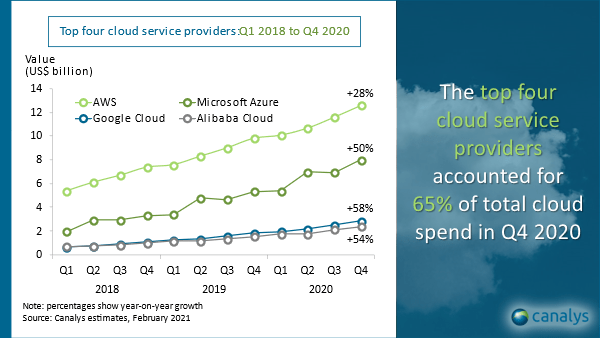
Then in the mid-2000’s came the advent of the commercially available cloud platform, as I briefly mentioned and referenced above. Now you have the option to put the technology that you in theory “own” and all of the inherent issues (ex. updates, backups, scalability) into the hands of someone else, but obviously for a fee / subscription. This became a great option for those that wanted to ensure they had the latest software, hardware, availability and protection, especially from lost information, provided to them via an SLA (Service Level Agreement). All the usual players have stepped-up to offer these services, primarily since they already had the hardware (in most cases), resources and infrastructure available to be leveraged. The names you should be familiar with, Amazon AWS, Google Cloud and Microsoft Azure own the largest market share of this technology as of early 2021.
This offering has become ideal to those that do not want to invest in quickly outdated hardware and software, plus if you are selling products and services any downtime, or lost data (vendors often have backup/restore options) can be critical to your business. When adopted, you now own the creativity, business model, growth and vision, plus your products and services are available “on-demand” to the public, while the technology infrastructure and administration of it (to some, the unfortunate part of doing business) is being administered and executed by a 3rd party.
However, now I want to remind you of what was mentioned in the opening paragraph, regarding the long-term vision for your products and services. Always keep in mind that you are at the mercy of the Terms and Conditions of the contract you signed with your service provider. It is not uncommon for these T&C’s to be updated, or modified numerous times per year. You may receive an email with a 45 page PDF file attached, that is full of legal jargon, and you just click the <AGREE> button and never think twice about it. While your business model, products and services being offered may have not changed, there might have been a wave of cultural, political and social changes that now put your ideas, products and services out-of-favor and no longer something that your service provider wants to “support” via their infrastructure. Overnight, that centralized offering that you adopted with open hands may now be unavailable to you, your organization and the audience / customers you count on. The vendor ultimately is in the right, because you are no longer adhering to the Terms and Conditions of doing business with them, which you early agreed to in that email that you gave little attention to. Now you may be in trouble and starting to scramble for any option, or alternative that will keep you and your business afloat. Being proactive, versus reactive is the key to surviving the just-in-time climate that we are forced to live with.
In a centralized model, always ask yourself the following in advance:
How much control do I “need / want” over what is being offered from me, or my organization to the public (ex. Are my products, services deemed edgy, controversial, opinionated, trendy, or focused towards a particular audience)
How much control do I “have” over what is being offered by me, or my organization (ex. Are channels, comments, endorsements, feedback and input allowed without moderation)
If my platform, or vendor suddenly became unavailable, how would I respond and reach my audience / customers – Always have a backup and/or disaster recovery plan and options ready in case the inevitable happens
Do I know my audience / customer and their expectations – Is your business meeting the needs of your audience, or is it being constrained by the terms and conditions of the service provider
Do I understand the value of data, privacy, reputation and protecting it – This is not just for you and your organization, but also your audience and customers
In my next Post, I will explore Decentralization and summarize the advantages / disadvantages of each model.
Today I was the recipient of news that my favorite local news publisher, was ceasing operations going forward. Yes, print journalism is not viable in any fashion going forward, but others have found ways to go behind a successful paywall, or leverage advertising and diversity in their content to attract a wider audience. While I enjoyed the weekly print copy in my mail, I could see items relevant to my town or school district, it was often loaded with print advertisements to make it capable of being delivered weekly. The ads would be for merchants inside and out of my neighborhood, I would quickly peruse the 15 or 20 pages to see if there was a picture or article of interest and would often find minimal content that pulled me in, thus tossing the periodical into recycling. Back in the day, there may be an editorial written by a historian of the area…but that has long passed. Now we will find a political, sponsored or vanilla piece that has as much interest as the Reddit post that I just scrolled past. But you know what will be missed by the “Print” version of these outlets…the picture in its glorious black and white, color on inky paper. I had dozens of clipped pictures / articles that I would send to relatives about the exploits of my offspring.
Ironically, I have received over the last few years a physically mailed note from my parents about an article they saw in their local newspaper related to something that may have been going on in my neighborhood. I often was torn between saving the mailing and / or wondering why I received this from them nearly seven days after I read about it online. So with a guilty complex, I would save it for a few days and then ultimately toss in that weeks recycling. Bottom line, nostalgia is only worth as much as the person receiving the material and what they envision doin with the content. That being said, I want to propose the following to the local media providers / outlets. You need to fully understand the following before transformation:
Audience: Do you know who they are (you have subscription lists, social media follows, unsolicited comments and other interactions)
Contributors: Most engaged individuals (participants, audience, family members) are posting content about the event with disregard – They have become your reporters
Analytics: Do you know what articles have had the highest page views, clickthroughs and retention based on exposure
Demographics: Do you know who prefers online versus print, you know the segmentation of your audience (ex. age, sex, location, socio-economic…etc.)
Content Preference: Who prefers Sports, Cultural, Ethnic, Religious, Philanthropic content as this can be derived from various content streams that receive the most interaction and engagement
Delivery Preference: Where did you have your highest interaction – online, published or direct via social interaction.
Contributors: Who is most likely to contribute to the content – Family members, Students, Faculty or professionally hired resources
The Next Step…
If you fully understand the above observations and the desire for the general public to receive their news in a timely manner, but with personalization, I think you know the direction I’m going. Engage, Interact, Promote Participation and you create a “crowd sourced” media aggregator and the heavy lifting of content is taken care of by your advocates, while the detailed dissemination is provided by the professionals. Revenue is derived by personalization and retained audience.
Now that most of us have been asked / forced to work from home, collaboration tools are getting a lot of use and hopefully your organization was ahead of the move and not scrambling to deploy and adopt during a crisis.
Over the years that I’ve spent in consulting, I’ve been exposed to numerous tools, some good, some bad, but they all seemed to meet the immediate need at the moment. I witnessed the progression from messaging to full fledge collaboration (sharing, editing of files live) and with each iteration there were always hurdles and learning curves that needed to be overcome. Messaging always seemed to be fairly straightforward…type a comment or response, click send and repeat.
Then came the Calendar and Scheduling functions…a bit trickier as you need to filter between public and private entries, have access to others calendars and even the more complex ability to schedule conference rooms. However, if this capability is functioning as expected it becomes very efficient in scheduling meetings / calls and ensuring that participants are available and not double-booked. I found folks that would “block” certain hours out during the day so they weren’t swamped with back-to-back meetings, or requested for attendance during their lunch hour. This practice is highly effective when working in a global culture and when individuals forget about timezones.
Then came the more exotic and truly collaborative functionality of live / in-line editing of files (documents, spreadsheets, project plans…etc.). This often requires a lot of education and more important governance around who, what and when documents should be manipulated. There have been too many times when someone forgets they are actively updating, or worse, deleting a document. When you are working as a team on a file, you have to remember that someone else can be in that file at the same time. I’ve found that the old SharePoint method of checking-out and checking-in documents was a bit safer. However, new tools will show you when a person is in the document and what they may be updating at the moment. This often works well when your network, WiFi and connectivity are top-notch.
Here are some Pros and Cons of collaboration tools: (per my colleagues)
Pro:
Higher productivity in a team environment
Accountability across the team versus individual
Greater visibility within the team to workload and availability
Intuitive collaboration – Sharing of ideas with immediate feedback
Standardization of applications
Fairly easy deployment of tool(s)
Con:
Managing individual calendar more difficult (being invited to everything)
Collaboration governance not adhered to – Too much access is granted to files (files deleted, modified or moved)
Tool adoption is more complicated when someone has used another tool they are more comfortable with – Bring Your own Tool (BYOT)
Fear of Big Brother – Opening my calendar, or current status allows management to see what I’m doing every minute of the day
Finally, while there are numerous offerings out there with a lot of options for small to large corporations and even families or groups, you should spend some time defining your problem statement – what is it that you want to address and make more efficient. Perhaps starting small and then rolling-in more complexity will make your team adopt the tool more effectively. Either way, this is the ideal time to do your research and see how a collaboration application can help keep your team’s communication optimal.
In no particular order, here are some tools that I’ve used and / or deployed:
In future posts I will explore the content management systems (on-premise / cloud), repositories and digital asset management systems that have linkage to the products listed above that I’ve been exposed to.
No, I’m not talking about daily hygiene, however there are some that should heed this recommendation. You know who you are.
What I am hoping to explain is that during a mandated “Stay at Home Advisory” via our local, state or federal government, there will never been a better time to retool, or at a bare minimum keep yourself fresh with the latest technology and professional offerings being provided (often at zero “temporary” membership fees) by many vendors. Companies are providing professional skills training and also high tech, pre-certification courses to the population in response to our current situation and we need to accept their offerings as required.
Some of the current offerings can be found at: (many more are available)
I would hope that after this period, you don’t look back and wish you spent a few hours a week, developing a new skill or polishing a skill that you may use daily, but haven’t explored the outer reaches of. There was a lot of buzz prior to the start of the year (2020) around, Artificial Intelligence, Robotic Process Automation, Cloud Computing, Predictive Analytics and numerous other cutting-edge technologies. Now that the world is taking a short pause, there is no better time to get a jumpstart on some of these concepts. Once we re-emerge from scenarios taken out of our control, why not be ahead of the competition and ready to lead the resurgence that most of us are anticipating going into 2021.
In just a matter of weeks, we will be back to long work weeks, short weekends and the limited bandwidth that never allows us to fill in the gaps within our skill set repertoire arsenal. Motivation may be waning at this point, but it’s your decision to execute or look for another excuse.
Something to consider as we increase our Alexa, Google, Siri, Bixby and other digital assistants at home – Especially my parents with their new Hotwire setup.
As my family knows, I have a ton of devices (about 50) on my home’s wifi and I was trying to figure out the best way to allocate the speed and coverage within my house. I decided to experiment with assigning the devices best suited for 2.4GHz to that SSID and the others to the 5GHz band. I noticed that all of my Wyze cameras, Ring doorbell, Nest smoke detectors, Printers, Vector robot and wifi outlets could only use 2.4GHz…so that was easy, I just gave that band a new SSID and password and forced them all to log into that address. The others, like laptops, desktops, Xbox, Phones, Google Chromecast, were better suited for faster speeds on 5GHz, so I left them as-is and they seem to be a lot happier with the extra bandwidth. What I don’t know yet is the Alexa / Google devices seem to prefer 5GHz, but not sure why they would need the faster speeds (expect for Amazon FireTV since it’s pushing my TV content), so I may force them to 2.4GHz also at some point.
Items to keep in mind: 2.4GHz is slower but has a longer range 5GHz is faster but has a shorter range Your router must support sending out two bands (2.4GHz / 5GHz) simultaneously
Bottomline for me was that I appeared to be overfeeding some devices with 5GHz, when they didn’t really need it and underfeeding the guys with 2.4GHz who could use the faster speeds.
Oh yeah, you may say “But Mike, what about all the Sonos speakers?” – They actually create their own network and the “hub” is wired to the router. This is also true with the Phillips Hue lights – Hub is wired and they are on their own network.
Good luck getting you wifi under control and please seek guidance from the numerous sites out there providing support: