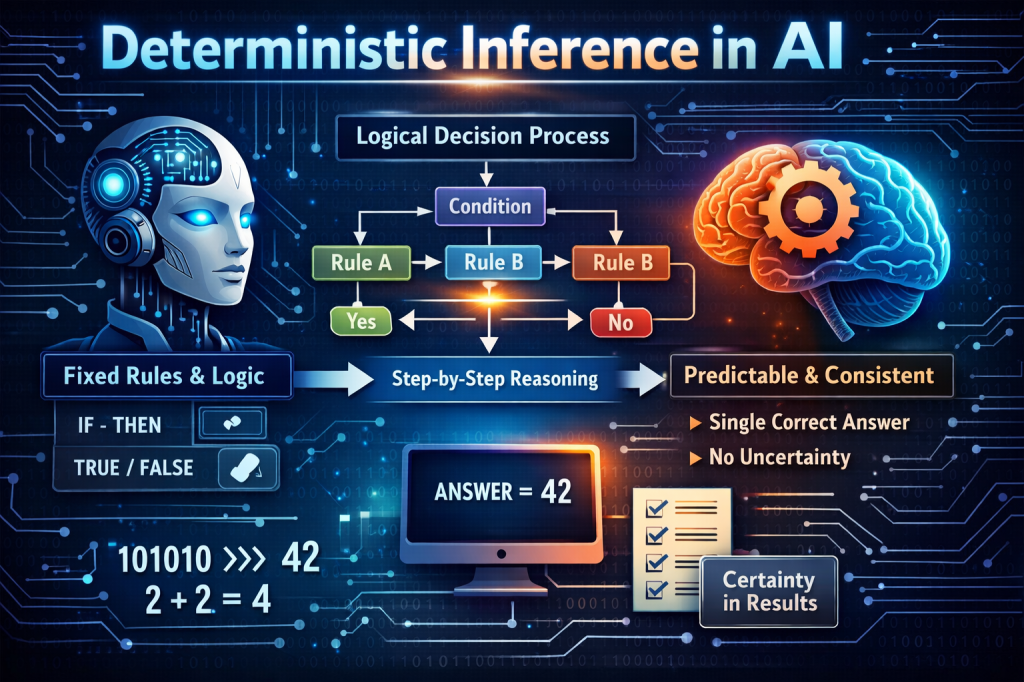
Deterministic Inference in AI: A Customer Experience (CX) Perspective

Introduction: Why Determinism Matters to Customer Experience

Customer Experience (CX) leaders increasingly rely on AI to shape how customers are served, advised, and supported. From virtual agents and recommendation engines to decision-support tools for frontline employees, AI is now embedded directly into the moments that define customer trust.

In this context, deterministic inference is not a technical curiosity, it is a CX enabler. It determines whether customers receive consistent answers, whether agents trust AI guidance, and whether organizations can scale personalized experiences without introducing confusion, risk, or inequity.

This article reframes deterministic inference through a CX lens. It begins with an intuitive explanation, then explores how determinism influences customer trust, operational consistency, and experience quality in AI-driven environments. By the end, you should be able to articulate why deterministic inference is central to modern CX strategy and how it shapes the future of AI-powered customer engagement.


Part 1: Deterministic Thinking in Everyday Customer Experiences

At a basic level, customers expect consistency.

If a customer:

  • Checks an order status online
  • Calls the contact center later
  • Chats with a virtual agent the next day

They expect the same answer each time.

This expectation maps directly to determinism.

A Simple CX Analogy

Consider a loyalty program:

  • Input: Customer ID + purchase history
  • Output: Loyalty tier and benefits

If the system classifies a customer as Gold on Monday and Silver on Tuesday—without any change in behavior—the experience immediately degrades. Trust erodes.

Customers may not know the word “deterministic,” but they feel its absence instantly.


Part 2: What Inference Means in CX-Oriented AI Systems

In CX, inference is the moment AI translates customer data into action.

Examples include:

  • Deciding which response a chatbot gives
  • Recommending next-best actions to an agent
  • Determining eligibility for refunds or credits
  • Personalizing offers or messaging

Inference is where customer data becomes customer experience.


Part 3: Deterministic Inference Defined for CX

From a CX perspective, deterministic inference means:

Given the same customer context, business rules, and AI model state, the system produces the same customer-facing outcome every time.

This does not mean experiences are static. It means they are predictably adaptive.

Why This Is Non-Trivial in Modern CX AI

Many CX AI systems introduce variability by design:

  • Generative chat responses – Replies produced by an artificial intelligence (AI) system that uses machine learning to create original, human-like text in real-time, rather than relying on predefined scripts or rules. These responses are generated based on patterns the AI has learned from being trained on vast amounts of existing data, such as books, web pages, and conversation examples.
  • Probabilistic intent classification – a machine learning method used in natural language processing (NLP) to identify the purpose behind a user’s input (such as a chat message or voice command) by assigning a probability distribution across a predefined set of potential goals, rather than simply selecting a single, most likely intent.
  • Dynamic personalization models – Refer to systems that automatically tailor digital content and user experiences in real time based on an individual’s unique preferences, past behaviors, and current context. This approach contrasts with static personalization, which relies on predefined rules and broad customer segments.
  • Agentic workflows – An AI-driven process where autonomous “agents” independently perform multi-step tasks, make decisions, and adapt to changing conditions to achieve a goal, requiring minimal human oversight. Unlike traditional automation that follows strict rules, agentic workflows use AI’s reasoning, planning, and tool-use abilities to handle complex, dynamic situations, making them more flexible and efficient for tasks like data analysis, customer support, or IT management.

Without guardrails, two customers with identical profiles may receive different experiences—or the same customer may receive different answers across channels.


Part 4: Deterministic vs. Probabilistic CX Experiences

Probabilistic CX (Common in Generative AI)

Probabilistic inference can produce varied but plausible responses.

Example:

Customer asks: “What fees apply to my account?”

Possible outcomes:

  • Response A mentions two fees
  • Response B mentions three fees
  • Response C phrases exclusions differently

All may be linguistically correct, but CX consistency suffers.

Deterministic CX

With deterministic inference:

  • Fee logic is fixed
  • Eligibility rules are stable
  • Response content is governed

The customer receives the same answer regardless of channel, agent, or time.


Part 5: Why Deterministic Inference Is Now a CX Imperative

1. Omnichannel Consistency

A customer-centric strategy that creates a seamless, integrated, and consistent brand experience across all customer touchpoints, whether online (website, app, social media, email) or offline (physical store), allowing customers to move between channels effortlessly with a unified journey. It breaks down silos between channels, using customer data to deliver personalized, real-time interactions that build loyalty and drive conversions, unlike multichannel, which often keeps channels separate.

Customers move fluidly across a marketing centered ecosystem: (Consisting typically of)

  • Web
  • Mobile
  • Chat
  • Voice
  • Human agents

Deterministic inference ensures that AI behaves like a single brain, not a collection of loosely coordinated tools.

2. Trust and Perceived Fairness

Trust and perceived fairness are two of the most fragile and valuable assets in customer experience. AI systems, particularly those embedded in service, billing, eligibility, and recovery workflows, directly influence whether customers believe a company is acting competently, honestly, and equitably.

Deterministic inference plays a central role in reinforcing both.


Defining Trust and Fairness in a CX Context

Customer Trust can be defined as:

The customer’s belief that an organization will behave consistently, competently, and in the customer’s best interest across interactions.

Trust is cumulative. It is built through repeated confirmation that the organization “remembers,” “understands,” and “treats me the same way every time under the same conditions.”

Perceived Fairness refers to:

The customer’s belief that decisions are applied consistently, without arbitrariness, favoritism, or hidden bias.

Importantly, perceived fairness does not require that outcomes always favor the customer—only that outcomes are predictable, explainable, and consistently applied.


How Non-Determinism Erodes Trust

When AI-driven CX systems are non-deterministic, customers may experience:

  • Different answers to the same question on different days
  • Different outcomes depending on channel (chat vs. voice vs. agent)
  • Inconsistent eligibility decisions without explanation

From the customer’s perspective, this variability feels indistinguishable from:

  • Incompetence
  • Lack of coordination
  • Unfair treatment

Even if every response is technically “reasonable,” inconsistency signals unreliability.


How Deterministic Inference Reinforces Trust

Deterministic inference ensures that:

  • Identical customer contexts yield identical decisions
  • Policy interpretation does not drift between interactions
  • AI behavior is stable over time unless explicitly changed

This creates what customers experience as institutional memory and coherence.

Customers begin to trust that:

  • The system knows who they are
  • The rules are real (not improvised)
  • Outcomes are not arbitrary

Trust, in this sense, is not emotional—it is structural.


Determinism as the Foundation of Perceived Fairness

Fairness in CX is primarily about consistency of application.

Deterministic inference supports fairness by:

  • Applying the same logic to all customers with equivalent profiles
  • Eliminating accidental variance introduced by sampling or generative phrasing
  • Enabling clear articulation of “why” a decision occurred

When determinism is present, organizations can say:

“Anyone in your situation would have received the same outcome.”

That statement is nearly impossible to defend in a non-deterministic system.


Real-World CX Examples

Example 1: Billing Disputes

A customer disputes a late fee.

  • Non-deterministic system:
    • Chatbot waives the fee
    • Phone agent denies the waiver
    • Follow-up email escalates to a partial credit

The customer concludes the process is arbitrary and learns to “channel shop.”

  • Deterministic system:
    • Eligibility rules are fixed
    • All channels return the same decision
    • Explanation is consistent

Even if the fee is not waived, the experience feels fair.


Example 2: Service Recovery Offers

Two customers experience the same outage.

  • Non-deterministic AI generates different goodwill offers
  • One customer receives a credit, the other an apology only

Perceived inequity emerges immediately—often amplified on social media.

Deterministic inference ensures:

  • Outage classification is stable
  • Compensation logic is uniformly applied

Example 3: Financial or Insurance Eligibility

In lending, insurance, or claims environments:

  • Customers frequently recheck decisions
  • Outcomes are scrutinized closely

Deterministic inference enables:

  • Reproducible decisions during audits
  • Clear explanations to customers
  • Reduced escalation to human review

The result is not just compliance—it is credibility.


Trust, Fairness, and Escalation Dynamics

Inconsistent AI decisions increase:

  • Repeat contacts
  • Supervisor escalations
  • Customer complaints

Deterministic systems reduce these behaviors by removing perceived randomness.

When customers believe outcomes are consistent and rule-based, they are less likely to challenge them—even unfavorable ones.


Key CX Takeaway

Deterministic inference does not guarantee positive outcomes for every customer.

What it guarantees is something more important:

  • Consistency over time
  • Uniform application of rules
  • Explainability of decisions

These are the structural prerequisites for trust and perceived fairness in AI-driven customer experience.

3. Agent Confidence and Adoption

Frontline employees quickly disengage from AI systems that contradict themselves.

Deterministic inference:

  • Reinforces agent trust
  • Reduces second-guessing
  • Improves adherence to AI recommendations

Part 6: CX-Focused Examples of Deterministic Inference

Example 1: Contact Center Guidance

  • Input: Customer tenure, sentiment, issue type
  • Output: Recommended resolution path

If two agents receive different guidance for the same scenario, experience variance increases.

Example 2: Virtual Assistants

A customer asks the same question on chat and voice.

Deterministic inference ensures:

  • Identical policy interpretation
  • Consistent escalation thresholds

Example 3: Personalization Engines

Determinism ensures that personalization feels intentional – not random.

Customers should recognize patterns, not unpredictability.


Part 7: Deterministic Inference and Generative AI in CX

Generative AI has fundamentally changed how organizations design and deliver customer experiences. It enables natural language, empathy, summarization, and personalization at scale. At the same time, it introduces variability that if left unmanaged can undermine consistency, trust, and operational control.

Deterministic inference is the mechanism that allows organizations to harness the strengths of generative AI without sacrificing CX reliability.


Defining the Roles: Determinism vs. Generation in CX

To understand how these work together, it is helpful to separate decision-making from expression.

Deterministic Inference (CX Context)

The process by which customer data, policy rules, and business logic are evaluated in a repeatable way to produce a fixed outcome or decision.

Examples include:

  • Eligibility decisions
  • Next-best-action selection
  • Escalation thresholds
  • Compensation logic

Generative AI (CX Context)

The process of transforming decisions or information into human-like language, tone, or format.

Examples include:

  • Writing a response to a customer
  • Summarizing a case for an agent
  • Rephrasing policy explanations empathetically

In mature CX architectures, generative AI should not decide what happens -only how it is communicated.


Why Unconstrained Generative AI Creates CX Risk

When generative models are allowed to perform inference implicitly, several CX risks emerge:

  • Policy drift: responses subtly change over time
  • Inconsistent commitments: different wording implies different entitlements
  • Hallucinated exceptions or promises
  • Channel-specific discrepancies

From the customer’s perspective, these failures manifest as:

  • “The chatbot told me something different.”
  • “Another agent said I was eligible.”
  • “Your email says one thing, but your app says another.”

None of these are technical errors—they are experience failures caused by nondeterminism.


How Deterministic Inference Stabilizes Generative CX

Deterministic inference creates a stable backbone that generative AI can safely operate on.

It ensures that:

  • Business decisions are made once, not reinterpreted
  • All channels reference the same outcome
  • Changes occur only when rules or models are intentionally updated

Generative AI then becomes a presentation layer, not a decision-maker.

This separation mirrors proven software principles: logic first, interface second.


Canonical CX Architecture Pattern

A common and effective pattern in production CX systems is:

  1. Deterministic Decision Layer
    • Evaluates customer context
    • Applies rules, models, and thresholds
    • Produces explicit outputs (e.g., “eligible = true”)
  2. Generative Language Layer
    • Translates decisions into natural language
    • Adjusts tone, empathy, and verbosity
    • Adapts phrasing by channel

This pattern allows organizations to scale generative CX safely.


Real-World CX Examples

Example 1: Policy Explanations in Contact Centers

  • Deterministic inference determines:
    • Whether a fee can be waived
    • The maximum allowable credit
  • Generative AI determines:
    • How the explanation is phrased
    • The level of empathy
    • Channel-appropriate tone

The outcome remains fixed; the expression varies.


Example 2: Virtual Agent Responses

A customer asks: “Can I cancel without penalty?”

  • Deterministic layer evaluates:
    • Contract terms
    • Timing
    • Customer tenure
  • Generative layer constructs:
    • A clear, empathetic explanation
    • Optional next steps

This prevents the model from improvising policy interpretation.


Example 3: Agent Assist and Case Summaries

In agent-assist tools:

  • Deterministic inference selects next-best-action
  • Generative AI summarizes context and rationale

Agents see consistent guidance while benefiting from flexible language.


Example 4: Service Recovery Messaging

After an outage:

  • Deterministic logic assigns compensation tiers
  • Generative AI personalizes apology messages

Customers receive equitable treatment with human-sounding communication.


Determinism, Generative AI, and Compliance

In regulated industries, this separation is critical.

Deterministic inference enables:

  • Auditability of decisions
  • Reproducibility during disputes
  • Clear separation of logic and language

Generative AI, when constrained, does not threaten compliance—it enhances clarity.


Part 8: Determinism in Agentic CX Systems

As customer experience platforms evolve, AI systems are no longer limited to answering questions or generating text. Increasingly, they are becoming agentic – capable of planning, deciding, acting, and iterating across multiple steps to resolve customer needs.

Agentic CX systems represent a step change in automation power. They also introduce a step change in risk.

Deterministic inference is what allows agentic CX systems to operate safely, predictably, and at scale.


Defining Agentic AI in a CX Context

Agentic AI (CX Context) refers to AI systems that can:

  • Decompose a customer goal into steps
  • Decide which actions to take
  • Invoke tools or workflows
  • Observe outcomes and adjust behavior

Examples include:

  • An AI agent that resolves a billing issue end-to-end
  • A virtual assistant that coordinates between systems (CRM, billing, logistics)
  • An autonomous service agent that proactively reaches out to customers

In CX, agentic systems are effectively digital employees operating customer journeys.


Why Agentic CX Amplifies the Need for Determinism

Unlike single-response AI, agentic systems:

  • Make multiple decisions per interaction
  • Influence downstream systems
  • Accumulate effects over time

Without determinism, small variations compound into large experience divergence.

This leads to:

  • Different resolution paths for identical customers
  • Inconsistent journey lengths
  • Unpredictable escalation behavior
  • Inability to reproduce or debug failures

In CX terms, the journey itself becomes unstable.


Deterministic Inference as Journey Control

Deterministic inference acts as a control system for agentic CX.

It ensures that:

  • Identical customer states produce identical action plans
  • Tool selection follows stable rules
  • State transitions are predictable

Rather than improvising journeys, agentic systems execute governed playbooks.

This transforms agentic AI from a creative actor into a reliable operator.


Determinism vs. Emergent Behavior in CX

Emergent behavior is often celebrated in AI research. In CX, it is usually a liability.

Customers do not want:

  • Creative interpretations of policy
  • Novel escalation strategies
  • Personalized but inconsistent journeys

Determinism constrains emergence to expression, not action.


Canonical Agentic CX Architecture

Mature agentic CX systems typically separate concerns:

  1. Deterministic Orchestration Layer
    • Defines allowable actions
    • Enforces sequencing rules
    • Governs state transitions
  2. Probabilistic Reasoning Layer
    • Interprets intent
    • Handles ambiguity
  3. Generative Interaction Layer
    • Communicates with customers
    • Explains actions

Determinism anchors the system; intelligence operates within bounds.


Real-World CX Examples

Example 1: End-to-End Billing Resolution Agent

An agentic system resolves billing disputes autonomously.

  • Deterministic logic controls:
    • Eligibility checks
    • Maximum credits
    • Required verification steps
  • Agentic behavior sequences actions:
    • Retrieve invoice
    • Apply adjustment
    • Notify customer

Two identical disputes follow the same path, regardless of timing or channel.


Example 2: Proactive Service Outreach

An AI agent monitors service degradation and proactively contacts customers.

Deterministic inference ensures:

  • Outreach thresholds are consistent
  • Priority ordering is fair
  • Messaging triggers are stable

Without determinism, customers perceive favoritism or randomness.


Example 3: Escalation Management

An agentic CX system decides when to escalate to a human.

Deterministic rules govern:

  • Sentiment thresholds
  • Time-in-journey limits
  • Regulatory triggers

This prevents over-escalation, under-escalation, and agent mistrust.


Debugging, Auditability, and Learning

Agentic systems without determinism are nearly impossible to debug.

Deterministic inference enables:

  • Replay of customer journeys
  • Root-cause analysis
  • Safe iteration on rules and models

This is essential for continuous CX improvement.


Part 9: Strategic CX Implications

Deterministic inference is not merely a technical implementation detail – it is a strategic enabler that determines whether AI strengthens or destabilizes a customer experience operating model.

At scale, CX strategy is less about individual interactions and more about repeatable experience outcomes. Determinism is what allows AI-driven CX to move from experimentation to institutional capability.


Defining Strategic CX Implications

From a CX leadership perspective, a strategic implication is not about what the AI can do, but:

  • How reliably it can do it
  • How safely it can scale
  • How well it aligns with brand, policy, and regulation

Deterministic inference directly influences these dimensions.


1. Scalable Personalization Without Fragmentation

Scalable personalization means:

Delivering tailored experiences to millions of customers without introducing inconsistency, inequity, or operational chaos.

Without determinism:

  • Personalization feels random
  • Customers struggle to understand why they received a specific treatment
  • Frontline teams cannot explain or defend outcomes

With deterministic inference:

  • Personalization logic is explicit and repeatable
  • Customers with similar profiles experience similar journeys
  • Variations are intentional, not accidental

Real-world example:
A telecom provider personalizes retention offers.

  • Deterministic logic assigns offer tiers based on tenure, usage, and churn risk
  • Generative AI personalizes messaging tone and framing

Customers perceive personalization as thoughtful—not arbitrary.


2. Governable Automation and Risk Management

Governable automation refers to:

The ability to control, audit, and modify automated CX behavior without halting operations.

Deterministic inference enables:

  • Clear ownership of decision logic
  • Predictable effects of policy changes
  • Safe rollout and rollback of AI capabilities

Without determinism, automation becomes opaque and risky.

Real-world example:
An insurance provider automates claims triage.

  • Deterministic inference governs eligibility and routing
  • Changes to rules can be simulated before deployment

This reduces regulatory exposure while improving cycle time.


3. Experience Quality Assurance at Scale

Traditional CX quality assurance relies on sampling human interactions.

AI-driven CX requires:

System-level assurance that experiences conform to defined standards.

Deterministic inference allows organizations to:

  • Test AI behavior before release
  • Detect drift when logic changes
  • Guarantee experience consistency across channels

Real-world example:
A bank tests AI responses to fee disputes across all channels.

  • Deterministic logic ensures identical outcomes in chat, voice, and branch support
  • QA focuses on tone and clarity, not decision variance

4. Regulatory Defensibility and Audit Readiness

In regulated industries, CX decisions are often legally material.

Deterministic inference enables:

  • Reproduction of past decisions
  • Clear explanation of why an outcome occurred
  • Evidence that policies are applied uniformly

Real-world example:
A lender responds to a customer complaint about loan denial.

  • Deterministic inference allows the exact decision path to be replayed
  • The institution demonstrates fairness and compliance

This shifts AI from liability to asset.


5. Organizational Alignment and Operating Model Stability

CX failures are often organizational, not technical.

Deterministic inference supports:

  • Alignment between policy, legal, CX, and operations
  • Clear translation of business intent into system behavior
  • Reduced reliance on tribal knowledge

Real-world example:
A global retailer standardizes return policies across regions.

  • Deterministic logic encodes policy variations explicitly
  • Generative AI localizes communication

The experience remains consistent even as organizations scale.


6. Economic Predictability and ROI Measurement

From a strategic standpoint, leaders must justify AI investments.

Deterministic inference enables:

  • Predictable cost-to-serve
  • Stable deflection and containment metrics
  • Reliable attribution of outcomes to decisions

Without determinism, ROI analysis becomes speculative.

Real-world example:
A contact center deploys AI-assisted resolution.

  • Deterministic guidance ensures consistent handling time reductions
  • Leadership can confidently scale investment

Part 10: The Future of Deterministic Inference in CX

Key trends include:

  1. Experience Governance by Design – A proactive approach that embeds compliance, ethics, risk management, and operational rules directly into the creation of systems, products, or services from the very start, making them inherently aligned with desired outcomes, rather than adding them as an afterthought. It shifts governance from being a restrictive layer to a foundational enabler, ensuring that systems are built to be effective, trustworthy, and sustainable, guiding user behavior and decision-making intuitively.
  2. Hybrid Experience Architectures – A strategic framework that combines and integrates different computing, physical, or organizational elements to create a unified, flexible, and optimized user experience. The specific definition varies by context, but it fundamentally involves leveraging the strengths of disparate systems through seamless integration and orchestration.
  3. Audit-Ready Customer Journeys
    Every AI-driven interaction reproducible and explainable.
  4. Trust as a Differentiator – A brand’s proven reliability, integrity, and commitment to its promises become the primary reason customers choose it over competitors, especially when products are similar, leading to higher prices, reduced friction, and increased loyalty by building confidence and reducing perceived risk. It’s the belief that a company will act in the customer’s best interest, providing a competitive advantage difficult to replicate.

Conclusion: Determinism as the Backbone of Trusted CX

Deterministic inference is foundational to trustworthy, scalable, AI-driven customer experience. It ensures that intelligence does not come at the cost of consistency—and that automation enhances, rather than undermines, customer trust.

As AI becomes inseparable from CX, determinism will increasingly define which organizations deliver coherent, defensible, and differentiated experiences and which struggle with fragmentation and erosion of trust.

Please join us on (Spotify) as we discuss this and other AI / CX topics.

Transforming Call Centers with GenAI: A Strategic Approach for Senior Business Management

Introduction

In our previous discussion, we explored the landscape of traditional call centers, the strengths and weaknesses of these models, and how GenAI and other advanced technologies are revolutionizing the industry. Now, let’s delve deeper into how these technologies and leading vendors like IBM Watson, Amazon Connect, Google Cloud Contact Center AI, and Genesys Cloud can be strategically leveraged to transform a call center. We’ll discuss quick wins, mid-term, and long-term initiatives, as well as the pros and cons of these deployments to help senior business management make informed decisions.

Quick Wins: Initial Areas to Address

1. Automating Routine Inquiries with Virtual Agents:

Automating routine inquiries with virtual agents involves deploying AI-powered chatbots and voice assistants to handle common customer questions and tasks, such as checking account balances, tracking order statuses, and answering FAQs. These virtual agents use natural language processing to understand and respond to customer queries accurately, providing immediate assistance without the need for human intervention. This not only reduces the workload on human agents but also improves response times and customer satisfaction by delivering quick and consistent service.

Technologies to Leverage: (Illustrative)

Implementation: Deploying virtual agents to handle routine inquiries such as account balances, order status, and FAQs can provide immediate relief to human agents. These AI-driven virtual agents can understand natural language, provide accurate responses, and escalate complex issues to human agents when necessary.

Typical Results:

  • Reduced Call Volume for Human Agents: A significant reduction in the volume of routine calls handled by human agents, freeing them up for more complex interactions.
  • Improved Response Times: Faster resolution of common inquiries, leading to enhanced customer satisfaction.
  • Cost Savings: Reduced need for staffing during peak times, lowering operational costs.

2. Enhancing IVR Systems with AI:

Enhancing IVR (Interactive Voice Response) systems with AI involves integrating artificial intelligence to make these systems more intuitive and user-friendly. AI-powered IVR can understand and process natural language, allowing customers to speak naturally instead of navigating through rigid menu options. This improvement leads to more accurate call routing, quicker resolutions, and a more satisfying customer experience. Additionally, AI-enhanced IVR systems can handle a larger volume of calls efficiently, reducing wait times and operational costs.

Technologies to Leverage: (Illustrative)

Implementation: Integrating AI into existing IVR systems can enhance their functionality. AI-powered IVR can understand and process natural language, making it easier for customers to navigate the system and get the information they need without agent intervention.

Typical Results:

  • Higher Customer Satisfaction: Improved customer experience due to more intuitive and efficient IVR navigation.
  • Increased First Call Resolution (FCR): More accurate routing of calls to the right department or agent, increasing the chances of resolving issues on the first call.

Mid-Term Initiatives: Building on Initial Successes

1. Implementing AI-Powered Analytics and Insights:

Implementing AI-powered analytics and insights involves using advanced AI and machine learning tools to analyze customer interaction data. These tools provide deep insights into customer behaviors, preferences, and trends, allowing businesses to make data-driven decisions. By identifying patterns and predicting customer needs, companies can offer personalized experiences and proactively address potential issues. This enhances customer satisfaction, optimizes operational efficiency, and drives strategic improvements in call center performance.

Technologies to Leverage: (Illustrative)

Implementation: Use AI-powered analytics to gather and analyze data from customer interactions. These insights can help identify patterns, predict customer needs, and provide agents with real-time information to improve service quality.

Pros:

  • Personalized Customer Experience: AI-driven insights enable highly personalized interactions.
  • Proactive Issue Resolution: Predictive analytics can help anticipate and address issues before they escalate.

Cons:

  • Data Privacy Concerns: Handling large volumes of customer data requires robust security measures to protect privacy.
  • Integration Challenges: Integrating AI analytics with existing CRM and contact center systems can be complex and require significant IT resources.

2. Enhancing Agent Assistance with AI:

Enhancing agent assistance with AI involves using artificial intelligence tools to support customer service agents in real-time. These tools provide agents with relevant information, suggested responses, and insights based on historical data during customer interactions. AI can automate routine tasks, freeing agents to focus on more complex issues, and ensure consistent, high-quality service. This leads to increased agent productivity, improved customer satisfaction, and more efficient call center operations.

Technologies to Leverage: (Illustrative)

Implementation: Deploy AI to assist human agents in real-time by providing relevant information, suggesting responses, and offering insights based on historical data.

Pros:

  • Increased Agent Productivity: Agents can handle queries more efficiently with AI support.
  • Consistency in Service Quality: AI provides standardized responses, reducing variability in service quality.

Cons:

  • Agent Training: Agents need to be trained to effectively use AI tools, which can require time and resources.
  • Initial Setup Costs: Implementing AI assistance tools may involve significant initial investment.

Long-Term Initiatives: Transformational Changes

1. Full Integration of Omnichannel Support:

Full integration of omnichannel support means unifying all customer interaction channels, such as phone, email, chat, and social media, into a single, cohesive system. This allows for seamless transitions between channels and ensures consistent service quality regardless of the customer’s chosen method of communication. By integrating omnichannel support, companies can provide a more comprehensive and connected customer experience, improving satisfaction and efficiency while allowing agents to manage all interactions from a unified interface.

Technologies to Leverage: (Illustrative)

Implementation: Integrate all customer interaction channels (phone, email, chat, social media) into a unified platform supported by AI. This ensures seamless transitions between channels and consistent service quality.

Pros:

  • Unified Customer Experience: Customers enjoy a consistent experience across all touchpoints.
  • Improved Efficiency: Agents can handle interactions from multiple channels within a single interface.

Cons:

  • Complexity of Integration: Bringing all channels into a unified system can be technically challenging.
  • Ongoing Maintenance: Continuous updates and maintenance are required to keep the system running smoothly.

2. Advanced Predictive and Prescriptive Analytics:

Advanced predictive and prescriptive analytics involve using sophisticated AI and machine learning techniques to analyze data and forecast future customer behaviors and trends. Predictive analytics helps anticipate customer needs and potential issues before they arise, while prescriptive analytics offers actionable recommendations to optimize decision-making and operational strategies. This proactive approach enhances customer satisfaction, improves efficiency, and drives better business outcomes by enabling companies to address problems before they escalate and tailor services to individual customer preferences.

Technologies to Leverage: (Illustrative)

Implementation: Leverage advanced analytics to not only predict customer behavior but also prescribe actions for agents and automated systems to take, improving proactive customer service and operational efficiency.

Pros:

  • Proactive Customer Service: Ability to address issues before they arise, enhancing customer satisfaction.
  • Operational Efficiency: Streamlined processes and optimized resource allocation based on predictive insights.

Cons:

  • Data Management: Handling and analyzing large datasets requires robust data management strategies.
  • Skill Requirements: High-level data science skills are necessary to develop and maintain predictive models.

Developing the Plan: Pros and Cons of Deployments

Pros:

  • Enhanced Customer Experience: AI and GenAI technologies provide personalized, efficient, and seamless customer interactions.
  • Operational Efficiency: Automation reduces costs, improves agent productivity, and scales easily with demand.
  • Data-Driven Decision Making: Advanced analytics provide valuable insights into customer behavior and operational performance.

Cons:

  • High Initial Investment: Implementing AI technologies can require significant upfront investment in both technology and training.
  • Integration Complexity: Integrating new technologies with existing systems can be complex and resource-intensive.
  • Data Privacy and Security: Handling large volumes of sensitive customer data necessitates robust security measures and compliance with regulations.

Conclusion

Transforming call centers with GenAI and advanced technologies is a strategic imperative for modern businesses aiming to enhance customer experience, improve operational efficiency, and maintain a competitive edge. By focusing on quick wins, such as automating routine inquiries and enhancing IVR systems, companies can achieve immediate benefits. Building on these successes with mid-term initiatives like AI-powered analytics and agent assistance, and pursuing long-term goals such as omnichannel support and advanced predictive analytics, can lead to a comprehensive transformation.

When developing the transformation plan, it’s essential to weigh the pros and cons of each deployment phase, ensuring that the strategy aligns with the company’s overall business objectives and capabilities. By doing so, companies can navigate the complexities of digital transformation, harness the full potential of AI technologies, and ultimately deliver exceptional customer experiences.

Leveraging GenAI in Call Center Transformation Programs

Welcome back readers – we’ve been on a brief hiatus, taking the last few weeks to retool, reboot, and re-energize. This pause allowed us to externally view the industry and technology advancements and prepare for the exciting developments on the horizon in Generative AI and Customer Experience. We’re now back and ready to dive into the next wave of innovations in these rapidly evolving fields. Stay tuned for fresh insights and cutting-edge analysis as we explore how these advancements will reshape the future of business and technology.

Introduction

In today’s fast-paced digital landscape, the call center industry is undergoing significant transformation, driven by advancements in artificial intelligence, particularly generative AI (GenAI). As businesses strive to enhance customer experiences and optimize operational efficiency, understanding the current administration of call centers, their strengths and weaknesses, and the leading solutions in the marketplace is crucial. This blog post delves into these aspects and provides insights into the future trajectory of call center technologies, the goals and KPIs for transformation, and what to look for in a call center transformation consultant.

Current Administration of Call Centers

Traditional Models:

Most call centers today operate on a traditional model that relies heavily on human agents to handle customer interactions. These centers are typically structured into tiers, with frontline agents handling basic inquiries and more complex issues escalated to higher-tier support. The key elements of traditional call centers include:

  1. Human Agents: The backbone of the operation, handling inbound and outbound calls, emails, and live chat.
  2. IVR Systems: Interactive Voice Response (IVR) systems to route calls based on customer inputs.
  3. CRM Systems: Customer Relationship Management (CRM) platforms to track customer interactions and histories.
  4. Performance Monitoring: Metrics such as Average Handling Time (AHT), First Call Resolution (FCR), and Customer Satisfaction (CSAT) are used to gauge performance.

Strengths:

  • Human Touch: Human agents provide empathy and nuanced understanding in complex situations.
  • Flexibility: Agents can adapt to unexpected scenarios and offer personalized solutions.
  • Detailed Insights: Direct interactions with customers provide deep insights into their needs and preferences.

Weaknesses:

  • High Operational Costs: Salaries, training, and infrastructure maintenance contribute to significant costs.
  • Scalability Issues: Scaling up operations quickly in response to spikes in demand is challenging.
  • Inconsistent Quality: Performance can vary significantly between agents, affecting customer experience.

Why Transforming Your Company Away from Traditional Call Center Models is Crucial

In the rapidly evolving landscape of customer service, traditional call center models are increasingly falling short of meeting the dynamic needs and expectations of modern consumers. Transforming away from these outdated models is not just a trend but a necessity for companies aiming to stay competitive and relevant. Here’s why:

1. Changing Customer Expectations

Demand for Instant Gratification: Today’s customers expect fast, efficient, and seamless service. Traditional call centers, often characterized by long wait times and cumbersome processes, fail to deliver the immediacy that customers now demand.

Omnichannel Experience: Modern consumers interact with brands through multiple channels, including social media, email, chat, and phone. Traditional call centers are typically not equipped to handle this omnichannel approach effectively, leading to fragmented and inconsistent customer experiences.

2. Operational Efficiency and Cost Reduction

High Operational Costs: Maintaining a traditional call center is expensive, with significant costs associated with staffing, training, infrastructure, and maintenance. AI-driven solutions can automate routine tasks, reducing the need for a large workforce and lowering operational costs.

Scalability: Traditional models struggle with scalability, particularly during peak times or unexpected surges in demand. AI and cloud-based solutions offer the flexibility to scale operations up or down quickly, ensuring consistent service levels without the need for significant capital investment.

3. Enhanced Customer Insights and Personalization

Data-Driven Insights: Advanced AI and analytics tools provide deeper insights into customer behaviors and preferences. This data can be used to tailor interactions and offer personalized solutions, something traditional call centers are not equipped to do at scale.

Predictive Analytics: By leveraging predictive analytics, companies can anticipate customer needs and proactively address issues before they escalate, enhancing customer satisfaction and loyalty.

4. Competitive Advantage

Staying Ahead of the Curve: Companies that adopt advanced AI and automation technologies gain a competitive edge by offering superior customer experiences and operational efficiencies. In contrast, those sticking to traditional models risk falling behind more agile and innovative competitors.

Innovation and Adaptability: Transforming call centers with modern technologies fosters a culture of innovation and adaptability within the organization, enabling it to respond more quickly to market changes and customer demands.

5. Improved Agent Productivity and Satisfaction

Empowering Agents: AI tools can assist human agents by providing real-time information, suggestions, and automating repetitive tasks, allowing them to focus on more complex and value-added interactions. This not only improves productivity but also enhances job satisfaction.

Reduced Turnover: High turnover rates are a common issue in traditional call centers due to the repetitive and stressful nature of the work. By transforming call centers, companies can create a more engaging and rewarding work environment, reducing turnover and associated recruitment and training costs.

6. Better Customer Outcomes

Higher Resolution Rates: AI and advanced analytics can significantly improve First Call Resolution (FCR) rates by providing agents with the tools and information needed to resolve issues promptly and effectively.

Consistent Quality of Service: Automation ensures a consistent quality of service across all customer interactions, reducing the variability associated with human performance and enhancing overall customer satisfaction.

Transforming away from traditional call center models is essential for companies aiming to meet modern customer expectations, achieve operational efficiency, and maintain a competitive edge. The integration of GenAI and other advanced technologies into call center operations not only addresses the limitations of traditional models but also opens up new possibilities for innovation, personalization, and improved customer outcomes. By embracing this transformation, companies can ensure they are well-positioned to thrive in the fast-paced and ever-evolving landscape of customer service.

Leading Solutions in the Marketplace

The call center industry is witnessing a surge in AI-driven solutions aimed at addressing the limitations of traditional models. Several vendors and platforms are leading the charge in integrating GenAI into call center operations:

1. IBM Watson:

IBM Watson offers AI-driven customer service solutions that include natural language processing (NLP) and machine learning to automate interactions, analyze customer sentiments, and provide agents with real-time assistance.

2. Amazon Connect:

Amazon Connect is a cloud-based contact center service that leverages AWS’s machine learning capabilities. It offers features such as speech recognition, sentiment analysis, and real-time analytics to enhance customer interactions and streamline operations.

3. Google Cloud Contact Center AI:

Google‘s solution integrates AI to assist agents and automate routine tasks. It includes virtual agents for handling simple inquiries and agent assist features to provide real-time support, improving efficiency and customer satisfaction.

4. Genesys Cloud:

Genesys Cloud uses AI to optimize routing, provide predictive engagement, and offer deep analytics. It integrates with various CRM systems and offers scalability and flexibility for businesses of all sizes.

Future Directions:

  • Increased Automation: Continued advancements in AI will lead to higher levels of automation in handling routine and complex queries.
  • Enhanced Personalization: AI-driven analytics will enable hyper-personalized customer interactions based on real-time data.
  • Integration with IoT: Call centers will increasingly integrate with IoT devices, providing proactive support and maintenance services.
  • Voice Biometrics: Enhanced security through voice biometrics for customer verification.

Goals, Objectives, and KPIs for Call Center Transformation

Goals and Objectives:

  1. Enhancing Customer Experience: Improve CSAT scores by providing faster, more accurate, and personalized responses.
  2. Increasing Operational Efficiency: Reduce AHT and operational costs through automation and AI-driven insights.
  3. Scalability: Develop a flexible infrastructure that can scale quickly to meet changing customer demands.
  4. Employee Empowerment: Equip agents with AI tools to improve their performance and job satisfaction.

Key Performance Indicators (KPIs):

  • Customer Satisfaction (CSAT): Measures customer happiness with the service provided.
  • First Call Resolution (FCR): Percentage of issues resolved on the first call, indicating efficiency and effectiveness.
  • Average Handling Time (AHT): Average duration of customer interactions, aiming to reduce it without compromising quality.
  • Net Promoter Score (NPS): Gauges customer loyalty and likelihood to recommend the service.
  • Agent Utilization Rate: Measures the percentage of time agents are actively engaged in handling customer interactions.

Selecting a Call Center Transformation Partner

Choosing the right partner is crucial for the successful implementation of a call center transformation program. Here are the key attributes to look for:

1. Background and Experience:

  • Industry Expertise: Look for firms with extensive experience in the call center industry, particularly in managing large-scale transformation projects.
  • Technical Knowledge: They should have a deep understanding of AI, machine learning, and the latest call center technologies.
  • Proven Track Record: Check for a history of successful projects and satisfied clients.

2. Skills and Insight:

  • Strategic Thinking: The partner should be able to align the transformation project with the company’s overall strategic goals.
  • Analytical Skills: Ability to analyze current operations, identify areas for improvement, and develop data-driven solutions.
  • Change Management: Expertise in managing change, including training staff, modifying processes, and ensuring smooth transitions.
  • Communication: Strong communication skills to effectively collaborate with stakeholders at all levels.

3. Implementation Capability:

  • Customization: The ability to tailor solutions to meet the specific needs and challenges of the organization.
  • Vendor Relationships: Established connections with leading technology vendors to ensure access to the latest tools and solutions.
  • Ongoing Support: Commitment to providing continuous support and monitoring post-implementation to ensure sustained success.

Conclusion

The integration of GenAI into call center operations represents a significant leap forward in transforming customer service and operational efficiency. As businesses navigate this transformation, understanding the current landscape, leveraging leading solutions, and setting clear goals and KPIs will be critical. Additionally, selecting a consultant with the right expertise, skills, and implementation capabilities will ensure a smooth and successful transition to a more advanced, AI-driven call center environment. By embracing these advancements, companies can not only meet but exceed customer expectations, driving long-term growth and success.

Unveiling the Power of SuperPrompts in AI: A Confluence of Psychology and Technology

Introduction: Understanding Prompt Engineering in AI

In the rapidly evolving world of artificial intelligence (AI), prompt engineering has emerged as a key tool for interacting with and guiding the behavior of large language models (LLMs) like GPT-4. At its core, prompt engineering is the art and science of crafting inputs that effectively communicate a user’s intent to an AI model. These inputs, or prompts, are designed to optimize the AI’s response in terms of relevance, accuracy, and utility. As AI systems become more advanced and widely used, mastering prompt engineering has become crucial for leveraging AI’s full potential.

The Intersection of Psychology and AI

It’s not all about just entering a question, crossing your fingers and hoping for a good response. The integration of well-established psychological principles with the operational dynamics of Large Language Models (LLMs) in the context of SuperPrompt execution is a sophisticated approach. This methodology leverages the deep understanding of human cognition and behavior from psychology to enhance the effectiveness of prompts for LLMs, making them more nuanced and human-centric. Let’s delve into how this can be conceptualized and applied:

Understanding Human Cognition and AI Processing:

  • Cognitive Load Theory: In psychology, cognitive load refers to the amount of mental effort being used in the working memory. SuperPrompts can be designed to minimize cognitive load for LLMs by breaking complex tasks into simpler, more manageable components.
  • Schema Theory: Schemas are cognitive structures that help us organize and interpret information. SuperPrompts can leverage schema theory by structuring information in a way that aligns with the LLM’s ‘schemas’ (data patterns and associations it has learned during training).

Enhancing Clarity and Context:

  • Gestalt Principles: These principles, like similarity and proximity, are used in psychology to explain how humans perceive and group information. In SuperPrompts, these principles can be applied to structure information in a way that’s inherently more understandable for LLMs.
  • Contextual Priming: Priming in psychology involves activating particular representations or associations in memory. With LLMs, SuperPrompts can use priming by providing context or examples that ‘set the stage’ for the type of response desired.

Emotional and Behavioral Considerations:

  • Emotional Intelligence Concepts: Understanding and managing emotions is crucial in human interactions. Although LLMs don’t have emotions, SuperPrompts can incorporate emotional intelligence principles to better interpret and respond to prompts that contain emotional content or require empathy.
  • Behavioral Economics Insights: This involves understanding the psychological, cognitive, emotional, cultural, and social factors that affect decision-making. SuperPrompts can integrate these insights to predict and influence user responses or decisions based on the AI’s output.

Feedback and Iterative Learning:

  • Formative Assessment: In education, this involves feedback used to adapt teaching to meet student needs. Similarly, SuperPrompts can be designed to include mechanisms for feedback and adjustment, allowing the LLM to refine its responses based on user interaction.

Example of a SuperPrompt Incorporating Psychological Principles:

  • “Develop a customer engagement strategy focusing on users aged 25-35. Use principles of cognitive load and gestalt theory to ensure the information is easily digestible and engaging. Consider emotional intelligence factors in tailoring content that resonates emotionally with this demographic. Use behavioral economics insights to craft messages that effectively influence user decisions. Provide a step-by-step plan with examples and potential user feedback loops for continuous improvement.”

The Emergence of SuperPrompts

Moving beyond basic prompt engineering, we encounter the concept of SuperPrompts. SuperPrompts are highly refined prompts, meticulously crafted to elicit sophisticated and specific responses from AI models. They are particularly valuable in complex scenarios where standard prompts might fall short.

Characteristics of SuperPrompts:

  1. Specificity and Detail: SuperPrompts are characterized by their detail-oriented nature, clearly outlining the desired information or response format.
  2. Contextual Richness: They provide a comprehensive context, leading to more relevant and precise AI outputs.
  3. Instructional Clarity: These prompts are articulated to minimize ambiguity, guiding the AI towards the intended interpretation.
  4. Alignment with AI Comprehension: They are structured to resonate with the AI’s processing capabilities, ensuring efficient comprehension and response generation.

Examples of SuperPrompts in Action:

  1. Data-Driven Business Analysis:
    • “Examine the attached dataset reflecting Q2 2024 sales figures. Identify trends in consumer behavior, compare them with Q2 2023, and suggest data-driven strategies for market expansion.”
  2. Creative Marketing Strategies:
    • “Develop a marketing plan targeting tech-savvy millennials. Focus on digital platforms, leveraging AI in customer engagement. Include a catchy campaign slogan and an innovative approach to social media interaction.”

Integrating Psychological Principles with LLMs through SuperPrompts

The most groundbreaking aspect of SuperPrompts is their integration of psychological principles with the operational dynamics of LLMs. This methodology draws on human cognition and behavior theories to enhance the effectiveness of prompts.

Key Psychological Concepts Applied:

  1. Cognitive Load and Schema Theory: These concepts help in structuring information in a way that’s easily processable by AI, akin to how humans organize information in their minds.
  2. Gestalt Principles and Contextual Priming: These principles are used to format information for better comprehension by AI, similar to how humans perceive and group data.

Practical Applications:

  1. Emotionally Intelligent Customer Service Responses:
    • “Craft a response to a customer complaint about a delayed shipment. Use empathetic language and offer a practical solution, demonstrating understanding and care.”
  2. Behavioral Economics in User Experience Design:
    • “Suggest improvements for an e-commerce website, applying principles of behavioral economics. Focus on enhancing user engagement and simplifying the purchasing process.”

Conclusion: The Future of AI Interactions

The integration of psychological principles with the operational dynamics of LLMs in SuperPrompt execution represents a significant leap in AI interactions. This approach not only maximizes the technical efficiency of AI models but also aligns their outputs with human cognitive and emotional processes. As we continue to explore the vast potential of AI in areas like customer experience and digital transformation, the role of SuperPrompts, enriched with psychological insights, will be pivotal in creating more intuitive, human-centric AI solutions.

This methodology heralds a new era in AI interactions, where technology meets psychology, leading to more sophisticated, empathetic, and effective AI applications in various sectors, including strategic management consulting and digital transformation.

Embracing the Future: Strategic Preparation for Businesses at the Dawn of 2024

Introduction:

As we approach the end of December, and while many are winding down for a well-deserved break, there are forward-thinking businesses that are gearing up for a crucial period of strategic planning and preparation. This pivotal time offers a unique opportunity for companies to reflect on the lessons of 2023 and to anticipate the technological advancements that will shape 2024. Particularly, in the realms of Artificial Intelligence (AI), Customer Experience (CX), and Data Management, staying ahead of the curve is not just beneficial—it’s imperative for maintaining a competitive edge.

I. Retrospective Analysis: Learning from 2023

  1. Evaluating Performance Metrics:
    • Review key performance indicators (KPIs) from 2023. These KPI’s are set at the beginning of the year and should be typically monitored quarterly.
    • Analyze customer feedback and market trends to understand areas of strength and improvement. Be ready to pivot if there is a trend eroding your market share, and just like KPI’s this is a continual measurement.
  2. Technological Advancements:
    • Reflect on how AI and digital transformation have evolved over the past year. What are your strengths and weaknesses in this space and what should be discarded and what needs to be adopted.
    • Assess how well your business has integrated these technologies and where gaps exist. Don’t do this in a silo, understand what drives your business and what is technological noise.
  3. Competitive Analysis:
    • Study competitors’ strategies and performance.
    • Identify industry shifts and emerging players that could influence market dynamics.

II. Anticipating 2024: Trends and Advances in AI, CX, and Data Management

  1. Artificial Intelligence:
    • Explore upcoming AI trends, such as advancements in machine learning, natural language processing, and predictive analytics. Is this relevant to your organization, will it help you succeed. What can be ignored and what is imperative.
    • Plan for integration of AI in operational and decision-making processes. AI is inevitable, understand where it will be leveraged in your organization.
  2. Customer Experience (CX):
    • Anticipate new technologies and methods for enhancing customer engagement and personalization. CX is ever evolving and rather than chase nice-to-haves, ensure the need-to-haves are being met.
    • Prepare to leverage AI-driven analytics for deeper customer insights. This should always tie into your KPI strategy and reporting expectations.
  3. Data Management:
    • Stay abreast of evolving data privacy laws and regulations. Don’t get too far in front of your skis in this space, as this can lead to numerous scenarios where you are trying to course correct, and worse repair your image – A data breach is extremely costly to rectify.
    • Invest in robust data management systems that ensure security, compliance, and efficient data utilization. Always keep ahead and compliant with all data regulations, this includes domestic and global.

III. Strategic Planning: Setting the Course for 2024

  1. Goal Setting:
    • Define clear, measurable goals for 2024, aligning them with anticipated technological trends and market needs. Always ensure that a baseline is available, because trying to out perform a moving goal post, or expectations is difficult.
    • Ensure these goals are communicated across the organization for alignment and focus. Retroactively addressing missed goals is unproductive and costly, and as soon as the organization sees a miss, or opportunity for improvement, it should be addressed.
  2. Innovation and Risk Management:
    • Encourage a culture of innovation while balancing an atmosphere of risk. While Risk Management is crucial it should also be expected and to an extent encouraged within the organization. If you are not experiencing failures, you may not be be pushing the organization for growth and your resources may not be learning from failures.
    • Keep assessing potential technological investments and their ROI. As we mentioned above, technological advances should be adopted where appropriate, but also negative results that fail to meet expectations should not completely derail the team. To be a leader, an organization needs to learn from its failures.
  3. Skill Development and Talent Acquisition:
    • Identify skills gaps in your team, particularly in AI, CX, and data management. A team that becomes stale in their skills and value to the organization, may ultimately want to leave the organization, or worse be passed up and turn the overall team into a liability. Every member should enjoy the growth and opportunities being made available to them.
    • Plan for training, upskilling, or hiring to fill these gaps. Forecast by what’s in the pipeline / funnel, the team should be anticipating what is next and ultimately become a invaluable asset within the organization.

IV. Sustaining the Lead: Operational Excellence and Continuous Improvement

  1. Agile Methodologies:
    • Implement agile practices to adapt quickly to market changes and technological advancements. Remember that incremental change and upgrades are valuable, and that a shotgun deployment is often not meeting the needs of the stakeholders.
    • Foster a culture of flexibility and continuous learning. Don’t be afraid to make organizational changes when pushback to growth begins to to have negative impact on a team, or greater.
  2. Monitoring and Adaptation:
    • Regularly review performance against goals. As we have always said, goals should be quantitative vs. qualitative – An employee should have clear metrics to how, what and where they may be measured. These goals need to be set at the beginning of the measurement cycle, with consistent reviews throughout that time period. Anything beyond that it a subjective measurement and unfair to the performance management process.
    • Be prepared to pivot strategies in response to new data and insights. The team should always be willing to pivot within realistic limitations. When the expectations are not realistic or clear, this needs to be called out early, as this can lead to frustration at all levels.
  3. Customer-Centricity:
    • Keep the customer at the heart of all strategies. If the organization is not focused on the customer, there should be an immediate concern across teams and senior management. Without the customer, there is no organization and regardless of the amount of technology thrown at the problem, unless it’s focused and relevant, it will quickly become a liability.
    • Continuously seek feedback and use it to refine your approach. This is an obvious strategy in the world of CX, if you don’t know what your customer desires, or at a bare minimum wants – What are you working towards?

Conclusion:

As we stand on the brink of 2024, businesses that proactively prepare during this period will be best positioned to lead and thrive in the new year. By learning from the past, anticipating future trends, and setting strategic goals, companies can not only stay ahead of the competition but also create enduring value for their customers. The journey into 2024 is not just about embracing new technologies; it’s about weaving these advancements into the fabric of your business strategy to drive sustainable growth and success.

Please let the team at DTT (deliotechtrends) know what you want to hear about in 2024. We don’t want this to be a one way conversation, but an interaction and perhaps we can share some nuggets between the followers.

We will be taking the next few days off to spend with family and friends, and recharge the batteries – Then we’re excited to see what is in store for a new year and an exciting year of supporting your journey in technology. Happy Holidays and Here’s to a Prosperous New Year!!

Exploring the Future of Customer Engagement: Multimodal AI in Action

Introduction

In today’s rapidly evolving digital landscape, customer engagement has transcended traditional boundaries. The rise of Multimodal Artificial Intelligence (AI) marks a significant leap, offering an unparalleled blend of interaction capabilities that extend far beyond what was previously possible. This long-form blog post delves deep into how multimodal AI is reshaping customer experience, illustrating this transformation with real-world examples and exploring the technology’s trajectory.

The Evolution of Customer Engagement and AI

Historically, customer engagement was limited by the technology of the time. Early in the digital era, interactions were predominantly text-based, progressing through telephone and email communications to more sophisticated internet chat services. However, the advent of AI brought a paradigm shift. Initial AI efforts focused on enhancing single-mode interactions – like text (chatbots) or voice (voice assistants). Yet, these single-mode systems, despite their advancements, often lacked the depth and contextual understanding required for complex interactions.

Multimodal AI emerged as a solution, combining multiple modes of communication – text, voice, visual cues, and even sentiment analysis – to create a more holistic and human-like interaction. It not only understands inputs from various sources but also responds in the most appropriate format, be it a spoken word, a text message, or even a visual display.

Multimodal AI refers to artificial intelligence systems that can understand, interpret, and interact with multiple forms of human communication simultaneously, such as text, speech, images, and videos. Unlike traditional AI models that typically specialize in one mode of interaction (like text-only chatbots), multimodal AI integrates various types of data inputs and outputs. This integration allows for a more comprehensive and contextually aware understanding, akin to human-like communication.

Expectations for Multimodal AI:

  1. Enhanced User Experience: By combining different modes of interaction, multimodal AI can provide a more natural and intuitive user experience, making technology more accessible and user-friendly.
  2. Improved Accuracy and Efficiency: Multimodal AI can analyze data from multiple sources, leading to more accurate interpretations and responses. This is particularly valuable in complex scenarios where context is key.
  3. Greater Personalization: It can tailor interactions based on the user’s preferences and behavior across different modes, offering a higher degree of personalization in services and responses.
  4. Broader Applications: The versatility of multimodal AI allows its application in diverse fields such as healthcare, customer service, education, and entertainment, providing innovative solutions and enhancing overall efficiency.

The overarching expectation is that multimodal AI will lead to more sophisticated, efficient, and human-like interactions between humans and machines, thereby transforming various aspects of business and everyday life.

Real-World Examples of Multimodal AI in Action

Leading companies across industries are adopting multimodal AI to enhance customer engagement:

  • Retail: In retail, companies like Amazon and Alibaba are utilizing multimodal AI for personalized shopping experiences. Their systems analyze customer voice queries, text searches, and even past purchase history to recommend products in a highly personalized manner.
  • Healthcare: In healthcare, multimodal AI is revolutionizing patient interactions. For instance, AI-powered kiosks in hospitals use voice, text, and touch interactions to efficiently guide patients through their hospital visits, reducing wait times and improving patient experience.
  • Banking: Banks like JP Morgan Chase are implementing multimodal AI for customer service, combining voice recognition and natural language processing to understand and solve customer queries more efficiently.

Pros and Cons of Multimodal AI in Customer Engagement

Pros:

  1. Enhanced Personalization: Multimodal AI offers a level of personalization that is unmatched, leading to improved customer satisfaction and loyalty.
  2. Efficiency and Accessibility: It streamlines interactions, making them more efficient and accessible to a diverse customer base, including those with disabilities.
  3. Rich Data Insights: The integration of multiple modes provides rich data, enabling businesses to understand their customers better and make informed decisions.

Cons:

  1. Complexity and Cost: Implementing multimodal AI can be complex and costly, requiring substantial investment in technology and expertise.
  2. Privacy Concerns: The extensive data collection involved raises significant privacy concerns, necessitating robust data protection measures.
  3. Risk of Overdependence: There’s a risk of becoming overly dependent on technology, potentially leading to a loss of human touch in customer service.

The Future of Multimodal AI in Customer Engagement

Looking ahead, the future of multimodal AI in customer engagement is poised for exponential growth and innovation. We anticipate advancements in natural language understanding and emotional AI, enabling even more nuanced and empathetic interactions. The integration of augmented reality (AR) and virtual reality (VR) will further enhance the customer experience, offering immersive and interactive engagement.

Moreover, as 5G technology becomes widespread, we can expect faster and more seamless multimodal interactions. The convergence of AI with other emerging technologies like blockchain for secure data management and IoT for enhanced connectivity will open new frontiers in customer engagement.

Conclusion

Multimodal AI represents a significant leap forward in customer engagement, offering personalized, efficient, and dynamic interactions. While challenges such as complexity, cost, and privacy concerns persist, the benefits are substantial, making it a crucial element in the digital transformation strategies of businesses. As we move forward, multimodal AI will continue to evolve, playing an increasingly central role in shaping the future of customer experience.


This exploration of multimodal AI underscores its transformative impact on customer engagement, blending historical context with current applications and a vision for the future. It serves as a comprehensive guide for those looking to understand and harness this revolutionary technology in the ever-evolving landscape of customer experience and business innovation.

The Fusion of String Theory and AI: Navigating the New Era of Technological Enlightenment

Introduction

In the realm of science and technology, the convergence of theoretical physics, specifically string theory, with artificial intelligence (AI) is a groundbreaking development. This fusion promises to revolutionize how we perceive AI and its applications in our daily lives. By leveraging the complex, multi-dimensional insights of string theory, AI is poised to reach new heights of capability and integration. Today’s blog post explores the transformative impact of string theory on AI evolution, offering a glimpse into a future where AI’s assistance is seamlessly woven into the fabric of everyday life. Prepare to embark on an intellectual journey through this new era of technological enlightenment.

What is String Theory

String theory is a theoretical framework in physics that postulates that the fundamental constituents of the universe are not point-like particles, as traditionally conceived, but rather one-dimensional “strings.” These strings vibrate at different frequencies, and their vibrational modes correspond to various elementary particles. The theory suggests a multi-dimensional universe, extending beyond the familiar three dimensions of space and one of time. For those familiar with the concept, the benefits of string theory include its potential to unify all fundamental forces of nature, offering a comprehensive understanding of the universe’s workings. It also opens up new avenues for research in both cosmology and quantum physics. However, concerns revolve around its current lack of empirical evidence and testability, as well as its complex mathematical framework, which some critics argue could distance it from physical reality. This balance of groundbreaking potential and theoretical challenges makes string theory a continually fascinating and debated topic in modern physics.

String Theory Pros and Cons

String theory, has always been a significant theoretical leap in our understanding of the universe, and as a result it has also been a subject of controversy and skepticism within the scientific community for several reasons:

Negative Perceptions and Controversies

  1. Lack of Empirical Evidence: One of the most significant criticisms of string theory is its lack of direct empirical evidence. Unlike many other theories in physics, string theory has not yet been confirmed by experiments or observations, making it more speculative than empirically grounded.
  2. Testability Issues: The energies required to test the predictions of string theory are far beyond the capabilities of current technology. This raises concerns about its falsifiability – a key criterion for scientific theories – leading some to question whether it can be considered a scientific theory at all.
  3. Mathematical Complexity: String theory is mathematically complex and requires a high level of abstraction. Its heavy reliance on advanced mathematics has led to criticisms that it might be more of a mathematical exercise than a physical theory.
  4. Multiplicity of Solutions: String theory allows for a vast number of possible universes (often referred to as the “landscape” of string theory). This multitude of solutions makes it challenging to make specific predictions about our own universe, diminishing its explanatory power.
  5. Resource Allocation: Some critics argue that the resources and intellectual focus devoted to string theory might be better used on more empirically grounded areas of physics.

Benefits of String Theory

Despite these criticisms, string theory also offers several potential benefits:

  1. Unification of Forces: String theory is a candidate for the ‘Theory of Everything’ that physicists have sought, aiming to unify all fundamental forces of nature – gravitational, electromagnetic, strong nuclear, and weak nuclear – under one theoretical framework.
  2. Insights into Quantum Gravity: It provides a framework for understanding how gravity could be integrated into quantum mechanics, a longstanding challenge in physics.
  3. New Mathematical Tools: The development of string theory has led to advancements in mathematics, including new insights into geometry and topology, which have applications beyond theoretical physics.
  4. Conceptual Innovation: String theory pushes the boundaries of our understanding of the universe, challenging conventional notions of space, time, and matter. This can lead to novel hypotheses and conceptual breakthroughs.
  5. Interdisciplinary Influence: It has stimulated cross-disciplinary research, influencing areas like cosmology, particle physics, and even areas outside of physics like information theory.

While string theory remains controversial due to its speculative nature and the challenges in testing its predictions, it continues to be a rich source of theoretical innovation and interdisciplinary dialogue. Its potential to reshape our fundamental understanding of the universe offers an exciting, albeit uncertain, frontier in modern physics.

The Impact of String Theory on AI Evolution

Advanced Problem-Solving Abilities

String theory, a theoretical framework in which the point-like particles of particle physics are replaced by one-dimensional objects called strings, suggests a multi-dimensional universe far beyond our current understanding. When applied to AI, this theory opens doors to advanced problem-solving capabilities. AI systems, inspired by the multi-dimensional approach of string theory, could analyze problems from numerous perspectives simultaneously, leading to more nuanced and comprehensive solutions.

Example: In strategic management consulting, an AI enhanced by string theory principles could evaluate market trends, consumer behavior, and economic indicators across multiple dimensions, offering deeper insights for businesses.

Enhanced Predictive Analytics

The multi-dimensional nature of string theory could significantly enhance the predictive analytics of AI. By considering a broader range of variables and potential outcomes, AI systems could predict future trends and events with greater accuracy.

Example: In customer experience management, AI could predict consumer needs and preferences with higher precision, allowing companies to tailor their services proactively.

Quantum Computing Integration

String theory’s exploration of multiple dimensions aligns closely with the principles of quantum computing, which operates on the quantum state of subatomic particles. The integration of AI with quantum computing, guided by string theory, could lead to exponential increases in processing power and efficiency.

Example: AI-powered digital transformation initiatives could leverage quantum computing to analyze vast datasets in seconds, transforming business decision-making processes.

Fostering Greater Acceptance of AI Assistance

Personalized Interactions

AI, when combined with the principles of string theory, could offer highly personalized interactions. Understanding and predicting individual preferences across various dimensions can make AI assistants more intuitive and responsive to individual needs.

Example: In a home setting, AI could manage energy usage, entertainment preferences, and even dietary needs, adapting to subtle changes in behavior and preference.

Ethical and Responsible AI

The complex ethical considerations in AI development can be addressed more effectively through a multi-dimensional approach. By considering a wide range of potential consequences and cultural contexts, AI can be developed more responsibly.

Example: AI systems in public policy could consider the social, economic, and ethical implications of decisions, ensuring more balanced and fair outcomes.

Preparing Theorists for the New Technology

Interdisciplinary Education

Theorists and professionals must embrace an interdisciplinary approach, combining insights from physics, computer science, and other fields to stay ahead in this new era.

Continuous Learning and Adaptation

As AI evolves, continuous learning and adaptation are essential. Professionals must stay abreast of the latest developments in both string theory and AI to effectively harness their combined potential.

Conclusion

The intersection of string theory and AI marks the dawn of a new era in technology, promising advancements that were once the realm of science fiction. As we navigate this exciting frontier, the potential for AI to enrich and enhance our daily lives is immense. The key to harnessing this potential lies in our willingness to embrace change, interdisciplinary collaboration, and a commitment to ethical development. Stay tuned for our next post, where we delve deeper into the practical applications of this groundbreaking synergy in various industries, keeping you at the forefront of this technological renaissance.

Embracing the Holographic Future: The Convergence of AI and the Holographic Principle

Introduction

In the rapidly evolving landscape of technology, the integration of artificial intelligence (AI) and the holographic principle is poised to revolutionize our understanding and interaction with digital environments. This convergence promises to transform AI into a more intuitive, interactive, and integral part of our daily lives. As we stand on the cusp of this technological renaissance, it’s crucial to delve into how this synergy will shape the future of AI and enhance our experience in both personal and professional realms.

The Holographic Principle

The holographic principle, a concept rooted in theoretical physics, suggests that the information contained within a volume of space can be fully described by the information on the boundary of that space. In simpler terms, it proposes that our seemingly three-dimensional universe could be represented by two-dimensional information, much like a hologram. For those familiar with the concept, the perceived benefits are profound, especially in the realms of data storage and processing, where it could lead to groundbreaking efficiencies and new ways of visualizing complex information. However, this principle also raises concerns, particularly around the computational complexity and the practical feasibility of applying such an abstract concept to real-world technology. Additionally, there are implications for data privacy and security, as the shift to a holographic data representation could necessitate new protective measures and ethical considerations.

Holographic Principle Pros and Cons

The holographic principle, while revolutionary, stirs controversy and skepticism, primarily due to its roots in complex theoretical physics and its challenging implications for our understanding of reality. Here are some key aspects contributing to its controversial nature:

  1. Conceptual Complexity: The principle is deeply rooted in string theory and quantum gravity, areas that are already intensely debated within the scientific community. Its abstract nature and reliance on advanced mathematics make it difficult for even experts to fully grasp, let alone apply practically.
  2. Challenging Existing Paradigms: The holographic principle fundamentally challenges our conventional understanding of space and information. It suggests that our perceptions of a three-dimensional world could be a projection of two-dimensional information. This radical shift in perspective is not easily accepted in scientific circles accustomed to traditional models of physics.
  3. Computational and Practical Feasibility: Implementing the holographic principle in practical applications, such as computing or data storage, presents enormous technical challenges. The computational requirements for such applications are currently beyond our technological capabilities, leading to skepticism about its practicality.
  4. Data Security and Privacy Concerns: In a world where data security and privacy are paramount, the idea of compressing and storing vast amounts of information in a highly efficient, holographic format raises concerns. This new form of data storage would require rethinking existing security protocols and could introduce new vulnerabilities.

Benefits Derived from the Holographic Principle

Despite these concerns, the potential benefits of the holographic principle are significant, particularly in fields like information technology and quantum computing:

  1. Revolutionizing Data Storage: The principle offers a theoretical framework for storing information more efficiently. If realized, this could lead to a paradigm shift in data storage, allowing for much greater quantities of data to be stored in much smaller physical spaces.
  2. Enhancing Computational Models: In computational physics and other sciences, the holographic principle provides a new way to model complex systems. It could lead to more accurate simulations of phenomena in quantum mechanics and cosmology.
  3. Improving Visualization and Processing: For AI and data analytics, the holographic principle could enable more sophisticated methods of visualizing and processing large data sets, making it easier to identify patterns and extract meaningful insights.
  4. Advancing Theoretical Physics: The principle is a key component in the ongoing quest to unify quantum mechanics and general relativity. Its implications could lead to significant breakthroughs in our understanding of the fundamental nature of the universe.

While the holographic principle raises as many questions as it potentially answers, its implications for both theoretical physics and practical applications in technology are too significant to ignore. Its controversial nature stems from its challenge to conventional understanding and the practical difficulties in its application, but its potential benefits could be transformative across multiple scientific and technological domains.

The Holographic Principle and AI: A Synergistic Evolution

The holographic principle, when applied to AI, opens up groundbreaking possibilities for data processing and representation. AI systems can potentially process and project vast amounts of information in a more compact and efficient manner, akin to a hologram containing the essence of a three-dimensional object within a two-dimensional space.

Enhanced Data Visualization and Interaction

AI, armed with holographic data processing, can revolutionize the way we visualize and interact with data. Imagine a strategic management consultant, being able to interact with a holographic display of complex customer experience data. This not only makes data more accessible but also allows for a more intuitive understanding of intricate patterns and relationships, essential for making informed decisions in today’s fast-paced business environments.

Immersive Learning and Training

The combination of AI and holography can lead to the creation of immersive training and educational environments. Trainees and students could interact with lifelike holographic simulations, guided by AI, providing a hands-on experience in a controlled, virtual setting. This approach can be particularly beneficial in industries where practical experience is as crucial as theoretical knowledge.

Personalized User Experiences

AI-driven holographic technology can tailor personal experiences to an unprecedented degree. From holographic personal assistants that understand and predict individual preferences to customized holographic interfaces for smart homes and devices, the potential for personalization is vast. This level of customization could significantly enhance customer experience management, making technology more adaptable and responsive to individual needs.

Bridging Physical and Digital Realms

The integration of AI with the holographic principle blurs the lines between physical and digital realities. In a digital transformation context, this means creating seamless transitions between real-world interactions and digital interfaces. Businesses can leverage this to offer more engaging and interactive customer experiences, merging online and offline elements in innovative ways.

Preparing for the Holographic AI Era

As we embrace this new era, theorists, technologists, and strategists must be prepared for the paradigm shift. Understanding the underlying principles of holography and AI is just the starting point. There is a need to develop robust frameworks for data security, privacy, and ethical considerations in holographic AI applications. Additionally, continuous learning and adaptation will be key in harnessing the full potential of this technology.

Conclusion

The fusion of AI and the holographic principle is not just a step forward; it’s a leap into a future where technology is more integrated, intuitive, and indispensable in our lives. As we anticipate the myriad ways this synergy will enhance our personal and professional experiences, it’s crucial to remain informed and adaptive to the changes it brings. Stay tuned for more insights into the evolving landscape of AI and emerging technologies, where we’ll continue to explore the limitless possibilities of this exciting new era.

Navigating the Future: How Simulation Theory is Shaping AI and Our Lives

Introduction

In an era where artificial intelligence (AI) is transcending traditional boundaries, a fascinating intersection is emerging with simulation theory. This convergence is not just a theoretical exercise; it’s shaping the very fabric of how we interact with AI in our daily lives. From strategic management consultants to tech enthusiasts, understanding this nexus is crucial for grasping the future of technology. In this blog post, we’ll delve into how simulation theory is influencing AI’s evolution and fostering a new level of acceptance and reliance on AI in various aspects of our lives. Join us as we explore examples and insights that prepare you for this transformative journey.

Simulation Theory

Simulation theory posits that our reality could be an artificial construct, akin to an advanced computer simulation. This concept, often associated with philosophical and technological realms, suggests that everything we perceive as reality might be a creation of a higher form of intelligence. For those familiar with the theory, its perceived benefits include a novel framework for understanding consciousness and the nature of reality, potentially opening new avenues in fields like artificial intelligence, where simulated environments could greatly enhance machine learning and predictive modelling. However, it also raises profound ethical and philosophical concerns, such as the nature of free will, the implications for our understanding of existence, and the potential risks associated with blurring the lines between simulated and actual reality. These dual perspectives make simulation theory both a fascinating and contentious topic in contemporary discourse.

Simulation Theory Pros and Cons

Simulation theory, while captivating in its implications, stirs considerable controversy and concern, primarily due to its profound philosophical and ethical implications.

Negative Perceptions and Controversies:

  1. Existential Questions: The theory challenges the fundamental understanding of reality and existence. If our world is a simulation, it raises unsettling questions about the nature of consciousness and free will. Are our choices truly ours, or are they predetermined by the parameters of the simulation?
  2. Ethical Dilemmas: If reality is a simulation, the ethical framework governing our actions comes into question. It could lead to nihilistic attitudes, where actions are deemed inconsequential in a simulated world, potentially eroding moral and social structures.
  3. Reality Distortion: Embracing simulation theory could blur the lines between actual and virtual realities. This could lead to an increased detachment from the physical world and real human interactions, exacerbating issues like social isolation and digital addiction.
  4. Scientific Skepticism: From a scientific standpoint, the theory is criticized for its lack of empirical evidence. It’s often viewed as more of a philosophical thought experiment than a scientifically testable hypothesis, leading to skepticism in the scientific community.

Benefits of Simulation Theory:

Despite these concerns, simulation theory also offers intriguing benefits, especially in technological and intellectual domains:

  1. Advancements in Technology: The concept of creating realistic simulations has practical applications in AI development, where simulated environments can be used to train and refine AI algorithms safely and efficiently.
  2. Innovative Perspectives in Science: The theory encourages thinking beyond conventional boundaries, potentially leading to innovative approaches in physics and cosmology to understand the universe and consciousness.
  3. Ethical and Philosophical Growth: The discussions around simulation theory contribute to deeper philosophical and ethical explorations, fostering a more nuanced understanding of human existence and the nature of reality.
  4. Enhanced Problem-Solving: In fields like strategic management and urban planning, simulation-based models inspired by this theory can help in visualizing complex scenarios and making informed decisions.

While simulation theory is controversial due to its existential and ethical implications, it also opens up new avenues for technological innovation and intellectual exploration. The balance between these negative perceptions and potential benefits continues to fuel debate and interest in the theory.

The Intersection of Simulation Theory and AI

Conceptually, simulation theory proposes that our reality might be an artificial simulation, akin to a highly advanced computer program. While this seems like science fiction, its principles are increasingly relevant in the field of AI.

  1. Enhanced Predictive Models: AI systems thrive on data. Through simulation, these systems can generate and analyze vast, complex datasets that mimic real-world scenarios. This approach allows for more sophisticated predictive models. For instance, in customer experience management, AI can simulate millions of customer journeys, providing insights that guide businesses in crafting personalized experiences.
  2. Improved Decision-Making: In strategic management, AI simulations offer a risk-free environment to test different strategies. By simulating market conditions and consumer behavior, AI can predict outcomes of various approaches, enabling more informed decision-making.
  3. Training and Development: AI can be trained in simulated environments, which is crucial in areas like autonomous vehicles or robotic surgery. These AI systems can learn and adapt in a safe, controlled setting, reducing real-world risks.

Simulation Theory and Public Perception of AI

The concept of simulation brings AI closer to our understanding of reality, potentially increasing public acceptance. People become more comfortable with AI assistance in their daily lives when they perceive it as an extension of a familiar concept.

  1. Personalized AI Assistants: Imagine AI assistants that understand your preferences and needs so deeply, they seem to be a part of your reality. This level of personalization, made possible by simulation-driven data analysis, can significantly enhance daily life.
  2. AI in Healthcare: Simulated environments enable AI to predict patient outcomes, tailor treatments, and even assist in complex surgeries. This can lead to greater trust and reliance on AI in life-saving situations.
  3. AI in Education: Simulated teaching environments can adapt to individual learning styles, revolutionizing education. This tailored approach can foster a deeper appreciation for AI’s role in personal development.

Preparing for the Simulation-AI Era

  1. Stay Informed: Understanding the basics of simulation theory and AI is crucial. Regularly engaging with the latest research and discussions in this field is essential for theorists and practitioners alike.
  2. Ethical Considerations: As we integrate AI more deeply into our lives, ethical considerations become paramount. It’s vital to address issues like privacy, data security, and the potential for AI biases.
  3. Embracing Change: Adopting a mindset open to change and innovation is key. Businesses, educators, and individuals need to be flexible and adaptable to leverage AI effectively.

Conclusion

The fusion of simulation theory and AI is more than an academic curiosity; it’s a pivotal development that is reshaping our world. From enhancing customer experiences to revolutionizing healthcare and education, the impact is profound. As we stand at this crossroads, staying informed, ethical, and adaptable are the cornerstones for harnessing the potential of this exciting era. Stay tuned for more insights on how AI continues to transform our lives in ways we are just beginning to understand.

Harnessing the Power of Data: The Dual Edges of Web Scraping for AI-driven Customer Growth

Introduction:

In a rapidly digitizing world, businesses relentlessly pursue the edge that will set them apart from the herd. Artificial Intelligence (AI) has emerged as the torchbearer in this quest, offering unparalleled insights and customer engagement strategies. A critical fuel to this technological marvel is data, vast oceans of which are navigated and harnessed through an array of techniques, among which web scraping is prominent. This process of extracting publicly available data from websites is a cornerstone in feeding the ever-hungry algorithms that power AI systems. However, as with any potent tool, web scraping presents a dichotomy of advantages and potential drawbacks. The ethical and operational facets of data scraping are under constant scrutiny, shaping the trajectory of the industry towards a future that balances innovation with integrity.

Pros of Data Scraping:

  1. Enriched Customer Insights:
    • Web scraping aggregates diverse data from various online sources, providing a richer understanding of customer behaviors, preferences, and market trends. This, in turn, empowers businesses to tailor their strategies, enhancing customer satisfaction and fostering growth.
  2. Competitive Analysis:
    • In a market where staying ahead is the mantra, web scraping provides a lens to monitor competitors’ moves, pricing strategies, and customer reviews, which are invaluable for making informed business decisions.
  3. Improved Product Offerings:
    • By analyzing the data harvested, businesses can finetune their product offerings to meet the evolving demands of the market, ensuring they remain relevant and competitive.
  4. Innovation in AI Development:
    • The myriad of data harvested through web scraping acts as the bedrock for developing and refining AI algorithms, promoting innovation and advancing the state of AI technology.

Cons of Data Scraping:

  1. Privacy Concerns:
    • With data breaches becoming almost commonplace, the ethics and legality surrounding web scraping are under the microscope. The process can inadvertently capture personal information, raising serious privacy concerns.
  2. Data Quality:
    • Not all scraped data is useful or accurate. The process can yield irrelevant or misleading information, which when fed into AI systems, can lead to incorrect insights and decisions.
  3. Resource Intensive:
    • Web scraping can be resource-intensive, requiring significant computational power and storage, which can be a bottleneck for smaller enterprises.
  4. Potential Legal and Ethical Implications:
    • The legal landscape surrounding web scraping is still evolving, with potential implications for copyright infringement and terms of service violations.

The Open Data Debate:

The discussion around web scraping invariably steers towards the broader debate on open data. The proponents argue that open data fosters innovation, inclusivity, and a competitive market. On the flip side, the opponents raise valid concerns surrounding privacy, data misuse, and the economic implications for businesses whose value is heavily vested in their data.

Industry Trajectory:

The industry is moving towards establishing clearer guidelines and ethical frameworks surrounding data scraping and open data. The essence is to strike a balance that propels innovation while safeguarding privacy and economic interests.

AI Bias and Open Data:

AI systems are a reflection of the data they are trained on. A lack of diversity in data or access to a skewed dataset can lead to the development of biased AI systems. Open data can potentially mitigate this by providing a more balanced, holistic dataset for training AI.

Conclusion:

The discourse around data scraping and open data is complex and multi-faceted. As the industry matures, finding a middle ground that fuels the growth and effectiveness of AI, while upholding ethical and legal standards, will be imperative. The journey towards leveraging AI for customer growth and satisfaction while navigating the choppy waters of data ethics is both challenging and exhilarating, encapsulating the dynamic essence of the digital transformation era. In future posts will explore the slippery slop of where data scraping is considered intrusive and where it is deemed necessary.