AI Reasoning in 2025: From Statistical Guesswork to Deliberate Thought

1. Why “AI Reasoning” Is Suddenly The Hot Topic

The 2025 Stanford AI Index calls out complex reasoning as the last stubborn bottleneck even as models master coding, vision and natural language tasks — and reminds us that benchmark gains flatten as soon as true logical generalization is required.hai.stanford.edu
At the same time, frontier labs now market specialized reasoning models (OpenAI o-series, Gemini 2.5, Claude Opus 4), each claiming new state-of-the-art scores on math, science and multi-step planning tasks.blog.googleopenai.comanthropic.com


2. So, What Exactly Is AI Reasoning?

At its core, AI reasoning is the capacity of a model to form intermediate representations that support deduction, induction and abduction, not merely next-token prediction. DeepMind’s Gemini blog phrases it as the ability to “analyze information, draw logical conclusions, incorporate context and nuance, and make informed decisions.”blog.google

Early LLMs approximated reasoning through Chain-of-Thought (CoT) prompting, but CoT leans on incidental pattern-matching and breaks when steps must be verified. Recent literature contrasts these prompt tricks with explicitly architected reasoning systems that self-correct, search, vote or call external tools.medium.com

Concrete Snapshots of AI Reasoning in Action (2023 – 2025)

Below are seven recent systems or methods that make the abstract idea of “AI reasoning” tangible. Each one embodies a different flavor of reasoning—deduction, planning, tool-use, neuro-symbolic fusion, or strategic social inference.

#System / PaperCore Reasoning ModalityWhy It Matters Now
1AlphaGeometry (DeepMind, Jan 2024)Deductive, neuro-symbolic – a language model proposes candidate geometric constructs; a symbolic prover rigorously fills in the proof steps.Solved 25 of 30 International Mathematical Olympiad geometry problems within the contest time-limit, matching human gold-medal capacity and showing how LLM “intuition” + logic engines can yield verifiable proofs. deepmind.google
2Gemini 2.5 Pro (“thinking” model, Mar 2025)Process-based self-reflection – the model produces long internal traces before answering.Without expensive majority-vote tricks, it tops graduate-level benchmarks such as GPQA and AIME 2025, illustrating that deliberate internal rollouts—not just bigger parameters—boost reasoning depth. blog.google
3ARC-AGI-2 Benchmark (Mar 2025)General fluid intelligence test – puzzles easy for humans, still hard for AIs.Pure LLMs score 0 – 4 %; even OpenAI’s o-series with search nets < 15 % at high compute. The gap clarifies what isn’t solved and anchors research on genuinely novel reasoning techniques. arcprize.org
4Tree-of-Thought (ToT) Prompting (2023, NeurIPS)Search over reasoning paths – explores multiple partial “thoughts,” backtracks, and self-evaluates.Raised GPT-4’s success on the Game-of-24 puzzle from 4 % → 74 %, proving that structured exploration outperforms linear Chain-of-Thought when intermediate decisions interact. arxiv.org
5ReAct Framework (ICLR 2023)Reason + Act loops – interleaves natural-language reasoning with external API calls.On HotpotQA and Fever, ReAct cuts hallucinations by actively fetching evidence; on ALFWorld/WebShop it beats RL agents by +34 % / +10 % success, showing how tool-augmented reasoning becomes practical software engineering. arxiv.org
6Cicero (Meta FAIR, Science 2022)Social & strategic reasoning – blends a dialogue LM with a look-ahead planner that models other agents’ beliefs.Achieved top-10 % ranking across 40 online Diplomacy games by planning alliances, negotiating in natural language, and updating its strategy when partners betrayed deals—reasoning that extends beyond pure logic into theory-of-mind. noambrown.github.io
7PaLM-SayCan (Google Robotics, updated Aug 2024)Grounded causal reasoning – an LLM decomposes a high-level instruction while a value-function checks which sub-skills are feasible in the robot’s current state.With the upgraded PaLM backbone it executes 74 % of 101 real-world kitchen tasks (up +13 pp), demonstrating that reasoning must mesh with physical affordances, not just text. say-can.github.io

Key Take-aways

  1. Reasoning is multi-modal.
    Deduction (AlphaGeometry), deliberative search (ToT), embodied planning (PaLM-SayCan) and strategic social inference (Cicero) are all legitimate forms of reasoning. Treating “reasoning” as a single scalar misses these nuances.
  2. Architecture beats scale—sometimes.
    Gemini 2.5’s improvements come from a process model training recipe; ToT succeeds by changing inference strategy; AlphaGeometry succeeds via neuro-symbolic fusion. Each shows that clever structure can trump brute-force parameter growth.
  3. Benchmarks like ARC-AGI-2 keep us honest.
    They remind the field that next-token prediction tricks plateau on tasks that require abstract causal concepts or out-of-distribution generalization.
  4. Tool use is the bridge to the real world.
    ReAct and PaLM-SayCan illustrate that reasoning models must call calculators, databases, or actuators—and verify outputs—to be robust in production settings.
  5. Human factors matter.
    Cicero’s success (and occasional deception) underscores that advanced reasoning agents must incorporate explicit models of beliefs, trust and incentives—a fertile ground for ethics and governance research.

3. Why It Works Now

  1. Process- or “Thinking” Models. OpenAI o3, Gemini 2.5 Pro and similar models train a dedicated process network that generates long internal traces before emitting an answer, effectively giving the network “time to think.”blog.googleopenai.com
  2. Massive, Cheaper Compute. Inference cost for GPT-3.5-level performance has fallen ~280× since 2022, letting practitioners afford multi-sample reasoning strategies such as majority-vote or tree-search.hai.stanford.edu
  3. Tool Use & APIs. Modern APIs expose structured tool-calling, background mode and long-running jobs; OpenAI’s GPT-4.1 guide shows a 20 % SWE-bench gain just by integrating tool-use reminders.cookbook.openai.com
  4. Hybrid (Neuro-Symbolic) Methods. Fresh neurosymbolic pipelines fuse neural perception with SMT solvers, scene-graphs or program synthesis to attack out-of-distribution logic puzzles. (See recent survey papers and the surge of ARC-AGI solvers.)arcprize.org

4. Where the Bar Sits Today

CapabilityFrontier Performance (mid-2025)Caveats
ARC-AGI-1 (general puzzles)~76 % with OpenAI o3-low at very high test-time computePareto trade-off between accuracy & $$$ arcprize.org
ARC-AGI-2< 9 % across all labsStill “unsolved”; new ideas needed arcprize.org
GPQA (grad-level physics Q&A)Gemini 2.5 Pro #1 without votingRequires million-token context windows blog.google
SWE-bench Verified (code repair)63 % with Gemini 2.5 agent; 55 % with GPT-4.1 agentic harnessNeeds bespoke scaffolds and rigorous evals blog.googlecookbook.openai.com

Limitations to watch

  • Cost & Latency. Step-sampling, self-reflection and consensus raise latency by up to 20× and inflate bill-rates — a point even Business Insider flags when cheaper DeepSeek releases can’t grab headlines.businessinsider.com
  • Brittleness Off-Distribution. ARC-AGI-2’s single-digit scores illustrate how models still over-fit to benchmark styles.arcprize.org
  • Explainability & Safety. Longer chains can amplify hallucinations if no verifier model checks each step; agents that call external tools need robust sandboxing and audit trails.

5. Practical Take-Aways for Aspiring Professionals

PillarWhat to MasterWhy It Matters
Prompt & Agent DesignCoT, ReAct, Tree-of-Thought, tool schemas, background execution modesUnlock double-digit accuracy gains on reasoning tasks cookbook.openai.com
Neuro-Symbolic ToolingLangChain Expressions, Llama-Index routers, program-synthesis libraries, SAT/SMT interfacesCombine neural intuition with symbolic guarantees for safety-critical workflows
Evaluation DisciplineBenchmarks (ARC-AGI, PlanBench, SWE-bench), custom unit tests, cost-vs-accuracy curvesReasoning quality is multidimensional; naked accuracy is marketing, not science arcprize.org
Systems & MLOpsDistributed tracing, vector-store caching, GPU/TPU economics, streaming APIsReasoning models are compute-hungry; efficiency is a feature hai.stanford.edu
Governance & EthicsAlignment taxonomies, red-team playbooks, policy awareness (e.g., SB-1047 debates)Long-running autonomous agents raise fresh safety and compliance questions

6. The Road Ahead—Deepening the Why, Where, and ROI of AI Reasoning


1 | Why Enterprises Cannot Afford to Ignore Reasoning Systems

  • From task automation to orchestration. McKinsey’s 2025 workplace report tracks a sharp pivot from “autocomplete” chatbots to autonomous agents that can chat with a customer, verify fraud, arrange shipment and close the ticket in a single run. The differentiator is multi-step reasoning, not bigger language models.mckinsey.com
  • Reliability, compliance, and trust. Hallucinations that were tolerable in marketing copy are unacceptable when models summarize contracts or prescribe process controls. Deliberate reasoning—often coupled with verifier loops—cuts error rates on complex extraction tasks by > 90 %, according to Google’s Gemini 2.5 enterprise pilots.cloud.google.com
  • Economic leverage. Vertex AI customers report that Gemini 2.5 Flash executes “think-and-check” traces 25 % faster and up to 85 % cheaper than earlier models, making high-quality reasoning economically viable at scale.cloud.google.com
  • Strategic defensibility. Benchmarks such as ARC-AGI-2 expose capability gaps that pure scale will not close; organizations that master hybrid (neuro-symbolic, tool-augmented) approaches build moats that are harder to copy than fine-tuning another LLM.arcprize.org

2 | Where AI Reasoning Is Already Flourishing

EcosystemEvidence of MomentumWhat to Watch Next
Retail & Supply ChainTarget, Walmart and Home Depot now run AI-driven inventory ledgers that issue billions of demand-supply predictions weekly, slashing out-of-stocks.businessinsider.comAutonomous reorder loops with real-time macro-trend ingestion (EY & Pluto7 pilots).ey.compluto7.com
Software EngineeringDeveloper-facing agents boost productivity ~30 % by generating functional code, mapping legacy business logic and handling ops tickets.timesofindia.indiatimes.com“Inner-loop” reasoning: agents that propose and formally verify patches before opening pull requests.
Legal & ComplianceReasoning models now hit 90 %+ clause-interpretation accuracy and auto-triage mass-tort claims with traceable justifications, shrinking review time by weeks.cloud.google.compatterndata.aiedrm.netCourt systems are drafting usage rules after high-profile hallucination cases—firms that can prove veracity will win market share.theguardian.com
Advanced Analytics on Cloud PlatformsGemini 2.5 Pro on Vertex AI, OpenAI o-series agents on Azure, and open-source ARC Prize entrants provide managed “reasoning as a service,” accelerating adoption beyond Big Tech.blog.googlecloud.google.comarcprize.orgIndustry-specific agent bundles (finance, life-sciences, energy) tuned for regulatory context.

3 | Where the Biggest Business Upside Lies

  1. Decision-centric Processes
    Supply-chain replanning, revenue-cycle management, portfolio optimization. These tasks need models that can weigh trade-offs, run counter-factuals and output an action plan, not a paragraph. Early adopters report 3–7 pp margin gains in pilot P&Ls.businessinsider.compluto7.com
  2. Knowledge-intensive Service Lines
    Legal, audit, insurance claims, medical coding. Reasoning agents that cite sources, track uncertainty and pass structured “sanity checks” unlock 40–60 % cost take-outs while improving auditability—as long as governance guard-rails are in place.cloud.google.compatterndata.ai
  3. Developer Productivity Platforms
    Internal dev-assist, code migration, threat modelling. Firms embedding agentic reasoning into CI/CD pipelines report 20–30 % faster release cycles and reduced security regressions.timesofindia.indiatimes.com
  4. Autonomous Planning in Operations
    Factory scheduling, logistics routing, field-service dispatch. EY forecasts a shift from static optimization to agents that adapt plans as sensor data changes, citing pilot ROIs of 5× in throughput-sensitive industries.ey.com

4 | Execution Priorities for Leaders

PriorityAction Items for 2025–26
Set a Reasoning Maturity TargetChoose benchmarks (e.g., ARC-AGI-style puzzles for R&D, SWE-bench forks for engineering, synthetic contract suites for legal) and quantify accuracy-vs-cost goals.
Build Hybrid ArchitecturesCombine process-models (Gemini 2.5 Pro, OpenAI o-series) with symbolic verifiers, retrieval-augmented search and domain APIs; treat orchestration and evaluation as first-class code.
Operationalise GovernanceImplement chain-of-thought logging, step-level verification, and “refusal triggers” for safety-critical contexts; align with emerging policy (e.g., EU AI Act, SB-1047).
Upskill Cross-Functional TalentPair reasoning-savvy ML engineers with domain SMEs; invest in prompt/agent design, cost engineering, and ethics training. PwC finds that 49 % of tech leaders already link AI goals to core strategy—laggards risk irrelevance.pwc.com

Bottom Line for Practitioners

Expect the near term to revolve around process-model–plus-tool hybrids, richer context windows and automatic verifier loops. Yet ARC-AGI-2’s stubborn difficulty reminds us that statistical scaling alone will not buy true generalization: novel algorithmic ideas — perhaps tighter neuro-symbolic fusion or program search — are still required.

For you, that means interdisciplinary fluency: comfort with deep-learning engineering and classical algorithms, plus a habit of rigorous evaluation and ethical foresight. Nail those, and you’ll be well-positioned to build, audit or teach the next generation of reasoning systems.

AI reasoning is transitioning from a research aspiration to the engine room of competitive advantage. Enterprises that treat reasoning quality as a product metric, not a lab curiosity—and that embed verifiable, cost-efficient agentic workflows into their core processes—will capture out-sized economic returns while raising the bar on trust and compliance. The window to build that capability before it becomes table stakes is narrowing; the playbook above is your blueprint to move first and scale fast.

We can also be found discussing this topic on (Spotify)

Enhancing A Spring Break Adventure in Arizona with AI: A Guide for a Memorable Father-Son Trip

Introduction:

In the digital age, Artificial Intelligence (AI) has transcended its initial boundaries, weaving its transformative threads into the very fabric of our daily lives and various sectors, from healthcare and finance to entertainment and travel. Our past blog posts have delved deep into the concepts and technologies underpinning AI, unraveling its capabilities, challenges, and impacts across industries and personal experiences. As we’ve explored the breadth of AI’s applications, from automating mundane tasks to driving groundbreaking innovations, it’s clear that this technology is not just a futuristic notion but a present-day tool reshaping our world.

Now, as Spring Break approaches, the opportunity to marry AI’s prowess with the joy of vacation planning presents itself, offering a new frontier in our exploration of AI’s practical benefits. The focus shifts from theoretical discussions to real-world application, demonstrating how AI can elevate a traditional Spring Break getaway into an extraordinary, hassle-free adventure.

Imagine leveraging AI to craft a Spring Break experience that not only aligns with your interests and preferences but also adapts dynamically to ensure every moment is optimized for enjoyment and discovery. Whether it’s uncovering hidden gems in Tucson, Mesa, or the vast expanses of the Tonto National Forest, AI’s predictive analytics, personalized recommendations, and real-time insights can transform the way we experience travel. This blog post aims to bridge the gap between AI’s theoretical potential and its tangible benefits, illustrating how it can be a pivotal ally in creating a Spring Break vacation that stands out not just for its destination but for its innovation and seamless personalization, ensuring a memorable journey for a father and his 19-year-old son.

But how can they ensure their trip is both thrilling and smooth? This is where Artificial Intelligence (AI) steps in, transforming vacation planning and experiences from the traditional hit-and-miss approach to a streamlined, personalized journey. We will dive into how AI can be leveraged to discover exciting activities and hikes, thereby enhancing the father-son bonding experience while minimizing the uncertainties typically associated with vacation planning.

Discovering Arizona with AI:

  1. AI-Powered Travel Assistants:
    • Personalized Itinerary Creation: AI-driven travel apps can analyze your preferences, past trip reviews, and real-time data to suggest activities and hikes in Tucson, Mesa, and the Tonto National Forest tailored to your interests.
    • Dynamic Adjustment: These platforms can adapt your itinerary based on real-time weather updates, unexpected closures, or even your real-time feedback, ensuring your plans remain optimal and flexible.
  2. AI-Enhanced Discovery:
    • Virtual Exploration: Before setting foot in Arizona, virtual tours powered by AI can offer a sneak peek into various attractions, providing a better sense of what to expect and helping you prioritize your visit list.
    • Language Processing: AI-powered chatbots can understand and respond to your queries in natural language, offering instant recommendations and insights about local sights, thus acting as a 24/7 digital concierge.
  3. Optimized Route Planning:
    • Efficient Navigation: AI algorithms can devise the most scenic or fastest routes for your hikes and travels between cities, considering current traffic conditions, road work, and even scenic viewpoints.
    • Location-based Suggestions: While exploring, AI can recommend nearby points of interest, eateries, or even less crowded trails, enhancing your exploration experience.
    • Surprise Divergence: Even AI can’t always predict the off route suggestion to Fountain Hills, Arizona where the world famous Fountain (as defined by EarthCam) is located.

AI vs. Traditional Planning:

  • Efficiency: AI streamlines the research and planning process, reducing hours of browsing through various websites to mere minutes of automated, personalized suggestions.
  • Personalization: Unlike one-size-fits-all travel guides, AI offers tailored advice that aligns with your specific interests and preferences, whether you’re seeking adrenaline-fueled adventures or serene nature walks.
  • Informed Decision-Making: AI’s ability to analyze vast datasets allows for more informed recommendations, based on reviews, ratings, and even social media trends, ensuring you’re aware of the latest and most popular attractions.

Creating Memories with AI:

  1. AI-Enhanced Photography:
    • Utilize AI-powered photography apps to capture stunning images of your adventures, with features like optimal lighting adjustments and composition suggestions to immortalize your trip’s best moments.
  2. Travel Journals and Blogs:
    • AI can assist in creating digital travel journals or blogs, where you can combine your photos and narratives into a cohesive story, offering a modern twist to the classic travelogue.
  3. Cultural Engagement:
    • Language translation apps and cultural insight tools can deepen your understanding and appreciation of the places you visit, fostering a more immersive and enriching experience.

Conclusion:

Embracing AI in your Spring Break trip planning and execution can significantly enhance your father-son adventure, making it not just a vacation but an experience brimming with discovery, ease, and personalization. From uncovering hidden gems in the Tonto National Forest to capturing and sharing breathtaking moments, AI becomes your trusted partner in crafting a journey that’s as unique as it is memorable. As we step into this new era of travel, let AI take the wheel, guiding you to a more connected, informed, and unforgettable exploration of Arizona’s beauty.

The Impact of AGI on the 2024 U.S. Elections: A Comprehensive Overview

Introduction

As we approach the 2024 United States elections, the rapid advancements in Artificial Intelligence (AI) and the potential development of Artificial General Intelligence (AGI) have become increasingly relevant topics of discussion. The incorporation of cutting-edge AI and AGI technologies, particularly multimodal models, by leading AI firms such as OpenAI, Anthropic, Google, and IBM, has the potential to significantly influence various aspects of the election process. In this blog post, we will explore the importance of these advancements and their potential impact on the 2024 elections.

Understanding AGI and Multimodal Models

Before delving into the specifics of how AGI and multimodal models may impact the 2024 elections, it is essential to define these terms. AGI refers to the hypothetical ability of an AI system to understand or learn any intellectual task that a human being can. While current AI systems excel at specific tasks, AGI would have a more general, human-like intelligence capable of adapting to various domains.

Multimodal models, on the other hand, are AI systems that can process and generate multiple forms of data, such as text, images, audio, and video. These models have the ability to understand and generate content across different modalities, enabling more natural and intuitive interactions between humans and AI.

The Role of Leading AI Firms

Companies like OpenAI, Anthropic, Google, and IBM have been at the forefront of AI research and development. Their latest product offerings, which incorporate multimodal models and advanced AI techniques, have the potential to revolutionize various aspects of the election process.

For instance, OpenAI’s GPT (Generative Pre-trained Transformer) series has demonstrated remarkable language understanding and generation capabilities. The latest iteration, GPT-4, is a multimodal model that can process both text and images, allowing for more sophisticated analysis and content creation.

Anthropic’s AI systems focus on safety and ethics, aiming to develop AI that is aligned with human values. Their work on constitutional AI and AI governance could play a crucial role in ensuring that AI is used responsibly and transparently in the context of elections.

Google’s extensive research in AI, particularly in the areas of natural language processing and computer vision, has led to the development of powerful multimodal models. These models can analyze vast amounts of data, including social media posts, news articles, and multimedia content, to provide insights into public sentiment and opinion.

IBM’s Watson AI platform has been applied to various domains, including healthcare and finance. In the context of elections, Watson’s capabilities could be leveraged to analyze complex data, detect patterns, and provide data-driven insights to campaign strategists and policymakers.

Potential Impact on the 2024 Elections

  1. Sentiment Analysis and Voter Insights: Multimodal AI models can analyze vast amounts of data from social media, news articles, and other online sources to gauge public sentiment on various issues. By processing text, images, and videos, these models can provide a comprehensive understanding of voter opinions, concerns, and preferences. This information can be invaluable for political campaigns in crafting targeted messages and addressing the needs of specific demographics.
  2. Personalized Campaign Strategies: AGI and multimodal models can enable political campaigns to develop highly personalized strategies based on individual voter profiles. By analyzing data on a voter’s interests, behavior, and engagement with political content, AI systems can suggest tailored campaign messages, policy positions, and outreach methods. This level of personalization can potentially increase voter engagement and turnout.
  3. Misinformation Detection and Fact-Checking: The spread of misinformation and fake news has been a significant concern in recent elections. AGI and multimodal models can play a crucial role in detecting and combating the spread of false information. By analyzing the content and sources of information across various modalities, AI systems can identify patterns and inconsistencies that indicate potential misinformation. This can help fact-checkers and media organizations quickly verify claims and provide accurate information to the public.
  4. Predictive Analytics and Forecasting: AI-powered predictive analytics can provide valuable insights into election outcomes and voter behavior. By analyzing historical data, polling information, and real-time social media sentiment, AGI systems can generate more accurate predictions and forecasts. This information can help campaigns allocate resources effectively, identify key battleground states, and adjust their strategies accordingly.
  5. Policy Analysis and Decision Support: AGI and multimodal models can assist policymakers and candidates in analyzing complex policy issues and their potential impact on voters. By processing vast amounts of data from various sources, including academic research, government reports, and public opinion, AI systems can provide data-driven insights and recommendations. This can lead to more informed decision-making and the development of policies that better address the needs and concerns of the electorate.

Challenges and Considerations

While the potential benefits of AGI and multimodal models in the context of elections are significant, there are also challenges and considerations that need to be addressed:

  1. Ethical Concerns: The use of AI in elections raises ethical concerns around privacy, transparency, and fairness. It is crucial to ensure that AI systems are developed and deployed responsibly, with appropriate safeguards in place to prevent misuse or manipulation.
  2. Bias and Fairness: AI models can potentially perpetuate or amplify existing biases if not properly designed and trained. It is essential to ensure that AI systems used in the election process are unbiased and treat all voters and candidates fairly, regardless of their background or affiliations.
  3. Transparency and Accountability: The use of AI in elections should be transparent, with clear guidelines on how the technology is being employed and for what purposes. There should be mechanisms in place to hold AI systems and their developers accountable for their actions and decisions.
  4. Regulation and Governance: As AGI and multimodal models become more prevalent in the election process, there is a need for appropriate regulations and governance frameworks. Policymakers and stakeholders must collaborate to develop guidelines and standards that ensure the responsible and ethical use of AI in elections.

Conclusion

The advancements in AGI and multimodal models, driven by leading AI firms like OpenAI, Anthropic, Google, and IBM, have the potential to significantly impact the 2024 U.S. elections. From sentiment analysis and personalized campaign strategies to misinformation detection and predictive analytics, these technologies can revolutionize various aspects of the election process.

However, it is crucial to address the ethical concerns, biases, transparency, and governance issues associated with the use of AI in elections. By proactively addressing these challenges and ensuring responsible deployment, we can harness the power of AGI and multimodal models to enhance the democratic process and empower voters to make informed decisions.

As we move forward, it is essential for practitioners, policymakers, and the general public to stay informed about the latest advancements in AI and their potential impact on elections. By fostering a comprehensive understanding of these technologies and their implications, we can work towards a future where AI serves as a tool to strengthen democracy and promote the well-being of all citizens.

The Intersection of Neural Radiance Fields and Text-to-Video AI: A New Frontier for Content Creation

Introduction

Last week we discussed advances in Gaussian Splatting and the impact on text-to-video content creation within the rapidly evolving landscape of artificial intelligence, these technologies are making significant strides and changing the way we think about content creation. Today we will discuss another technological advancement; Neural Radiance Fields (NeRF) and its impact on text-to-video AI. When these technologies converge, they unlock new possibilities for content creators, offering unprecedented levels of realism, customization, and efficiency. In this blog post, we will delve deep into these technologies, focusing particularly on their integration in OpenAI’s latest product, Sora, and explore their implications for the future of digital content creation.

Understanding Neural Radiance Fields (NeRF)

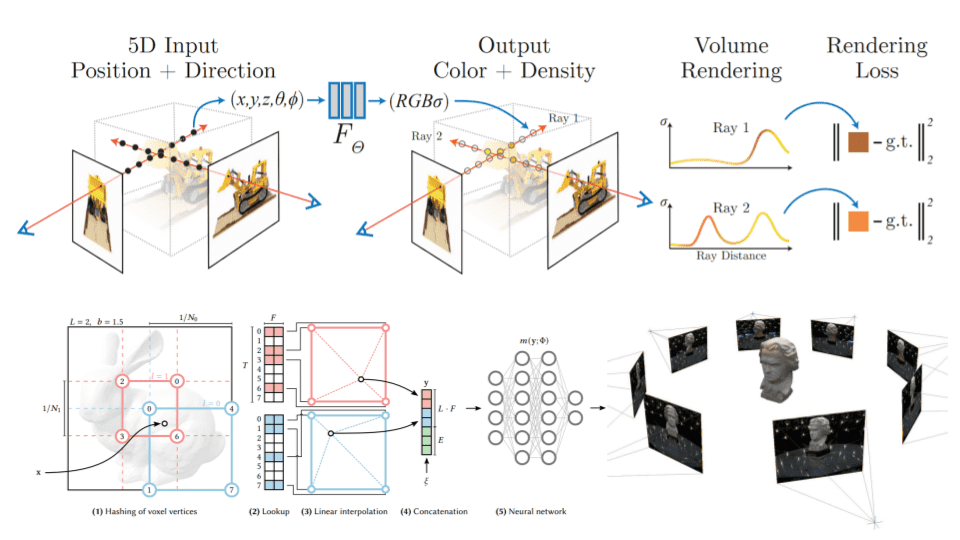
NeRF represents a groundbreaking approach to rendering 3D scenes from 2D images with astonishing detail and photorealism. This technology uses deep learning to interpolate light rays as they travel through space, capturing the color and intensity of light at every point in a scene to create a cohesive and highly detailed 3D representation. For content creators, NeRF offers a way to generate lifelike environments and objects from a relatively sparse set of images, reducing the need for extensive 3D modeling and manual texturing.

Expanded Understanding of Neural Radiance Fields (NeRF)

Neural Radiance Fields (NeRF) is a novel framework in the field of computer vision and graphics, enabling the synthesis of highly realistic images from any viewpoint using a sparse set of 2D input images. At its core, NeRF utilizes a fully connected deep neural network to model the volumetric scene functionally, capturing the intricate play of light and color in a 3D space. This section aims to demystify NeRF for technologists, illustrating its fundamental concepts and practical applications to anchor understanding.

Fundamentals of NeRF

NeRF represents a scene using a continuous 5D function, where each point in space (defined by its x, y, z coordinates) and each viewing direction (defined by angles θ and φ) is mapped to a color (RGB) and a volume density. This mapping is achieved through a neural network that takes these 5D coordinates as input and predicts the color and density at that point. Here’s how it breaks down:

  • Volume Density: This measure indicates the opaqueness of a point in space. High density suggests a solid object, while low density implies empty space or transparency.
  • Color Output: The predicted color at a point, given a specific viewing direction, accounts for how light interacts with objects in the environment.

When rendering an image, NeRF integrates these predictions along camera rays, a process that simulates how light travels and scatters in a real 3D environment, culminating in photorealistic image synthesis.

Training and Rendering

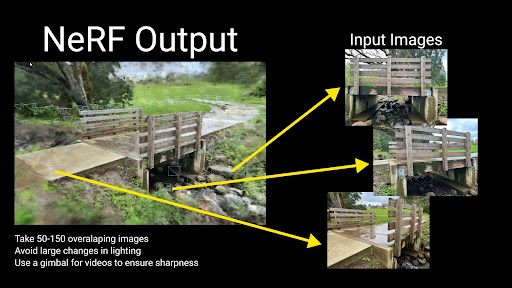
To train a NeRF model, you need a set of images of a scene from various angles, each with its corresponding camera position and orientation. The training process involves adjusting the neural network parameters until the rendered views match the training images as closely as possible. This iterative optimization enables NeRF to interpolate and reconstruct the scene with high fidelity.

During rendering, NeRF computes the color and density for numerous points along each ray emanating from the camera into the scene, aggregating this information to form the final image. This ray-marching process, although computationally intensive, results in images with impressive detail and realism.

Practical Examples and Applications

  1. Virtual Tourism: Imagine exploring a detailed 3D model of the Colosseum in Rome, created from a set of tourist photos. NeRF can generate any viewpoint, allowing users to experience the site from angles never captured in the original photos.
  2. Film and Visual Effects: In filmmaking, NeRF can help generate realistic backgrounds or virtual sets from a limited set of reference photos, significantly reducing the need for physical sets or extensive location shooting.
  3. Cultural Heritage Preservation: By capturing detailed 3D models of historical sites or artifacts from photographs, NeRF aids in preserving and studying these treasures, making them accessible for virtual exploration.
  4. Product Visualization: Companies can use NeRF to create realistic 3D models of their products from a series of photographs, enabling interactive customer experiences online, such as viewing the product from any angle or in different lighting conditions.

Key Concepts in Neural Radiance Fields (NeRF)

To understand Neural Radiance Fields (NeRF) thoroughly, it is essential to grasp its foundational concepts and appreciate how these principles translate into the generation of photorealistic 3D scenes. Below, we delve deeper into the key concepts of NeRF, providing examples to elucidate their practical significance.

Scene Representation

NeRF models a scene using a continuous, high-dimensional function that encodes the volumetric density and color information at every point in space, relative to the viewer’s perspective.

  • Example: Consider a NeRF model creating a 3D representation of a forest. For each point in space, whether on the surface of a tree trunk, within its canopy, or in the open air, the model assigns both a density (indicating whether the point contributes to the scene’s geometry) and a color (reflecting the appearance under particular lighting conditions). This detailed encoding allows for the realistic rendering of the forest from any viewpoint, capturing the nuances of light filtering through leaves or the texture of the bark on the trees.

Photorealism

NeRF’s ability to synthesize highly realistic images from any perspective is one of its most compelling attributes, driven by its precise modeling of light interactions within a scene.

  • Example: If a NeRF model is applied to replicate a glass sculpture, it would capture how light bends through the glass and the subtle color shifts resulting from its interaction with the material. The end result is a set of images so detailed and accurate that viewers might struggle to differentiate them from actual photographs of the sculpture.

Efficiency

Despite the high computational load required during the training phase, once a NeRF model is trained, it can render new views of a scene relatively quickly and with fewer resources compared to traditional 3D rendering techniques.

  • Example: After a NeRF model has been trained on a dataset of a car, it can generate new views of this car from angles not included in the original dataset, without the need to re-render the model entirely from scratch. This capability is particularly valuable for applications like virtual showrooms, where potential buyers can explore a vehicle from any angle or lighting condition, all generated with minimal delay.

Continuous View Synthesis

NeRF excels at creating smooth transitions between different viewpoints in a scene, providing a seamless viewing experience that traditional 3D models struggle to match.

  • Example: In a virtual house tour powered by NeRF, as the viewer moves from room to room, the transitions are smooth and realistic, with no abrupt changes in texture or lighting. This continuous view synthesis not only enhances the realism but also makes the virtual tour more engaging and immersive.

Handling of Complex Lighting and Materials

NeRF’s nuanced understanding of light and material interaction enables it to handle complex scenarios like transparency, reflections, and shadows with a high degree of realism.

  • Example: When rendering a scene with a pond, NeRF accurately models the reflections of surrounding trees and the sky in the water, the transparency of the water with varying depths, and the play of light and shadow on the pond’s bed, providing a remarkably lifelike representation.

The key concepts of NeRF—scene representation, photorealism, efficiency, continuous view synthesis, and advanced handling of lighting and materials—are what empower this technology to create stunningly realistic 3D environments from a set of 2D images. By understanding these concepts, technologists and content creators can better appreciate the potential applications and implications of NeRF, from virtual reality and filmmaking to architecture and beyond. As NeRF continues to evolve, its role in shaping the future of digital content and experiences is likely to expand, offering ever more immersive and engaging ways to interact with virtual worlds.

Advancements in Text-to-Video AI

Parallel to the developments in NeRF, text-to-video AI technologies are transforming the content landscape by enabling creators to generate video content directly from textual descriptions. This capability leverages advanced natural language processing and deep learning techniques to understand and visualize complex narratives, scenes, and actions described in text, translating them into engaging video content.

Integration with NeRF:

  • Dynamic Content Generation: Combining NeRF with text-to-video AI allows creators to generate realistic 3D environments that can be seamlessly integrated into video narratives, all driven by textual descriptions.
  • Customization and Flexibility: Content creators can use natural language to specify details about environments, characters, and actions, which NeRF and text-to-video AI can then bring to life with high fidelity.

OpenAI’s Sora: A Case Study in NeRF and Text-to-Video AI Convergence

OpenAI’s Sora exemplifies the integration of NeRF and text-to-video AI, illustrating the potential of these technologies to revolutionize content creation. Sora leverages NeRF to create detailed, realistic 3D environments from textual inputs, which are then animated and rendered into dynamic video content using text-to-video AI algorithms.

OpenAI Sora: SUV in The Dust

Implications for Content Creators:

  • Enhanced Realism: Sora enables the production of videos with lifelike environments and characters, raising the bar for visual quality and immersion.
  • Efficiency: By automating the creation of complex scenes and animations, Sora reduces the time and resources required to produce high-quality video content.
  • Accessibility: With Sora, content creators do not need deep technical expertise in 3D modeling or animation to create compelling videos, democratizing access to advanced content creation tools.

Conclusion

The integration of NeRF and text-to-video AI, as demonstrated by OpenAI’s Sora, marks a significant milestone in the evolution of content creation technology. It offers content creators unparalleled capabilities to produce realistic, engaging, and personalized video content efficiently and at scale.

As we look to the future, the continued advancement of these technologies will further expand the possibilities for creative expression and storytelling, enabling creators to bring even the most ambitious visions to life. For junior practitioners and seasoned professionals alike, understanding the potential and applications of NeRF and text-to-video AI is essential for staying at the forefront of the digital content creation revolution.

In conclusion, the convergence of NeRF and text-to-video AI is not just a technical achievement; it represents a new era in storytelling, where the barriers between imagination and reality are increasingly blurred. For content creators and consumers alike, this is a journey just beginning, promising a future rich with possibilities that are as limitless as our creativity.

Unveiling the Future: Gaussian Splatting in Text-to-Video AI

Introduction

In the rapidly evolving landscape of artificial intelligence, the introduction of text-to-video AI technologies marks a significant milestone. We highlighted the introduction and advancement of OpenAI’s product suite with their introduction of Sora (text-to-video) in our previous post. Embedded in these products, and typically without a lot of marketing fanfare are the technologies that continually drive this innovation and specifically one of them, Gaussian splatting, has emerged as a pivotal technique. This blog post delves into the intricacies of Gaussian splatting, its integration with current AI prompt technology, and its crucial role in enhancing content creation through text-to-video AI. Our aim is to provide a comprehensive understanding of this technology, making it accessible not only to seasoned professionals but also to junior practitioners eager to grasp the future of AI-driven content creation. Additionally, a companion technology is often discussed hand-in-hand with Gaussian splatting and that is called, Neural Radiance Fields (NeRF) and we will dive into that topic in a future post.

Understanding Gaussian Splatting

Gaussian splatting is a sophisticated technique used in the realm of computer graphics and image processing. It involves the use of Gaussian functions to simulate the effects of splatting or scattering light and particles. This method is particularly effective in creating realistic textures and effects in digital images by smoothly blending colors and intensities.

In the context of AI, Gaussian splatting plays a fundamental role in generating high-quality, realistic images and videos from textual descriptions. The technique allows for the seamless integration of various elements within a scene, ensuring that the generated visuals are not only convincing but also aesthetically pleasing.

Gaussian splatting, as a technique, is integral to many advanced computer graphics and image processing applications, particularly those involving the generation of realistic textures, lighting, and smooth transitions between visual elements. In the context of AI-driven platforms like OpenAI’s Sora, which is designed to generate video content from text prompts, Gaussian splatting and similar techniques are foundational to achieving high-quality, realistic outputs.

Is Gaussian Splatting Automatically Embedded?

In products like Sora, Gaussian splatting and other advanced image processing techniques are typically embedded within the AI models themselves. These models are trained on vast datasets that include examples of realistic textures, lighting effects, and color transitions, learning how to replicate these effects in generated content. This means that the application of Gaussian splatting is automatic and integrated into the content generation process, requiring no manual intervention from the user.

Understanding the Role of Gaussian Splatting in AI Products

For AI-driven content creation tools:

  • Automatic Application: Advanced techniques like Gaussian splatting are embedded within the AI’s algorithms, ensuring that the generated images, videos, or other visual content automatically include these effects for realism and visual appeal.
  • No Manual Requirement: Users do not need to apply Gaussian splatting or similar techniques manually. The focus is on inputting creative prompts, while the AI handles the complex task of rendering realistic outputs based on its training and built-in processing capabilities.
  • Enhanced Quality and Realism: The integration of such techniques is crucial for achieving the high quality and realism that users expect from AI-generated content. It enables the creation of visuals that are not just technically impressive but also emotionally resonant and engaging.

Expanding on Gaussian Splatting

Visually Understanding Gaussian Splatting

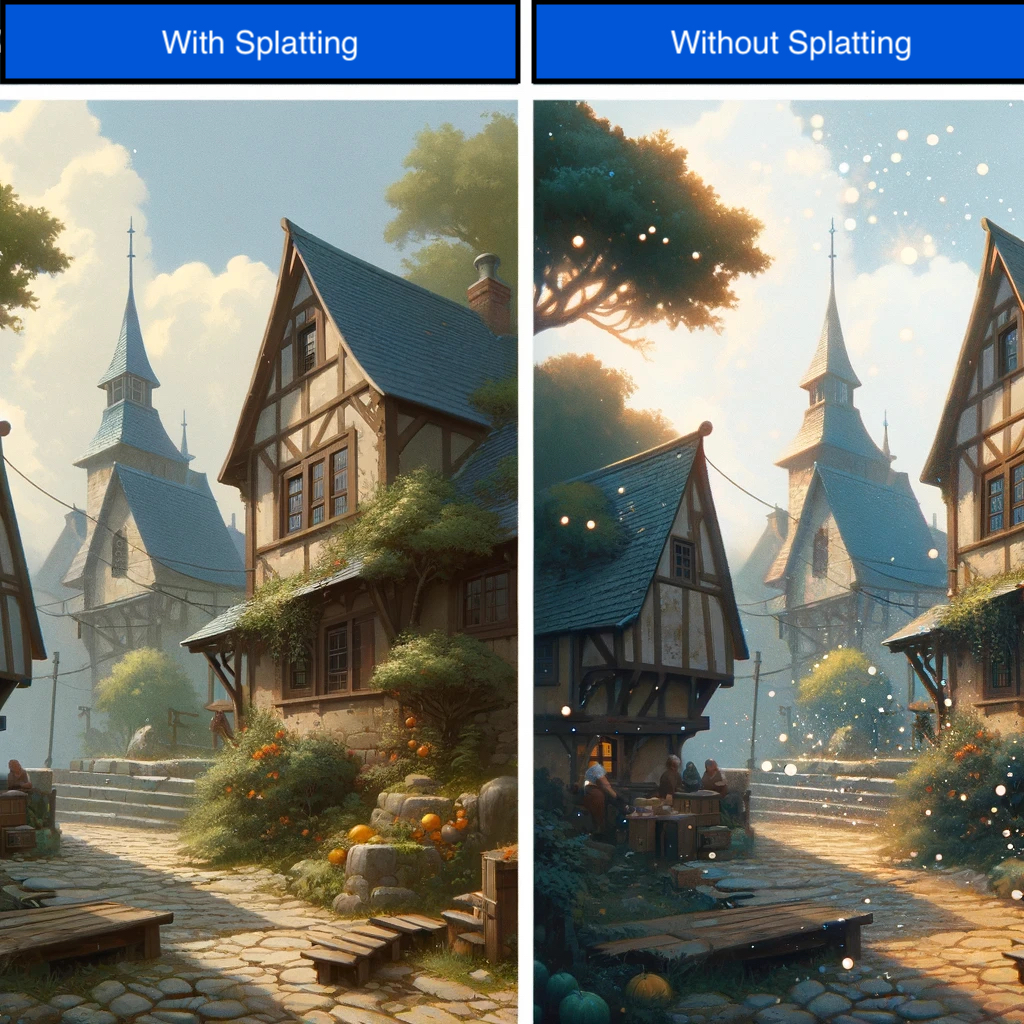
To deepen your understanding of Gaussian splatting, let’s examine an illustrative comparison. This illustration contrasts a scene with Gaussian splatting against one where Gaussian splatting is not applied. In the later, you’ll notice harsh transitions and unrealistic blending of elements, resulting in a scene that feels disjointed and artificial. Conversely, the scene employing Gaussian splatting showcases smooth color transitions and realistic effects, significantly enhancing the visual realism and aesthetic appeal.

Example: Enhancing Realism in Digital Imagery

Consider a sunset beach scene where people are walking along the shore. Without Gaussian splatting, the sunlight’s diffusion, shadows cast by the people, and the blending of the sky’s colors could appear abrupt and unnatural. The transitions between different elements of the scene might be too stark, detracting from the overall realism.

Now, apply Gaussian splatting to the same scene. This technique uses Gaussian functions to simulate the natural diffusion of light and the soft blending of colors. The result is a more lifelike representation of the sunset, with gently blended skies and realistically rendered shadows on the sand. The people walking on the beach are integrated into the scene seamlessly, with their outlines and the surrounding environment blending in a way that mimics the natural observation of such a scene.

This visual and example highlight the significance of Gaussian splatting in creating digital images and videos that are not just visually appealing but also convincingly realistic. By understanding and applying this technique, content creators can push the boundaries of digital realism, making artificial scenes indistinguishable from real-life observations.

The Advent of Text-to-Video AI

Text-to-video AI represents the next leap in content creation, enabling users to generate complex video content from simple text prompts. This technology leverages deep learning models to interpret textual descriptions and translate them into dynamic visual narratives. The process encompasses a wide range of tasks, including scene composition, object placement, motion planning, and the rendering of realistic textures and lighting effects.

Gaussian splatting becomes instrumental in this process, particularly in the rendering phase, where it ensures that the visual elements are blended naturally. It contributes to the realism and dynamism of the generated videos, making the technology invaluable for content creators seeking to produce high-quality visual content efficiently.

Integration with AI Prompt Technology

The integration of Gaussian splatting with AI prompt technology is a cornerstone of text-to-video AI systems. AI prompt technology refers to the mechanisms by which users can instruct AI models using natural language. These prompts are then interpreted by the AI to generate content that aligns with the user’s intent.

In the case of text-to-video AI, Gaussian splatting is employed to refine the visual output based on the textual prompts. For example, if a prompt describes a sunset scene with people walking on the beach, Gaussian splatting helps in creating the soft transitions of the sunset’s colors and the realistic blending of the people’s shadows on the sand. This ensures that the final video output closely matches the scene described in the prompt, with natural-looking effects and transitions.

OpenAI’s Sora: A Case Study in Innovation

OpenAI’s Sora stands as a testament to the potential of integrating Gaussian splatting with text-to-video AI. Sora is designed to offer content creators a powerful tool for generating high-quality video content directly from text descriptions. The platform utilizes advanced AI models, including those trained on Gaussian splatting techniques, to produce videos that are not only visually stunning but also deeply engaging.

The significance of Gaussian splatting in Sora’s technology stack cannot be overstated. It allows Sora to achieve a level of visual fidelity and realism that sets a new standard for AI-generated content. This makes Sora an invaluable asset for professionals in marketing, and digital content creation, who can leverage the platform to create compelling visual narratives with minimal effort.

Key Topics for Discussion and Understanding

To fully appreciate the impact of Gaussian splatting in text-to-video AI, several key topics warrant discussion:

  • Realism and Aesthetics: Understanding how Gaussian splatting contributes to the realism and aesthetic quality of AI-generated videos.
  • Efficiency in Content Creation: Exploring how this technology streamlines the content creation process, enabling faster production times without compromising on quality.
  • AI Prompt Technology: Delving into the advancements in AI prompt technology that make it possible to accurately translate text descriptions into complex visual content.
  • Applications and Implications: Considering the broad range of applications for text-to-video AI and the potential implications for industries such as marketing, entertainment, and education.

Conclusion

Gaussian splatting represents a critical technological advancement in the field of text-to-video AI, offering unprecedented opportunities for content creators. By understanding this technology and its integration with AI prompt technology, professionals can harness the power of platforms like OpenAI’s Sora to revolutionize the way visual content is created and consumed. As we look to the future, the potential of Gaussian splatting in enhancing digital transformation and customer experience through AI-driven content creation is immense, promising a new era of creativity and innovation in the digital landscape.

The Inevitable Disruption of Text-to-Video AI for Content Creators: Navigating the Future Landscape

Introduction

On Thursday 02/15/2024 we heard about the latest development from OpenAI – Sora (Text-to-Video AI). The introduction of OpenAI’s Sora into the public marketplace is set to revolutionize the content and media creation landscape over the next five years. This transformation will be driven by Sora’s advanced capabilities in generating, understanding, and processing natural language, as well as its potential for creative content generation. The impact on content creators, media professionals, and the broader ecosystem will be multifaceted, influencing production processes, content personalization, and the overall economics of the media industry.


Transformation of Content Creation Processes

Sora’s advanced AI capabilities can significantly streamline the content creation process, making it more efficient and cost-effective. For writers, journalists, and digital content creators, Sora can offer real-time suggestions, improve drafting efficiency, and provide editing assistance to enhance the quality of the output. This can lead to a reduction in the time and resources required to produce high-quality content, allowing creators to focus more on the creative and strategic aspects of their work.

Personalization and User Engagement

In the realm of media and entertainment, Sora’s ability to analyze and understand audience preferences at a granular level will enable unprecedented levels of content personalization. Media companies can leverage Sora to tailor content to individual user preferences, improving engagement and user satisfaction. This could manifest in personalized news feeds, customized entertainment recommendations, or even dynamically generated content that adapts to the user’s interests and behaviors. Such personalization capabilities are likely to redefine the standards for user experience in digital media platforms. So, let’s dive a bit deeper into how this technology can advance personalization and user engagement within the marketplace.

Examples of Personalization and User Engagement

1. Personalized News Aggregation:

  • Pros: Platforms can use Sora to curate news content tailored to the individual interests and reading habits of each user. For example, a user interested in technology and sustainability might receive a news feed focused on the latest in green tech innovations, while someone interested in finance and sports might see articles on sports economics. This not only enhances user engagement but also increases the time spent on the platform.
  • Cons: Over-personalization can lead to the creation of “filter bubbles,” where users are exposed only to viewpoints and topics that align with their existing beliefs and interests. This can narrow the diversity of content consumed and potentially exacerbate societal divisions.

2. Customized Learning Experiences:

  • Pros: Educational platforms can leverage Sora to adapt learning materials to the pace and learning style of each student. For instance, a visual learner might receive more infographic-based content, while a verbal learner gets detailed textual explanations. This can improve learning outcomes and student engagement.
  • Cons: There’s a risk of over-reliance on automated personalization, which might overlook the importance of exposing students to challenging materials that are outside their comfort zones, potentially limiting their learning scope.

3. Dynamic Content Generation for Entertainment:

  • Pros: Streaming services can use Sora to dynamically alter storylines, music, or visual elements based on user preferences. For example, a streaming platform could offer multiple storyline outcomes in a series, allowing users to experience a version that aligns with their interests or past viewing behaviors.
  • Cons: This level of personalization might reduce the shared cultural experiences that traditional media offers, as audiences fragment across personalized content paths. It could also challenge creators’ artistic visions when content is too heavily influenced by algorithms.

4. Interactive Advertising:

  • Pros: Advertisers can utilize Sora to create highly targeted and interactive ad content that resonates with the viewer’s specific interests and behaviors, potentially increasing conversion rates. For example, an interactive ad could adjust its message or product recommendations in real-time based on how the user interacts with it.
  • Cons: Highly personalized ads raise privacy concerns, as they rely on extensive data collection and analysis of user behavior. There’s also the risk of user fatigue if ads become too intrusive or overly personalized, leading to negative brand perceptions.

Navigating the Pros and Cons

To maximize the benefits of personalization while mitigating the downsides, content creators and platforms need to adopt a balanced approach. This includes:

  • Transparency and Control: Providing users with clear information about how their data is used for personalization and offering them control over their personalization settings.
  • Diversity and Exposure: Implementing algorithms that occasionally introduce content outside of the user’s usual preferences to broaden their exposure and prevent filter bubbles.
  • Ethical Data Use: Adhering to ethical standards for data collection and use, ensuring user privacy is protected, and being transparent about data handling practices.

While Sora’s capabilities in personalization and user engagement offer exciting opportunities for content and media creation, they also come with significant responsibilities. Balancing personalization benefits with the need for privacy, diversity, and ethical considerations will be key to harnessing this technology effectively.


Expansion of Creative Possibilities

Sora’s potential to generate creative content opens up new possibilities for media creators. This includes the creation of written content, such as articles, stories, and scripts, as well as the generation of artistic elements like graphics, music, and video content. By augmenting human creativity, Sora can help creators explore new ideas, themes, and formats, potentially leading to the emergence of new genres and forms of media. This democratization of content creation could also lower the barriers to entry for aspiring creators, fostering a more diverse and vibrant media landscape. We will dive a bit deeper into these creative possibilities by exploring the Pros and Cons.

Pros:

  • Enhanced Creative Tools: Sora can act as a powerful tool for creators, offering new ways to generate ideas, draft content, and even create complex narratives. For example, a novelist could use Sora to brainstorm plot ideas or develop character backstories, significantly speeding up the writing process and enhancing the depth of their stories.
  • Accessibility to Creation: With Sora, individuals who may not have traditional artistic skills or technical expertise can participate in creative endeavors. For instance, someone with a concept for a graphic novel but without the ability to draw could use Sora to generate visual art, making creative expression more accessible to a broader audience.
  • Innovative Content Formats: Sora’s capabilities could lead to the creation of entirely new content formats that blend text, visuals, and interactive elements in ways previously not possible. Imagine an interactive educational platform where content dynamically adapts to each student’s learning progress and interests, offering a highly personalized and engaging learning experience.

Cons:

  • Potential for Diminished Human Creativity: There’s a concern that over-reliance on AI for creative processes could diminish the value of human creativity. If AI-generated content becomes indistinguishable from human-created content, it could devalue original human artistry and creativity in the public perception.
  • Intellectual Property and Originality Issues: As AI-generated content becomes more prevalent, distinguishing between AI-assisted and purely human-created content could become challenging. This raises questions about copyright, ownership, and the originality of AI-assisted works. For example, if a piece of music is composed with the help of Sora, determining the rights and ownership could become complex.
  • Homogenization of Content: While AI like Sora can generate content based on vast datasets, there’s a risk that it might produce content that leans towards what is most popular or trending, potentially leading to a homogenization of content. This could stifle diversity in creative expression and reinforce existing biases in media and art.

Navigating the Pros and Cons

To harness the creative possibilities of Sora while addressing the challenges, several strategies can be considered:

  • Promoting Human-AI Collaboration: Encouraging creators to use Sora as a collaborative tool rather than a replacement for human creativity can help maintain the unique value of human artistry. This approach leverages AI to enhance and extend human capabilities, not supplant them.
  • Clear Guidelines for AI-generated Content: Developing industry standards and ethical guidelines for the use of AI in creative processes can help address issues of copyright and originality. This includes transparently acknowledging the use of AI in the creation of content.
  • Diversity and Bias Mitigation: Actively working to ensure that AI models like Sora are trained on diverse datasets and are regularly audited for bias can help prevent the homogenization of content and promote a wider range of voices and perspectives in media and art.

Impact on the Economics of Media Production

The efficiencies and capabilities introduced by Sora are likely to have profound implications for the economics of media production. Reduced production costs and shorter development cycles can make content creation more accessible and sustainable, especially for independent creators and smaller media outlets. However, this could also lead to increased competition and a potential oversaturation of content, challenging creators to find new ways to stand out and monetize their work. While this topic is always considered sensitive, if we can look at it from pro versus con perspective, perhaps we can address it with a neutral focus.

Impact on Cost Structures

Pros:

  • Reduced Production Costs: Sora can automate aspects of content creation, such as writing, editing, and even some elements of video production, reducing the need for large production teams and lowering costs. For example, a digital news outlet could use Sora to generate first drafts of articles based on input data, allowing journalists to focus on adding depth and context, thus speeding up the production process and reducing labor costs.
  • Efficiency in Content Localization: Media companies looking to expand globally can use Sora to automate the translation and localization of content, making it more cost-effective to reach international audiences. This could significantly lower the barriers to global content distribution.

Cons:

  • Initial Investment and Training: The integration of Sora into media production workflows requires upfront investment in technology and training for staff. Organizations may face challenges in adapting existing processes to leverage AI capabilities effectively, which could initially increase costs.
  • Dependence on AI: Over-reliance on AI for content production could lead to a homogenization of content, as algorithms might favor formats and topics that have historically performed well, potentially stifacing creativity and innovation.

Impact on Revenue Models

Pros:

  • New Monetization Opportunities: Sora enables the creation of personalized content at scale, opening up new avenues for monetization. For instance, media companies could offer premium subscriptions for highly personalized news feeds or entertainment content, adding a new revenue stream.
  • Enhanced Ad Targeting: The deep understanding of user preferences and behaviors facilitated by Sora can improve ad targeting, leading to higher ad revenues. For example, a streaming service could use viewer data analyzed by Sora to place highly relevant ads, increasing viewer engagement and advertiser willingness to pay.

Cons:

  • Shift in Consumer Expectations: As consumers get accustomed to personalized and AI-generated content, they might become less willing to pay for generic content offerings. This could pressure media companies to continuously invest in AI to keep up with expectations, potentially eroding profit margins.
  • Ad Blockers and Privacy Tools: The same technology that allows for enhanced ad targeting might also lead to increased use of ad blockers and privacy tools by users wary of surveillance and data misuse, potentially impacting ad revenue.

Impact on the Competitive Landscape

Pros:

  • Level Playing Field for Smaller Players: Sora can democratize content production, allowing smaller media companies and independent creators to produce high-quality content at a lower cost. This could lead to a more diverse media landscape with a wider range of voices and perspectives.
  • Innovation and Differentiation: Companies that effectively integrate Sora into their production processes can innovate faster and differentiate their offerings, capturing market share from competitors who are slower to adapt.

Cons:

  • Consolidation Risk: Larger companies with more resources to invest in AI could potentially dominate the market, leveraging Sora to produce content more efficiently and at a larger scale than smaller competitors. This could lead to consolidation in the media industry, reducing diversity in content and viewpoints.

Navigating the Pros and Cons

To effectively navigate these economic impacts, media companies and content creators need to:

  • Invest in skills and training to ensure their teams can leverage AI tools like Sora effectively.
  • Develop ethical guidelines and transparency around the use of AI in content creation to maintain trust with audiences.
  • Explore innovative revenue models that leverage the capabilities of AI while addressing consumer concerns about privacy and data use.

Ethical and Societal Considerations

As Sora influences the content and media industry, ethical and societal considerations will come to the forefront. Issues such as copyright, content originality, misinformation, and the impact of personalized content on societal discourse will need to be addressed. Media creators and platforms will have to navigate these challenges carefully, establishing guidelines and practices that ensure responsible use of AI in content creation while fostering a healthy, informed, and engaged public discourse.

Conclusion

Over the next five years, OpenAI’s Sora is poised to significantly impact the content and media creation industry by enhancing creative processes, enabling personalized experiences, and transforming the economics of content production. As these changes unfold, content and media professionals will need to adapt to the evolving landscape, leveraging Sora’s capabilities to enhance creativity and engagement while addressing the ethical and societal implications of AI-driven content creation.

Inside the RAG Toolbox: Understanding Retrieval-Augmented Generation for Advanced Problem Solving

Introduction

We continue our discussion about RAG from last week’s post, as the topic has garnered some attention this week in the press and it’s always of benefit to be ahead of the narrative in an ever evolving technological landscape such as AI.

Retrieval-Augmented Generation (RAG) models represent a cutting-edge approach in natural language processing (NLP) that combines the best of two worlds: the retrieval of relevant information and the generation of coherent, contextually accurate responses. This post aims to guide practitioners in understanding and applying RAG models in solving complex business problems and effectively explaining these concepts to junior team members to make them comfortable in front of clients and customers.

What is a RAG Model?

At its core, a RAG model is a hybrid machine learning model that integrates retrieval (searching and finding relevant information) with generation (creating text based on the retrieved data). This approach enables the model to produce more accurate and contextually relevant responses than traditional language models. It’s akin to having a researcher (retrieval component) working alongside a writer (generation model) to answer complex queries.

The Retrieval Component

The retrieval component of Retrieval-Augmented Generation (RAG) systems is a sophisticated and crucial element, it functions like a highly efficient librarian for sourcing relevant information that forms the foundation for the generation of accurate and contextually appropriate responses. It operates on the principle of understanding and matching the context and semantics of the user’s query to the vast amount of data it has access to. Typically built upon advanced neural network architectures like BERT (Bidirectional Encoder Representations from Transformers), the retrieval component excels in comprehending the nuanced meanings and relationships within the text. BERT’s prowess in understanding the context of words in a sentence by considering the words around them makes it particularly effective in this role.

In a typical RAG setup, the retrieval component first processes the input query, encoding it into a vector representation that captures its semantic essence. Simultaneously, it maintains a pre-processed, encoded database of potential source texts or information. The retrieval process then involves comparing the query vector with the vectors of the database contents, often employing techniques like cosine similarity or other relevance metrics to find the best matches. This step ensures that the information fetched is the most pertinent to the query’s context and intent.

The sophistication of this component is evident in its ability to sift through and understand vast and varied datasets, ranging from structured databases to unstructured text like articles and reports. Its effectiveness is not just in retrieving the most obvious matches but in discerning subtle relevance that might not be immediately apparent. For example, in a customer service application, the retrieval component can understand a customer’s query, even if phrased unusually, and fetch the most relevant information from a comprehensive knowledge base, including product details, customer reviews, or troubleshooting guides. This capability of accurately retrieving the right information forms the bedrock upon which the generation models build coherent and contextually rich responses, making the retrieval component an indispensable part of the RAG framework.

Applications of the Retrieval Component:

  1. Healthcare and Medical Research: In the healthcare sector, the retrieval component can be used to sift through vast medical records, research papers, and clinical trial data to assist doctors and researchers in diagnosing diseases, understanding patient histories, and staying updated with the latest medical advancements. For instance, when a doctor inputs symptoms or a specific medical condition, the system retrieves the most relevant case studies, treatment options, and research findings, aiding in informed decision-making.
  2. Legal Document Analysis: In the legal domain, the retrieval component can be used to search through extensive legal databases and past case precedents. This is particularly useful for lawyers and legal researchers who need to reference previous cases, laws, and legal interpretations that are relevant to a current case or legal query. It streamlines the process of legal research by quickly identifying pertinent legal documents and precedents.
  3. Academic Research and Literature Review: For scholars and researchers, the retrieval component can expedite the literature review process. It can scan academic databases and journals to find relevant publications, research papers, and articles based on specific research queries or topics. This application not only saves time but also ensures a comprehensive understanding of the existing literature in a given field.
  4. Financial Market Analysis: In finance, the retrieval component can be utilized to analyze market trends, company performance data, and economic reports. It can retrieve relevant financial data, news articles, and market analyses in real time, assisting financial analysts and investors in making data-driven investment decisions and understanding market dynamics.
  5. Content Recommendation in Media and Entertainment: In the media and entertainment industry, the retrieval component can power recommendation systems by fetching content aligned with user preferences and viewing history. Whether it’s suggesting movies, TV shows, music, or articles, the system can analyze user data and retrieve content that matches their interests, enhancing the user experience on streaming platforms, news sites, and other digital media services.

The Generation Models: Transformers and Beyond

Once the relevant information is retrieved, generation models come into play. These are often based on Transformer architectures, renowned for their ability to handle sequential data and generate human-like text.

Transformer Models in RAG:

  • BERT (Bidirectional Encoder Representations from Transformers): Known for its deep understanding of language context.
  • GPT (Generative Pretrained Transformer): Excels in generating coherent and contextually relevant text.

To delve deeper into the models used with Retrieval-Augmented Generation (RAG) and their deployment, let’s explore the key components that form the backbone of RAG systems. These models are primarily built upon the Transformer architecture, which has revolutionized the field of natural language processing (NLP). Two of the most significant models in this domain are BERT (Bidirectional Encoder Representations from Transformers) and GPT (Generative Pretrained Transformer).

BERT in RAG Systems

  1. Overview: BERT, developed by Google, is known for its ability to understand the context of a word in a sentence by looking at the words that come before and after it. This is crucial for the retrieval component of RAG systems, where understanding context is key to finding relevant information.
  2. Deployment: In RAG, BERT can be used to encode the query and the documents in the database. This encoding helps in measuring the semantic similarity between the query and the available documents, thereby retrieving the most relevant information.
  3. Example: Consider a RAG system deployed in a customer service scenario. When a customer asks a question, BERT helps in understanding the query’s context and retrieves information from a knowledge base, like FAQs or product manuals, that best answers the query.

GPT in RAG Systems

  1. Overview: GPT, developed by OpenAI, is a model designed for generating text. It can predict the probability of a sequence of words and hence, can generate coherent and contextually relevant text. This is used in the generation component of RAG systems.
  2. Deployment: After the retrieval component fetches the relevant information, GPT is used to generate a response that is not only accurate but also fluent and natural-sounding. It can stitch together information from different sources into a coherent answer.
  3. Example: In a market research application, once the relevant market data is retrieved by the BERT component, GPT could generate a comprehensive report that synthesizes this information into an insightful analysis.

Other Transformer Models in RAG

Apart from BERT and GPT, other Transformer-based models also play a role in RAG systems. These include models like RoBERTa (a robustly optimized BERT approach) and T5 (Text-To-Text Transfer Transformer). Each of these models brings its strengths, like better handling of longer texts or improved accuracy in specific domains.

Practical Application

The practical application of these models in RAG systems spans various domains. For instance, in a legal research tool, BERT could retrieve relevant case laws and statutes based on a lawyer’s query, and GPT could help in drafting a legal document or memo by synthesizing this information.

  1. Customer Service Automation: RAG models can provide precise, informative responses to customer inquiries, enhancing the customer experience.
  2. Market Analysis Reports: They can generate comprehensive market analysis by retrieving and synthesizing relevant market data.

In conclusion, the integration of models like BERT and GPT within RAG systems offers a powerful toolset for solving complex NLP tasks. These models, rooted in the Transformer architecture, work in tandem to retrieve relevant information and generate coherent, contextually aligned responses, making them invaluable in various real-world applications (Sushant Singh and A. Mahmood).

Real-World Case Studies

Case Study 1: Enhancing E-commerce Customer Support

An e-commerce company implemented a RAG model to handle customer queries. The retrieval component searched through product databases, FAQs, and customer reviews to find relevant information. The generation model then crafted personalized responses, resulting in improved customer satisfaction and reduced response time.

Case Study 2: Legal Research and Analysis

A legal firm used a RAG model to streamline its research process. The retrieval component scanned through thousands of legal documents, cases, and legislations, while the generation model summarized the findings, aiding lawyers in case preparation and legal strategy development.

Solving Complex Business Problems with RAG

RAG models can be instrumental in solving complex business challenges. For instance, in predictive analytics, a RAG model can retrieve historical data and generate forecasts. In content creation, it can amalgamate research from various sources to generate original content.

Tips for RAG Prompt Engineering:

  1. Define Clear Objectives: Understand the specific problem you want the RAG model to solve.
  2. Tailor the Retrieval Database: Customize the database to ensure it contains relevant and high-quality information.
  3. Refine Prompts for Specificity: The more specific the prompt, the more accurate the retrieval and generation will be.

Educating Junior Team Members

When explaining RAG models to junior members, focus on the synergy between the retrieval and generation components. Use analogies like a librarian (retriever) and a storyteller (generator) working together to create accurate, comprehensive narratives.

Hands-on Exercises:

  1. Role-Playing Exercise:
    • Setup: Divide the team into two groups – one acts as the ‘Retrieval Component’ and the other as the ‘Generation Component’.
    • Task: Give the ‘Retrieval Component’ group a set of data or documents and a query. Their task is to find the most relevant information. The ‘Generation Component’ group then uses this information to generate a coherent response.
    • Learning Outcome: This exercise helps in understanding the collaborative nature of RAG systems and the importance of precision in both retrieval and generation.
  2. Prompt Refinement Workshop:
    • Setup: Present a series of poorly formulated prompts and their outputs.
    • Task: Ask the team to refine these prompts to improve the relevance and accuracy of the outputs.
    • Learning Outcome: This workshop emphasizes the importance of clear and specific prompts in RAG systems and how they affect the output quality.
  3. Case Study Analysis:
    • Setup: Provide real-world case studies where RAG systems have been implemented.
    • Task: Analyze the prompts used in these case studies, discuss why they were effective, and explore potential improvements.
    • Learning Outcome: This analysis offers insights into practical applications of RAG systems and the nuances of prompt engineering in different contexts.
  4. Interactive Q&A Sessions:
    • Setup: Create a session where team members can input prompts into a RAG system and observe the responses.
    • Task: Encourage them to experiment with different types of prompts and analyze the system’s responses.
    • Learning Outcome: This hands-on experience helps in understanding how different prompt structures influence the output.
  5. Prompt Design Challenge:
    • Setup: Set up a challenge where team members design prompts for a hypothetical business problem.
    • Task: Evaluate the prompts based on their clarity, relevance, and potential effectiveness in solving the problem.
    • Learning Outcome: This challenge fosters creative thinking and practical skills in designing effective prompts for real-world problems.

By incorporating these examples and exercises into the training process, junior team members can gain a deeper, practical understanding of RAG prompt engineering. It will equip them with the skills to effectively design prompts that lead to more accurate and relevant outputs from RAG systems.

Conclusion

RAG models represent a significant advancement in AI’s ability to process and generate language. By understanding and harnessing their capabilities, businesses can solve complex problems more efficiently and effectively. As these models continue to evolve, their potential applications in various industries are boundless, making them an essential tool in the arsenal of any AI practitioner. Please continue to follow our posts as we explore more about the world of AI and the various topics that support this growing environment.

Artificial General Intelligence: Transforming Customer Experience Management

Introduction

In the realm of technological innovation, Artificial General Intelligence (AGI) stands as a frontier with unparalleled potential. As a team of strategic management consultants specializing in AI, customer experience, and digital transformation, our exploration into AGI’s implications for Customer Experience Management (CEM) is not only a professional pursuit but a fascination. This blog post aims to dissect the integration of AGI in various sectors, focusing on its impact on CEM, while weighing its benefits and drawbacks.

Understanding AGI

Artificial General Intelligence, as discussed in previous blog posts and unlike its counterpart Artificial Narrow Intelligence (ANI), is characterized by its ability to understand, learn, and apply its intelligence broadly, akin to human cognitive abilities. AGI’s theoretical framework promises adaptability and problem-solving across diverse domains, a significant leap from the specialized functions of ANI.

The Intersection with Customer Experience Management

CEM, a strategic approach to managing customer interactions and expectations, stands to be revolutionized by AGI. The integration of AGI in CEM could offer unprecedented personalization, efficiency, and innovation in customer interactions.

Deep Dive: AGI’s Role in Enhancing Customer Experience Management

At the crux of AGI’s intersection with Customer Experience Management (CEM) lies its unparalleled ability to mimic and surpass human-like understanding and responsiveness. This aspect of AGI transforms CEM from a reactive to a proactive discipline. Imagine a scenario where AGI, through its advanced learning algorithms, not only anticipates customer needs based on historical data but also adapts to emerging trends in real-time. This capability enables businesses to offer not just what the customer wants now but what they might need in the future, thereby creating a truly anticipatory customer service experience. Furthermore, AGI can revolutionize the entire customer journey – from initial engagement to post-sales support. For instance, in a retail setting, AGI could orchestrate a seamless omnichannel experience, where the digital and physical interactions are not only consistent but continuously optimized based on customer feedback and behavior. However, this level of personalization and foresight requires a sophisticated integration of AGI into existing CEM systems, ensuring that the technology aligns with and enhances business objectives without compromising customer trust and data privacy. The potential of AGI in CEM is not just about elevating customer satisfaction; it’s about redefining the customer-business relationship in an ever-evolving digital landscape.

The Sectorial Overview

Federal and Public Sector

In the public sphere, AGI’s potential in improving citizen services is immense. By harnessing AGI, government agencies could offer more personalized, efficient services, enhancing overall citizen satisfaction. However, concerns about privacy, security, and ethical use of AGI remain significant challenges.

Private Business Perspective

The private sector, notably in retail, healthcare, and finance, could witness a paradigm shift with AGI-driven CEM. Personalized marketing, predictive analytics for customer behavior, and enhanced customer support are a few facets where AGI could shine. However, the cost of implementation and the need for robust data infrastructure pose challenges.

Benefits of AGI in CEM

  1. Personalization at Scale: AGI can analyze vast datasets, enabling businesses to offer highly personalized experiences to customers.
  2. Predictive Analytics: With its ability to learn and adapt, AGI can predict customer needs and behavior, aiding in proactive service.
  3. Efficient Problem Solving: AGI can handle complex customer queries, reducing response times and improving satisfaction.

Disadvantages and Challenges

  1. Ethical Concerns: Issues like data privacy, algorithmic bias, and decision transparency are critical challenges.
  2. Implementation Cost: Developing and integrating AGI systems can be expensive and resource-intensive.
  3. Adaptability and Trust: Gaining customer trust in AGI-driven systems and ensuring these systems can adapt to diverse scenarios are significant hurdles.

Current Landscape and Pioneers

Leading technology firms like Google’s DeepMind, OpenAI, and IBM are at the forefront of AGI research. For example, DeepMind’s AlphaFold is revolutionizing protein folding predictions, a leap with immense implications in healthcare. In customer experience, companies like Amazon and Salesforce are integrating AI in their customer management systems, paving the way for AGI’s future role.

Practical Examples in Business

  1. Retail: AGI can power recommendation engines, offering personalized shopping experiences, and optimizing supply chains.
  2. Healthcare: From personalized patient care to advanced diagnostics, AGI can significantly enhance patient experiences.
  3. Banking: AGI can revolutionize customer service with personalized financial advice and fraud detection systems.

Conclusion

The integration of AGI into Customer Experience Management heralds a future brimming with possibilities and challenges. As we stand on the cusp of this technological revolution, it is imperative to navigate its implementation with a balanced approach, considering ethical, economic, and practical aspects. The potential of AGI in transforming customer experiences is vast, but it must be approached with caution and responsibility.

Stay tuned for more insights into the fascinating world of AGI and its multifaceted impacts. Follow this blog for continued exploration into how Artificial General Intelligence is reshaping our business landscapes and customer experiences.


This blog post is a part of a week-long series exploring Artificial General Intelligence and its integration into various sectors. Future posts will delve deeper into specific aspects of AGI and its evolving role in transforming business and society.

The Evolution and Relevance of Multimodal AI: A Data Scientist’s Perspective

Today we asked a frequent reader of our blog posts and someone with more than 20 years as a Data Scientist, to discuss the impact of multimodal AI as the overall space continues to grow and mature. The following blog post is that conversation:

Introduction

In the ever-evolving landscape of artificial intelligence (AI), one term that has gained significant traction in recent years is “multimodal AI.” As someone who has been immersed in the data science realm for two decades, I’ve witnessed firsthand the transformative power of AI technologies. Multimodal AI, in particular, stands out as a revolutionary advancement. Let’s delve into what multimodal AI is, its historical context, and its future trajectory.


Understanding Multimodal AI

At its core, multimodal AI refers to AI systems that can understand, interpret, and generate information across multiple modes or types of data. This typically includes text, images, audio, and video. Instead of focusing on a singular data type, like traditional models, multimodal AI integrates and synthesizes information from various sources, offering a more holistic understanding of complex data.

Multimodal AI: An In-depth Look

Definition: Multimodal AI refers to artificial intelligence systems that can process, interpret, and generate insights from multiple types of data or modes simultaneously. These modes can include text, images, audio, video, and more. By integrating information from various sources, multimodal AI offers a richer, more comprehensive understanding of data, allowing for more nuanced decision-making and predictions.

Why is it Important? In the real world, information rarely exists in isolation. For instance, a presentation might include spoken words, visual slides, and audience reactions. A traditional unimodal AI might only analyze the text, missing out on the context provided by the visuals and audience feedback. Multimodal AI, however, can integrate all these data points, leading to a more holistic understanding.

Relevant Examples of Multimodal AI in Use Today:

  1. Virtual Assistants & Smart Speakers: Modern virtual assistants, such as Amazon’s Alexa or Google Assistant, are becoming increasingly sophisticated in understanding user commands. They can process voice commands, interpret the sentiment based on tone, and even integrate visual data if they have a screen interface. This multimodal approach allows for more accurate and context-aware responses.
  2. Healthcare: In medical diagnostics, AI tools can analyze and cross-reference various data types. For instance, an AI system might integrate a patient’s textual medical history with medical images, voice descriptions of symptoms, and even wearable device data to provide a more comprehensive diagnosis.
  3. Autonomous Vehicles: Self-driving cars use a combination of sensors, cameras, LIDAR, and other tools to navigate their environment. The AI systems in these vehicles must process and integrate this diverse data in real-time to make driving decisions. This is a prime example of multimodal AI in action.
  4. E-commerce & Retail: Advanced recommendation systems in e-commerce platforms can analyze textual product descriptions, user reviews, product images, and video demonstrations to provide more accurate product recommendations to users.
  5. Education & Remote Learning: Modern educational platforms can analyze a student’s written assignments, spoken presentations, and even video submissions to provide comprehensive feedback. This is especially relevant in today’s digital transformation era, where remote learning tools are becoming more prevalent.
  6. Entertainment & Media: Streaming platforms, like Netflix or Spotify, might use multimodal AI to recommend content. By analyzing user behavior, textual reviews, audio preferences, and visual content, these platforms can curate a more personalized entertainment experience.

Multimodal AI is reshaping how we think about data integration and analysis. By breaking down silos and integrating diverse data types, it offers a more comprehensive view of complex scenarios, making it an invaluable tool in today’s technology-driven, business-centric world.


Historical Context

  1. Unimodal Systems: In the early days of AI, models were primarily unimodal. They were designed to process one type of data – be it text for natural language processing or images for computer vision. These models, while groundbreaking for their time, had limitations in terms of comprehensiveness and context.
  2. Emergence of Multimodal Systems: As computational power increased and datasets became richer, the AI community began to recognize the potential of combining different data types. This led to the development of early multimodal systems, which could, for instance, correlate text descriptions with images.
  3. Deep Learning and Integration: With the advent of deep learning, the integration of multiple data types became more seamless. Neural networks, especially those with multiple layers, could process and relate different forms of data more effectively, paving the way for today’s advanced multimodal systems.

Relevance in Today’s AI Space

Multimodal AI is not just a buzzword; it’s a necessity. In our interconnected digital world, data is rarely isolated to one form. Consider the following real-life applications:

  1. Customer Support Bots: Modern bots can analyze a user’s text input, voice tone, and even facial expressions to provide more empathetic and accurate responses.
  2. Healthcare Diagnostics: AI tools can cross-reference medical images with patient history and textual notes to offer more comprehensive diagnoses.
  3. E-commerce: Platforms can analyze user reviews, product images, and video demonstrations to recommend products more effectively.

The Road Ahead: 10-15 Years into the Future

The potential of multimodal AI is vast, and its trajectory is promising. Here’s where I foresee the technology heading:

  1. Seamless Human-AI Interaction: As multimodal systems become more sophisticated, the line between human and machine interaction will blur. AI will understand context better, leading to more natural and intuitive interfaces.
  2. Expansion into New Domains: We’ll see multimodal AI in areas we haven’t even considered yet, from advanced urban planning tools that analyze various city data types to entertainment platforms offering personalized experiences based on user behavior across multiple mediums.
  3. Ethical Considerations: With great power comes great responsibility. The AI community will need to address the ethical implications of such advanced systems, ensuring they’re used responsibly and equitably.

Skill Sets for Aspiring Multimodal AI Professionals

For those looking to venture into this domain, a diverse skill set is essential:

  1. Deep Learning Expertise: A strong foundation in neural networks and deep learning models is crucial.
  2. Data Integration: Understanding how to harmonize and integrate diverse data types is key.
  3. Domain Knowledge: Depending on the application, domain-specific knowledge (e.g., medical imaging, linguistics) might be necessary.

AI’s Impact on Multimodal Technology

AI, with its rapid advancements, will continue to push the boundaries of what’s possible with multimodal systems. Enhanced algorithms, better training techniques, and more powerful computational infrastructures will lead to multimodal AI systems that are more accurate, efficient, and context-aware.


Conclusion: The Path Forward for Multimodal AI

As we gaze into the horizon of artificial intelligence, the potential of multimodal AI is undeniable. Its ability to synthesize diverse data types promises to redefine industries, streamline operations, and enhance user experiences. Here’s a glimpse of what the future might hold:

  1. Personalized User Experiences: With the convergence of customer experience management and multimodal AI, businesses can anticipate user needs with unprecedented accuracy. Imagine a world where your devices not only understand your commands but also your emotions, context, and environment, tailoring responses and actions accordingly.
  2. Smarter Cities and Infrastructure: As urban centers become more connected, multimodal AI can play a pivotal role in analyzing diverse data streams—from traffic patterns and weather conditions to social media sentiment—leading to smarter city planning and management.
  3. Enhanced Collaboration Tools: In the realm of digital transformation, we can expect collaboration tools that seamlessly integrate voice, video, and text, enabling more effective remote work and global teamwork.

However, with these advancements come challenges that could hinder the full realization of multimodal AI’s potential:

  1. Data Privacy Concerns: As AI systems process more diverse and personal data, concerns about user privacy and data security will escalate. Businesses and developers will need to prioritize transparent data handling practices and robust security measures.
  2. Ethical Implications: The ability of AI to interpret emotions and context raises ethical questions. For instance, could such systems be manipulated for surveillance or to influence user behavior? The AI community and regulators will need to establish guidelines to prevent misuse.
  3. Complexity in Integration: As AI models become more sophisticated, integrating multiple data types can become technically challenging. Ensuring that these systems are both accurate and efficient will require continuous innovation and refinement.
  4. Bias and Fairness: Multimodal AI systems, like all AI models, are susceptible to biases present in their training data. Ensuring that these systems are fair and unbiased, especially when making critical decisions, will be paramount.

In the grand tapestry of AI’s evolution, multimodal AI represents a promising thread, weaving together diverse data to create richer, more holistic patterns. However, as with all technological advances, it comes with its set of challenges. Embracing the potential while navigating the pitfalls will be key to harnessing the true power of multimodal AI in the coming years.

Many organizations are already tapping the benefits of multimodal AI, such as Google and OpenAI and in 2024 we can expect a greater increase in AI advances and results.

Which Large Language Models Are Best for Supporting a Customer Experience Management Strategy?

Introduction

In the digital age, businesses are leveraging artificial intelligence (AI) to enhance customer experience (CX). Among the most promising AI tools are large language models (LLMs) that can understand and interact with human language. But with several LLMs available, which one is the best fit for a customer experience management strategy? Let’s explore.

Comparing the Contenders

We’ll focus on four of the most prominent LLMs:

  1. OpenAI’s GPT Series (GPT-4)
  2. Google’s BERT and its derivatives
  3. Facebook’s BART
  4. IBM’s WatsonX

1. OpenAI’s GPT Series (GPT-4)

Strengths:

  • Versatile in generating human-like text.
  • Ideal for chatbots due to conversational capabilities.
  • Can be fine-tuned for specific industries or customer queries.

Examples in CX:

  • Virtual Assistants: GPT models power chatbots that handle customer queries or provide product recommendations.
  • Content Creation: GPT-4 can generate content for websites, FAQs, or email campaigns, ensuring consistent messaging.

OpenAI’s GPT series, particularly GPT-4, has been at the forefront of the AI revolution due to its unparalleled ability to generate human-like text. Its applications span a wide range of industries and use cases. Here are some detailed examples of how GPT-4 is being utilized:

1. Customer Support

Example: Many companies have integrated GPT-4 into their customer support systems to handle frequently asked questions. Instead of customers waiting in long queues, GPT-4-powered chatbots can provide instant, accurate answers to common queries, improving response times and customer satisfaction.

2. Content Creation

Example: Bloggers, marketers, and content creators use GPT-4 to help brainstorm ideas, create drafts, or even generate full articles. For instance, a travel blogger might use GPT-4 to generate content about a destination they haven’t visited, based on available data.

3. Gaming

Example: Game developers have started using GPT-4 to create dynamic dialogues for characters. Instead of pre-written dialogues, characters can now interact with players in more fluid and unpredictable ways, enhancing the gaming experience.

4. Education

Example: Educational platforms leverage GPT-4 to create interactive learning experiences. A student struggling with a math problem can ask the AI tutor (powered by GPT-4) for step-by-step guidance, making the learning process more engaging and personalized.

5. Research Assistance

Example: Researchers and students use GPT-4 to summarize lengthy articles, generate hypotheses, or even draft sections of their papers. For instance, a researcher studying climate change might use GPT-4 to quickly generate a literature review based on a set of provided articles.

6. Language Translation and Learning

Example: While GPT-4 isn’t primarily a translation tool, its vast knowledge of languages can be used to assist in translation or language learning. Language learning apps might incorporate GPT-4 to provide context or examples when teaching new words or phrases.

7. Creative Writing

Example: Novelists and scriptwriters use GPT-4 as a brainstorming tool. If a writer is experiencing writer’s block, they can input their last written paragraph into a GPT-4 interface, and the model can suggest possible continuations or plot twists.

8. Business Analytics

Example: Companies use GPT-4 to transform raw data into readable reports. Instead of analysts sifting through data, GPT-4 can generate insights in natural language, making it easier for decision-makers to understand and act upon.

9. Medical Field

Example: In telehealth platforms, GPT-4 can assist in preliminary diagnosis by asking patients a series of questions and providing potential medical advice based on their responses. This doesn’t replace doctors but can help in triaging cases.

10. E-commerce

Example: Online retailers use GPT-4 to enhance product descriptions or generate reviews. If a new product is added, GPT-4 can create a detailed, appealing product description based on the provided specifications.

Summary

GPT-4’s versatility is evident in its wide range of applications across various sectors. Its ability to understand context, generate human-like text, and provide valuable insights makes it a valuable asset in the modern digital landscape. As the technology continues to evolve, it’s likely that even more innovative uses for GPT-4 will emerge.

2. Google’s BERT

Strengths:

  • Understands the context of words in search queries.
  • Excels in tasks requiring understanding the relationship between different parts of a sentence.

Examples in CX:

  • Search Enhancements: E-commerce platforms leverage BERT for better user search queries, leading to relevant product recommendations.
  • Sentiment Analysis: BERT gauges customer sentiment from reviews, helping businesses identify areas of improvement.

Google’s BERT (Bidirectional Encoder Representations from Transformers) has been a groundbreaking model in the realm of natural language processing (NLP). Its unique bidirectional training approach allows it to understand the context of words in a sentence more effectively than previous models. This capability has led to its widespread adoption in various applications:

1. Search Engines

Example: Google itself has integrated BERT into its search engine to better understand search queries. With BERT, Google can interpret the context of words in a search query, leading to more relevant search results. For instance, for the query “2019 Brazil traveler to USA need a visa”, BERT helps Google understand the importance of the word “to” and returns more accurate information about a Brazilian traveler to the USA in 2019.

2. Sentiment Analysis

Example: Companies use BERT to analyze customer reviews and feedback. By understanding the context in which words are used, BERT can more accurately determine if a review is positive, negative, or neutral. This helps businesses quickly gauge customer satisfaction and identify areas for improvement.

3. Chatbots and Virtual Assistants

Example: While chatbots have been around for a while, integrating BERT can make them more context-aware. For instance, if a user says, “Book me a ticket to Paris,” followed by “Make it business class,” BERT can understand the relationship between the two sentences and respond appropriately.

4. Content Recommendation

Example: News websites and content platforms can use BERT to recommend articles to readers. By analyzing the context of articles a user reads, BERT can suggest other articles on similar topics or themes, enhancing user engagement.

5. Question Answering Systems

Example: BERT has been employed in systems designed to provide direct answers to user questions. For instance, in a legal database, a user might ask, “What are the penalties for tax evasion?” BERT can understand the context and return the most relevant sections from legal documents.

6. Text Classification

Example: Organizations use BERT for tasks like spam detection in emails. By understanding the context of an email, BERT can more accurately classify it as spam or legitimate, reducing false positives.

7. Language Translation

Example: While BERT isn’t primarily a translation model, its understanding of context can enhance machine translation systems. By integrating BERT, translation tools can produce more natural and contextually accurate translations.

8. Medical Field

Example: BERT has been fine-tuned for specific tasks in the medical domain, such as identifying diseases from medical notes. By understanding the context in which medical terms are used, BERT can assist in tasks like diagnosis or treatment recommendation.

9. E-commerce

Example: Online retailers use BERT to enhance product search functionality. If a user searches for “shoes for rainy weather,” BERT can understand the context and show waterproof or rain-appropriate shoes.

10. Financial Sector

Example: Financial institutions use BERT to analyze financial documents and news. For instance, by analyzing the context of news articles, BERT can help determine if a piece of news is likely to have a positive or negative impact on stock prices.

Summary

BERT’s ability to understand the context of words in text has made it a valuable tool in a wide range of applications. Its influence is evident across various sectors, from search engines to specialized industries like finance and medicine. As NLP continues to evolve, BERT’s foundational contributions will likely remain a cornerstone in the field.

3. Facebook’s BART

Strengths:

  • Reads and generates text, making it versatile.
  • Strong in tasks requiring understanding and generating longer text pieces.

Examples in CX:

  • Summarization: BART summarizes lengthy customer feedback, allowing for quicker insights.
  • Response Generation: Customer support platforms use BART to generate responses to common customer queries.

BART (Bidirectional and Auto-Regressive Transformers) is a model developed by Facebook AI. It’s designed to be both a denoising autoencoder and a sequence-to-sequence model, making it versatile for various tasks. BART’s unique architecture allows it to handle tasks that require understanding and generating longer pieces of text. Here are some detailed examples and applications of BART:

1. Text Summarization

Example: News agencies and content platforms can use BART to automatically generate concise summaries of lengthy articles. For instance, a 2000-word analysis on global economic trends can be summarized into a 200-word brief, making it easier for readers to quickly grasp the main points.

2. Text Generation

Example: BART can be used to generate textual content based on a given prompt. For instance, a content creator might provide a headline like “The Future of Renewable Energy,” and BART could generate a short article or opinion piece based on that topic.

3. Data Augmentation

Example: In machine learning, having diverse training data is crucial. BART can be used to augment datasets by generating new textual examples, which can be particularly useful for tasks like sentiment analysis or text classification.

4. Question Answering

Example: BART can be employed in QA systems, especially in scenarios where the answer needs to be generated rather than extracted. For instance, if a user asks, “What are the implications of global warming?”, BART can generate a concise response based on its training data.

5. Conversational Agents

Example: While many chatbots use models like GPT or BERT, BART’s sequence-to-sequence capabilities make it suitable for generating conversational responses. For instance, in a customer support scenario, if a user explains a problem they’re facing, BART can generate a multi-sentence response offering a solution.

6. Text Completion and Restoration

Example: BART can be used to fill in missing parts of a text or restore corrupted text. For instance, in a document where some parts have been accidentally deleted or are illegible, BART can predict and restore the missing content based on the surrounding context.

7. Translation

Example: While BERT is not primarily a translation model, its sequence-to-sequence capabilities can be harnessed for translation tasks. By training BART on parallel corpora, it can be used to translate sentences or paragraphs from one language to another.

8. Sentiment Analysis

Example: Companies can use BART to gauge sentiment in customer reviews. By understanding the context and generating a summarized sentiment, businesses can quickly determine if feedback is positive, negative, or neutral.

9. Content Moderation

Example: Online platforms can employ BART to detect and moderate inappropriate content. By understanding the context of user-generated content, BART can flag or filter out content that violates community guidelines.

10. Paraphrasing

Example: BART can be used to rephrase sentences or paragraphs, which can be useful for content creators, educators, or any application where varied expressions of the same content are needed.

Summary

BART’s unique architecture and capabilities have made it a valuable tool in the NLP toolkit. Its ability to both understand and generate text in a contextually accurate manner allows it to be applied across a range of tasks, from content generation to data analysis. As AI research progresses, models like BART will continue to play a pivotal role in shaping the future of text-based applications.

4. IBM’s WatsonX

Strengths:

  • Built on the legacy of IBM’s Watson, known for its deep learning and cognitive computing capabilities.
  • Integrates well with enterprise systems, making it a good fit for large businesses.
  • Offers a suite of tools beyond just language processing, such as data analysis and insights.

Examples in CX:

  • Customer Insights: WatsonX can analyze vast amounts of customer data to provide actionable insights on customer behavior and preferences.
  • Personalized Marketing: With its deep learning capabilities, WatsonX can tailor marketing campaigns to individual customer profiles, enhancing engagement.
  • Support Automation: WatsonX can be integrated into support systems to provide instant, accurate responses to customer queries, reducing wait times.

IBM Watson is the overarching brand for IBM’s suite of AI and machine learning services, which has been applied across various industries and use cases. Currently IBM Watson is being segmented and reimagined by particular use cases and that product information as it is being deployed can be found here. Please keep in mind that IBM Watson has been around for nearly a decade, and while not fully engulfed in the “buzz” that OpenAI created with ChatGPT it is one of the foundational elements of Artificial Intelligence.

IBM Watson: Applications and Examples

1. Healthcare

Example: Watson Health aids medical professionals in diagnosing diseases, suggesting treatments, and analyzing medical images. For instance, Watson for Oncology assists oncologists by providing evidence-based treatment options for cancer patients.

2. Financial Services

Example: Watson’s AI has been used by financial institutions for risk assessment, fraud detection, and customer service. For instance, a bank might use Watson to analyze a customer’s financial history and provide personalized financial advice.

3. Customer Service

Example: Watson Assistant powers chatbots and virtual assistants for businesses, providing 24/7 customer support. These AI-driven chatbots can handle a range of queries, from troubleshooting tech issues to answering product-related questions.

4. Marketing and Advertising

Example: Watson’s AI capabilities have been harnessed for market research, sentiment analysis, and campaign optimization. Brands might use Watson to analyze social media data to gauge public sentiment about a new product launch.

5. Legal and Compliance

Example: Watson’s Discovery service can sift through vast amounts of legal documents to extract relevant information, aiding lawyers in case research. Additionally, it can help businesses ensure they’re compliant with various regulations by analyzing and cross-referencing their practices with legal standards.

6. Human Resources

Example: Watson Talent provides AI-driven solutions for HR tasks, from recruitment to employee engagement. Companies might use it to screen resumes, predict employee attrition, or personalize employee learning paths.

7. Supply Chain Management

Example: Watson Supply Chain offers insights to optimize supply chain operations. For instance, a manufacturing company might use it to predict potential disruptions in their supply chain and find alternative suppliers or routes.

8. Language Translation

Example: Watson Language Translator provides real-time translation for multiple languages, aiding businesses in global communication and content localization.

9. Speech Recognition

Example: Watson Speech to Text can transcribe audio from various sources, making it useful for tasks like transcribing meetings, customer service calls, or even generating subtitles for videos.

10. Research and Development

Example: Watson’s AI capabilities have been used in R&D across industries, from pharmaceuticals to automotive. Researchers might use Watson to analyze vast datasets, simulate experiments, or predict trends based on historical data.

Summary

IBM Watson’s suite of AI services has been applied across a myriad of industries, addressing diverse challenges. Its adaptability and range of capabilities have made it a valuable tool for businesses and institutions looking to harness the power of AI. As with any rapidly evolving technology, the applications of Watson continue to grow and adapt to the changing needs of the modern world.

The Verdict

While BERT, BART, and GPT-4 have their strengths, WatsonX stands out for businesses, especially large enterprises, due to its comprehensive suite of tools and integration capabilities. Its deep learning and cognitive computing abilities make it a powerhouse for data-driven insights, which are crucial for enhancing CX.

However, if the primary need is for human-like text generation and conversation, GPT-4 remains the top choice. Its versatility in generating and maintaining conversations is unparalleled.

Conclusion

Choosing the right LLM for enhancing customer experience depends on specific business needs. While GPT-4 excels in human-like interactions, WatsonX provides a comprehensive toolset ideal for enterprises. As AI continues to evolve, businesses must remain informed and adaptable, ensuring they leverage the best tools for their unique requirements.