
Introduction
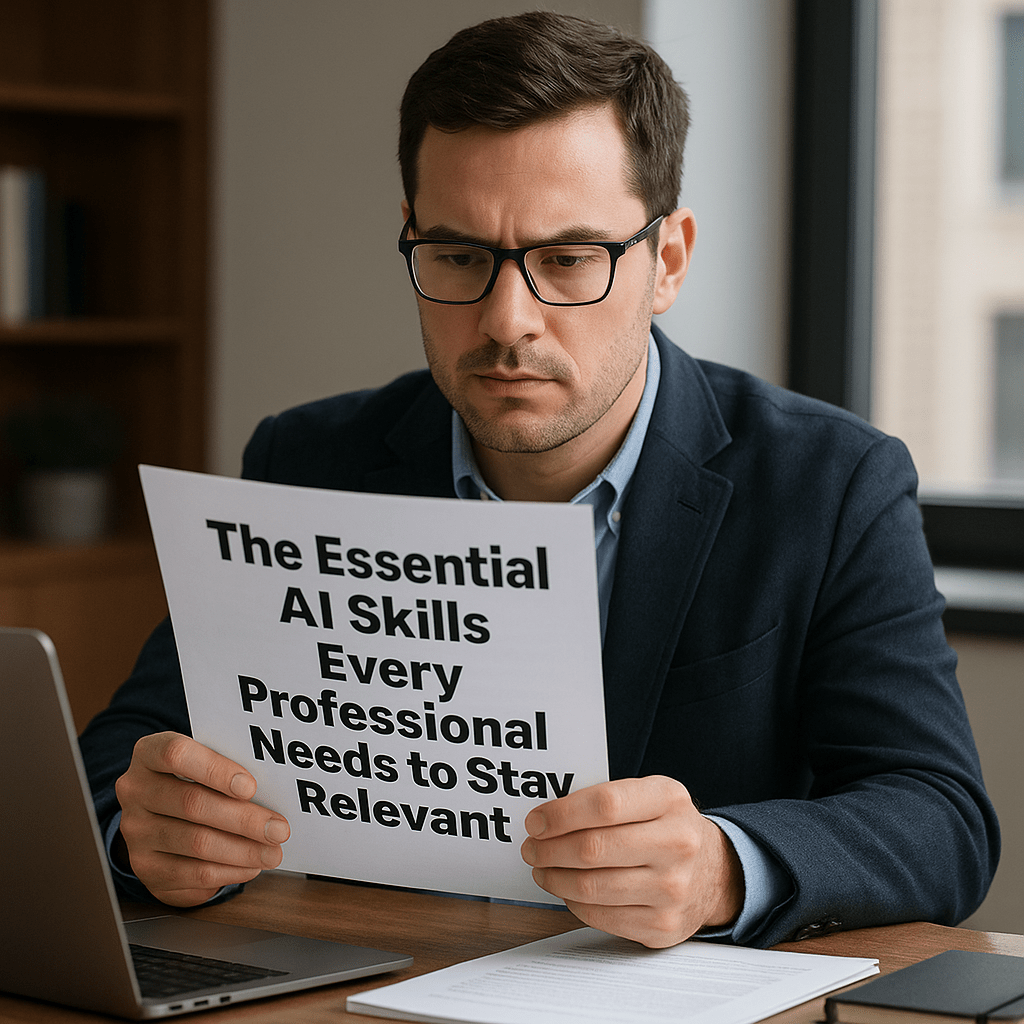
Artificial Intelligence (AI) is no longer an optional “nice-to-know” for professionals—it has become a baseline skill set, similar to email in the 1990s or spreadsheets in the 2000s. Whether you’re in marketing, operations, consulting, design, or management, your ability to navigate AI tools and concepts will influence your value in an organization. But here’s the catch: knowing about AI is very different from knowing how to use it effectively and responsibly.
If you’re trying to build credibility as someone who can bring AI into your work in a meaningful way, there are four foundational skill sets you should focus on: terminology and tools, ethical use, proven application, and discernment of AI’s strengths and weaknesses. Let’s break these down in detail.
1. Build a Firm Grasp of AI Terminology and Tools
If you’ve ever sat in a meeting where “transformer models,” “RAG pipelines,” or “vector databases” were thrown around casually, you know how intimidating AI terminology can feel. The good news is that you don’t need a PhD in computer science to keep up. What you do need is a working vocabulary of the most commonly used terms and a sense of which tools are genuinely useful versus which are just hype.
- Learn the language. Know what “machine learning,” “large language models (LLMs),” and “generative AI” mean. Understand the difference between supervised vs. unsupervised learning, or between predictive vs. generative AI. You don’t need to be an expert in the math, but you should be able to explain these terms in plain language.
- Track the hype cycle. Tools like ChatGPT, MidJourney, Claude, Perplexity, and Runway are popular now. Tomorrow it may be different. Stay aware of what’s gaining traction, but don’t chase every shiny new app—focus on what aligns with your work.
- Experiment regularly. Spend time actually using these tools. Reading about them isn’t enough; you’ll gain more credibility by being the person who can say, “I tried this last week, here’s what worked, and here’s what didn’t.”
The professionals who stand out are the ones who can translate the jargon into everyday language for their peers and point to tools that actually solve problems.
Why it matters: If you can translate AI jargon into plain English, you become the bridge between technical experts and business leaders.
Examples:
- A marketer who understands “vector embeddings” can better evaluate whether a chatbot project is worth pursuing.
- A consultant who knows the difference between supervised and unsupervised learning can set more realistic expectations for a client project.
To-Do’s (Measurable):
- Learn 10 core AI terms (e.g., LLM, fine-tuning, RAG, inference, hallucination) and practice explaining them in one sentence to a non-technical colleague.
- Test 3 AI tools outside of ChatGPT or MidJourney (try Perplexity for research, Runway for video, or Jasper for marketing copy).
- Track 1 emerging tool in Gartner’s AI Hype Cycle and write a short summary of its potential impact for your industry.
2. Develop a Clear Sense of Ethical AI Use
AI is a productivity amplifier, but it also has the potential to become a shortcut for avoiding responsibility. Organizations are increasingly aware of this tension. On one hand, AI can help employees save hours on repetitive work; on the other, it can enable people to “phone in” their jobs by passing off machine-generated output as their own.
To stand out in your workplace:
- Draw the line between productivity and avoidance. If you use AI to draft a first version of a report so you can spend more time refining insights—that’s productive. If you copy-paste AI-generated output without review—that’s shirking.
- Be transparent. Many companies are still shaping their policies on AI disclosure. Until then, err on the side of openness. If AI helped you get to a deliverable faster, acknowledge it. This builds trust.
- Know the risks. AI can hallucinate facts, generate biased responses, and misrepresent sources. Ethical use means knowing where these risks exist and putting safeguards in place.
Being the person who speaks confidently about responsible AI use—and who models it—positions you as a trusted resource, not just another tool user.
Why it matters: AI can either build trust or erode it, depending on how transparently you use it.
Examples:
- A financial analyst discloses that AI drafted an initial market report but clarifies that all recommendations were human-verified.
- A project manager flags that an AI scheduling tool systematically assigns fewer leadership roles to women—and brings it up to leadership as a fairness issue.
To-Do’s (Measurable):
- Write a personal disclosure statement (2–3 sentences) you can use when AI contributes to your work.
- Identify 2 use cases in your role where AI could cause ethical concerns (e.g., bias, plagiarism, misuse of proprietary data). Document mitigation steps.
- Stay current with 1 industry guideline (like NIST AI Risk Management Framework or EU AI Act summaries) to show awareness of standards.
3. Demonstrate Experience Beyond Text and Images
For many people, AI is synonymous with ChatGPT for writing and MidJourney or DALL·E for image generation. But these are just the tip of the iceberg. If you want to differentiate yourself, you need to show experience with AI in broader, less obvious applications.
Examples include:
- Data analysis: Using AI to clean, interpret, or visualize large datasets.
- Process automation: Leveraging tools like UiPath or Zapier AI integrations to cut repetitive steps out of workflows.
- Customer engagement: Applying conversational AI to improve customer support response times.
- Decision support: Using AI to run scenario modeling, market simulations, or forecasting.
Employers want to see that you understand AI not only as a creativity tool but also as a strategic enabler across functions.
Why it matters: Many peers will stop at using AI for writing or graphics—you’ll stand out by showing how AI adds value to operational, analytical, or strategic work.
Examples:
- A sales ops analyst uses AI to cleanse CRM data, improving pipeline accuracy by 15%.
- An HR manager automates resume screening with AI but layers human review to ensure fairness.
To-Do’s (Measurable):
- Document 1 project where AI saved measurable time or improved accuracy (e.g., “AI reduced manual data entry from 10 hours to 2”).
- Explore 2 automation tools like UiPath, Zapier AI, or Microsoft Copilot, and create one workflow in your role.
- Present 1 short demo to your team on how AI improved a task outside of writing or design.
4. Know Where AI Shines—and Where It Falls Short
Perhaps the most valuable skill you can bring to your organization is discernment: understanding when AI adds value and when it undermines it.
- AI is strong at:
- Summarizing large volumes of information quickly.
- Generating creative drafts, brainstorming ideas, and producing “first passes.”
- Identifying patterns in structured data faster than humans can.
- AI struggles with:
- Producing accurate, nuanced analysis in complex or ambiguous situations.
- Handling tasks that require deep empathy, cultural sensitivity, or lived experience.
- Delivering error-free outputs without human oversight.
By being clear on the strengths and weaknesses, you avoid overpromising what AI can do for your organization and instead position yourself as someone who knows how to maximize its real capabilities.
Why it matters: Leaders don’t just want enthusiasm—they want discernment. The ability to say, “AI can help here, but not there,” makes you a trusted voice.
Examples:
- A consultant leverages AI to summarize 100 pages of regulatory documents but refuses to let AI generate final compliance interpretations.
- A customer success lead uses AI to draft customer emails but insists that escalation communications be written entirely by a human.
To-Do’s (Measurable):
- Make a two-column list of 5 tasks in your role where AI is high-value (e.g., summarization, analysis) vs. 5 where it is low-value (e.g., nuanced negotiations).
- Run 3 experiments with AI on tasks you think it might help with, and record performance vs. human baseline.
- Create 1 slide or document for your manager/team outlining “Where AI helps us / where it doesn’t.”
Final Thought: Standing Out Among Your Peers
AI skills are not about showing off your technical expertise—they’re about showing your judgment. If you can:
- Speak the language of AI and use the right tools,
- Demonstrate ethical awareness and transparency,
- Prove that your applications go beyond the obvious, and
- Show wisdom in where AI fits and where it doesn’t,
…then you’ll immediately stand out in the workplace.
The professionals who thrive in the AI era won’t be the ones who know the most tools—they’ll be the ones who know how to use them responsibly, strategically, and with impact.
We also discuss this topic on (Spotify)

 De Lio Tech Trends
I’ll always be wondering if this article was AI generated.
LikeLiked by 1 person