Agentic AI: The Next Frontier of Intelligent Systems

A Brief Look Back: Where Agentic AI Was

Just a couple of years ago, the concept of Agentic AI—AI systems capable of autonomous, goal-driven behavior—was more of an academic exercise than an enterprise-ready technology. Early prototypes existed mostly in research labs or within experimental startups, often framed as “AI agents” that could perform multi-step tasks. Tools like AutoGPT and BabyAGI (launched in 2023) captured public attention by demonstrating how large language models (LLMs) could chain reasoning steps, execute tasks via APIs, and iterate toward objectives without constant human oversight.

However, these early systems had major limitations. They were prone to “hallucinations,” lacked memory continuity, and were fragile when operating in real-world environments. Their usefulness was often confined to proofs of concept, not enterprise-grade deployments.

But to fully understand the history of Agentic AI, one should also understand what Agentic AI is.


What Is Agentic AI?

At its core, Agentic AI refers to AI systems designed to act as autonomous agents—entities that can perceive, reason, make decisions, and take action toward specific goals, often across multiple steps, without constant human input. Unlike traditional AI models that respond only when prompted, agentic systems are capable of initiating actions, adapting strategies, and managing workflows over time. Think of it as the evolution from a calculator that solves one equation when asked, to a project manager who receives an objective and figures out how to achieve it with minimal supervision.

What makes Agentic AI distinct is its loop of autonomy:

  1. Perception/Input – The agent gathers information from prompts, APIs, databases, or even sensors.
  2. Reasoning/Planning – It determines what needs to be done, breaking large objectives into smaller tasks.
  3. Action Execution – It carries out these steps—querying data, calling APIs, or updating systems.
  4. Reflection/Iteration – It reviews its results, adjusts if errors occur, and continues until the goal is reached.

This cycle creates AI systems that are proactive and resilient, much closer to how humans operate when solving problems.


Why It Matters

Agentic AI represents a shift from static assistance to dynamic collaboration. Traditional AI (like chatbots or predictive models) waits for input and gives an output. Agentic AI, by contrast, can set its own “to-do list,” monitor its own progress, and adjust strategies based on changing conditions. This unlocks powerful use cases—such as running multi-step research projects, autonomously managing supply chain reroutes, or orchestrating entire IT workflows.

For example, where a conventional AI tool might summarize a dataset when asked, an agentic AI could:

  • Identify inconsistencies in the data.
  • Retrieve missing information from connected APIs.
  • Draft a cleaned version of the dataset.
  • Run a forecasting model.
  • Finally, deliver a report with next-step recommendations.

This difference—between passive tool and active partner—is why companies are investing so heavily in agentic systems.


Key Enablers of Agentic AI

For readers wanting to sound knowledgeable in conversation, it’s important to know the underlying technologies that make agentic systems possible:

  • Large Language Models (LLMs) – Provide reasoning, planning, and natural language interaction.
  • Memory Systems – Vector databases and knowledge stores give agents continuity beyond a single session.
  • Tool Use & APIs – The ability to call external services, retrieve data, and interact with enterprise applications.
  • Autonomous Looping – Internal feedback cycles that let the agent evaluate and refine its own work.
  • Multi-Agent Collaboration – Frameworks where several agents specialize and coordinate, mimicking human teams.

Understanding these pillars helps differentiate a true agentic AI deployment from a simple chatbot integration.

Evolution to Today: Maturing Into Practical Systems

Fast-forward to today, Agentic AI has rapidly evolved from experimentation into strategic business adoption. Several factors contributed to this shift:

  • Memory and Contextual Persistence: Modern agentic systems can now maintain long-term memory across interactions, allowing them to act consistently and learn from prior steps.
  • Tool Integration: Agentic AI platforms integrate with enterprise systems (CRM, ERP, ticketing, cloud APIs), enabling end-to-end process execution rather than single-step automation.
  • Multi-Agent Collaboration: Emerging frameworks allow multiple AI agents to work together, simulating teams of specialists that can negotiate, delegate, and collaborate.
  • Guardrails & Observability: Safety layers, compliance monitoring, and workflow orchestration tools have made enterprises more confident in deploying agentic AI.

What was once a lab curiosity is now a boardroom strategy. Organizations are embedding Agentic AI in workflows that require autonomy, adaptability, and cross-system orchestration.


Real-World Use Cases and Examples

  1. Customer Experience & Service
    • Example: ServiceNow, Zendesk, and Genesys are experimenting with agentic AI-powered service agents that can autonomously resolve tickets, update records, and trigger workflows without escalating to human agents.
    • Impact: Reduces resolution time, lowers operational costs, and improves personalization.
  2. Software Development
    • Example: GitHub Copilot X and Meta’s Code Llama integration are evolving into full-fledged coding agents that not only suggest code but also debug, run tests, and deploy to staging environments.
  3. Business Process Automation
    • Example: Microsoft’s Copilot for Office and Salesforce Einstein GPT are increasingly agentic—scheduling meetings, generating proposals, and sending follow-up emails without direct prompts.
  4. Healthcare & Life Sciences
    • Example: Clinical trial management agents monitor data pipelines, flag anomalies, and recommend adaptive trial designs, reducing the time to regulatory approval.
  5. Supply Chain & Operations
    • Example: Retailers like Walmart and logistics giants like DHL are experimenting with autonomous AI agents for demand forecasting, shipment rerouting, and warehouse robotics coordination.

The Biggest Players in Agentic AI

  • OpenAI – With GPT-4.1 and agent frameworks built around it, OpenAI is pushing toward autonomous research assistants and enterprise copilots.
  • Anthropic – Claude models emphasize safety and reliability, which are critical for scalable agentic deployments.
  • Google DeepMind – Leading with Gemini and research into multi-agent reinforcement learning environments.
  • Microsoft – Integrating agentic AI deeply into its Copilot ecosystem across productivity, Azure, and Dynamics.
  • Meta – Open-source leadership with LLaMA, encouraging community-driven agentic frameworks.
  • Specialized Startups – Companies like Adept (AI for action execution), LangChain (orchestration), and Replit (coding agents) are shaping the ecosystem.

Core Technologies Required for Successful Adoption

  1. Orchestration Frameworks: Tools like LangChain, LlamaIndex, and CrewAI allow chaining of reasoning steps and integration with external systems.
  2. Memory Systems: Vector databases (Pinecone, Weaviate, Milvus, Chroma) are essential for persistent, contextual memory.
  3. APIs & Connectors: Robust integration with business systems ensures agents act meaningfully.
  4. Observability & Guardrails: Tools such as Humanloop and Arthur AI provide monitoring, error handling, and compliance.
  5. Cloud & Edge Infrastructure: Scalability depends on access to hyperscaler ecosystems (AWS, Azure, GCP), with edge deployments crucial for industries like manufacturing and retail.

Without these pillars, agentic AI implementations risk being fragile or unsafe.


Career Guidance for Practitioners

For professionals looking to lead in this space, success requires a blend of AI fluency, systems thinking, and domain expertise.

Skills to Develop

  • Foundational AI/ML Knowledge – Understand transformer models, reinforcement learning, and vector databases.
  • Prompt Engineering & Orchestration – Skill in frameworks like LangChain and CrewAI.
  • Systems Integration – Knowledge of APIs, cloud deployment, and workflow automation.
  • Ethics & Governance – Strong understanding of responsible AI practices, compliance, and auditability.

Where to Get Educated

  • University Programs:
    • Stanford HAI, MIT CSAIL, and Carnegie Mellon all now offer courses in multi-agent AI and autonomy.
  • Industry Certifications:
    • Microsoft AI Engineer, AWS Machine Learning Specialty, and NVIDIA’s Deep Learning Institute offer pathways with agentic components.
  • Online Learning Platforms:
    • Coursera (Andrew Ng’s AI for Everyone), DeepLearning.AI’s Generative AI courses, and specialized LangChain workshops.
  • Communities & Open Source:
    • Contributing to open frameworks like LangChain or LlamaIndex builds hands-on credibility.

Final Thoughts

Agentic AI is not just a buzzword—it is becoming a structural shift in how digital work gets done. From customer support to supply chain optimization, agentic systems are redefining the boundaries between human and machine workflows.

For organizations, the key is understanding the core technologies and guardrails that make adoption safe and scalable. For practitioners, the opportunity is clear: those who master agent orchestration, memory systems, and ethical deployment will be the architects of the next generation of enterprise AI.

We discuss this topic further in depth on (Spotify).

The Convergence of Edge Computing and Artificial Intelligence: Unlocking the Next Era of Digital Transformation

Introduction – What Is Edge Computing?

Edge computing is the practice of processing data closer to where it is generated—on devices, sensors, or local gateways—rather than sending it across long distances to centralized cloud data centers. The “edge” refers to the physical location near the source of the data. By moving compute power and storage nearer to endpoints, edge computing reduces latency, saves bandwidth, and provides faster, more context-aware insights.

The Current Edge Computing Landscape

Market Size & Growth Trajectory

  • The global edge computing market is estimated to be worth about USD 168.4 billion in 2025, with projections to reach roughly USD 249.1 billion by 2030, implying a compound annual growth rate (CAGR) of ~8.1 %. MarketsandMarkets
  • Adoption is accelerating: some estimates suggest that 40% or more of large enterprises will have integrated edge computing into their IT infrastructure by 2025. Forbes
  • Analysts project that by 2025, 75% of enterprise-generated data will be processed at or near the edge—versus just about 10% in 2018. OTAVA+2Wikipedia+2

These numbers reflect both the scale and urgency driving investments in edge architectures and technologies.

Structural Themes & Challenges in Today’s Landscape

While edge computing is evolving rapidly, several structural patterns and obstacles are shaping how it’s adopted:

  • Fragmentation and Siloed Deployments
    Many edge solutions today are deployed for specific use cases (e.g., factory machine vision, retail analytics) without unified orchestration across sites. This creates operational complexity, limited visibility, and maintenance burdens. ZPE Systems
  • Vendor Ecosystem Consolidation
    Large cloud providers (AWS, Microsoft, Google) are aggressively extending toward the edge, often via “edge extensions” or telco partnerships, thereby pushing smaller niche vendors to specialize or integrate more deeply.
  • 5G / MEC Convergence
    The synergy between 5G (or private 5G) and Multi-access Edge Computing (MEC) is central. Low-latency, high-bandwidth 5G links provide the networking substrate that makes real-time edge applications viable at scale.
  • Standardization & Interoperability Gaps
    Because edge nodes are heterogeneous (in compute, networking, form factor, OS), developing portable applications and unified orchestration is non-trivial. Emerging frameworks (e.g. WebAssembly for the cloud-edge continuum) are being explored to bridge these gaps. arXiv
  • Security, Observability & Reliability
    Each new edge node introduces attack surface, management overhead, remote access challenges, and reliability concerns (e.g. power or connectivity outages).
  • Scale & Operational Overhead
    Managing hundreds or thousands of distributed edge nodes (especially in retail chains, logistics, or field sites) demands robust automation, remote monitoring, and zero-touch upgrades.

Despite these challenges, momentum continues to accelerate, and many of the pieces required for large-scale edge + AI are falling into place.


Who’s Leading & What Products Are Being Deployed

Here’s a look at the major types of players, some standout products/platforms, and real-world deployments.

Leading Players & Product Offerings

Player / TierEdge-Oriented Offerings / PlatformsStrength / Differentiator
Hyperscale cloud providersAWS Wavelength, AWS Local Zones, Azure IoT Edge, Azure Stack Edge, Google Distributed Cloud EdgeBring edge capabilities with tight link to cloud services and economies of scale.
Telecom / network operatorsTelco MEC platforms, carrier edge nodesThey own or control the access network and can colocate compute at cell towers or local aggregation nodes.
Edge infrastructure vendorsNutanix, HPE Edgeline, Dell EMC, Schneider + Cisco edge solutionsHardware + software stacks optimized for rugged, distributed deployment.
Edge-native software / orchestration vendorsZededa, EdgeX Foundry, Cloudflare Workers, VMWare Edge, KubeEdge, LatizeSpecialize in containerized virtualization, orchestration, and lightweight edge stacks.
AI/accelerator chip / microcontroller vendorsNvidia Jetson family, Arm Ethos NPUs, Google Edge TPU, STMicro STM32N6 (edge AI MCU)Provide the inference compute at the node level with energy-efficient designs.

Below are some of the more prominent examples:

AWS Wavelength (AWS Edge + 5G)

AWS Wavelength is AWS’s mechanism for embedding compute and storage resources into telco networks (co-located with 5G infrastructure) to minimize the network hops required between devices and cloud services. Amazon Web Services, Inc.+2STL Partners+2

  • Wavelength supports EC2 instance types including GPU-accelerated ones (e.g. G4 with Nvidia T4) for local inference workloads. Amazon Web Services, Inc.
  • Verizon 5G Edge with AWS Wavelength is a concrete deployment: in select metro areas, AWS services are actually in Verizon’s network footprint so applications from mobile devices can connect with ultra-low latency. Verizon
  • AWS just announced a new Wavelength edge location in Lenexa, Kansas, showing the continued expansion of the program. Data Center Dynamics

In practice, that enables use cases like real-time AR/VR, robotics in warehouses, video analytics, and mobile cloud gaming with minimal lag.

Azure Edge Stack / IoT Edge / Azure Stack Edge

Microsoft has multiple offerings to bridge between cloud and edge:

  • Azure IoT Edge: A runtime environment for deploying containerized modules (including AI, logic, analytics) to devices. Microsoft Azure
  • Azure Stack Edge: A managed edge appliance (with compute, storage) that acts as a gateway and local processing node with tight connectivity to Azure. Microsoft Azure
  • Azure Private MEC (Multi-Access Edge Compute): Enables enterprises (or telcos) to host low-latency, high-bandwidth compute at their own edge premises. Microsoft Learn
  • Microsoft also offers Azure Edge Zones with Carrier, which embeds Azure services at telco edge locations to enable low-latency app workloads tied to mobile networks. GeeksforGeeks

Across these, Microsoft’s edge strategy transparently layers cloud-native services (AI, database, analytics) closer to the data source.

Edge AI Microcontrollers & Accelerators

One of the more exciting trends is pushing inference even further down to microcontrollers and domain-specific chips:

  • STMicro STM32N6 Series was introduced to target edge AI workloads (image/audio) on very low-power MCUs. Reuters
  • Nvidia Jetson line (Nano, Xavier, Orin) remains a go-to for robotics, vision, and autonomous edge workloads.
  • Google Coral / Edge TPU chips are widely used in embedded devices to accelerate small ML models on-device.
  • Arm Ethos NPUs, and similar neural accelerators embedded in mobile SoCs, allow smartphone OEMs to run inference offline.

The combination of tiny form factor compute + co-located memory + optimized model quantization is enabling AI to run even in constrained edge environments.

Edge-Oriented Platforms & Orchestration

  • Zededa is among the better-known edge orchestration vendors—helping manage distributed nodes with container abstraction and device lifecycle management.
  • EdgeX Foundry is an open-source IoT/edge interoperability framework that helps unify sensors, analytics, and edge services across heterogeneous hardware.
  • KubeEdge (a Kubernetes extension for edge) enables cloud-native developers to extend Kubernetes to edge nodes, with local autonomy.
  • Cloudflare Workers / Cloudflare R2 etc. push computation closer to the user (in many cases, at edge PoPs) albeit more in the “network edge” than device edge.

Real-World Use Cases & Deployments

Below are concrete examples to illustrate where edge + AI is being used in production or pilot form:

Autonomous Vehicles & ADAS

Vehicles generate massive sensor data (radar, lidar, cameras). Sending all that to the cloud for inference is infeasible. Instead, autonomous systems run computer vision, sensor fusion and decision-making locally on edge compute in the vehicle. Many automakers partner with Nvidia, Mobileye, or internal edge AI stacks.

Smart Manufacturing & Predictive Maintenance

Factories embed edge AI systems on production lines to detect anomalies in real time. For example, a camera/vision system may detect a defective item on the line and remove it as production is ongoing, without round-tripping to the cloud. This is among the canonical “Industry 4.0” edge + AI use cases.

Video Analytics & Surveillance

Cameras at the edge run object detection, facial recognition, or motion detection locally; only flagged events or metadata are sent upstream to reduce bandwidth load. Retailers might use this for customer count, behavior analytics, queue management, or theft detection. IBM

Retail / Smart Stores

In retail settings, edge AI can do real-time inventory detection, cashier-less checkout (via camera + AI), or shelf analytics (detect empty shelves). This reduces need to transmit full video streams externally. IBM

Transportation / Intelligent Traffic

Edge nodes at intersections or along roadways process sensor data (video, LiDAR, signal, traffic flows) to optimize signal timings, detect incidents, and respond dynamically. Rugged edge computers are used in vehicles, stations, and city infrastructure. Premio Inc+1

Remote Health / Wearables

In medical devices or wearables, edge inference can detect anomalies (e.g. arrhythmias) without needing continuous connectivity to the cloud. This is especially relevant in remote or resource-constrained settings.

Private 5G + Campus Edge

Enterprises (e.g. manufacturing, logistics hubs) deploy private 5G networks + MEC to create an internal edge fabric. Applications like robotics coordination, augmented reality-assisted maintenance, or real-time operational dashboards run in the campus edge.

Telecom & CDN Edge

Content delivery networks (CDNs) already run caching at edge nodes. The new twist is embedding microservices or AI-driven personalization logic at CDN PoPs (e.g. recommending content variants, performing video transcoding at the edge).


What This Means for the Future of AI Adoption

With this backdrop, the interplay between edge and AI becomes clearer—and more consequential. Here’s how the current trajectory suggests the future will evolve.

Inference Moves Downstream, Training Remains Central (But May Hybridize)

  • Inference at the Edge: Most AI workloads in deployment will increasingly be inference rather than training. Running real-time predictions locally (on-device or in edge nodes) becomes the norm.
  • Selective On-Device Training / Adaptation: For certain edge use cases (e.g. personalization, anomaly detection), localized model updates or micro-learning may occur on-device or edge node, then get aggregated back to central models.
  • Federated / Split Learning Hybrid Models: Techniques such as federated learning, split computing, or in-edge collaborative learning allow sharing model updates without raw data exposure—critical for privacy-sensitive scenarios.

New AI Architectures & Model Design

  • Model Compression, Quantization & Pruning will become even more essential so models can run on constrained hardware.
  • Modular / Composable Models: Instead of monolithic LLMs, future deployments may use small specialist models at the edge, coordinated by a “control plane” model in the cloud.
  • Incremental / On-Device Fine-Tuning: Allowing models to adapt locally over time to new conditions at the edge (e.g. local drift) while retaining central oversight.

Edge-to-Cloud Continuum

The future is not discrete “cloud or edge” but a continuum where workloads dynamically shift. For instance:

  • Preprocessing and inference happen at the edge, while periodic retraining, heavy analytics, or model upgrades happen centrally.
  • Automation and orchestration frameworks will migrate tasks between edge and cloud based on latency, cost, energy, or data sensitivity.
  • More uniform runtimes (via WebAssembly, container runtimes, or edge-aware frameworks) will smooth application portability across the continuum.

Democratized Intelligence at Scale

As cost, tooling, and orchestration improve:

  • More industries—retail, agriculture, energy, utilities—will embed AI at scale (hundreds to thousands of nodes).
  • Intelligent systems will become more “ambient” (embedded), not always visible: edge AI running quietly in logistics, smart buildings, or critical infrastructure.
  • Edge AI lowers the barrier to entry: less reliance on massive cloud spend or latency constraints means smaller players (and local/regional businesses) can deploy AI-enabled services competitively.

Privacy, Governance & Trust

  • Edge AI helps satisfy privacy requirements by keeping sensitive data local and transmitting only aggregate insights.
  • Regulatory pressures (GDPR, HIPAA, CCPA, etc.) will push more workloads toward the edge as a technique for compliance and trust.
  • Transparent governance, explainability, model versioning, and audit trails will become essential in coordinating edge nodes across geographies.

New Business Models & Monetization

  • Telcos can monetize MEC infrastructure by becoming “edge enablers” rather than pure connectivity providers.
  • SaaS/AI providers will offer “Edge-as-a-Service” or “AI inference as a service” at the edge.
  • Edge-based marketplaces may emerge: e.g. third-party AI models sold and deployed to edge nodes (subject to validation and trust).

Why Edge Computing Is Being Advanced

The rise of billions of connected devices—from smartphones to autonomous vehicles to industrial IoT sensors—has driven massive amounts of real-time data. Traditional cloud models, while powerful, cannot efficiently handle every request due to latency constraints, bandwidth limitations, and security concerns. Edge computing emerges as a complementary paradigm, enabling:

  • Low latency decision-making for mission-critical applications like autonomous driving or robotic surgery.
  • Reduced bandwidth costs by processing raw data locally before transmitting only essential insights to the cloud.
  • Enhanced security and compliance as sensitive data can remain on-device or within local networks rather than being constantly exposed across external channels.
  • Resiliency in scenarios where internet connectivity is weak or intermittent.

Pros and Cons of Edge Computing

Pros

  • Ultra-low latency processing for real-time decisions
  • Efficient bandwidth usage and reduced cloud dependency
  • Improved privacy and compliance through localized data control
  • Scalability across distributed environments

Cons

  • Higher complexity in deployment and management across many distributed nodes
  • Security risks expand as the attack surface grows with more endpoints
  • Hardware limitations at the edge (power, memory, compute) compared to centralized data centers
  • Integration challenges with legacy infrastructure

In essence, edge computing complements cloud computing, rather than replacing it, creating a hybrid model where tasks are performed in the optimal environment.


How AI Leverages Edge Computing

Artificial intelligence has advanced at an unprecedented pace, but many AI models—especially large-scale deep learning systems—require massive processing power and centralized training environments. Once trained, however, AI models can be deployed in distributed environments, making edge computing a natural fit.

Here’s how AI and edge computing intersect:

  1. Real-Time Inference
    AI models can be deployed at the edge to make instant decisions without sending data back to the cloud. For example, cameras embedded with computer vision algorithms can detect anomalies in manufacturing lines in milliseconds.
  2. Personalization at Scale
    Edge AI enables highly personalized experiences by processing user behavior locally. Smart assistants, wearables, and AR/VR devices can tailor outputs instantly while preserving privacy.
  3. Bandwidth Optimization
    Rather than transmitting raw video feeds or sensor data to centralized servers, AI models at the edge can analyze streams and send only summarized results. This optimization is crucial for autonomous vehicles and connected cities where data volumes are massive.
  4. Energy Efficiency and Sustainability
    By processing data locally, organizations reduce unnecessary data transmission, lowering energy consumption—a growing concern given AI’s power-hungry nature.

Implications for the Future of AI Adoption

The convergence of AI and edge computing signals a fundamental shift in how intelligent systems are built and deployed.

  • Mass Adoption of AI-Enabled Devices
    With edge infrastructure, AI can run efficiently on consumer-grade devices (smartphones, IoT appliances, AR glasses). This decentralization democratizes AI, embedding intelligence into everyday environments.
  • Next-Generation Industrial Automation
    Industries like manufacturing, healthcare, agriculture, and energy will see exponential efficiency gains as edge-based AI systems optimize operations in real time without constant cloud reliance.
  • Privacy-Preserving AI
    As AI adoption grows, regulatory scrutiny over data usage intensifies. Edge AI’s ability to keep sensitive data local aligns with stricter privacy standards (e.g., GDPR, HIPAA).
  • Foundation for Autonomous Systems
    From autonomous vehicles to drones and robotics, ultra-low-latency edge AI is essential for safe, scalable deployment. These systems cannot afford delays caused by cloud round-trips.
  • Hybrid AI Architectures
    The future is not cloud or edge—it’s both. Training of large models will remain cloud-centric, but inference and micro-learning tasks will increasingly shift to the edge, creating a distributed intelligence network.

Conclusion

Edge computing is not just a networking innovation—it is a critical enabler for the future of artificial intelligence. While the cloud remains indispensable for training large-scale models, the edge empowers AI to act in real time, closer to users, with greater efficiency and privacy. Together, they form a hybrid ecosystem that ensures AI adoption can scale across industries and geographies without being bottlenecked by infrastructure limitations.

As organizations embrace digital transformation, the strategic alignment of edge computing and AI will define competitive advantage. In the years ahead, businesses that leverage this convergence will not only unlock new efficiencies but also pioneer entirely new products, services, and experiences built on real-time intelligence at the edge.

Major cloud and telecom players are pushing edge forward through hybrid platforms, while hardware accelerators and orchestration frameworks are filling in the missing pieces for a scalable, manageable edge ecosystem.

From the AI perspective, edge computing is no longer just a “nice to have”—it’s becoming a fundamental enabler of deploying real-time, scalable intelligence across diverse environments. As edge becomes more capable and ubiquitous, AI will shift more decisively into hybrid architectures where cloud and edge co-operate.

We continue this conversation on (Spotify).

The Infrastructure Backbone of AI: Power, Water, Space, and the Role of Hyperscalers

Introduction

Artificial Intelligence (AI) is advancing at an unprecedented pace. Breakthroughs in large language models, generative systems, robotics, and agentic architectures are driving massive adoption across industries. But beneath the algorithms, APIs, and hype cycles lies a hard truth: AI growth is inseparably tied to physical infrastructure. Power grids, water supplies, land, and hyperscaler data centers form the invisible backbone of AI’s progress. Without careful planning, these tangible requirements could become bottlenecks that slow innovation.

This post examines what infrastructure is required in the short, mid, and long term to sustain AI’s growth, with an emphasis on utilities and hyperscaler strategy.

Hyperscalers

First, lets define what a hyerscaler is to understand their impact on AI and their overall role in infrastructure demands.

Hyperscalers are the world’s largest cloud and infrastructure providers—companies such as Amazon Web Services (AWS), Microsoft Azure, Google Cloud, and Meta—that operate at a scale few organizations can match. Their defining characteristic is the ability to provision computing, storage, and networking resources at near-infinite scale through globally distributed data centers. In the context of Artificial Intelligence, hyperscalers serve as the critical enablers of growth by offering the sheer volume of computational capacity needed to train and deploy advanced AI models. Training frontier models such as large language models requires thousands of GPUs or specialized AI accelerators running in parallel, sustained power delivery, and advanced cooling—all of which hyperscalers are uniquely positioned to provide. Their economies of scale allow them to continuously invest in custom silicon (e.g., Google TPUs, AWS Trainium, Azure Maia) and state-of-the-art infrastructure that dramatically lowers the cost per unit of AI compute, making advanced AI development accessible not only to themselves but also to enterprises, startups, and researchers who rent capacity from these platforms.

In addition to compute, hyperscalers play a strategic role in shaping the AI ecosystem itself. They provide managed AI services—ranging from pre-trained models and APIs to MLOps pipelines and deployment environments—that accelerate adoption across industries. More importantly, hyperscalers are increasingly acting as ecosystem coordinators, forging partnerships with chipmakers, governments, and enterprises to secure power, water, and land resources needed to keep AI growth uninterrupted. Their scale allows them to absorb infrastructure risk (such as grid instability or water scarcity) and distribute workloads across global regions to maintain resilience. Without hyperscalers, the barrier to entry for frontier AI development would be insurmountable for most organizations, as few could independently finance the billions in capital expenditures required for AI-grade infrastructure. In this sense, hyperscalers are not just service providers but the industrial backbone of the AI revolution—delivering both the physical infrastructure and the strategic coordination necessary for the technology to advance.


1. Short-Term Requirements (0–3 Years)

Power

AI model training runs—especially for large language models—consume megawatts of electricity at a single site. Training GPT-4 reportedly used thousands of GPUs running continuously for weeks. In the short term:

  • Co-location with renewable sources (solar, wind, hydro) is essential to offset rising demand.
  • Grid resilience must be enhanced; data centers cannot afford outages during multi-week training runs.
  • Utilities and AI companies are negotiating power purchase agreements (PPAs) to lock in dedicated capacity.

Water

AI data centers use water for cooling. A single hyperscaler facility can consume millions of gallons per day. In the near term:

  • Expect direct air cooling and liquid cooling innovations to reduce strain.
  • Regions facing water scarcity (e.g., U.S. Southwest) will see increased pushback, forcing siting decisions to favor water-rich geographies.

Space

The demand for GPU clusters means hyperscalers need:

  • Warehouse-scale buildings with high ceilings, robust HVAC, and reinforced floors.
  • Strategic land acquisition near transmission lines, fiber routes, and renewable generation.

Example

Google recently announced water-positive initiatives in Oregon to address public concern while simultaneously expanding compute capacity. Similarly, Microsoft is piloting immersion cooling tanks in Arizona to reduce water draw.


2. Mid-Term Requirements (3–7 Years)

Power

By mid-decade, demand for AI compute could exceed entire national grids (estimates show AI workloads may consume as much power as the Netherlands by 2030). Mid-term strategies include:

  • On-site generation (small modular reactors, large-scale solar farms).
  • Energy storage solutions (grid-scale batteries to handle peak training sessions).
  • Power load orchestration—training workloads shifted geographically to balance global demand.

Water

The focus will shift to circular water systems:

  • Closed-loop cooling with minimal water loss.
  • Advanced filtration to reuse wastewater.
  • Heat exchange systems where waste heat is repurposed into district heating (common in Nordic countries).

Space

Scaling requires more than adding buildings:

  • Specialized AI campuses spanning hundreds of acres with redundant utilities.
  • Underground and offshore facilities could emerge for thermal and land efficiency.
  • Governments will zone new “AI industrial parks” to support expansion, much like they did for semiconductor fabs.

Example

Amazon Web Services (AWS) is investing heavily in Northern Virginia, not just with more data centers but by partnering with Dominion Energy to build new renewable capacity. This signals a co-investment model between hyperscalers and utilities.


3. Long-Term Requirements (7+ Years)

Power

At scale, AI will push humanity toward entirely new energy paradigms:

  • Nuclear fusion (if commercialized) may be required to fuel exascale and zettascale training clusters.
  • Global grid interconnection—shifting compute to “follow the sun” where renewable generation is active.
  • AI-optimized energy routing, where AI models manage their own energy demand in real time.

Water

  • Water use will likely become politically regulated. AI will need to transition away from freshwater entirely, using desalination-powered cooling in coastal hubs.
  • Cryogenic cooling or non-water-based methods (liquid metals, advanced refrigerants) could replace water as the medium.

Space

  • Expect the rise of mega-scale AI cities: entire urban ecosystems designed around compute, robotics, and autonomous infrastructure.
  • Off-planet infrastructure—lunar or orbital data processing facilities—may become feasible by the 2040s, reducing Earth’s ecological load.

Example

NVIDIA and TSMC are already discussing future demand that will require not just new fabs but new national infrastructure commitments. Long-term AI growth will resemble the scale of the interstate highway system or space programs.


The Role of Hyperscalers

Hyperscalers (AWS, Microsoft Azure, Google Cloud, Meta, and others) are the central orchestrators of this infrastructure challenge. They are uniquely positioned because:

  • They control global networks of data centers across multiple jurisdictions.
  • They negotiate direct agreements with governments to secure power and water access.
  • They are investing in custom chips (TPUs, Trainium, Gaudi) to improve compute per watt, reducing overall infrastructure stress.

Their strategies include:

  • Geographic diversification: building in regions with abundant hydro (Quebec), cheap nuclear (France), or geothermal (Iceland).
  • Sustainability pledges: Microsoft aims to be carbon negative and water positive by 2030, a commitment tied directly to AI growth.
  • Shared ecosystems: Hyperscalers are opening AI supercomputing clusters to enterprises and researchers, distributing the benefits while consolidating infrastructure demand.

Why This Matters

AI’s future is not constrained by algorithms—it’s constrained by infrastructure reality. If the industry underestimates these requirements:

  • Power shortages could stall training of frontier models.
  • Water conflicts could cause public backlash and regulatory crackdowns.
  • Space limitations could delay deployment of critical capacity.

Conversely, proactive strategy—led by hyperscalers but supported by utilities, regulators, and innovators—will ensure uninterrupted growth.


Conclusion

The infrastructure needs of AI are as tangible as steel, water, and electricity. In the short term, hyperscalers must expand responsibly with local resources. In the mid-term, systemic innovation in cooling, storage, and energy balance will define competitiveness. In the long term, humanity may need to reimagine energy, water, and space itself to support AI’s exponential trajectory.

The lesson is simple but urgent: without foundational infrastructure, AI’s promise cannot be realized. The winners in the next wave of AI will not only master algorithms, but also the industrial, ecological, and geopolitical dimensions of its growth.

This topic has become extremely important as AI demand continues unabated and yet the resources needed are limited. We will continue in a series of posts to add more clarity to this topic and see if there is a common vision to allow innovations in AI to proceed, yet not at the detriment of our natural resources.

We discuss this topic in depth on (Spotify)

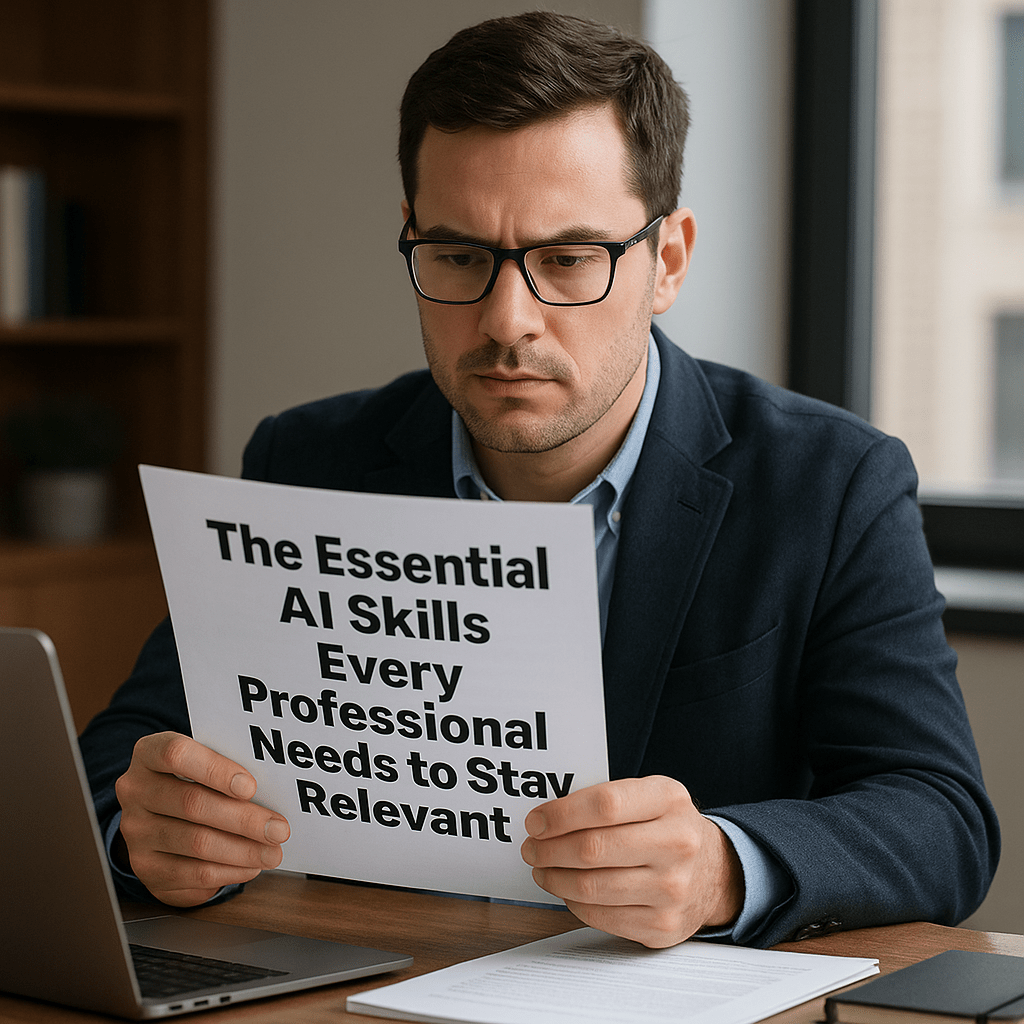
The Essential AI Skills Every Professional Needs to Stay Relevant

Introduction

Artificial Intelligence (AI) is no longer an optional “nice-to-know” for professionals—it has become a baseline skill set, similar to email in the 1990s or spreadsheets in the 2000s. Whether you’re in marketing, operations, consulting, design, or management, your ability to navigate AI tools and concepts will influence your value in an organization. But here’s the catch: knowing about AI is very different from knowing how to use it effectively and responsibly.

If you’re trying to build credibility as someone who can bring AI into your work in a meaningful way, there are four foundational skill sets you should focus on: terminology and tools, ethical use, proven application, and discernment of AI’s strengths and weaknesses. Let’s break these down in detail.


1. Build a Firm Grasp of AI Terminology and Tools

If you’ve ever sat in a meeting where “transformer models,” “RAG pipelines,” or “vector databases” were thrown around casually, you know how intimidating AI terminology can feel. The good news is that you don’t need a PhD in computer science to keep up. What you do need is a working vocabulary of the most commonly used terms and a sense of which tools are genuinely useful versus which are just hype.

  • Learn the language. Know what “machine learning,” “large language models (LLMs),” and “generative AI” mean. Understand the difference between supervised vs. unsupervised learning, or between predictive vs. generative AI. You don’t need to be an expert in the math, but you should be able to explain these terms in plain language.
  • Track the hype cycle. Tools like ChatGPT, MidJourney, Claude, Perplexity, and Runway are popular now. Tomorrow it may be different. Stay aware of what’s gaining traction, but don’t chase every shiny new app—focus on what aligns with your work.
  • Experiment regularly. Spend time actually using these tools. Reading about them isn’t enough; you’ll gain more credibility by being the person who can say, “I tried this last week, here’s what worked, and here’s what didn’t.”

The professionals who stand out are the ones who can translate the jargon into everyday language for their peers and point to tools that actually solve problems.

Why it matters: If you can translate AI jargon into plain English, you become the bridge between technical experts and business leaders.

Examples:

  • A marketer who understands “vector embeddings” can better evaluate whether a chatbot project is worth pursuing.
  • A consultant who knows the difference between supervised and unsupervised learning can set more realistic expectations for a client project.

To-Do’s (Measurable):

  • Learn 10 core AI terms (e.g., LLM, fine-tuning, RAG, inference, hallucination) and practice explaining them in one sentence to a non-technical colleague.
  • Test 3 AI tools outside of ChatGPT or MidJourney (try Perplexity for research, Runway for video, or Jasper for marketing copy).
  • Track 1 emerging tool in Gartner’s AI Hype Cycle and write a short summary of its potential impact for your industry.

2. Develop a Clear Sense of Ethical AI Use

AI is a productivity amplifier, but it also has the potential to become a shortcut for avoiding responsibility. Organizations are increasingly aware of this tension. On one hand, AI can help employees save hours on repetitive work; on the other, it can enable people to “phone in” their jobs by passing off machine-generated output as their own.

To stand out in your workplace:

  • Draw the line between productivity and avoidance. If you use AI to draft a first version of a report so you can spend more time refining insights—that’s productive. If you copy-paste AI-generated output without review—that’s shirking.
  • Be transparent. Many companies are still shaping their policies on AI disclosure. Until then, err on the side of openness. If AI helped you get to a deliverable faster, acknowledge it. This builds trust.
  • Know the risks. AI can hallucinate facts, generate biased responses, and misrepresent sources. Ethical use means knowing where these risks exist and putting safeguards in place.

Being the person who speaks confidently about responsible AI use—and who models it—positions you as a trusted resource, not just another tool user.

Why it matters: AI can either build trust or erode it, depending on how transparently you use it.

Examples:

  • A financial analyst discloses that AI drafted an initial market report but clarifies that all recommendations were human-verified.
  • A project manager flags that an AI scheduling tool systematically assigns fewer leadership roles to women—and brings it up to leadership as a fairness issue.

To-Do’s (Measurable):

  • Write a personal disclosure statement (2–3 sentences) you can use when AI contributes to your work.
  • Identify 2 use cases in your role where AI could cause ethical concerns (e.g., bias, plagiarism, misuse of proprietary data). Document mitigation steps.
  • Stay current with 1 industry guideline (like NIST AI Risk Management Framework or EU AI Act summaries) to show awareness of standards.

3. Demonstrate Experience Beyond Text and Images

For many people, AI is synonymous with ChatGPT for writing and MidJourney or DALL·E for image generation. But these are just the tip of the iceberg. If you want to differentiate yourself, you need to show experience with AI in broader, less obvious applications.

Examples include:

  • Data analysis: Using AI to clean, interpret, or visualize large datasets.
  • Process automation: Leveraging tools like UiPath or Zapier AI integrations to cut repetitive steps out of workflows.
  • Customer engagement: Applying conversational AI to improve customer support response times.
  • Decision support: Using AI to run scenario modeling, market simulations, or forecasting.

Employers want to see that you understand AI not only as a creativity tool but also as a strategic enabler across functions.

Why it matters: Many peers will stop at using AI for writing or graphics—you’ll stand out by showing how AI adds value to operational, analytical, or strategic work.

Examples:

  • A sales ops analyst uses AI to cleanse CRM data, improving pipeline accuracy by 15%.
  • An HR manager automates resume screening with AI but layers human review to ensure fairness.

To-Do’s (Measurable):

  • Document 1 project where AI saved measurable time or improved accuracy (e.g., “AI reduced manual data entry from 10 hours to 2”).
  • Explore 2 automation tools like UiPath, Zapier AI, or Microsoft Copilot, and create one workflow in your role.
  • Present 1 short demo to your team on how AI improved a task outside of writing or design.

4. Know Where AI Shines—and Where It Falls Short

Perhaps the most valuable skill you can bring to your organization is discernment: understanding when AI adds value and when it undermines it.

  • AI is strong at:
    • Summarizing large volumes of information quickly.
    • Generating creative drafts, brainstorming ideas, and producing “first passes.”
    • Identifying patterns in structured data faster than humans can.
  • AI struggles with:
    • Producing accurate, nuanced analysis in complex or ambiguous situations.
    • Handling tasks that require deep empathy, cultural sensitivity, or lived experience.
    • Delivering error-free outputs without human oversight.

By being clear on the strengths and weaknesses, you avoid overpromising what AI can do for your organization and instead position yourself as someone who knows how to maximize its real capabilities.

Why it matters: Leaders don’t just want enthusiasm—they want discernment. The ability to say, “AI can help here, but not there,” makes you a trusted voice.

Examples:

  • A consultant leverages AI to summarize 100 pages of regulatory documents but refuses to let AI generate final compliance interpretations.
  • A customer success lead uses AI to draft customer emails but insists that escalation communications be written entirely by a human.

To-Do’s (Measurable):

  • Make a two-column list of 5 tasks in your role where AI is high-value (e.g., summarization, analysis) vs. 5 where it is low-value (e.g., nuanced negotiations).
  • Run 3 experiments with AI on tasks you think it might help with, and record performance vs. human baseline.
  • Create 1 slide or document for your manager/team outlining “Where AI helps us / where it doesn’t.”

Final Thought: Standing Out Among Your Peers

AI skills are not about showing off your technical expertise—they’re about showing your judgment. If you can:

  1. Speak the language of AI and use the right tools,
  2. Demonstrate ethical awareness and transparency,
  3. Prove that your applications go beyond the obvious, and
  4. Show wisdom in where AI fits and where it doesn’t,

…then you’ll immediately stand out in the workplace.

The professionals who thrive in the AI era won’t be the ones who know the most tools—they’ll be the ones who know how to use them responsibly, strategically, and with impact.

We also discuss this topic on (Spotify)

The Risks of AI Models Learning from Their Own Synthetic Data

Introduction

Artificial Intelligence continues to reshape industries through increasingly sophisticated training methodologies. Yet, as models grow larger and more autonomous, new risks are emerging—particularly around the practice of training models on their own outputs (synthetic data) or overly relying on self-supervised learning. While these approaches promise efficiency and scale, they also carry profound implications for accuracy, reliability, and long-term sustainability.

The Challenge of Synthetic Data Feedback Loops

When a model consumes its own synthetic outputs as training input, it risks amplifying errors, biases, and distortions in what researchers call a “model collapse” scenario. Rather than learning from high-quality, diverse, and grounded datasets, the system is essentially echoing itself—producing outputs that become increasingly homogenous and less tethered to reality. This self-reinforcement can degrade performance over time, particularly in knowledge domains that demand factual precision or nuanced reasoning.

From a business perspective, such degradation erodes trust in AI-driven processes—whether in customer service, decision support, or operational optimization. For industries like healthcare, finance, or legal services, where accuracy is paramount, this can translate into real risks: misdiagnoses, poor investment strategies, or flawed legal interpretations.

Implications of Self-Supervised Learning

Self-supervised learning (SSL) is one of the most powerful breakthroughs in AI, allowing models to learn patterns and relationships without requiring large amounts of labeled data. While SSL accelerates training efficiency, it is not immune to pitfalls. Without careful oversight, SSL can inadvertently:

  • Reinforce biases present in raw input data.
  • Overfit to historical data, leaving models poorly equipped for emerging trends.
  • Mask gaps in domain coverage, particularly for niche or underrepresented topics.

The efficiency gains of SSL must be weighed against the ongoing responsibility to maintain accuracy, diversity, and relevance in datasets.

Detecting and Managing Feedback Loops in AI Training

One of the more insidious risks of synthetic and self-supervised training is the emergence of feedback loops—situations where model outputs begin to recursively influence model inputs, leading to compounding errors or narrowing of outputs over time. Detecting these loops early is critical to preserving model reliability.

How to Identify Feedback Loops Early

  1. Performance Drift Monitoring
    • If model accuracy, relevance, or diversity metrics show non-linear degradation (e.g., sudden increases in hallucinations, repetitive outputs, or incoherent reasoning), it may indicate the model is training on its own errors.
    • Tools like KL-divergence (to measure distribution drift between training and inference data) can flag when the model’s outputs are diverging from expected baselines.
  2. Redundancy in Output Diversity
    • A hallmark of feedback loops is loss of creativity or variance in outputs. For instance, generative models repeatedly suggesting the same phrases, structures, or ideas may signal recursive data pollution.
    • Clustering analyses of generated outputs can quantify whether output diversity is shrinking over time.
  3. Anomaly Detection on Semantic Space
    • By mapping embeddings of generated data against human-authored corpora, practitioners can identify when synthetic data begins drifting into isolated clusters, disconnected from the richness of real-world knowledge.
  4. Bias Amplification Checks
    • Feedback loops often magnify pre-existing biases. If demographic representation or sentiment polarity skews more heavily over time, this may indicate self-reinforcement.
    • Continuous fairness testing frameworks (such as IBM AI Fairness 360 or Microsoft Fairlearn) can catch these patterns early.

Risk Mitigation Strategies in Practice

Organizations are already experimenting with a range of safeguards to prevent feedback loops from undermining model performance:

  1. Data Provenance Tracking
    • Maintaining metadata on the origin of each data point (human-generated vs. synthetic) ensures practitioners can filter synthetic data or cap its proportion in training sets.
    • Blockchain-inspired ledger systems for data lineage are emerging to support this.
  2. Synthetic-to-Real Ratio Management
    • A practical safeguard is enforcing synthetic data quotas, where synthetic samples never exceed a set percentage (often <20–30%) of the training dataset.
    • This keeps models grounded in verified human or sensor-based data.
  3. Periodic “Reality Resets”
    • Regular retraining cycles incorporate fresh real-world datasets (from IoT sensors, customer transactions, updated documents, etc.), effectively “resetting” the model’s grounding in current reality.
  4. Adversarial Testing
    • Stress-testing models with adversarial prompts, edge-case scenarios, or deliberately noisy inputs helps expose weaknesses that might indicate a feedback loop forming.
    • Adversarial red-teaming has become a standard practice in frontier labs for exactly this reason.
  5. Independent Validation Layers
    • Instead of letting models validate their own outputs, independent classifiers or smaller “critic” models can serve as external judges of factuality, diversity, and novelty.
    • This “two-model system” mirrors human quality assurance structures in critical business processes.
  6. Human-in-the-Loop Corrections
    • Feedback loops often go unnoticed without human context. Having SMEs (subject matter experts) periodically review outputs and synthetic training sets ensures course correction before issues compound.
  7. Regulatory-Driven Guardrails
    • In regulated sectors like finance and healthcare, compliance frameworks are beginning to mandate data freshness requirements and model explainability checks that implicitly help catch feedback loops.

Real-World Example of Early Detection

A notable case came from OpenAI’s 2023 research on “Model Collapse: researchers demonstrated that repeated synthetic retraining caused language models to degrade rapidly. By analyzing entropy loss in vocabulary and output repetitiveness, they identified the collapse early. The mitigation strategy was to inject new human-generated corpora and limit synthetic sampling ratios—practices that are now becoming industry best standards.

The ability to spot feedback loops early will define whether synthetic and self-supervised learning can scale sustainably. Left unchecked, they compromise model usefulness and trustworthiness. But with structured monitoring—distribution drift metrics, bias amplification checks, and diversity analyses—combined with deliberate mitigation practices, practitioners can ensure continuous improvement while safeguarding against collapse.

Ensuring Freshness, Accuracy, and Continuous Improvement

To counter these risks, practitioners can implement strategies rooted in data governance and continuous model management:

  1. Human-in-the-loop validation: Actively involve domain experts in evaluating synthetic data quality and correcting drift before it compounds.
  2. Dynamic data pipelines: Continuously integrate new, verified, real-world data sources (e.g., sensor data, transaction logs, regulatory updates) to refresh training corpora.
  3. Hybrid training strategies: Blend synthetic data with carefully curated human-generated datasets to balance scalability with grounding.
  4. Monitoring and auditing: Employ metrics such as factuality scores, bias detection, and relevance drift indicators as part of MLOps pipelines.
  5. Continuous improvement frameworks: Borrowing from Lean and Six Sigma methodologies, organizations can set up closed-loop feedback systems where model outputs are routinely measured against real-world performance outcomes, then fed back into retraining cycles.

In other words, just as businesses employ continuous improvement in operational excellence, AI systems require structured retraining cadences tied to evolving market and customer realities.

When Self-Training Has Gone Wrong

Several recent examples highlight the consequences of unmonitored self-supervised or synthetic training practices:

  • Large Language Model Degradation: Research in 2023 showed that when generative models (like GPT variants) were trained repeatedly on their own synthetic outputs, the results included vocabulary shrinkage, factual hallucinations, and semantic incoherence. To address this, practitioners introduced data filtering layers—ensuring only high-quality, diverse, and human-originated data were incorporated.
  • Computer Vision Drift in Surveillance: Certain vision models trained on repetitive, limited camera feeds began over-identifying common patterns while missing anomalies. This was corrected by introducing augmented real-world datasets from different geographies, lighting conditions, and behaviors.
  • Recommendation Engines: Platforms overly reliant on clickstream-based SSL created “echo chambers” of recommendations, amplifying narrow interests while excluding diversity. To rectify this, businesses implemented diversity constraints and exploration algorithms to rebalance exposure.

These case studies illustrate a common theme: unchecked self-training breeds fragility, while proactive human oversight restores resilience.

Final Thoughts

The future of AI will likely continue to embrace self-supervised and synthetic training methods because of their scalability and cost-effectiveness. Yet practitioners must be vigilant. Without deliberate strategies to keep data fresh, accurate, and diverse, models risk collapsing into self-referential loops that erode their value. The takeaway is clear: synthetic data isn’t inherently dangerous, but it requires disciplined governance to avoid recursive fragility.

The path forward lies in disciplined data stewardship, robust MLOps governance, and a commitment to continuous improvement methodologies. By adopting these practices, organizations can enjoy the efficiency benefits of self-supervised learning while safeguarding against the hidden dangers of synthetic data feedback loops.

We discuss this topic on (Spotify)