
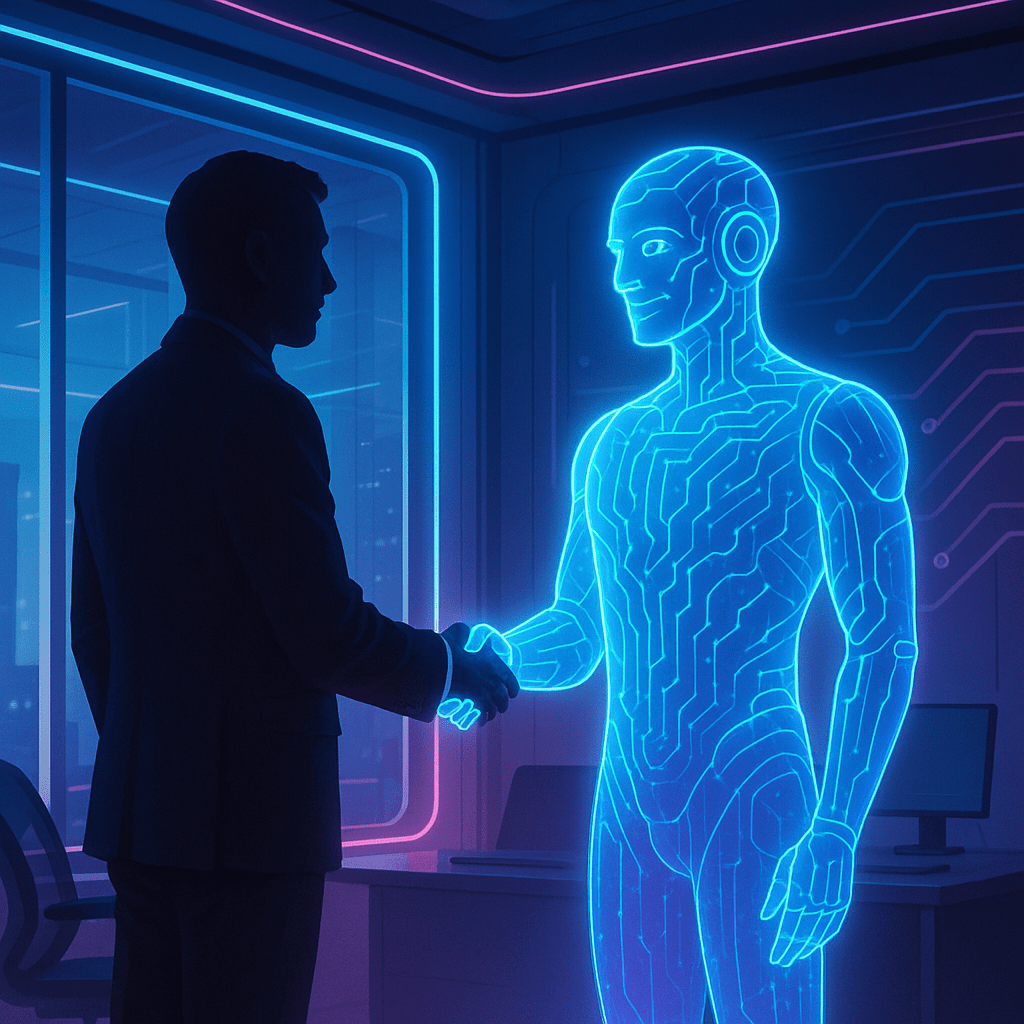
Artificially Intelligent (AI) “virtual employees” are fully autonomous software agents designed to perform the end-to-end duties of a traditional staff member, ranging from customer service interactions and data analysis to decision-making processes, without a human in the loop. Unlike narrow AI tools that assist humans with specific tasks (e.g., scheduling or transcription), virtual employees possess broader role-based capabilities, integrating natural language understanding, process automation, and, increasingly, adaptive learning to fulfill job descriptions in their entirety.
What is an AI Virtual Employee?
- End-to-End Autonomy
- Role-Based Scope: Unlike narrow AI tools that assist with specific tasks (e.g., scheduling or transcription), a virtual employee owns an entire role—such as “Customer Support Specialist” or “Data Analyst.”
- Lifecycle Management: It can initiate, execute, and complete tasks on its own, from gathering inputs to delivering final outputs and even escalating exceptions.
- Core Capabilities
- Natural Language Understanding (NLU)
Interprets customer emails, chat requests, or internal memos in human language. - Process Automation & Orchestration
Executes multi-step workflows—accessing databases, running scripts, updating records, and generating reports. - Adaptive Learning
Continuously refines its models based on feedback loops (e.g., customer satisfaction ratings or accuracy metrics). - Decision-Making
Applies business rules, policy engines, and predictive analytics to make autonomous judgments within its remit.
- Natural Language Understanding (NLU)
- Integration & Interfaces
- APIs and Enterprise Systems
Connects to CRM, ERP, document management, and collaboration platforms via secure APIs. - Dashboards & Monitoring
Exposes performance metrics (e.g., throughput, error rates) to human supervisors through BI dashboards and alerting systems.
- APIs and Enterprise Systems
- Governance & Compliance
- Policy Enforcement
Embeds regulatory guardrails (e.g., GDPR data handling, SOX invoice processing) to prevent unauthorized actions. - Auditability
Logs every action with detailed metadata—timestamps, decision rationale, data sources—for post-hoc review and liability assignment.
- Policy Enforcement
Examples of Virtual Employees
1. Virtual Customer Support Agent
- Context: A telecom company receives thousands of customer inquiries daily via chat and email.
- Capabilities:
- Handles tier-1 troubleshooting (password resets, billing queries).
- Uses sentiment analysis to detect frustrated customers and escalates to a human for complex issues.
- Automatically updates the CRM with case notes and resolution codes.
- Benefits:
- 24/7 coverage without shift costs.
- Consistent adherence to company scripts and compliance guidelines.
2. AI Financial Reporting Analyst
- Context: A mid-sized financial services firm needs monthly performance reports for multiple funds.
- Capabilities:
- Aggregates data from trading systems, accounting ledgers, and market feeds.
- Applies predefined accounting rules and generates variance analyses, balance sheets, and P&L statements.
- Drafts narrative commentary summarizing key drivers and forwards the package for human review.
- Benefits:
- Reduces report-generation time from days to hours.
- Minimizes manual calculation errors and standardizes commentary tone.
3. Virtual HR Onboarding Coordinator
- Context: A global enterprise hires dozens of new employees each month across multiple time zones.
- Capabilities:
- Sends personalized welcome emails, schedules orientation sessions, and issues system access requests.
- Verifies completion of compliance modules (e.g., code of conduct training) and issues reminders.
- Benefits:
- Ensures a seamless, uniform onboarding experience.
- Frees HR staff to focus on higher-value tasks like talent development.
These examples illustrate how AI virtual employees can seamlessly integrate into core business functions — delivering consistent, scalable, and auditable performance while augmenting or, in some cases, replacing repetitive human work.
Pros of Introducing AI-Based Virtual Employees
- Operational Efficiency and Cost Savings
- Virtual employees can operate 24/7 without fatigue, breaks, or shift differentials, driving substantial throughput gains in high-volume roles such as customer support or back-office processing Bank of America.
- By automating repetitive or transaction-driven functions, organizations can reduce per-unit labor costs and redeploy budget toward strategic initiatives.
- Scalability and Rapid Deployment
- Unlike human hiring—which may take weeks to months—AI agents can be instantiated, configured, and scaled globally within days, helping firms meet sudden demand surges or geographic expansion needs Business Insider.
- Cloud-based architectures enable elastic resource allocation, ensuring virtual employees have access to the compute power they need at scale.
- Consistency and Compliance
- Well-trained AI models adhere strictly to programmed policies and regulations, minimizing variation in decision-making and lowering error rates in compliance-sensitive areas like financial reporting or claims processing Deloitte United States.
- Audit trails and immutable logs can record every action taken by a virtual employee, simplifying regulatory audits and internal reviews.
- Data-Driven Continuous Improvement
- Virtual employees generate rich performance metrics—response times, resolution accuracy, customer satisfaction scores—that can feed continuous learning loops, enabling incremental improvements through retraining and updated data inputs.
Cons and Challenges
- Lack of Human Judgment and Emotional Intelligence
- AI systems may struggle with nuance, empathy, or complex conflict resolution, leading to suboptimal customer experiences in high-touch scenarios.
- Overreliance on historical data can perpetuate biases, especially in areas like hiring or lending, potentially exposing firms to reputational and legal risk.
- Accountability and Liability
- When a virtual employee’s action contravenes company policy or legal regulations, it can be challenging to assign responsibility. Organizations must establish clear frameworks—often involving legal, compliance, and risk management teams—to define liability and remedial processes.
- Insurance and indemnification agreements may need to evolve to cover AI-driven operational failures.
- Integration Complexity
- Embedding virtual employees into existing IT ecosystems requires substantial investment in APIs, data pipelines, and security controls. Poor integration can generate data silos or create new attack surfaces.
- Workforce Impact and Ethical Considerations
- Widespread deployment of virtual employees could lead to workforce displacement, intensifying tensions over fair pay and potentially triggering regulatory scrutiny The Business Journals.
- Organizations must balance cost-efficiency gains with responsibilities to reskill or transition affected employees.
Organizational Fit and Reporting Structure
- Position Within the Organization
Virtual employees typically slot into established departmental hierarchies—e.g., reporting to the Director of Customer Success, Head of Finance, or their equivalent. In matrix organizations, an AI Governance Office or Chief AI Officer may oversee standards, risk management, and strategic alignment across these agents. - Supervision and Oversight
Rather than traditional “line managers,” virtual employees are monitored via dashboards that surface key performance indicators (KPIs), exception reports, and compliance flags. Human overseers review flagged incidents and sign off on discretionary decisions beyond the AI’s remit. - Accountability Mechanisms
- Policy Engines & Guardrails: Business rules and legal constraints are encoded into policy engines that block prohibited actions in real time.
- Audit Logging: Every action is logged with timestamps and rationale, creating an immutable chain of custody for later review.
- Human-in-the-Loop (HITL) Triggers: For high-risk tasks, AI agents escalate to human reviewers when confidence scores fall below a threshold.
Ensuring Compliance and Ethical Use
- Governance Frameworks
Companies must establish AI ethics committees and compliance charters that define acceptable use cases, data privacy protocols, and escalation paths. Regular “model risk” assessments and bias audits help ensure alignment with legal guidelines, such as GDPR or sector-specific regulations. - Legal Accountability
Contracts with AI vendors should stipulate liability clauses, performance warranties, and audit rights. Internally developed virtual employees demand clear policies on intellectual property, data ownership, and jurisdictional compliance, backed by legal sign-off before deployment.
Adoption Timeline: How Far Away Are Fully AI-Based Employees?
- 2025–2027 (Pilot and Augmentation Phase)
Many Fortune 500 firms are already piloting AI agents as “digital colleagues,” assisting humans in defined tasks. Industry leaders like Microsoft predict a three-phase evolution—starting with assistants today, moving to digital colleagues in the next 2–3 years, and full AI-driven business units by 2027–2030 The Guardian. - 2028–2032 (Early Adoption of Fully Autonomous Roles)
As models mature in reasoning, context retention, and domain adaptability, companies in tech-savvy sectors—finance, logistics, and customer service—will begin appointing virtual employees to standalone roles, e.g., an AI account manager or virtual claims adjuster. - 2033+ (Mainstream Deployment)
Widespread integration across industries will hinge on breakthroughs in explainability, regulatory frameworks, and public trust. By the early 2030s, we can expect virtual employees to be commonplace in back-office and mid-level professional functions.
Conclusion
AI-based virtual employees promise transformative efficiencies, scalability, and data-driven consistency, but they also introduce significant challenges around empathy, integration complexity, and ethical accountability. Organizations must evolve governance, reporting structures, and legal frameworks in lockstep with technological advances. While fully autonomous virtual employees remain in pilot today, rapid advancements and strategic imperatives indicate that many firms will seriously explore these models within the next 2 to 5 years, laying the groundwork for mainstream adoption by the early 2030s. Balancing innovation with responsible oversight will be the key to harnessing virtual employees’ full potential.
Also follow us on (Spotify)

 De Lio Tech Trends