Meet Your Next Digital Colleague: Navigating the Rise of AI Virtual Employees


Artificially Intelligent (AI) “virtual employees” are fully autonomous software agents designed to perform the end-to-end duties of a traditional staff member, ranging from customer service interactions and data analysis to decision-making processes, without a human in the loop. Unlike narrow AI tools that assist humans with specific tasks (e.g., scheduling or transcription), virtual employees possess broader role-based capabilities, integrating natural language understanding, process automation, and, increasingly, adaptive learning to fulfill job descriptions in their entirety.


What is an AI Virtual Employee?

  1. End-to-End Autonomy
    • Role-Based Scope: Unlike narrow AI tools that assist with specific tasks (e.g., scheduling or transcription), a virtual employee owns an entire role—such as “Customer Support Specialist” or “Data Analyst.”
    • Lifecycle Management: It can initiate, execute, and complete tasks on its own, from gathering inputs to delivering final outputs and even escalating exceptions.
  2. Core Capabilities
    • Natural Language Understanding (NLU)
      Interprets customer emails, chat requests, or internal memos in human language.
    • Process Automation & Orchestration
      Executes multi-step workflows—accessing databases, running scripts, updating records, and generating reports.
    • Adaptive Learning
      Continuously refines its models based on feedback loops (e.g., customer satisfaction ratings or accuracy metrics).
    • Decision-Making
      Applies business rules, policy engines, and predictive analytics to make autonomous judgments within its remit.
  3. Integration & Interfaces
    • APIs and Enterprise Systems
      Connects to CRM, ERP, document management, and collaboration platforms via secure APIs.
    • Dashboards & Monitoring
      Exposes performance metrics (e.g., throughput, error rates) to human supervisors through BI dashboards and alerting systems.
  4. Governance & Compliance
    • Policy Enforcement
      Embeds regulatory guardrails (e.g., GDPR data handling, SOX invoice processing) to prevent unauthorized actions.
    • Auditability
      Logs every action with detailed metadata—timestamps, decision rationale, data sources—for post-hoc review and liability assignment.

Examples of Virtual Employees

1. Virtual Customer Support Agent

  • Context: A telecom company receives thousands of customer inquiries daily via chat and email.
  • Capabilities:
    • Handles tier-1 troubleshooting (password resets, billing queries).
    • Uses sentiment analysis to detect frustrated customers and escalates to a human for complex issues.
    • Automatically updates the CRM with case notes and resolution codes.
  • Benefits:
    • 24/7 coverage without shift costs.
    • Consistent adherence to company scripts and compliance guidelines.

2. AI Financial Reporting Analyst

  • Context: A mid-sized financial services firm needs monthly performance reports for multiple funds.
  • Capabilities:
    • Aggregates data from trading systems, accounting ledgers, and market feeds.
    • Applies predefined accounting rules and generates variance analyses, balance sheets, and P&L statements.
    • Drafts narrative commentary summarizing key drivers and forwards the package for human review.
  • Benefits:
    • Reduces report-generation time from days to hours.
    • Minimizes manual calculation errors and standardizes commentary tone.

3. Virtual HR Onboarding Coordinator

  • Context: A global enterprise hires dozens of new employees each month across multiple time zones.
  • Capabilities:
    • Sends personalized welcome emails, schedules orientation sessions, and issues system access requests.
    • Verifies completion of compliance modules (e.g., code of conduct training) and issues reminders.
  • Benefits:
    • Ensures a seamless, uniform onboarding experience.
    • Frees HR staff to focus on higher-value tasks like talent development.

These examples illustrate how AI virtual employees can seamlessly integrate into core business functions — delivering consistent, scalable, and auditable performance while augmenting or, in some cases, replacing repetitive human work.

Pros of Introducing AI-Based Virtual Employees

  1. Operational Efficiency and Cost Savings
    • Virtual employees can operate 24/7 without fatigue, breaks, or shift differentials, driving substantial throughput gains in high-volume roles such as customer support or back-office processing Bank of America.
    • By automating repetitive or transaction-driven functions, organizations can reduce per-unit labor costs and redeploy budget toward strategic initiatives.
  2. Scalability and Rapid Deployment
    • Unlike human hiring—which may take weeks to months—AI agents can be instantiated, configured, and scaled globally within days, helping firms meet sudden demand surges or geographic expansion needs Business Insider.
    • Cloud-based architectures enable elastic resource allocation, ensuring virtual employees have access to the compute power they need at scale.
  3. Consistency and Compliance
    • Well-trained AI models adhere strictly to programmed policies and regulations, minimizing variation in decision-making and lowering error rates in compliance-sensitive areas like financial reporting or claims processing Deloitte United States.
    • Audit trails and immutable logs can record every action taken by a virtual employee, simplifying regulatory audits and internal reviews.
  4. Data-Driven Continuous Improvement
    • Virtual employees generate rich performance metrics—response times, resolution accuracy, customer satisfaction scores—that can feed continuous learning loops, enabling incremental improvements through retraining and updated data inputs.

Cons and Challenges

  1. Lack of Human Judgment and Emotional Intelligence
    • AI systems may struggle with nuance, empathy, or complex conflict resolution, leading to suboptimal customer experiences in high-touch scenarios.
    • Overreliance on historical data can perpetuate biases, especially in areas like hiring or lending, potentially exposing firms to reputational and legal risk.
  2. Accountability and Liability
    • When a virtual employee’s action contravenes company policy or legal regulations, it can be challenging to assign responsibility. Organizations must establish clear frameworks—often involving legal, compliance, and risk management teams—to define liability and remedial processes.
    • Insurance and indemnification agreements may need to evolve to cover AI-driven operational failures.
  3. Integration Complexity
    • Embedding virtual employees into existing IT ecosystems requires substantial investment in APIs, data pipelines, and security controls. Poor integration can generate data silos or create new attack surfaces.
  4. Workforce Impact and Ethical Considerations
    • Widespread deployment of virtual employees could lead to workforce displacement, intensifying tensions over fair pay and potentially triggering regulatory scrutiny The Business Journals.
    • Organizations must balance cost-efficiency gains with responsibilities to reskill or transition affected employees.

Organizational Fit and Reporting Structure

  • Position Within the Organization
    Virtual employees typically slot into established departmental hierarchies—e.g., reporting to the Director of Customer Success, Head of Finance, or their equivalent. In matrix organizations, an AI Governance Office or Chief AI Officer may oversee standards, risk management, and strategic alignment across these agents.
  • Supervision and Oversight
    Rather than traditional “line managers,” virtual employees are monitored via dashboards that surface key performance indicators (KPIs), exception reports, and compliance flags. Human overseers review flagged incidents and sign off on discretionary decisions beyond the AI’s remit.
  • Accountability Mechanisms
    1. Policy Engines & Guardrails: Business rules and legal constraints are encoded into policy engines that block prohibited actions in real time.
    2. Audit Logging: Every action is logged with timestamps and rationale, creating an immutable chain of custody for later review.
    3. Human-in-the-Loop (HITL) Triggers: For high-risk tasks, AI agents escalate to human reviewers when confidence scores fall below a threshold.

Ensuring Compliance and Ethical Use

  • Governance Frameworks
    Companies must establish AI ethics committees and compliance charters that define acceptable use cases, data privacy protocols, and escalation paths. Regular “model risk” assessments and bias audits help ensure alignment with legal guidelines, such as GDPR or sector-specific regulations.
  • Legal Accountability
    Contracts with AI vendors should stipulate liability clauses, performance warranties, and audit rights. Internally developed virtual employees demand clear policies on intellectual property, data ownership, and jurisdictional compliance, backed by legal sign-off before deployment.

Adoption Timeline: How Far Away Are Fully AI-Based Employees?

  • 2025–2027 (Pilot and Augmentation Phase)
    Many Fortune 500 firms are already piloting AI agents as “digital colleagues,” assisting humans in defined tasks. Industry leaders like Microsoft predict a three-phase evolution—starting with assistants today, moving to digital colleagues in the next 2–3 years, and full AI-driven business units by 2027–2030 The Guardian.
  • 2028–2032 (Early Adoption of Fully Autonomous Roles)
    As models mature in reasoning, context retention, and domain adaptability, companies in tech-savvy sectors—finance, logistics, and customer service—will begin appointing virtual employees to standalone roles, e.g., an AI account manager or virtual claims adjuster.
  • 2033+ (Mainstream Deployment)
    Widespread integration across industries will hinge on breakthroughs in explainability, regulatory frameworks, and public trust. By the early 2030s, we can expect virtual employees to be commonplace in back-office and mid-level professional functions.

Conclusion

AI-based virtual employees promise transformative efficiencies, scalability, and data-driven consistency, but they also introduce significant challenges around empathy, integration complexity, and ethical accountability. Organizations must evolve governance, reporting structures, and legal frameworks in lockstep with technological advances. While fully autonomous virtual employees remain in pilot today, rapid advancements and strategic imperatives indicate that many firms will seriously explore these models within the next 2 to 5 years, laying the groundwork for mainstream adoption by the early 2030s. Balancing innovation with responsible oversight will be the key to harnessing virtual employees’ full potential.

Also follow us on (Spotify)
The Importance of Reasoning in AI: A Step Towards AGI

Artificial Intelligence has made remarkable strides in pattern recognition and language generation, but the true hallmark of human-like intelligence lies in the ability to reason—to piece together intermediate steps, weigh evidence, and draw conclusions. Modern AI models are increasingly incorporating structured reasoning capabilities, such as Chain‑of‑Thought (CoT) prompting and internal “thinking” modules, moving us closer to Artificial General Intelligence (AGI). arXivAnthropic


Understanding Reasoning in AI

Reasoning in AI typically refers to the model’s capacity to generate and leverage a sequence of logical steps—its “thought process”—before arriving at an answer. Techniques include:

  • Chain‑of‑Thought Prompting: Explicitly instructs the model to articulate intermediate steps, improving performance on complex tasks (e.g., math, logic puzzles) by up to 8.6% over plain prompting arXiv.
  • Internal Reasoning Modules: Some models perform reasoning internally without exposing every step, balancing efficiency with transparency Home.
  • Thinking Budgets: Developers can allocate or throttle computational resources for reasoning, optimizing cost and latency for different tasks Business Insider.

By embedding structured reasoning, these models better mimic human problem‑solving, a crucial attribute for general intelligence.


Examples of Reasoning in Leading Models

GPT‑4 and the o3 Family

OpenAI’s GPT‑4 series introduced explicit support for CoT and tool integration. Recent upgrades—o3 and o4‑mini—enhance reasoning by incorporating visual inputs (e.g., whiteboard sketches) and seamless tool use (web browsing, Python execution) directly into their inference pipeline The VergeOpenAI.

Google Gemini 2.5 Flash

Gemini 2.5 models are built as “thinking models,” capable of internal deliberation before responding. The Flash variant adds a “thinking budget” control, allowing developers to dial reasoning up or down based on task complexity, striking a balance between accuracy, speed, and cost blog.googleBusiness Insider.

Anthropic Claude

Claude’s extended-thinking versions leverage CoT prompting to break down problems step-by-step, yielding more nuanced analyses in research and safety evaluations. However, unfaithful CoT remains a concern when the model’s verbalized reasoning doesn’t fully reflect its internal logic AnthropicHome.

Meta Llama 3.3

Meta’s open‑weight Llama 3.3 70B uses post‑training techniques to enhance reasoning, math, and instruction-following. Benchmarks show it rivals its much larger 405B predecessor, offering inference efficiency and cost savings without sacrificing logical rigor Together AI.


Advantages of Leveraging Reasoning

  1. Improved Accuracy & Reliability
    • Structured reasoning enables finer-grained problem solving in domains like mathematics, code generation, and scientific analysis arXiv.
    • Models can self-verify intermediate steps, reducing blatant errors.
  2. Transparency & Interpretability
    • Exposed chains of thought allow developers and end‑users to audit decision paths, aiding debugging and trust-building Medium.
  3. Complex Task Handling
    • Multi-step reasoning empowers AI to tackle tasks requiring planning, long-horizon inference, and conditional logic (e.g., legal analysis, multi‑stage dialogues).
  4. Modular Integration
    • Tool-augmented reasoning (e.g., Python, search) allows dynamic data retrieval and computation within the reasoning loop, expanding the model’s effective capabilities The Verge.

Disadvantages and Challenges

  1. Computational Overhead
    • Reasoning steps consume extra compute, increasing latency and cost—especially for large-scale deployments without budget controls Business Insider.
  2. Potential for Unfaithful Reasoning
    • The model’s stated chain of thought may not fully mirror its actual inference, risking misleading explanations and overconfidence Home.
  3. Increased Complexity in Prompting
    • Crafting effective CoT prompts or schemas (e.g., Structured Output) requires expertise and iteration, adding development overhead Medium.
  4. Security and Bias Risks
    • Complex reasoning pipelines can inadvertently amplify biases or generate harmful content if not carefully monitored throughout each step.

Comparing Model Capabilities

ModelReasoning StyleStrengthsTrade‑Offs
GPT‑4/o3/o4Exposed & internal CoTPowerful multimodal reasoning; broad tool supportHigher cost & compute demand
Gemini 2.5 FlashInternal thinkingCustomizable reasoning budget; top benchmark scoresLimited public availability
Claude 3.xInternal CoTSafety‑focused red teaming; conceptual “language of thought”Occasional unfaithfulness
Llama 3.3 70BPost‑training CoTCost‑efficient logical reasoning; fast inferenceSlightly lower top‑tier accuracy

The Path to AGI: A Historical Perspective

  1. Early Neural Networks (1950s–1990s)
    • Perceptrons and shallow networks established pattern recognition foundations.
  2. Deep Learning Revolution (2012–2018)
    • CNNs, RNNs, and Transformers achieved breakthroughs in vision, speech, and NLP.
  3. Scale and Pretraining (2018–2022)
    • GPT‑2/GPT‑3 demonstrated that sheer scale could unlock emergent language capabilities.
  4. Prompting & Tool Use (2022–2024)
    • CoT prompting and model APIs enabled structured reasoning and external tool integration.
  5. Thinking Models & Multimodal Reasoning (2024–2025)
    • Models like GPT‑4o, o3, Gemini 2.5, and Llama 3.3 began internalizing multi-step inference and vision, a critical leap toward versatile, human‑like cognition.

Conclusion

The infusion of reasoning into AI models marks a pivotal shift toward genuine Artificial General Intelligence. By enabling step‑by‑step inference, exposing intermediate logic, and integrating external tools, these systems now tackle problems once considered out of reach. Yet, challenges remain: computational cost, reasoning faithfulness, and safe deployment. As we continue refining reasoning techniques and balancing performance with interpretability, we edge ever closer to AGI—machines capable of flexible, robust intelligence across domains.

Please follow us on Spotify as we discuss this episode.

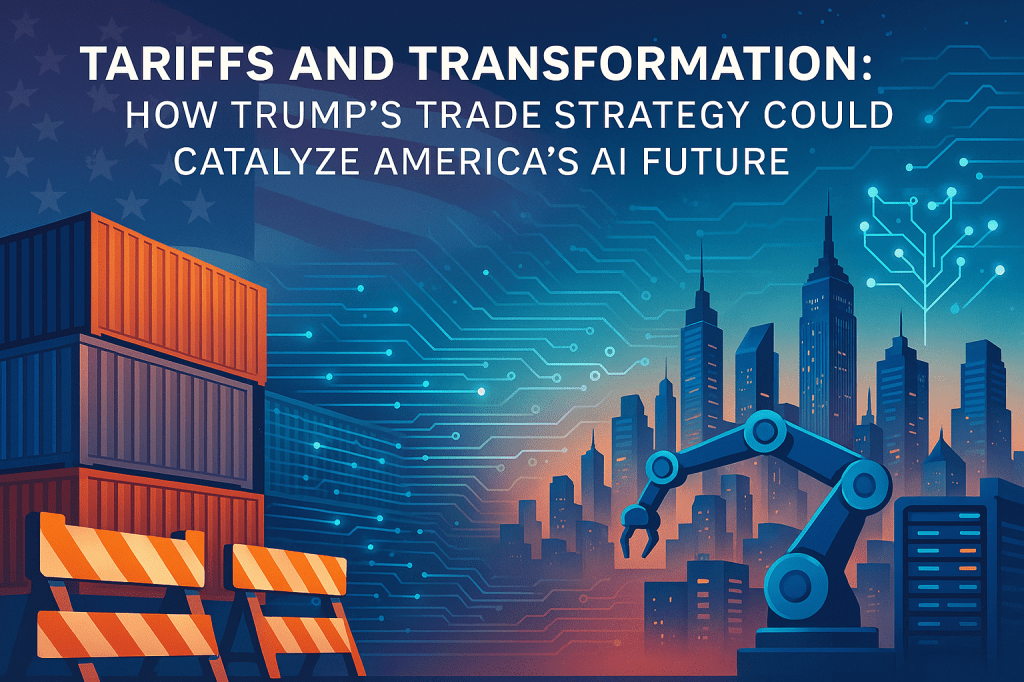
Tariffs and Transformation: How Trump’s Trade Strategy Could Catalyze America’s AI Future

When economic tensions flare, unexpected opportunities emerge. While President Donald Trump’s renewed push for worldwide tariffs has reignited debate over globalization and economic isolation, a contrarian view is quietly gaining traction: Could protectionist trade policies act as an accelerant for American innovation, particularly in Artificial Intelligence (AI)? As access to cheap foreign labor and outsourced manufacturing becomes constrained, the U.S. may be nudged — or forced — into a new industrial renaissance powered by automation, AI, and advanced digital infrastructure.

In this post, we’ll explore how an aggressive trade war scenario may inadvertently lay the foundation for rapid AI adoption, workforce transformation, and strategic repositioning of U.S. economic competitiveness — not in spite of tariffs, but because of them.


Short-Term Ripple Effects: Immediate Catalysts for AI Integration

1. Supply Chain Shock → Automation Investment

  • Tariffs on imported goods — particularly from manufacturing hubs like China — immediately raise the cost of parts, electronics, and finished products.
  • To combat increased costs, U.S. manufacturers may invest in robotic process automation (RPA), AI-driven predictive maintenance, and computer vision for quality control, reducing reliance on human labor and global inputs.

Example: An American electronics company previously sourcing sensors from Asia might now use AI to optimize domestic additive manufacturing (3D printing) operations, cutting turnaround time and offsetting tariff costs.

2. Labor Cost Rebalancing

  • With offshore labor becoming less cost-effective due to tariffs, the cost parity between human workers and AI solutions narrows.
  • Companies accelerate deployment of AI-powered customer support, logistics optimization, and AI-enhanced B2B services.

Example: SMBs adopt platforms like UiPath or Microsoft Power Automate to streamline finance and HR workflows, reducing the need for outsourced back-office functions in India or the Philippines.

3. Energy and Commodities Realignment

  • Tariffs on materials like rare earth metals or lithium may hamper hardware-dependent industries, incentivizing a pivot to software-first innovation.
  • U.S. firms may double down on software-defined infrastructure, AI-driven simulation, and synthetic data generation to reduce dependence on imported physical components.

Example: In response to tariffs on imported rare earth metals, U.S. energy firms may accelerate investment in AI-driven material discovery and recycling technologies to secure domestic alternatives and reduce dependency on foreign supply chains.


Mid to Long-Term Scenarios: Strategic AI Acceleration

1. Re-Industrialization Through AI-First Infrastructure

As tariffs insulate domestic industries:

  • Federal and state incentives (similar to the CHIPS Act) may emerge to promote AI innovation zones in Rust Belt regions.
  • Legacy factories get retrofit with digital twins, AI-powered supply chain orchestration, and IoT-based production analytics.
  • AI talent clusters emerge in places like Detroit, Pittsburgh, and Milwaukee, rejuvenating local economies.

Long-Term Outcome:
The U.S. begins to compete not on low-cost goods, but high-efficiency, AI-integrated advanced manufacturing.

2. Defense and National Security-Driven AI Growth

A tariff-fueled standoff with nations like China may escalate:

  • U.S. defense agencies double down on autonomous systems, cybersecurity AI, and quantum AI research.
  • Public-private partnerships with defense contractors and startups accelerate dual-use AI innovations (e.g., drones, AI threat detection, digital war gaming).

Long-Term Outcome:
AI becomes a core pillar of national resilience, similar to how the space race galvanized aerospace R&D.

3. Higher Education & Workforce Realignment

As industries shift to domestic AI-first operations:

  • Trade schools, community colleges, and universities modernize programs to teach AI integration, ML operations, low-code automation, and ethical AI use.
  • Federal workforce reskilling programs (akin to the GI Bill) are introduced to support mid-career transitions.

Example:
A 52-year-old logistics manager in Ohio completes a certificate in AI-driven supply chain tools and pivots into a role coordinating digital freight platforms.


Opportunities for New Workforce Entrants

🧠 AI-First Entrepreneurism

  • Tariffs reconfigure global pricing dynamics — creating white space opportunities for AI startups to solve new domestic pain points in manufacturing, agriculture, and logistics.
  • Young entrepreneurs can build lean AI-driven businesses targeting newly re-domesticated industries.

💼 Entry-Level Talent Floodgates Open

  • The surge in demand for AI system maintenance, prompt engineering, data labeling, and ML model tuning opens doors for tech-savvy but non-degreed workers.
  • Apprenticeship programs and AI bootcamps become more valuable than 4-year degrees for many roles.

Upskilling Pathways for Stable-Career Professionals

📈 Business Leaders and Analysts

  • Professionals in stable sectors (e.g., retail, finance, insurance) can future-proof by learning AI analytics, customer segmentation AI, and LMM-enhanced decision intelligence.
  • MBAs and strategists gain value by adding AI fluency and toolkits like Tableau+Einstein AI or Snowflake Cortex to their profiles.

🏭 Operations & Manufacturing Roles

  • Engineers and managers shift into AI-integrated plant operations, robotics orchestration, and digital twin strategy roles.
  • Experienced technicians transition into AI-powered maintenance via platforms like Avathon or Uptake.

Conclusion: A New Kind of American Resilience

While protectionism has long been painted as anti-innovation, we may be witnessing a rare inversion of that narrative. If U.S. businesses are pushed away from cheap global sourcing and back toward domestic self-reliance, AI may emerge as the only economically viable way to bridge the gap. This shift can usher in not only a smarter economy but a more inclusive one — if policymakers, educators, and enterprises act quickly.

By viewing tariffs not merely as a cost, but as a forcing function for digital transformation, the U.S. has a window to reindustrialize with intelligence — quite literally.

Please listen to us discuss this topic on Spotify