Is There an AI Bubble Forming – Or Durable Super-Cycle?

Introduction

Artificial intelligence has become the defining capital theme of this decade – not just in technology, but in macroeconomics, geopolitics, and industrial policy. The world’s largest corporations are investing at a rate not seen since the early days of the internet, while governments are channeling billions into chip fabrication, data centers, and energy infrastructure to secure their place in the AI value chain. This convergence of public subsidy, private ambition, and rapid technical evolution has led analysts to ask a critical question: are we witnessing the birth of a durable technological super-cycle, or the inflation of a modern AI bubble? What follows is a data-grounded exploration of both possibilities – how governments, hyperscalers, and AI firms are investing in each other, how those capital flows are reshaping global markets, and what signals investors should watch to determine whether this boom is sustainable or speculative.

Recent Commentary Making News

  • Government capital (grants, tax credits, and potentially equity stakes) is accelerating AI supply chains, especially semiconductors and power infrastructure. That lowers hurdle rates but can also distort price signals if demand lags. Reuters+2Reuters+2
  • Corporate capex + cross-investments are at historic highs (hyperscalers, model labs, chipmakers), with new mega-deals in data centers and long-dated chip supply. This can look “bubble-ish,” but much of it targets hard assets with measurable cash-costs and potential operating leverage. Reuters+2Reuters+2
  • Bubble case: valuations + concentration risk, debt-financed spending, power and supply-chain bottlenecks, and uncertain near-term ROI. Reuters+2Yahoo Finance+2
  • No-bubble case: rising earnings from AI leaders, multi-year backlog in chips & data centers, and credible productivity/efficiency uplifts beginning to show in early adopters. Reuters+2Business Insider+2

1) The public sector is now a direct capital allocator to AI infrastructure

  • U.S. CHIPS & Science Act: ~$53B in incentives over five years (≈$39B for fabs, ≈$13B for R&D/workforce) plus a 25% investment tax credit for fab equipment started before 2027. This is classic industrial policy aimed at upstream resilience that AI depends on. OECD
  • Policy evolution toward equity: U.S. officials have considered taking non-voting equity stakes in chipmakers in exchange for CHIPS grants—shifting government from grants toward balance-sheet exposure. Whether one applauds or worries about that, it’s a material change in risk-sharing and price discovery. Reuters+1
  • Power & grid as the new bottleneck: DOE’s Speed to Power initiative explicitly targets multi-GW projects to meet AI/data-center demand; GRIP adds $10.5B to grid resilience and flexibility. That’s government money and convening power aimed at the non-silicon side of AI economics. The Department of Energy’s Energy.gov+2Federal Register+2
  • Europe: The EU Chips Act and state-aid approvals (e.g., Germany’s subsidy packages for TSMC and Intel) show similar public-private leverage onshore. Reuters+1

Implication: Subsidies and public credit reduce WACC for critical assets (fabs, packaging, grid, data centers). That can support a durable super-cycle. It can also mask overbuild risk if end-demand underdelivers.


2) How companies are financing each other — and each other’s customers

  • Hyperscaler capex super-cycle: Analyst tallies point to $300–$400B+ annualized run-rates across Big Tech & peers for AI-tied infrastructure in 2025, with momentum into 2026–27. theCUBE Research+1
  • Strategic/vertical deals:
    • Amazon ↔ Anthropic (up to $4B), embedding model access into AWS Bedrock and compute consumption. About Amazon
    • Microsoft ↔ OpenAI: revenue-share and compute alignment continue under a new MOU; reporting suggests revenue-share stepping down toward decade’s end—altering cashflows and risk. The Official Microsoft Blog+1
    • NVIDIA ↔ ecosystem: aggressive strategic investing (direct + NVentures) into models, tools, even energy, tightening its demand flywheel. Crunchbase News+1
    • Chip supply commitments: hyperscalers are locking multi-year GPU supply, and foundry/packaging capacity (TSMC CoWoS) is a coordinating constraint that disciplines overbuild for now. Reuters+1
  • Infra M&A & consortiums: A BlackRock/Microsoft/NVIDIA (and others) consortium agreed to acquire Aligned Data Centers for $40B, signaling long-duration capital chasing AI-ready power and land banks. Reuters
  • Direct chip supply partnerships: e.g., Microsoft sourcing ~200,000 NVIDIA AI chips with partners—evidence of corporate-to-corporate market-making outside simple spot buys. Reuters

Implication: The sector’s not just “speculators bidding memes.” It’s hard-asset contracting + strategic equity + revenue-sharing across tiers. That dampens some bubble dynamics—but can also interlink balance sheets, raising systemic risk if a single tier stumbles.


3) Why a bubble could be forming (watch these pressure points)

  1. Capex outrunning near-term cash returns: Investors warn that unchecked spend by the hyperscalers (and partners) may pressure FCF if monetization lags. Street scenarios now contemplate $500B annual AI capex by 2027—a heroic curve. Reuters
  2. Debt as a growing fuel: AI-adjacent issuers have already printed >$140B in 2025 corporate credit issuance, surpassing 2024 totals—good for liquidity, risky if rates stay high or revenues slip. Yahoo Finance
  3. Concentration risk: Market cap gains are heavily clustered in a handful of firms; if earnings miss, there are few “safe” places in cap-weighted indices. The Guardian
  4. Physical constraints: Packaging (CoWoS), grid interconnects, and siting (water, permitting) are non-trivial. Delays or policy reversals could deflate expectations fast. Reuters+1
  5. Policy & geopolitics: Export controls (e.g., China/H100, A100) and shifting industrial policy (including equity models) add non-market risk premia to the stack. Reuters+1

4) Why it may not be a bubble (the durable super-cycle case)

  1. Earnings & order books: Upstream suppliers like TSMC are printing record profits on AI demand; that’s realized, not just narrative. Reuters
  2. Hard-asset backing: A large share of spend is in long-lived, revenue-producing infrastructure (fabs, power, data centers), not ephemeral eyeballs. Recent $40B data-center M&A underscores institutional belief in durable cash yields. Reuters
  3. Early productivity signals: Large adopters report tangible efficiency wins (e.g., ~20% dev-productivity improvements), hinting at operating leverage that can justify spend as tools mature. The Financial Brand
  4. Sell-side macro views: Some houses (e.g., Goldman/Morgan Stanley) argue today’s valuations are below classic bubble extremes and that AI revenues (esp. software) can begin to self-fund by ~2028 if deployment curves hold. Axios+1

5) Government money: stabilizer or accelerant?

  • When grants/tax credits pull forward capacity (fabs, packaging, grid), they lower unit costs and speed learning curves—anti-bubble if demand is real. OECD
  • If policy extends to equity stakes, government becomes a co-risk-bearer. That can stabilize strategic supply or encourage moral hazard and overcapacity. Either way, the macro beta of AI increases because policy risk becomes embedded in returns. Reuters+1

6) What to watch next (leading indicators for practitioners and investors)

  • Power lead times: Interconnect queue velocity and DOE actions under Speed to Power; project-finance closings for multi-GW campuses. If grid timelines slip, revenue ramps slip. The Department of Energy’s Energy.gov
  • Packaging & foundry tightness: Utilization and cycle-times in CoWoS and 2.5D/3D stacks; watch TSMC’s guidance and any signs of order deferrals. Reuters
  • Contracting structure: More take-or-pay compute contracts or prepayments? More infra consortium deals (private credit, sovereigns, asset managers)? Signals of discipline vs. land-grab. Reuters
  • Unit economics at application layer: Gross margin expansion in AI-native SaaS and in “AI features” of incumbents; payback windows for copilots/agents moving from pilot to fleet. (Sell-side work suggests software is where margins land if infra constraints ease.) Business Insider
  • Policy trajectory: Final shapes of subsidies, and any equity-for-grants programs; EU state-aid cadence; export-control drift. These can materially reprice risk. Reuters+1

7) Bottom line

  • We don’t have a classic, purely narrative bubble (yet): too much of the spend is in earning assets and capacity that’s already monetizing in upstream suppliers and cloud run-rates. Reuters
  • We could tip into bubble dynamics if capex continues to outpace monetization, if debt funding climbs faster than cash returns, or if power/packaging bottlenecks push out paybacks while policy support prolongs overbuild. Reuters+2Yahoo Finance+2
  • For operators and investors with advanced familiarity in AI and markets, the actionable stance is scenario discipline: underwrite projects to realistic utilization, incorporate policy/energy risk, and favor structures that share risk (capacity reservations, indexed pricing, rev-share) across chips–cloud–model–app layers.

Recent AI investment headlines

Meta commits $1.5 billion for AI data center in Texas

Reuters

Meta commits $1.5 billion for AI data center in Texas

BlackRock, Nvidia-backed group strikes $40 billion AI data center deal

Reuters

BlackRock, Nvidia-backed group strikes $40 billion AI data center deal

Morgan Stanley says the colossal AI spending spree could pay for itself by 2028

Business Insider

Morgan Stanley says the colossal AI spending spree could pay for itself by 2028

Investors on guard for risks that could derail the AI gravy train

Reuters

Investors on guard for risks that could derail the AI gravy train

We discuss this topic and others on (Spotify).

Standing at the Edge of the Next Chapter: A Consultant’s Crossroads

History is Fleeting:

For three decades, the rhythm of his life had been measured in client meetings, strategy decks, and project milestones. Thirty years in management consulting is not just a career—it’s a lifetime of problem-solving, navigating complex corporate landscapes, and delivering solutions that move the needle. He had partnered with clients from nearly every sector imaginable—financial services, manufacturing, healthcare, utilities—each engagement a new chapter in a story of innovation, adaptation, and perseverance.

Along the way, his passport became a tapestry of stamps, each marking a journey to a city (ex. Helsinki, Copenhagen, Seoul, Latvia, Estonia) he may never have otherwise seen. From bustling global capitals to remote industrial hubs, the world opened itself to him, and consulting became his passport not just to travel, but to perspectives, cultures, and opportunities that reshaped how he saw business and life.

His proudest moments often lived in the CRM space—projects where technology and human engagement intertwined. Solutions that didn’t just solve technical pain points, but redefined how his clients and their customers experienced a brand. There were the programs that fueled his energy—where creative vision met flawless execution—and the team left each day feeling the exhilaration of progress. But there were also the difficult ones: the engagements that drained him, mentally and physically, leaving little room for the spark that had once driven his career. These were the ones that made him question if it was actually worth the sacrifice of missing out on family and friend relationships.


Knowing the Comfort Zone

After thirty years, mastery becomes second nature. He knew how to walk into a room and quickly diagnose the unspoken challenges. He could anticipate objections before they surfaced, turn a chaotic discussion into a path forward, and lead teams through transformations that once seemed impossible. The skill set was honed, tested, and battle-proven. He felt comfortable in assuming who to listen to and who to respectfully ignore. Unfortunately, once that callus was formed, and his patience challenged the blinders would go up and any “noise” being perceived would be deflected, this lead to selective listening.

Mastery can also create a comfortable cage. The work was familiar, the playbook polished. The rewards—professional respect, client trust, financial stability—were still there. Yet the question lingered: was this the summit, or simply a plateau disguised as one?


The Pull of the Unknown

Recently, his thoughts began drifting far from the world of RFPs, client escalations, and program risk reviews. Photography had always been an interest, a quiet art that forced him to see the world through a different lens—literally. While consulting had trained him to scan for problems, photography taught him to look for beauty, for light, for composition. It was a way to slow time down instead of measuring it in billable hours.

There was also the allure of blending the two worlds—using technology to push creative boundaries, exploring AI-assisted image processing, drone-based storytelling, or immersive digital exhibitions. The idea of building something where art met innovation wasn’t just appealing—it felt like a natural evolution of the skills he already had, repurposed for a new purpose.


The Edge of the Ledge

Still, the prospect of stepping away from the familiar came with its own quiet fear. Consulting had been his safety net, his identity, his stage. To step onto a ledge and leap into something unknown meant risking that comfort.

What if the thrill of photography faded after the novelty wore off?
What if blending art and tech never gained traction?
What if leaving consulting meant leaving behind not just a career, but a core part of himself?

These questions weren’t just hypothetical—they carried the weight of real-life consequences. And yet, he knew that staying too long in the same place could quietly drain him just as much as the hardest project ever had.


The Path Forward

The truth is, there’s no single right answer. The next chapter doesn’t have to be a clean break; it could be a bridge. Perhaps it’s continuing in consulting, but selectively—choosing projects that excite, while carving out space for photography and creative technology ventures.

Or maybe it’s a phased transition—leveraging consulting expertise to fund and launch a photography business that incorporates emerging tech: VR travel experiences, AI-generated art exhibitions, or global storytelling projects that merge data with imagery.

And perhaps, the ultimate goal is not to replicate the success of his consulting career, but to build something that delivers a different kind of return—fulfillment, creative freedom, and the joy of waking up every day knowing that the work ahead is chosen, not assigned.

Things could get exciting the next few years and I hope that you will join in this journey and offer support, recommendations and lessons-learned, as this is something that we can all sample together.

We discuss this and other topics on (Spotify)

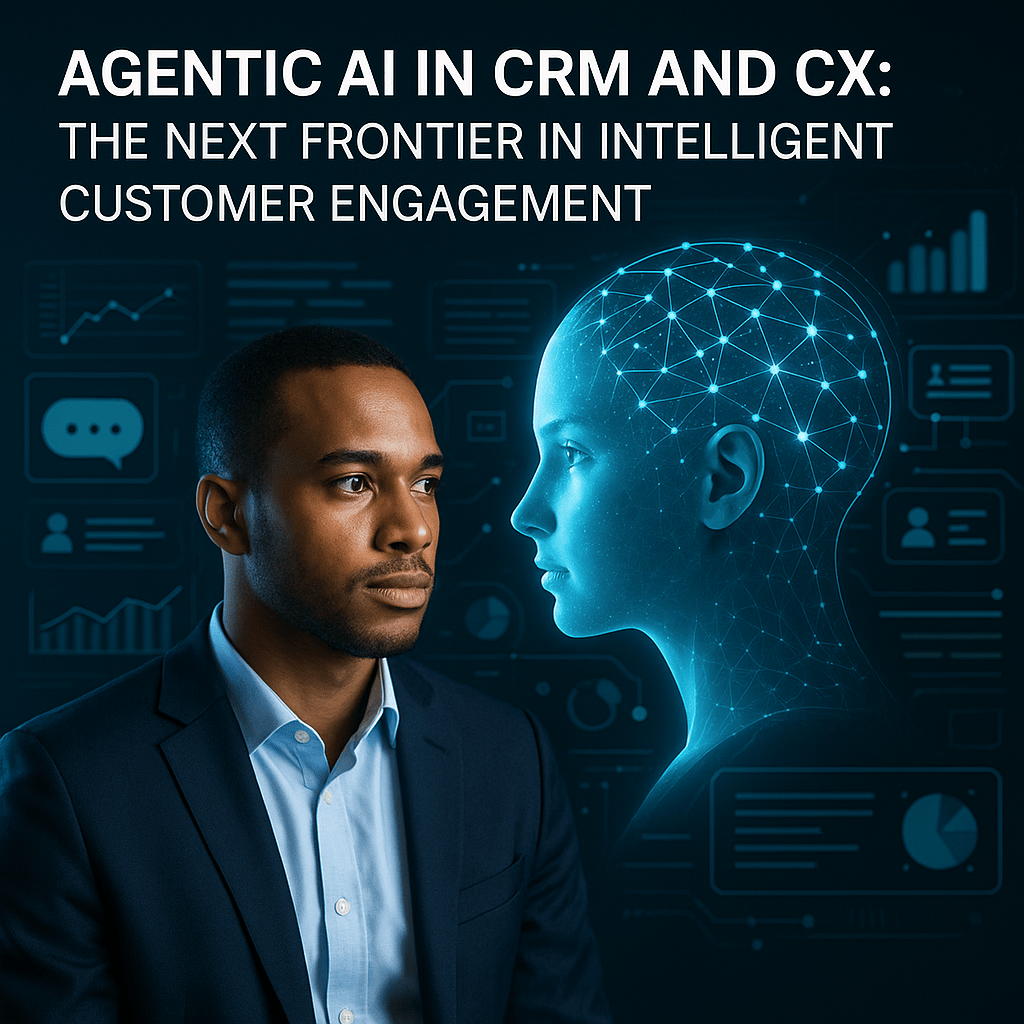
Agentic AI in CRM and CX: The Next Frontier in Intelligent Customer Engagement

Introduction: Why Agentic AI Is the Evolution CRM Needed

For decades, Customer Relationship Management (CRM) and Customer Experience (CX) strategies have been shaped by rule-based systems, automated workflows, and static data models. While these tools streamlined operations, they lacked the adaptability, autonomy, and real-time reasoning required in today’s experience-driven, hyper-personalized markets. Enter Agentic AI — a paradigm-shifting advancement that brings decision-making, goal-driven autonomy, and continuous learning into CRM and CX environments.

Agentic AI systems don’t just respond to customer inputs; they pursue objectives, adapt strategies, and self-improve — making them invaluable digital coworkers in the pursuit of frictionless, personalized, and emotionally intelligent customer journeys.


What Is Agentic AI and Why Is It a Game-Changer for CRM/CX?

Defining Agentic AI in Practical Terms

At its core, Agentic AI refers to systems endowed with agency — the ability to pursue goals, make context-aware decisions, and act autonomously within a defined scope. Think of them as intelligent, self-directed digital employees that don’t just process inputs but reason, decide, and act to accomplish objectives aligned with business outcomes.

In contrast to traditional automation or rule-based systems, which execute predefined scripts, Agentic AI identifies the objective, plans how to achieve it, monitors progress, and adapts in real time.

Key Capabilities of Agentic AI in CRM/CX:

CapabilityWhat It Means for CRM/CX
Goal-Directed BehaviorAgents operate with intent — for example, “reduce churn risk for customer X.”
Multi-Step PlanningInstead of simple Q&A, agents coordinate complex workflows across systems and channels.
Autonomy with ConstraintsAgents act independently but respect enterprise rules, compliance, and escalation logic.
Reflection and AdaptationAgents learn from each interaction, improving performance over time without human retraining.
InteroperabilityThey can interact with APIs, CRMs, contact center platforms, and data lakes autonomously.

Why This Matters for Customer Experience (CX)

Agentic AI is not just another upgrade to your chatbot or recommendation engine — it is an architectural shift in how businesses engage with customers. Here’s why:

1. From Reactive to Proactive Service

Traditional systems wait for customers to raise their hands. Agentic AI identifies patterns (e.g., signs of churn, purchase hesitation) and initiates outreach — recommending solutions or offering support before problems escalate.

Example: An agentic system notices that a SaaS user hasn’t logged in for 10 days and triggers a personalized re-engagement sequence including a check-in, a curated help article, and a call to action from an AI Customer Success Manager.

2. Journey Ownership Instead of Fragmented Touchpoints

Agentic AI doesn’t just execute tasks — it owns outcomes. A single agent could shepherd a customer from interest to onboarding, support, renewal, and advocacy, creating a continuous, cohesive journey that reflects memory, tone, and evolving needs.

Benefit: This reduces handoffs, reintroductions, and fragmented service, addressing a major pain point in modern CX.

3. Personalization That’s Dynamic and Situational

Legacy personalization is static (name, segment, purchase history). Agentic systems generate personalization in-the-moment, using real-time sentiment, interaction history, intent, and environmental data.

Example: Instead of offering a generic discount, the agent knows this customer prefers sustainable products, had a recent complaint, and is shopping on mobile — and tailors an offer that fits all three dimensions.

4. Scale Without Sacrificing Empathy

Agentic AI can operate at massive scale, handling thousands of concurrent customers — each with a unique, emotionally intelligent, and brand-aligned interaction. These agents don’t burn out, don’t forget, and never break from protocol unless strategically directed.

Strategic Edge: This reduces dependency on linear headcount expansion, solving the scale vs. personalization tradeoff.

5. Autonomous Multimodal and Cross-Platform Execution

Modern agentic systems are channel-agnostic and modality-aware. They can initiate actions on WhatsApp, complete CRM updates, respond via voice AI, and sync to back-end systems — all within a single objective loop.


The Cognitive Leap Over Previous Generations

GenerationDescriptionLimitation
Rule-Based AutomationIf-then flows, decision treesRigid, brittle, high maintenance
Predictive AIForecasts churn, CLTV, etc.Inference-only, no autonomy
Conversational AIChatbots, voice botsLinear, lacks memory or deep reasoning
Agentic AIGoal-driven, multi-step, autonomous decision-makingEarly stage, needs governance

Agentic AI is not an iteration, it’s a leap — transitioning from “AI as a tool” to AI as a collaborator that thinks, plans, and performs with strategic context.


A Paradigm Shift for CRM/CX Leaders

This shift demands CX and CRM teams rethink what success looks like. No longer is it about deflection rates or NPS alone — it’s about:

Agentic AI will redefine what “customer-centric” actually means. Not just in how we communicate, but how we anticipate, align, and advocate for customer outcomes — autonomously, intelligently, and ethically.

It’s no longer about CRM being a “system of record.”
With Agentic AI, it becomes a system of action — and more critically, a system of intent.


2. Latest Technological Advances Powering Agentic AI in CRM/CX

Recent breakthroughs have moved Agentic AI from conceptual to operational in CRM/CX platforms. Notable advances include:

a. Multi-Agent Orchestration Frameworks

Platforms like LangGraph and AutoGen now support multiple collaborating AI agents — e.g., a “Retention Agent”, “Product Expert”, and “Billing Resolver” — working together autonomously in a shared context. This allows for parallel task execution and contextual delegation.

Example: A major telco uses a multi-agent system to diagnose billing issues, recommend upgrades, and offer retention incentives in a single seamless customer flow.

b. Conversational Memory + Vector Databases

Next-gen agents are enhanced by persistent memory across sessions, stored in vector databases like Pinecone or Weaviate. This allows them to retain customer preferences, pain points, and journey histories, creating deeply personalized experiences.

c. Autonomous Workflow Integration

Integrations with CRM platforms (Salesforce Einstein 1, HubSpot AI Agents, Microsoft Copilot for Dynamics) now allow agentic systems to act on structured and unstructured data, triggering workflows, updating fields, generating follow-ups — all autonomously.

d. Emotion + Intent Modeling

With advancements in multimodal understanding (e.g., OpenAI’s GPT-4o and Anthropic’s Claude 3 Opus), agents can now interpret tone, sentiment, and even emotional micro-patterns to adjust their behavior. This has enabled emotionally intelligent CX flows that defuse frustration and encourage loyalty.

e. Synthetic Persona Development

Some organizations are now training agentic personas — like “AI Success Managers” or “AI Brand Concierges” — to embody brand tone, style, and values, becoming consistent touchpoints across the customer journey.


3. What Makes This Wave Stand Out?

Unlike the past generation of AI, which was reactive and predictive at best, this wave is defined by:

  • Autonomy: Agents are not waiting for prompts — they take initiative.
  • Coordination: Multi-agent systems now function as collaborative teams.
  • Adaptability: Feedback loops enable rapid improvement without human intervention.
  • Contextuality: Real-time adjustments based on evolving customer signals, not static journeys.
  • E2E Capability: Agents can now close the loop — from issue detection to resolution to follow-up.

4. What Professionals Should Focus On: Skills, Experience, and Vision

If you’re in CRM, CX, or AI roles, here’s where you need to invest your time:

a. Short-Term Skills to Develop

SkillWhy It Matters
Prompt Engineering for AgentsMastering how to design effective system prompts, agent goals, and guardrails.
Multi-Agent System DesignUnderstand orchestration strategies, especially for complex CX workflows.
LLM Tool Integration (LangChain, Semantic Kernel)Embedding agents into enterprise-grade systems.
Customer Journey Mapping for AIKnowing how to translate customer journey touchpoints into agent tasks and goals.
Ethical Governance of AutonomyDefining escalation paths, fail-safes, and auditability for autonomous systems.

b. Experience That Stands Out

  • Leading agent-driven pilot projects in customer service, retention, or onboarding
  • Collaborating with AI/ML teams to train personas on brand tone and task execution
  • Contributing to LLM fine-tuning or using RAG to inject proprietary knowledge into CX agents
  • Designing closed-loop feedback systems that let agents self-correct

c. Vision to Embrace

  • Think in outcomes, not outputs. What matters is the result (e.g., retention), not the interaction (e.g., chat completed).
  • Trust—but verify—autonomy. Build systems with human oversight as-needed, but let agents do what they do best.
  • Design for continuous evolution. Agentic CX is not static. It learns, shifts, and reshapes customer touchpoints over time.

5. Why Agentic AI Is the Future of CRM/CX — And Why You Shouldn’t Ignore It

  • Scalability: One agent can serve millions while adapting to each customer’s context.
  • Hyper-personalization: Agents craft individualized journeys — not just messages.
  • Proactive retention: They act before the customer complains.
  • Self-improvement: With each interaction, they get better — a compounding effect.

The companies that win in the next 5 years won’t be the ones that simply automate CRM. They’ll be the ones that give it agency.

This is not about replacing humans — it’s about expanding the bandwidth of intelligent decision-making in customer experience. With Agentic AI, CRM transforms from a database into a living, breathing ecosystem of intelligent customer engagement.


Conclusion: The Call to Action

Agentic AI in CRM/CX is no longer optional or hypothetical. It’s already being deployed by customer-obsessed enterprises — and the gap between those leveraging it and those who aren’t is widening by the quarter.

To stay competitive, every CX leader, CRM architect, and AI practitioner must start building fluency in agentic thinking. The tools are available. The breakthroughs are proven. Now, the only question is: will you be the architect or the observer of this transformation?

As always, we encourage you to follow us on (Spotify) as we discuss this and all topics.

The Evolution of RAG: Why Retrieval-Augmented Generation Is the Centerpiece of Next-Gen AI

Retrieval-Augmented Generation (RAG) has moved from a conceptual novelty to a foundational strategy in state-of-the-art AI systems. As AI models reach new performance ceilings, the hunger for real-time, context-aware, and trustworthy outputs is pushing the boundaries of what traditional large language models (LLMs) can deliver. Enter the next wave of RAG—smarter, faster, and more scalable than ever before.

This post explores the latest technological advances in RAG, what differentiates them from previous iterations, and why professionals in AI, software development, knowledge management, and enterprise architecture must pivot their attention here—immediately.


🔍 RAG 101: A Quick Refresher

At its core, Retrieval-Augmented Generation is a framework that enhances LLM outputs by grounding them in external knowledge retrieved from a corpus or database. Unlike traditional LLMs that rely solely on static training data, RAG systems perform two main steps:

  1. Retrieve: Use a retriever (often vector-based, semantic search) to find the most relevant documents from a knowledge base.
  2. Generate: Feed the retrieved content into a generator (like GPT or LLaMA) to generate a more accurate, contextually grounded response.

This reduces hallucination, increases accuracy, and enables real-time adaptation to new information.


🧠 The Latest Technological Advances in RAG (Mid–2025)

Here are the most noteworthy innovations that are shaping the current RAG landscape:


1. Multimodal RAG Pipelines

What’s new:
RAG is no longer confined to text. The latest systems integrate image, video, audio, and structured data into the retrieval step.

Example:
Meta’s multi-modal RAG implementations now allow a model to pull insights from internal design documents, videos, and GitHub code in the same pipeline—feeding all into the generator to answer complex multi-domain questions.

Why it matters:
The enterprise world is awash in heterogeneous data. Modern RAG systems can now connect dots across formats, creating systems that “think” like multidisciplinary teams.


2. Long Context + Hierarchical Memory Fusion

What’s new:
Advanced memory management with hierarchical retrieval is allowing models to retrieve from terabyte-scale corpora while maintaining high precision.

Example:
Projects like MemGPT and Cohere’s long-context transformers push token limits beyond 1 million, reducing chunking errors and improving multi-turn dialogue continuity.

Why it matters:
This makes RAG viable for deeply nested knowledge bases—legal documents, pharma trial results, enterprise wikis—where context fragmentation was previously a blocker.


3. Dynamic Indexing with Auto-Updating Pipelines

What’s new:
Next-gen RAG pipelines now include real-time indexing and feedback loops that auto-adjust relevance scores based on user interaction and model confidence.

Example:
ServiceNow, Databricks, and Snowflake are embedding dynamic RAG capabilities into their enterprise stacks—enabling on-the-fly updates as new knowledge enters the system.

Why it matters:
This removes latency between knowledge creation and AI utility. It also means RAG is no longer a static architectural feature, but a living knowledge engine.


4. RAG + Agents (Agentic RAG)

What’s new:
RAG is being embedded into agentic AI systems, where agents retrieve, reason, and recursively call sub-agents or tools based on updated context.

Example:
LangChain’s RAGChain and OpenAI’s Function Calling + Retrieval plugins allow autonomous agents to decide what to retrieve and how to structure queries before generating final outputs.

Why it matters:
We’re moving from RAG as a backend feature to RAG as an intelligent decision-making layer. This unlocks autonomous research agents, legal copilots, and dynamic strategy advisors.


5. Knowledge Compression + Intent-Aware Retrieval

What’s new:
By combining knowledge distillation and intent-driven semantic compression, systems now tailor retrievals not only by relevance, but by intent profile.

Example:
Perplexity AI’s approach to RAG tailors responses based on whether the user is looking to learn, buy, compare, or act—essentially aligning retrieval depth and scope to user goals.

Why it matters:
This narrows the gap between AI systems and personalized advisors. It also reduces cognitive overload by retrieving just enough information with minimal hallucination.


🎯 Why RAG Is Advancing Now

The acceleration in RAG development is not incidental—it’s a response to major systemic limitations:

  • Hallucinations remain a critical trust barrier in LLMs.
  • Enterprises demand real-time, proprietary knowledge access.
  • Model training costs are skyrocketing. RAG extends utility without full retraining.

RAG bridges static intelligence (pretrained knowledge) with dynamic awareness (current, contextual, factual content). This is exactly what’s needed in customer support, scientific research, compliance workflows, and anywhere where accuracy meets nuance.


🔧 What to Focus on: Skills, Experience, Vision

Here’s where to place your bets if you’re a technologist, strategist, or AI practitioner:


📌 Technical Skills

  • Vector database management: (e.g., FAISS, Pinecone, Weaviate)
  • Embedding engineering: Understanding OpenAI, Cohere, and local embedding models
  • Indexing strategy: Hierarchical, hybrid (dense + sparse), or semantic filtering
  • Prompt engineering + chaining tools: LangChain, LlamaIndex, Haystack
  • Streaming + chunking logic: Optimizing token throughput for long-context RAG

📌 Experience to Build

  • Integrate RAG into existing enterprise workflows (e.g., internal document search, knowledge worker copilots)
  • Run A/B tests on hallucination reduction using RAG vs. non-RAG architectures
  • Develop evaluators for citation fidelity, source attribution, and grounding confidence

📌 Vision to Adopt

  • Treat RAG not just as retrieval + generation, but as a full-stack knowledge transformation layer.
  • Envision autonomous AI systems that self-curate their knowledge base using RAG.
  • Plan for continuous learning: Pair RAG with feedback loops and RLHF (Reinforcement Learning from Human Feedback).

🔄 Why You Should Care (Now)

Anyone serious about the future of AI should view RAG as central infrastructure, not a plug-in. Whether you’re building customer-facing AI agents, knowledge management tools, or decision intelligence systems—RAG enables contextual relevance at scale.

Ignoring RAG in 2025 is like ignoring APIs in 2005: it’s a miss on the most important architecture pattern of the decade.


📌 Final Takeaway

The evolution of RAG is not merely an enhancement—it’s a paradigm shift in how AI reasons, grounds, and communicates. As systems push beyond model-centric intelligence into retrieval-augmented cognition, the distinction between knowing and finding becomes the new differentiator.

Master RAG, and you master the interface between static knowledge and real-time intelligence.

Passion vs. Prudence: How to Know When Your Dream Deal Needs Hard-Core Due Diligence

A strategic guide for founders, search-funders, and would-be acquirers

Prelude: Five Years Behind the Bar — and Ready to Own One

You’ve spent the last half-decade immersed in the bar scene: shadowing owners, learning beverage costs, watching Friday receipts spike at 1 a.m., and quietly running your own P&L simulations on the back of a coaster. Now the neighborhood tavern you’ve admired from across the taps is officially for sale. Your gut says this is it—the culmination of five years’ passion, relationships, and late-night “someday” talk. You can already picture renovating the back patio, curating the craft-whiskey list, and giving loyal regulars an ownership stake through a community round. The dream feels not just enticing but inevitable—and with enough operational discipline it could become genuinely profitable for every investor who leans in.

That’s the emotional spark that brings you to a crossroads: Do you honor the dream immediately, or pause for a deeply researched diligence sprint? The rest of this post helps you decide.

1. The Moment of Temptation

Picture it: The bar you always loved is suddenly on the market. It’s been a local favorite and iconic tavern, but is now surprisingly listed for sale, a friend of the owner hints they’re ready to exit at a “friends-and-family” price. Your heart races and spreadsheets pop into your head simultaneously. Do you sprint or slow-walk?
That tension—between gut-feel opportunity and disciplined analysis—defines the fork in the road for every “dream” investment.


2. Why the Numbers Deserve a Seat at the Table

Reality check, first. Nearly 48 % of U.S. small businesses close within five years; two-thirds are gone by year ten lendingtree.comlendio.com.
Those odds alone justify professional diligence:

Diligence Work-streamTypical Cash Outlay (2025 market)Key Questions Answered
Financial QoE$2.5 k – $10 k (micro deals)Are the earnings repeatable?
Legal & IP$15 k – $30 k (small companies)Hidden liabilities? Contract landmines?
Operational / Tech$15 k – $30 kCan the process, stack, and people scale?

Ignoring diligence is like skipping a CT scan because you feel healthy.


3. When Emotion Becomes an Asset—not a Liability

Passion has a reputation for clouding judgment, but applied thoughtfully it can be the catalytic edge that transforms an ordinary deal into an extraordinary one. The trick is converting raw feeling into structured insight—a process that requires both self-awareness and disciplined translation mechanisms.

3.1 Diagnose Your “Why” with a Passion Audit
List every reason the opportunity excites you, then tag each driver as Intrinsic (mission, craftsmanship, community impact) or Extrinsic (status, quick upside, parental approval). Sustainably successful owners skew > 70 % intrinsic; anything less signals that enthusiasm could evaporate under pressure.

3.2 Quantify Founder–Market Fit
VCs obsess over founder–market fit because it predicts resilience. Score yourself 1–5 across four axes—

  1. Skill Alignment (finance, ops, hospitality),
  2. Network Density (suppliers, regulators, loyal patrons),
  3. Credibility Capital (reputation that recruits talent and investors),
  4. Energy Source (activities that give you flow vs. drain you).
    An aggregate score ≥ 15 suggests your emotional stake is backed by concrete leverage.

3.3 Convert Passion into KPIs
Turn fuzzy aspirations into operating metrics you’ll report weekly. Examples:

  • “Curate a community bar”Repeat-visitor rate ≥ 45 %.
  • “Champion craft cocktails”Average contribution margin per drink ≥ 65 %.
    Documenting these converts romance into an execution scorecard.

3.4 Guard Against Cognitive Biases
Emotional attachment invites:

  • Confirmation Bias – only hearing the rave Yelp reviews.
  • Sunk-Cost Fallacy – chasing bad leases because you already paid diligence fees.
    Countermeasures: appoint a “Devil’s CFO” (trusted peer with veto power) and pre-design walk-away thresholds.

3.5 Apply the Regret-Minimization Lens—Rigorously
Ask two framing questions, then assign a 1-to-10 risk-weighted score:

  1. Regret of Missing Out: “If I pass and see someone else thriving with this bar in five years, how miserable will I be?”
  2. Regret of Failure: “If I buy and it folds, how painful—financially, reputationally, psychologically—will that be?”
    Only green-light when the missing-out score materially exceeds the failure score and the downside remains survivable.

3.6 Capitalize on Signaling Power
Authentic enthusiasm can lower capital costs: lenders, key staff, and early patrons sense conviction. Use storytelling—your five-year journey behind the taps, your vision for a community stake—to negotiate better loan covenants or employee equity structures. Here, emotion literally converts to economic advantage.


Bottom line: Harnessed properly, emotion is not the enemy of diligence; it is the north star that justifies the grind of diligence. By auditing, quantifying, and bias-proofing your passion, you transform it from a liability into a strategic asset that attracts capital, talent, and—ultimately—profit.

Yet pure spreadsheets miss something critical: intrinsic motivation. Founders who deeply care push through regulatory mazes and 90-hour weeks. “Regret-minimization” (Jeff Bezos’ own decision lens) tells us that a choice we decline today can nag for decades.

Ask yourself:

  1. Will passing hurt more than failing?
  2. Is this my unique unfair advantage? (industry network, brand authority, technical insight)
  3. Will passion endure past the honeymoon?

These are qualitative—but they deserve codification.


4. A Two-Path Framework

PathHow It FeelsCore ActivitiesCapital at RiskTypical Outcome
Structured Diligence“Cold, methodical, spreadsheet-driven.”✅ Independent QoE
✅ Scenario modelling (base / bear / bull)
✅ Customer & tech audits
5–15 % of purchase price in diligence feesClear No/Go with confidence, stronger terms if “Go”
Impulse / Emotion-Led“If I don’t do this, I’ll hate myself.”✅ Minimal fact-finding
✅ Quick peer calls
✅ Personal brand narrative
Down payment + personal guaranteesBinary: inspirational win or costly lesson

5. Bridging the Gap: The Agile Acquisition Approach

  1. Rapid Triage (72 hrs)
    High-level P&L sanity, Market TAM, red-flag legal scan. If it fails here, exit gracefully.
  2. Micro-Experiments (2–6 weeks)
    • Mystery-shop the target’s customers.
    • Run limited paid ads to test demand.
    • Build a one-page LTV/CAC model.
  3. Stage-Gate Diligence (6–12 weeks)
    Release tranches of diligence budget only if each gate hits predefined metrics—e.g., gross-margin variance < 3 pp vs seller claim.
  4. Regret Audit
    Do a pre-mortem: write tomorrow’s failure headline and list root causes. Then delete each cause with mitigation tactics or accept the risk.

This cadence converts passion into data without killing momentum.


6. Capital & Risk Guardrails

GuardrailRule of Thumb
ExposureNever tie more than 25 % of your liquid net worth to any single private deal.
Debt Service CoverageMinimum 1.5× EBIT vs. all-in debt service in base case.
RunwayHold 6–12 months of personal living expenses outside the deal.
Re-trade TriggerIf verified EBIT is ≥ 10 % lower than seller-provided figures, renegotiate or walk.

Guardrails turn catastrophic risk into manageable downside.


7. Signals You’re Leaning Too Hard on Feelings

  • You fixate on décor, branding, or vision before reading the lease.
  • You accept “add-backs” without backup docs.
  • Your model shows year-one cash burn, but you still plan a full-time salary.
  • Pushback from neutral advisors feels “negative” rather than useful.

Recognizing the early warning signs preserves cash, relationships, and peace of mind. Below are nine red flags—grouped by category—with quick diagnostics and first-aid tactics:

CategoryRed FlagQuick DiagnosticFirst-Aid Tactic
Financial Discipline“It’s only a few thousand more…”—you round up rather than pin down working-capital needs.Ask: Can I reconcile every line of the seller’s P&L to bank statements within ±2 %?Pause until a third-party accountant verifies trailing-twelve-month (TTM) cash flow.
Founder Salary Blind Spot—you plan to immediately pay yourself market comp, even in a turnaround.Build a 24-month cash-flow waterfall: does owner draw ever exceed free cash flow?Phase-in salary or tie it to hitting EBIT milestones.
Operational Reality“We’ll fix that later.” You downplay aging equipment, lease escalators, or staff turnover.List every “later” fix and estimate cost; if fixes > 15 % of purchase price, that’s a stop sign.Convert each fix into a line item and bake into valuation or post-close cap-ex reserve.
Add-Back Addiction—accepting seller add-backs (one-time expenses, owner perks) without backup docs.Trace the three largest add-backs to invoices or canceled checks.Discount disputed add-backs dollar-for-dollar from EBITDA.
Market ValidationAnecdotal TAM—your market sizing comes from bar-stool chatter, not data.Can you quote an independent market study dated within 12 months?Commission a micro-TAM study or run a geo-targeted demand test on Meta/Google.
Echo-Chamber Forecasts—only your most enthusiastic friends think the concept will crush.Do a “cold” survey of 100 locals who’ve never heard your pitch.Adjust revenue projections to reflect neutral-audience feedback.
Governance & SupportAdvisor Fatigue—you’ve stopped sending updated models to your attorney, banker, or mentor because their critiques “kill the vibe.”Count last touchpoint—if > 2 weeks old, you’re in a blind spot.Schedule a red-team session; require sign-off before LOI or closing.
Veto Intolerance—any request for a break clause, earn-out, or price adjustment feels like sabotage.Track your emotional reaction: if frustration > curiosity, bias is active.Reframe: each tough term is optionality, not opposition.
Personal ResilienceLifestyle Delta Denial—you downplay that evenings, weekends, and holidays will be spent behind the bar.Map a realistic weekly calendar—including supply runs, payroll, and cleanup.Pilot the lifestyle: work four peak weekends in a row before closing.

Rule of thumb: if three or more flags flash simultaneously, suspend deal activity for at least seven days. Use that pause to gather one new piece of objective evidence—financial, operational, or market-based—before resuming negotiations.

Pro Tip – The “Deal Diary” Hack
Keep a short daily log during diligence. Whenever an entry begins with “I feel…” highlight it in red; when it begins with “The data show…” highlight it in green. A sea of red lines is your cue to recalibrate.

By vigilantly tracking these signals and implementing immediate counter-measures, you ensure that passion informs the deal—but never pilots it solo.


8. When the Leap Is Rational

Go “all-in” only when three checkboxes align:

  1. Validated Economics – independent diligence supports core KPIs.
  2. Mission Fit – the venture amplifies your long-term professional narrative.
  3. Regret Test Passed – walking away would create a bigger emotional toll than the worst-case financial hit (and that hit is survivable).

If any box is empty, keep iterating or walk.


9. Conclusion: Respect Both the Dream and the Math

Passion is the engine; due diligence is the seatbelt. The goal isn’t to smother inspiration with spreadsheets, nor to chase every shiny object because “life is short.” Instead:

  • Let passion trigger curiosity, not signature lines.
  • Use diligence as an investment—not a cost— in future peace of mind.
  • Iterate quickly, kill gently, commit decisively.

Follow that rhythm and, whether you buy the bar or pass gracefully, you’ll sleep at night knowing the choice was deliberate—and regret-proof.

The NFL’s Greatest Rivalry: Green Bay Packers vs. Chicago Bears

As we jump fully into Fall and the football season, the team decided to take a quick break from our AI and CX posts and discuss the rivalry between two legendary NFL teams. Of course we are a bit biased being a Chicago based crew, but we promise the discussion is not slanted and simply discusses the history of these teams to provide a greater appreciation and educational foundation of the match-up.

There are few rivalries in the world of sports that can match the intensity, longevity, and cultural significance of the NFL’s Green Bay Packers versus the Chicago Bears. This rivalry, which dates back to the early days of professional football, is not just a contest between two teams, but a clash of two storied franchises that represent the roots of the National Football League (NFL) itself. From iconic stadiums and legendary players to intense showdowns and memorable moments, this rivalry stands as a testament to the deep passion that fans have for the game. To truly appreciate the Packers-Bears rivalry, it’s essential to understand the unique history behind these two teams.

Founding of Two Football Titans

The Green Bay Packers and the Chicago Bears are two of the oldest teams in the NFL, both formed when professional football was still finding its footing. The Packers were founded in 1919 by Earl “Curly” Lambeau in the small industrial town of Green Bay, Wisconsin. Initially sponsored by the Indian Packing Company, the Packers were unique in that they were established in a community-owned structure—a trait that remains today, making the Packers the only publicly owned franchise in American professional sports.

On the other hand, the Chicago Bears began as the Decatur Staleys in 1920, founded by George Halas, a man who would later become one of the most influential figures in NFL history. Halas, a true pioneer, moved the team to Chicago in 1921, where they became the Bears. Under Halas’s leadership, the Bears would rise to prominence, becoming one of the NFL’s most successful franchises. Both Halas and Lambeau were instrumental in shaping not only their respective teams but the entire league, and their rivalry became a microcosm of the battle for NFL supremacy.

Stadiums Steeped in History

The setting of a Packers-Bears game is just as important as the players on the field. Lambeau Field in Green Bay, named after Curly Lambeau, is an iconic venue known for its “frozen tundra” and passionate fan base. Opened in 1957, it’s one of the most revered stadiums in professional sports, providing a unique atmosphere with its open-air design, harsh winter conditions, and unmatched fan loyalty. Lambeau Field is a fortress for the Packers, where countless legendary moments have unfolded under the most extreme weather conditions imaginable.

Soldier Field in Chicago, while not as old as Lambeau, carries its own storied past. Opened in 1924, Soldier Field is situated along the shores of Lake Michigan and has seen its fair share of historic moments. Renovated in 2003, the stadium retains its old-world charm while providing modern amenities for today’s fans. Soldier Field has hosted many legendary Bears teams, and its location in the heart of Chicago makes it a symbol of the city’s grit and resilience.

Legendary Coaches and the Birth of Rivalry

If Lambeau and Halas set the foundation for this rivalry, it was the legendary coaches that followed who further stoked its flames. George Halas, known as “Papa Bear,” was more than a coach; he was an NFL visionary. Coaching the Bears for over 40 years, Halas led the team to six NFL championships and is widely regarded as one of the most successful coaches in the history of the league. His coaching style emphasized tough defense and a ground-and-pound running game, which became the hallmark of Bears football.

On the other sideline, Vince Lombardi brought the Packers into their golden era during the 1960s. Known for his disciplined coaching and emphasis on teamwork, Lombardi turned the Packers into an NFL dynasty, winning five NFL Championships and the first two Super Bowls. His rivalry with the Bears was deeply personal, as Lombardi saw Halas as a mentor and rival. The Lombardi-Halas matchups weren’t just games; they were chess matches between two of the greatest minds in football, and the games were often decided by the smallest margins.

Historic Matchups and Iconic Moments

Throughout the decades, the Packers and Bears have faced off in over 200 games, making it the longest-running rivalry in the NFL. These games have produced some of the most dramatic and memorable moments in league history. One of the earliest iconic matchups came in 1941 when the Packers and Bears met in the NFL playoffs for the first time. The Bears, led by Sid Luckman, who revolutionized the quarterback position, dominated the game 33-14 en route to an NFL Championship. It was a game that solidified the Bears as a powerhouse and deepened the animosity between the teams.

In the 1960s, the Packers dominated the rivalry under Lombardi, but the games were no less intense. In a 1962 showdown, the Packers edged out the Bears 38-7, securing one of the most lopsided victories in the series, a loss that stung deep for Chicago. But the Bears would have their revenge in the 1980s, during the reign of Mike Ditka and the fearsome Bears defense led by Richard Dent, Mike Singletary, and William “The Refrigerator” Perry. The 1985 Bears, considered one of the greatest teams in NFL history, crushed the Packers twice that season, with their brutal defense setting the tone for years to come.

In more recent years, Brett Favre and Aaron Rodgers have carried the Packers’ torch, producing some incredible performances against the Bears. One of the most memorable games came in 2010, when the Packers defeated the Bears in the NFC Championship Game, securing a trip to Super Bowl XLV, which they would go on to win. That victory not only reaffirmed the Packers’ dominance but also dealt a crushing blow to the Bears’ Super Bowl hopes.

Players Who Defined the Rivalry

The Packers and Bears rivalry has featured some of the greatest players in NFL history, many of whom are enshrined in the Pro Football Hall of Fame. On the Packers side, legends like Bart Starr, Brett Favre, and Aaron Rodgers have cemented their legacies by delivering unforgettable performances against Chicago. Favre, known for his gunslinger mentality, always seemed to save his best for the Bears, earning a reputation as one of Chicago’s greatest tormentors.

The Bears, meanwhile, have boasted some of the most iconic defensive players in NFL history. Dick Butkus, perhaps the most feared linebacker to ever play the game, terrorized Packers offenses in the 1960s and 70s with bone-crushing hits and relentless aggression. Walter Payton, known affectionately as “Sweetness,” dominated the rivalry with his unmatched blend of power and finesse, becoming one of the greatest running backs in history. His legendary matchups against Packers defenders were a sight to behold, with each yard coming at a price.

Why This Rivalry Matters

The Packers-Bears rivalry is more than just a football game. It is a battle of pride, tradition, and regional identity. Green Bay, a small town of just over 100,000, represents the heartland of America, while Chicago, one of the largest and most influential cities in the country, is a symbol of urban power and dominance. When these two teams meet, it’s not just a game; it’s a clash of two cultures, two ways of life, and two football philosophies.

But what makes this rivalry truly special is the respect that exists between the two franchises. Despite their intense competition, there is a shared understanding that the Packers and Bears have helped define the NFL. Their rivalry has stood the test of time, surviving the league’s transformation into a global phenomenon. It represents everything that is great about football—passion, history, and a relentless desire to win.

Witnessing the Packers-Bears Rivalry

To watch a Packers-Bears game is to experience history in motion. Whether it’s a freezing December game at Lambeau Field, where snowflakes fall like confetti, or a hard-hitting contest under the lights at Soldier Field, the atmosphere is electric. The roar of the crowd, the intensity on the field, and the knowledge that these two teams are fighting for more than just a victory make every game between the Packers and Bears feel like an epic chapter in the story of the NFL.

For any football fan, attending a Packers-Bears game should be a bucket list experience. It’s not just about the action on the field; it’s about being a part of something bigger—an enduring legacy that stretches back over a century. This rivalry is the essence of NFL football, and whether you’re a Packers fan, a Bears fan, or just a lover of the sport, there’s nothing quite like the feeling of witnessing these two teams collide.

In the end, the Green Bay Packers and Chicago Bears rivalry isn’t just about wins and losses. It’s about tradition, history, and the shared passion that fans of both teams bring to every game. As long as the NFL exists, this rivalry will continue, and that’s what makes it so special. Whether you’re in the stands or watching from home, this is a rivalry you simply can’t miss.

You can also catch our team discuss some of the posts via the DTT Podcast – Now available on (SoundCloud)

Cognitive AI vs. Artificial Intelligence: An Examination of Their Distinctions, Similarities, and Future Directions

Introduction

Artificial Intelligence (AI) and Cognitive AI represent two landmark developments in the realm of technology, each possessing its unique characteristics and potential. While they share common roots, these two technological domains diverge significantly in terms of their functionalities and applications. Let’s explore these similarities and differences from both a technical and functional perspective, and delve into their future directions and potential roles in small to medium business strategies.

Similarities and Overlap

Before delving into the differences, let’s highlight what unites Cognitive AI and Traditional AI. Both fall under the broad umbrella of AI, which implies the application of machine-based systems to mimic human intelligence and behavior. Both types of AI use algorithms and computational models to analyze data, make predictions, solve complex problems, and execute tasks with varying levels of autonomy.

Another similarity is their reliance on Machine Learning (ML), a subset of AI that allows systems to learn from data without explicit programming. Both Cognitive and Traditional AI use ML to refine their performance over time, becoming more accurate and efficient.

Artificial Intelligence and Cognitive AI share a fundamental objective: to replicate, augment, or even transcend human abilities in specific contexts. Both fields leverage advanced algorithms, machine learning techniques, and immense volumes of data to train systems capable of performing tasks traditionally requiring human intelligence. However, the degree to which they seek to emulate human cognition and the complexity of the tasks they undertake distinguishes them.

Artificial Intelligence vs. Cognitive Intelligence

Artificial Intelligence

Just to confirm our understanding, Artificial Intelligence (AI) encompasses a broad spectrum of technologies that emulate human intelligence. These technologies can range from rule-based systems that follow pre-defined algorithms to more advanced machine learning and deep learning systems that learn from data and improve over time. The primary goal is to create systems that can solve specific problems, often in a way that surpasses human capability in terms of speed, accuracy, or scalability.

Techniques like deep learning have allowed AI to solve complex problems and run intricate models, with applications spanning various sectors, including commerce, healthcare, and digital art. For example, AI tools like GitHub’s Copilot can expedite programming by converting natural language prompts into coding suggestions. Similarly, OpenAI’s GPT-3 through the current GPT-4 can generate human-like text, aiding in writing tasks​1​.

Cognitive AI

Cognitive AI, on the other hand, aims to emulate human cognition, going beyond specific problem-solving to achieve a comprehensive understanding of human perception, memory, attention, language, intelligence, and consciousness. Unlike traditional AI, where a specific algorithm is designed to solve a particular problem, cognitive computing seeks a universal algorithm for the brain, capable of solving a vast array of problems​2​.

Cognitive AI utilizes multiple AI technologies, such as natural language processing and image recognition, to enable machines to understand and respond to human interactions more accurately. It’s less about replacing human cognition and more about augmenting human expertise with AI’s capabilities. An example is IBM’s Watson for Oncology, which helps healthcare experts investigate a variety of treatment alternatives for patients with cancer​2​.

Technical and Functional Differences

Cognitive AI vs Traditional AI: A Technical Perspective

Despite these shared attributes, Cognitive AI and Traditional AI are fundamentally different in their methodologies and objectives.

Traditional AI, or Narrow AI, is designed to perform specific tasks, such as speech recognition, image analysis, or natural language processing. It uses rule-based algorithms, statistical techniques, and ML to analyze structured data and produce deterministic outcomes. Traditional AI does not understand or interpret information in the way humans do; it simply processes data according to predefined rules or patterns.

On the other hand, Cognitive AI, often referred to as Artificial General Intelligence (AGI) or Strong AI, aims to mimic human cognition. It not only performs tasks but also comprehends, reasons, and learns from unstructured data like text, images, and voice. Cognitive AI uses techniques like deep learning, a subset of ML, to understand the context, sentiment, and semantics of information. Its goal is not just to process data but to understand and interpret it in a human-like way.

Cognitive AI vs Traditional AI: A Functional Perspective

The distinction between Cognitive AI and Traditional AI becomes even more pronounced when looking at their functional perspectives.

Traditional AI excels in tasks with clear-cut rules and objectives. It’s perfect for repetitive, volume-intensive tasks where speed and accuracy are crucial and where Robotic Process Automation (RPA) was once popular. In the realm of customer service, for instance, Traditional AI can power chatbots that provide instant responses to common queries.

On the other hand, Cognitive AI shines in complex scenarios that require understanding and interpretation. It can handle unstructured data and ambiguous situations, where the ‘right’ answer isn’t defined by rigid rules. In healthcare, Cognitive AI can analyze medical images, detect anomalies that might be overlooked by human eyes, and even suggest treatment options based on the patient’s medical history.

Future Directions

As AI evolves, both Cognitive and Traditional AI will continue to grow, albeit in different directions.

Traditional AI will become more efficient and specialized, with advances in algorithms and computational power enabling it to process data at unprecedented speeds. It will remain the go-to solution for tasks that require speed, accuracy, and consistency, such as fraud detection, recommendation systems, and automation of routine tasks.

Cognitive AI, meanwhile, will push the boundaries of what machines can understand and accomplish. With advancements in Natural Language Processing (NLP), neural networks, and deep learning, Cognitive AI will become more adept at understanding human language, emotions, and context. It might even achieve the elusive goal of AGI, where machines can perform any intellectual# Let’s find some recent developments in Cognitive AI and Traditional AI to provide a more updated view on the future of these technologies.

The future of AI and cognitive computing heralds a transformative era in technology, with advancements shaping a multitude of sectors, including healthcare, financial services, supply chain management, and more.

In AI, the development of tools like AlphaFold has revolutionized our understanding of protein structures, opening the door for medical researchers to develop new drugs and vaccines. AI technologies like DALL-E 2, which can generate detailed images from text descriptions, have the potential to revolutionize digital art​1​.

Cognitive AI, meanwhile, is expected to enable advancements in the area of augmented expertise of humans and machines working together. For example, technologies like time-series databases are now becoming popular for analyzing trends and patterns over time, while machine learning models can predict future trends. These advancements are expected to solve many of the tough problems we face in society​2​.

Leveraging AI and Cognitive AI in Small to Medium Business Strategies

Both AI and Cognitive AI have immense potential to transform small and medium businesses (SMBs). AI technologies can automate repetitive tasks, analyze vast amounts of data for insights, and amplify the capabilities of workers. For example, AI can provide 24/7 customer support, help predict loan risks, and analyze client data for targeted marketing campaigns​1​.

Cognitive AI can also play a significant role in SMBs. By mimicking human cognition, it can enhance decision-making processes, improve customer interactions, and deliver personalized experiences. The ability to understand and interact in human language allows cognitive AI to deliver more intuitive and sophisticated services. For instance, customer service chatbots can understand customer queries in natural language and provide relevant responses, improving customer experience and efficiency.

In addition, cognitive AI can provide SMBs with predictive insights by analyzing historical and real-time data. This can help businesses anticipate customer needs, market trends, and potential risks, enabling them to make informed strategic decisions.

Companies that fail to adopt AI and Cognitive AI risk falling behind as these technologies become increasingly essential to maintaining a competitive edge. This is particularly true for newer companies, which have a distinct advantage in being able to invest in the latest technologies from the start​1​.

Conclusion

AI and Cognitive AI represent significant technological advancements with far-reaching implications for businesses of all sizes. As these technologies continue to evolve at a rapid pace, they offer immense potential to transform business operations, strategies, and outcomes. The key to leveraging these technologies lies in understanding their unique capabilities and identifying the most effective ways to integrate them into existing business processes.

Leveraging Large Language Models for Multilingual Chatbots: A Guide for Small to Medium-Sized Businesses

Introduction

The advent of large language models (LLMs), such as GPT-3 thru 4, developed by OpenAI, has paved the way for a revolution in the field of conversational artificial intelligence. One of the critical features of such models is their ability to understand and generate text in multiple languages, making them a game-changer for businesses seeking to expand their global footprint.

This post delves into the concept of leveraging LLMs for multilingual chatbots, outlining how businesses can implement and deploy such chatbots. We will also provide practical examples to illustrate the power of this technology.

Part 1: Understanding Large Language Models and Multilingual Processing

The Power of Large Language Models

LLMs, such as GPT-3, GPT-3.5, and GPT-4 are AI models trained on a wide range of internet text. They can generate human-like text based on the input provided. However, they are not simply a tool for generating text; they can understand context, answer questions, translate text, and even write in a specific style when prompted correctly.

Multilingual Capabilities of Large Language Models

LLMs are trained on a diverse dataset that includes text in multiple languages. As a result, they can understand and generate text in several languages. This multilingual capability is particularly useful for businesses that operate in a global market or plan to expand internationally.

Part 2: Implementing Multilingual Chatbots with LLMs

Step 1: Choosing the Right LLM

The first step is to select an LLM that suits your needs. Some LLMs, like GPT-3, 3.5 and 4, offer an API that developers can use to build applications. It’s crucial to consider factors such as cost, ease of use, and the languages supported by the LLM.

Step 2: Designing the Chatbot

After choosing the LLM, the next step is to design the chatbot. This involves defining the chatbot’s purpose (e.g., customer support, sales, information dissemination), scripting the conversation flow, and identifying key intents and entities that the chatbot needs to recognize.

Step 3: Training and Testing

The chatbot can be trained using the API provided by the LLM. It’s important to test the chatbot thoroughly, making sure it can accurately understand and respond to user inputs in different languages.

Step 4: Deployment and Integration

Once the chatbot is trained and tested, it can be deployed on various platforms (website, social media, messaging apps). The deployment process may involve integrating the chatbot with existing systems, such as CRM or ERP.

Part 3: Practical Examples of Multilingual Chatbots

Example 1: Customer Support

Consider a business that operates in several European countries and deals with customer queries in different languages. A multilingual chatbot can help by handling common queries in French, German, Spanish, and English, freeing up the customer support team to handle more complex issues.

Example 2: E-commerce

An e-commerce business looking to expand into new markets could use a multilingual chatbot to assist customers. The chatbot could help customers find products, answer questions about shipping and returns, and even facilitate transactions in their native language.

Example 3: Tourism and Hospitality

A hotel chain with properties in various countries could leverage a multilingual chatbot to handle bookings, answer queries about amenities and services, and provide local travel tips in the language preferred by the guest.

The multilingual capabilities of large language models offer immense potential for businesses looking to enhance their customer experience and reach a global audience. Implementing a multilingual chatbot may seem challenging, but with a strategic approach and the right tool

Leveraging Large Language Model (LLM) Multi-lingual Processing in Chatbots: A Comprehensive Guide for Small to Medium-sized Businesses

In our interconnected world, businesses are increasingly reaching beyond their local markets and expanding into the global arena. Consequently, it is essential for businesses to communicate effectively with diverse audiences, and this is where multilingual chatbots come into play. In this blog post, we will delve into the nuts and bolts of how you can leverage multilingual processing in chatbots using large language models (LLMs) like GPT-3, 3.5 and 4.

1. Introduction to Multilingual Chatbots and LLMs

Multilingual chatbots are chatbots that can converse in multiple languages. They leverage AI models capable of understanding and generating text in different languages, making them a powerful tool for businesses that serve customers around the world.

Large language models (LLMs) are particularly suited for this task due to their wide-ranging capabilities. They can handle various language tasks such as translations, generating codes, answering factual questions, and many more. It’s also worth noting that these models are constantly evolving, with newer versions becoming more versatile and powerful.

2. Implementing a Multilingual Chatbot with LLMs

While there are several steps involved in implementing a multilingual chatbot, let’s focus on the key stages for a business deploying this technology:

2.1. Prerequisites

Before you start building your chatbot, make sure you have the following:

  • Python 3.6 or newer
  • An OpenAI API key
    • A platform to deploy the chatbot. This could be your website, a messaging app, or a bespoke application.

2.2. Preparing the Environment

As a first step, create a separate directory for your chatbot project and a Python virtual environment within it. Then, install the necessary Python packages for your chatbot.

2.3. Building the Chatbot

To build a chatbot using LLMs, you need to structure your input in a way that prompts the engine to generate desired responses. You can “prime” the engine with example interactions between the user and the AI to set the tone of the bot. Append the actual user prompt at the end, and let the engine generate the response.

2.4. Making the Chatbot Multilingual

To leverage the multilingual capabilities of your LLM, you need to use prompts in different languages. If your chatbot is designed to support English and Spanish, for instance, you would prime it with example interactions in both languages.

Remember, however, that while LLMs can produce translations as coherent and accurate as an average human translator, they do have limitations. For instance, they can’t reference supplemental multimedia content and may struggle with creative translations loaded with cultural references and emotion-triggering verbiage.

2.5. Testing and Iterating

After building your chatbot, conduct extensive testing in all the languages it supports. Use this testing phase to refine your prompts, improve the chatbot’s performance, and ensure it provides value to the users. Remember to iterate and improve the model based on the feedback you receive.

3. Use Cases and Examples of Multilingual Chatbots

Now that we’ve explored how to implement a multilingual chatbot, let’s look at some practical examples of what these chatbots can do:

  1. Grammar Correction: Chatbots can correct grammar and spelling in user utterances, improving the clarity of the conversation.
  2. Text Summarization: Chatbots can automatically summarize long blocks of text, whether that’s user input or responses from a knowledge base. This can help keep the conversation concise and manageable.
  3. Keyword Extraction: By extracting keywords from a block of text, chatbots can categorize text and create a search index. This can be particularly helpful in managing large volumes of customer queries or generating insights from customer interactions.
  4. Parsing Unstructured Data: Chatbots can create structured data tables from long-form text. This is useful for extracting key information from user queries or responses.
  5. Classification: Chatbots can automatically classify items into categories based on example inputs. For example, a customer query could be automatically categorized based on the topic or the type of assistance needed【39†source】.
  6. Contact Information Extraction: Chatbots can extract contact information from a block of text, a useful feature for businesses that need to gather or verify customer contact details.
  7. Simplification of Complex Information: Chatbots can take a complex and relatively long piece of information, summarize and simplify it. This can be particularly useful in situations where users need quick and easy-to-understand responses to their queries.

Conclusion

Multilingual chatbots powered by large language models can be an invaluable asset for businesses looking to serve customers across different regions and languages. While they do have their limitations, their ability to communicate in multiple languages, along with their wide range of capabilities, make them an excellent tool for enhancing customer interaction and improving business operations on a global scale.

Cross-Modal Learning: Adaptivity, Prediction and Interaction

Social media popularity. Users giving likes to picture, post, profile flat vector illustration. Network, internet, blogging concept for banner, website design or landing web page

Introduction:

In the continuously evolving world we inhabit, the ability to adapt and learn from a diverse array of stimuli is a fundamental survival tool. This ability transcends human biology and extends into the realm of artificial intelligence (AI) and robotics, where the concept of cross-modal learning is gaining increasing recognition. The ability to synergistically synthesize and integrate information from various sensory modalities is not just an important aspect of adaptive behavior; it’s the bedrock of human cognition and a grand challenge in the AI world.

Cross-modal learning is a powerful process that allows the human brain, and potentially advanced AI systems, to integrate information from various senses to provide a more cohesive understanding of the world. As we delve deeper into this topic, we will unravel its links with neuroscience, psychology, computer science, and robotics, as well as discuss the potential of cross-modal learning in these fields.

Neuroscience and Cross-modal Learning

Neuroscience provides fascinating insights into the biological mechanisms underpinning cross-modal learning. Our brains are essentially cross-modal learning engines. They merge sensory inputs from the five senses into coherent, seamless perceptions. This function is especially evident in the superior colliculus of the midbrain, where neuronal responses to multi-sensory stimuli are often more robust than responses to unisensory stimuli.

Recent neuroscientific research has highlighted how the brain’s neural plasticity allows cross-modal learning to take place, shaping how the brain processes sensory information based on experiences. For instance, people who are blind often have heightened touch and auditory senses, exemplifying how the brain can rewire itself to adapt to sensory deficits by reallocating resources to other senses.

Psychology and Cross-modal Learning

Psychology presents a plethora of applications for cross-modal learning. Consider language learning, where written, spoken, and even non-verbal cues from facial expressions and body language come together to create a complete understanding of communication.

Another profound example is perceptual illusions such as the McGurk effect, a psychological phenomenon that demonstrates how vision and hearing interact in speech perception. These examples underscore the significant role of cross-modal learning in the mental schemas that guide our daily lives.

Computer Science, AI and Cross-modal Learning

Cross-modal learning is an exciting frontier in AI and machine learning. In AI, cross-modal learning could be leveraged to enhance the capabilities of neural networks by training them to interpret and make connections between different kinds of data. This capability could be invaluable for tasks such as image captioning, where an AI must understand the context and content of an image and convert that understanding into coherent text.

However, achieving cross-modal learning in AI is a grand challenge. Currently, most AI systems process unimodal data, meaning they work within one sensory modality at a time. Incorporating cross-modal learning into these systems would not only broaden their capabilities but also bring us a step closer to creating AI that understands and interacts with the world in a way that more closely mimics human cognition.

Robotics and Cross-modal Learning

For robotics, cross-modal learning offers the prospect of more autonomous and adaptable systems. By equipping robots with the capability to learn from various sensor inputs, such as vision, touch, and audio, we can enable them to better understand their environment and adapt to changes.

Consider a robotic system that uses both visual and tactile data. When manipulating an object, the robot could use vision to identify the object and plan the movement, while tactile data could help the robot adjust the grip strength and confirm successful manipulation. Cross-modal learning would enable the robot to integrate these different data types and improve its object manipulation skills over time.

The Future of Cross-modal Learning

Cross-modal learning is a fascinating field that, while not yet fully coalesced, holds immense potential. By linking neuroscience, ChatGPT, psychology, AI, and robotics, it presents unique opportunities for breakthroughs that can transform our understanding of the world and enhance technology’s capacity to engage with it. The potential is immense, but realizing it requires interdisciplinary collaboration and exchange, bridging the gap between these fields to form a unified approach towards cross-modal learning.

Neuroscientists can provide detailed insights into the biological mechanisms of cross-modal learning, including the processes of neural plasticity and how the brain integrates multiple sensory inputs. Psychologists can lend their understanding of cognitive processes, helping us grasp how cross-modal learning shapes perception and behavior. Computer scientists and AI researchers can apply these insights to design algorithms and neural networks that can process and learn from multimodal data. Roboticist’s, meanwhile, can utilize these advanced systems to create more adaptable and autonomous robots.

The ultimate goal is to create AI and robotic systems that can interpret and make sense of the world in a manner akin to humans. By doing so, we can create more effective AI tools, from personal assistants that understand user needs more deeply, to autonomous robots that can navigate and manipulate their environment more adeptly.

Moreover, integrating cross-modal learning into AI and robotics can also have significant implications for accessibility. Systems capable of understanding and translating between different forms of sensory data can be used to create assistive devices for people with sensory impairments. For example, systems that can translate visual data into auditory or tactile feedback could help individuals with visual impairments navigate their surroundings.

However, cross-modal learning in AI and robotics is not without challenges. Building systems that can process and learn from multimodal data requires vast computational resources and large, diverse datasets. Privacy and ethical considerations also arise, as these systems may need to collect and process personal data to function effectively.

In conclusion, cross-modal learning represents an exciting frontier in our quest to understand the brain and create more advanced AI and robotics. By fostering collaboration and integration across neuroscience, psychology, computer science, and robotics, we can harness the power of cross-modal learning to enhance human cognition, advance technology, and improve lives.

No Decision, is Not a Decision

We are starting to get to a point where localities, states and the federal government are making decisions on how we “act” outside of our house. Do we wear masks, assume a six foot distance from our neighbor, occupy with less than 10 people, submit to a temperature checks as we walk into the grocery store and only visit “essential” businesses. We are now entering the tipping point of where common sense individuals get pushed to a breaking-point. The models have been a disaster and have unfortunately led many to interpret the numbers per their political leaning. It’s very easy for those getting a paycheck because they can work from home and have a consumer willing to accept their services virtually.

But what about the “non-essential” worker…The person that needs to feed their family, pay their rent or mortgage, has expenses that all of us have? The rhetoric of, unemployment insurance, go-fund-me sites and local charities will keep an eye-out for you is outrageous. Ultimately, who has the audacity to proclaim that a person’s occupation is “non-essential“?

Of course, there are many that are willing to place this label on a vast majority of the workforce. As many of us have witnessed, many retailers have been shut down because of this title. If you worked at these retailers, society relegated you as non-essential and at a bare minimum, you need to remember this post crisis. No one should ever be labeled as non-essential!! One kink in the chain can cripple the rest of us and it will ultimately trip-up the whole.

So, the solution is ultimately making a decision, define the baseline and the proposed outcome and evaluate the results. Without a decision, everything becomes a guess and leaves many gaps for interpretation and hyperbole. When someone can defend their decision, there is opportunity for a dialog.