Picture a world where poverty, disease, and inequality are a distant memory. Imagine a society where humans and machines work together to create a better future for everyone. Welcome to the age of Artificial General Intelligence (AGI)!
What is AGI? AGI, or Artificial General Intelligence, refers to highly autonomous machines with the ability to understand, learn, and perform any intellectual task that a human can do. It’s the ultimate AI breakthrough – a powerful force that will reshape our world in unimaginable ways.
Here are just a few ways AGI can revolutionize society for the better:
Superior Healthcare: AGI could vastly improve diagnostics, treatment plans, and drug development, making healthcare more efficient, personalized, and accessible to all.
Ending World Hunger: AGI-powered farming innovations can boost crop yields, reduce waste, and optimize supply chains to ensure everyone has access to nutritious food.
Democratizing Education: AGI can offer personalized learning experiences, breaking down barriers to education and equipping people with the skills they need to thrive in the 21st century.
Saving the Environment: AGI can help us combat climate change by optimizing energy consumption, developing sustainable technologies, and monitoring ecological systems for signs of distress.
Job Creation: AGI will pave the way for new, high-quality jobs as humans and machines collaborate to address complex challenges and unlock new possibilities.
Collaboration and Innovation: AGI will serve as an invaluable partner, allowing us to tap into the combined strengths of human creativity and machine intelligence, solving problems and driving progress at an unprecedented scale.
The Path Forward: The AGI revolution presents us with an unparalleled opportunity to create a more equitable, sustainable, and prosperous world. It’s up to us to ensure that the development and deployment of AGI is guided by ethical principles, social responsibility, and a shared vision for the greater good.
Join the conversation and be a part of this groundbreaking journey! Together, we can harness the power of AGI to create a better future for all!
Groundbreaking Developments in Quantum Computing and AI Merge for an Exhilarating Tech Adventure
In a world where technology evolves at breakneck speed, today was a day like no other. We witnessed a quantum leap in the tech universe that promises to reshape our digital landscape forever. From groundbreaking developments in quantum computing to AI’s astounding fusion with human intelligence, let’s dive into the exhilarating events that unfolded today.
First up, we had the stunning announcement from QuantumCorp, a trailblazer in quantum computing. They revealed their latest quantum computer prototype, the Q-Force X1, capable of solving complex calculations at a speed 100,000 times faster than conventional supercomputers. The Q-Force X1 not only promises to revolutionize industries such as cryptography, drug discovery, and climate modeling but also brings us one step closer to achieving quantum supremacy.
But that’s not all! Today, we also saw AI pioneer NeuraGen unveil their game-changing neural interface, the SynapseLink. This revolutionary device allows seamless communication between human brains and artificial intelligence. With SynapseLink, we can now harness the power of AI to augment our cognitive capabilities, opening up a new era of human-machine collaboration. Just imagine the possibilities: enhanced memory recall, lightning-fast decision-making, and even unlocking the potential of telepathy!
Moreover, the tech world is buzzing with the launch of the much-awaited 8G network. This next-gen wireless technology boasts unparalleled connectivity, ultra-low latency, and exponential bandwidth growth. Say goodbye to buffering and hello to immersive virtual experiences, real-time holographic communication, and a true Internet of Things (IoT) ecosystem.
And, as if today couldn’t get any more exciting, we witnessed a groundbreaking collaboration between Tesla and SpaceX. The two tech giants have joined forces to develop the first-ever autonomous electric vehicle designed for Mars exploration. This innovative rover, dubbed the Mars Mobility One (MM-1), will utilize Tesla’s cutting-edge battery technology and AI-driven navigation systems to traverse the Martian terrain with ease and efficiency.
So, there you have it – today’s mind-blowing events in the world of technology have left us breathless with anticipation for what the future holds. As we continue to push the boundaries of innovation, one thing is clear: we’re on the cusp of a brave new world, and there’s no turning back. Stay tuned for more exciting tech updates and breakthroughs as we boldly venture into the unknown.
Today in the world of technology, we witnessed three groundbreaking events that are set to transform the way we perceive and interact with our world. From AI breakthroughs to space travel innovations and biotech marvels, we’re experiencing a technological renaissance that will leave you gasping for breath.
AI Shatters Limits: The Singularity Approaches
As artificial intelligence (AI) continues to evolve at a breakneck pace, today marked a pivotal moment in its development. A team of researchers unveiled their latest AI model, GPT-4.5, which demonstrated unprecedented cognitive capabilities, including self-awareness and empathy. This leap in AI development has raised both ethical and philosophical questions, as the line between human intelligence and machine intelligence continues to blur. As we stand on the brink of the technological singularity, the future of AI and its impact on society remain uncertain but undoubtedly fascinating.
Reusable Rockets Revolutionize Space Travel
SpaceX has done it again, this time by successfully launching and landing the Falcon X, a fully reusable rocket designed to significantly reduce the cost of space travel. The Falcon X’s successful test flight today opens the door to affordable and sustainable space exploration, making interstellar tourism a reality in the not-so-distant future. With the Falcon X, we can now envision a future where humans establish settlements on Mars, mine asteroids for valuable resources, and explore the far reaches of our solar system. Hold onto your seats, because the final frontier just got a whole lot more accessible!
In a historic breakthrough, scientists have unveiled CRISPR 3.0, a revolutionary gene-editing tool capable of reversing genetic diseases with pinpoint accuracy. This advancement allows for the elimination of genetic mutations responsible for conditions such as cystic fibrosis, sickle cell anemia, and Huntington’s disease. The successful application of CRISPR 3.0 in lab trials has ignited hope for millions of people worldwide suffering from debilitating genetic disorders. The dawn of a new era in biotechnology is upon us, where diseases once thought incurable are now within our reach to overcome.
As we wrap up this thrilling day in the realm of technology, it’s clear that we are witnessing the dawn of a new era. With AI pushing the boundaries of intelligence, space travel entering uncharted territories, and biotechnology unlocking new potentials, the future of our world is limited only by our imagination. Stay tuned for more astonishing developments as we continue to journey through this exciting technological landscape.
In this two-part series, I will cover the importance of understanding what, how, why and when centralized versus decentralized technology will impact how you interact with your audience / customers. The focus of messaging will be from a publish versus subscribe perspective.
As the debate over data ownership, privacy, monitoring and yes, even the freedom of speech intensifies, the dynamics and architecture of our technical platforms will become even more critical. Individuals and companies that are deciding how to develop, launch and support their products and services will need to think about their long-term vision and what type of control they (ex. Developers, Publishers, Influencers, Retailers) will require to ensure the items will be available when and where needed.
Differentiators
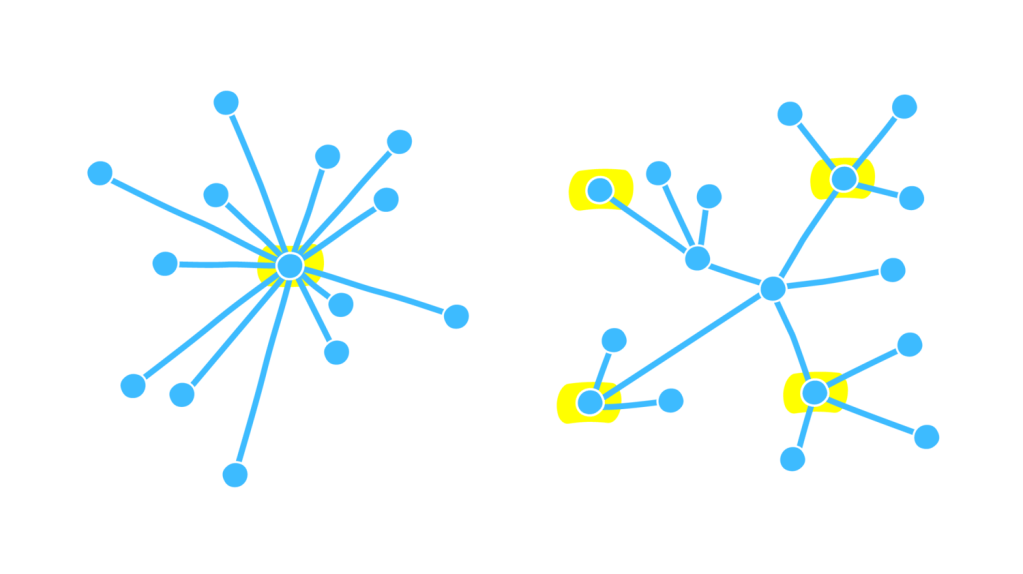
Centralized Technology: All users are connected to a central server that stores complete network data and user information.
Advantage: Standardization, Control, Administration and Monitoring – Usage Example: YouTube, Banking Systems
Disadvantage: Data Vulnerability (see Hackers), System Failure (Redundancy Required), Centralized (single point of attack)
In certain scenarios, the generic cloud computing model can be considered this type of technology, I’ll explain shortly. Typical Situation; Perhaps you have all of your technology (ex. applications, data, hardware) centrally located, at your home, or office. When you need to maintain, upgrade or retire the technology it is your responsibility to take care of it. You, in theory “own” the technology, infrastructure and any potential headaches / issues that may arrive with that responsibility. Yes, you may have a service agreement, or license that keeps you up to date and running, but the sole responsibility is in your hands.
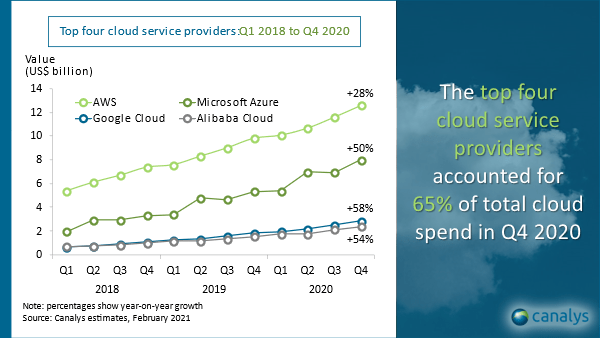
Then in the mid-2000’s came the advent of the commercially available cloud platform, as I briefly mentioned and referenced above. Now you have the option to put the technology that you in theory “own” and all of the inherent issues (ex. updates, backups, scalability) into the hands of someone else, but obviously for a fee / subscription. This became a great option for those that wanted to ensure they had the latest software, hardware, availability and protection, especially from lost information, provided to them via an SLA (Service Level Agreement). All the usual players have stepped-up to offer these services, primarily since they already had the hardware (in most cases), resources and infrastructure available to be leveraged. The names you should be familiar with, Amazon AWS, Google Cloud and Microsoft Azure own the largest market share of this technology as of early 2021.
This offering has become ideal to those that do not want to invest in quickly outdated hardware and software, plus if you are selling products and services any downtime, or lost data (vendors often have backup/restore options) can be critical to your business. When adopted, you now own the creativity, business model, growth and vision, plus your products and services are available “on-demand” to the public, while the technology infrastructure and administration of it (to some, the unfortunate part of doing business) is being administered and executed by a 3rd party.
However, now I want to remind you of what was mentioned in the opening paragraph, regarding the long-term vision for your products and services. Always keep in mind that you are at the mercy of the Terms and Conditions of the contract you signed with your service provider. It is not uncommon for these T&C’s to be updated, or modified numerous times per year. You may receive an email with a 45 page PDF file attached, that is full of legal jargon, and you just click the <AGREE> button and never think twice about it. While your business model, products and services being offered may have not changed, there might have been a wave of cultural, political and social changes that now put your ideas, products and services out-of-favor and no longer something that your service provider wants to “support” via their infrastructure. Overnight, that centralized offering that you adopted with open hands may now be unavailable to you, your organization and the audience / customers you count on. The vendor ultimately is in the right, because you are no longer adhering to the Terms and Conditions of doing business with them, which you early agreed to in that email that you gave little attention to. Now you may be in trouble and starting to scramble for any option, or alternative that will keep you and your business afloat. Being proactive, versus reactive is the key to surviving the just-in-time climate that we are forced to live with.
In a centralized model, always ask yourself the following in advance:
How much control do I “need / want” over what is being offered from me, or my organization to the public (ex. Are my products, services deemed edgy, controversial, opinionated, trendy, or focused towards a particular audience)
How much control do I “have” over what is being offered by me, or my organization (ex. Are channels, comments, endorsements, feedback and input allowed without moderation)
If my platform, or vendor suddenly became unavailable, how would I respond and reach my audience / customers – Always have a backup and/or disaster recovery plan and options ready in case the inevitable happens
Do I know my audience / customer and their expectations – Is your business meeting the needs of your audience, or is it being constrained by the terms and conditions of the service provider
Do I understand the value of data, privacy, reputation and protecting it – This is not just for you and your organization, but also your audience and customers
In my next Post, I will explore Decentralization and summarize the advantages / disadvantages of each model.
Did you ever have that idea that was so outstanding you were bursting with energy to let the world know all about? You were so confident that this was life-changing, it’s even unbelievable that no one else has even thought of this?
However, did you also know that your personality, or for that matter the members of your “Idea Team” were less than aggressive executioners (odd phrase) and risk-takers, meaning that the idea will never get off the runway, let alone the blueprint phase of putting it down in writing?
I live among individuals that are creative and ambitious, but not necessarily risk-takers. The ideas are often flowing at a rate that will make your head-spin, but a week later none of us can remember what that world changing concept was the previous week. Even worse, the ideas that needed “effort” beyond a concept, are left to die unceremoniously because someone needed to do “something” beyond ideation.
What makes a person pursue their idea, concept, or thoughts? I’m guessing it’s Passion…yes, you’re the one willing to go above-and-beyond the thought process to see your idea come to life. Does this mean sacrifice and heavens no, failure? Sure, that is what passion means…you’re willing to embody failure and feel the pain of embarrassment, if your cherished idea is not accepted with open arms by the unwashed of your audience. Do you give-up, no new iterations of the idea…back to brainstorming? – I’ve seen this too often to count.
But let’s say it is embraced, now what? I have witnessed colleagues that say “Excellent, let’s hire people to deliver this idea”without taking ownership in the growth and maturation of the concept. This is when the critical nature of “Passion” is called upon and all to often left to flounder. My colleagues had a great idea, but did not have the vision to develop the full roadmap that would bring it to fruition. The phrase “Passion” resonates once again in this scenario, while it may be easy to think of a concept, it’s much harder to foster its growth into a tangible deliverable.
This is where I will end for this post. I honestly believe people have great ideas, but too often lack the motivation to bring them to life. I think if you truly possess the passion to see you concept come to life, you need to ignore the inherent roadblocks (time, money, resources) the best you can, or forever regret what could have been.
As a side note, there are individuals/organizations willing to listen to fully vetted ideas, that may fund your pursuit if they feel you are passionate and have done the due-diligence. I would highly suggest the following sources to mature your idea, while fleshing out objections: