
Introduction: Why Agentic AI Is the Evolution CRM Needed
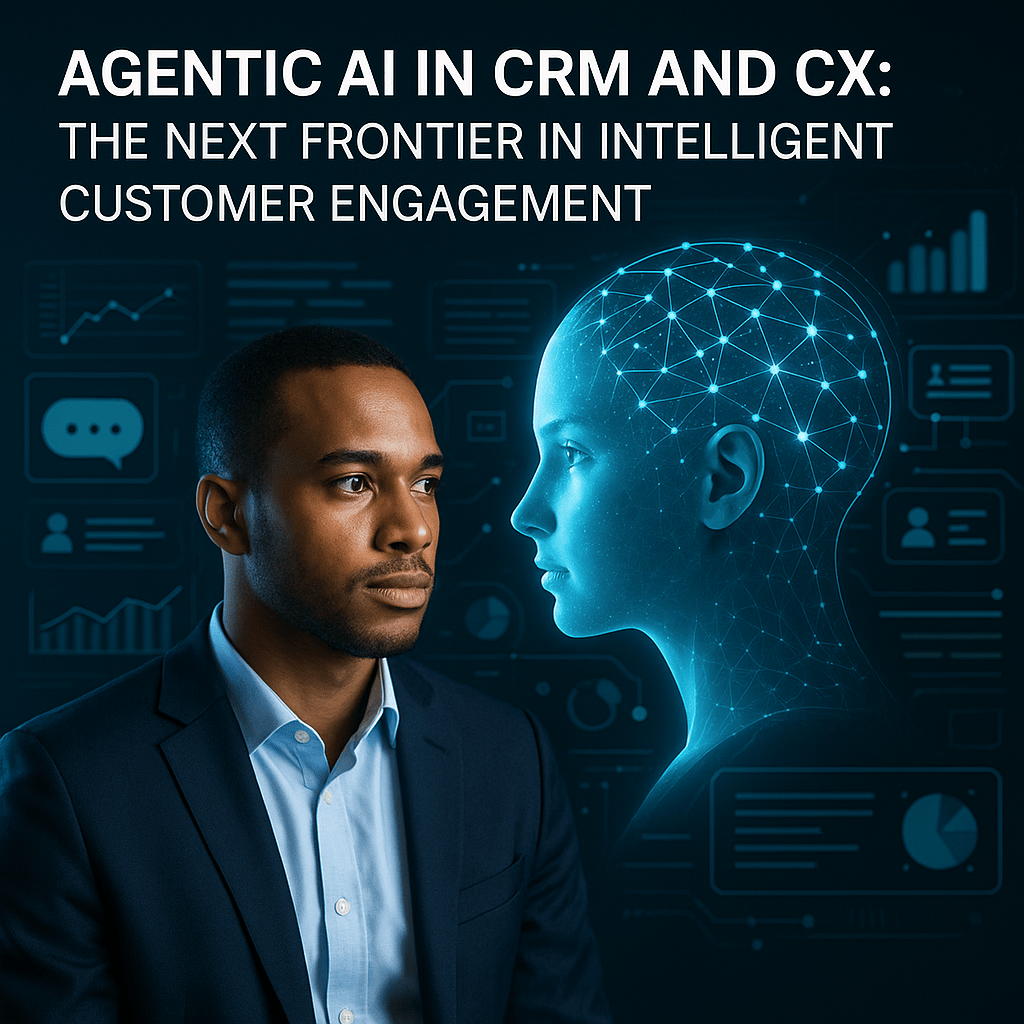
For decades, Customer Relationship Management (CRM) and Customer Experience (CX) strategies have been shaped by rule-based systems, automated workflows, and static data models. While these tools streamlined operations, they lacked the adaptability, autonomy, and real-time reasoning required in today’s experience-driven, hyper-personalized markets. Enter Agentic AI — a paradigm-shifting advancement that brings decision-making, goal-driven autonomy, and continuous learning into CRM and CX environments.
Agentic AI systems don’t just respond to customer inputs; they pursue objectives, adapt strategies, and self-improve — making them invaluable digital coworkers in the pursuit of frictionless, personalized, and emotionally intelligent customer journeys.
What Is Agentic AI and Why Is It a Game-Changer for CRM/CX?
Defining Agentic AI in Practical Terms
At its core, Agentic AI refers to systems endowed with agency — the ability to pursue goals, make context-aware decisions, and act autonomously within a defined scope. Think of them as intelligent, self-directed digital employees that don’t just process inputs but reason, decide, and act to accomplish objectives aligned with business outcomes.
In contrast to traditional automation or rule-based systems, which execute predefined scripts, Agentic AI identifies the objective, plans how to achieve it, monitors progress, and adapts in real time.
Key Capabilities of Agentic AI in CRM/CX:
| Capability | What It Means for CRM/CX |
|---|---|
| Goal-Directed Behavior | Agents operate with intent — for example, “reduce churn risk for customer X.” |
| Multi-Step Planning | Instead of simple Q&A, agents coordinate complex workflows across systems and channels. |
| Autonomy with Constraints | Agents act independently but respect enterprise rules, compliance, and escalation logic. |
| Reflection and Adaptation | Agents learn from each interaction, improving performance over time without human retraining. |
| Interoperability | They can interact with APIs, CRMs, contact center platforms, and data lakes autonomously. |
Why This Matters for Customer Experience (CX)
Agentic AI is not just another upgrade to your chatbot or recommendation engine — it is an architectural shift in how businesses engage with customers. Here’s why:
1. From Reactive to Proactive Service
Traditional systems wait for customers to raise their hands. Agentic AI identifies patterns (e.g., signs of churn, purchase hesitation) and initiates outreach — recommending solutions or offering support before problems escalate.
Example: An agentic system notices that a SaaS user hasn’t logged in for 10 days and triggers a personalized re-engagement sequence including a check-in, a curated help article, and a call to action from an AI Customer Success Manager.
2. Journey Ownership Instead of Fragmented Touchpoints
Agentic AI doesn’t just execute tasks — it owns outcomes. A single agent could shepherd a customer from interest to onboarding, support, renewal, and advocacy, creating a continuous, cohesive journey that reflects memory, tone, and evolving needs.
Benefit: This reduces handoffs, reintroductions, and fragmented service, addressing a major pain point in modern CX.
3. Personalization That’s Dynamic and Situational
Legacy personalization is static (name, segment, purchase history). Agentic systems generate personalization in-the-moment, using real-time sentiment, interaction history, intent, and environmental data.
Example: Instead of offering a generic discount, the agent knows this customer prefers sustainable products, had a recent complaint, and is shopping on mobile — and tailors an offer that fits all three dimensions.
4. Scale Without Sacrificing Empathy
Agentic AI can operate at massive scale, handling thousands of concurrent customers — each with a unique, emotionally intelligent, and brand-aligned interaction. These agents don’t burn out, don’t forget, and never break from protocol unless strategically directed.
Strategic Edge: This reduces dependency on linear headcount expansion, solving the scale vs. personalization tradeoff.
5. Autonomous Multimodal and Cross-Platform Execution
Modern agentic systems are channel-agnostic and modality-aware. They can initiate actions on WhatsApp, complete CRM updates, respond via voice AI, and sync to back-end systems — all within a single objective loop.
The Cognitive Leap Over Previous Generations
| Generation | Description | Limitation |
|---|---|---|
| Rule-Based Automation | If-then flows, decision trees | Rigid, brittle, high maintenance |
| Predictive AI | Forecasts churn, CLTV, etc. | Inference-only, no autonomy |
| Conversational AI | Chatbots, voice bots | Linear, lacks memory or deep reasoning |
| Agentic AI | Goal-driven, multi-step, autonomous decision-making | Early stage, needs governance |
Agentic AI is not an iteration, it’s a leap — transitioning from “AI as a tool” to AI as a collaborator that thinks, plans, and performs with strategic context.
A Paradigm Shift for CRM/CX Leaders
This shift demands CX and CRM teams rethink what success looks like. No longer is it about deflection rates or NPS alone — it’s about:
Agentic AI will redefine what “customer-centric” actually means. Not just in how we communicate, but how we anticipate, align, and advocate for customer outcomes — autonomously, intelligently, and ethically.
It’s no longer about CRM being a “system of record.”
With Agentic AI, it becomes a system of action — and more critically, a system of intent.
2. Latest Technological Advances Powering Agentic AI in CRM/CX
Recent breakthroughs have moved Agentic AI from conceptual to operational in CRM/CX platforms. Notable advances include:
a. Multi-Agent Orchestration Frameworks
Platforms like LangGraph and AutoGen now support multiple collaborating AI agents — e.g., a “Retention Agent”, “Product Expert”, and “Billing Resolver” — working together autonomously in a shared context. This allows for parallel task execution and contextual delegation.
Example: A major telco uses a multi-agent system to diagnose billing issues, recommend upgrades, and offer retention incentives in a single seamless customer flow.
b. Conversational Memory + Vector Databases
Next-gen agents are enhanced by persistent memory across sessions, stored in vector databases like Pinecone or Weaviate. This allows them to retain customer preferences, pain points, and journey histories, creating deeply personalized experiences.
c. Autonomous Workflow Integration
Integrations with CRM platforms (Salesforce Einstein 1, HubSpot AI Agents, Microsoft Copilot for Dynamics) now allow agentic systems to act on structured and unstructured data, triggering workflows, updating fields, generating follow-ups — all autonomously.
d. Emotion + Intent Modeling
With advancements in multimodal understanding (e.g., OpenAI’s GPT-4o and Anthropic’s Claude 3 Opus), agents can now interpret tone, sentiment, and even emotional micro-patterns to adjust their behavior. This has enabled emotionally intelligent CX flows that defuse frustration and encourage loyalty.
e. Synthetic Persona Development
Some organizations are now training agentic personas — like “AI Success Managers” or “AI Brand Concierges” — to embody brand tone, style, and values, becoming consistent touchpoints across the customer journey.
3. What Makes This Wave Stand Out?
Unlike the past generation of AI, which was reactive and predictive at best, this wave is defined by:
- Autonomy: Agents are not waiting for prompts — they take initiative.
- Coordination: Multi-agent systems now function as collaborative teams.
- Adaptability: Feedback loops enable rapid improvement without human intervention.
- Contextuality: Real-time adjustments based on evolving customer signals, not static journeys.
- E2E Capability: Agents can now close the loop — from issue detection to resolution to follow-up.
4. What Professionals Should Focus On: Skills, Experience, and Vision
If you’re in CRM, CX, or AI roles, here’s where you need to invest your time:
a. Short-Term Skills to Develop
| Skill | Why It Matters |
|---|---|
| Prompt Engineering for Agents | Mastering how to design effective system prompts, agent goals, and guardrails. |
| Multi-Agent System Design | Understand orchestration strategies, especially for complex CX workflows. |
| LLM Tool Integration (LangChain, Semantic Kernel) | Embedding agents into enterprise-grade systems. |
| Customer Journey Mapping for AI | Knowing how to translate customer journey touchpoints into agent tasks and goals. |
| Ethical Governance of Autonomy | Defining escalation paths, fail-safes, and auditability for autonomous systems. |
b. Experience That Stands Out
- Leading agent-driven pilot projects in customer service, retention, or onboarding
- Collaborating with AI/ML teams to train personas on brand tone and task execution
- Contributing to LLM fine-tuning or using RAG to inject proprietary knowledge into CX agents
- Designing closed-loop feedback systems that let agents self-correct
c. Vision to Embrace
- Think in outcomes, not outputs. What matters is the result (e.g., retention), not the interaction (e.g., chat completed).
- Trust—but verify—autonomy. Build systems with human oversight as-needed, but let agents do what they do best.
- Design for continuous evolution. Agentic CX is not static. It learns, shifts, and reshapes customer touchpoints over time.
5. Why Agentic AI Is the Future of CRM/CX — And Why You Shouldn’t Ignore It
- Scalability: One agent can serve millions while adapting to each customer’s context.
- Hyper-personalization: Agents craft individualized journeys — not just messages.
- Proactive retention: They act before the customer complains.
- Self-improvement: With each interaction, they get better — a compounding effect.
The companies that win in the next 5 years won’t be the ones that simply automate CRM. They’ll be the ones that give it agency.
This is not about replacing humans — it’s about expanding the bandwidth of intelligent decision-making in customer experience. With Agentic AI, CRM transforms from a database into a living, breathing ecosystem of intelligent customer engagement.
Conclusion: The Call to Action
Agentic AI in CRM/CX is no longer optional or hypothetical. It’s already being deployed by customer-obsessed enterprises — and the gap between those leveraging it and those who aren’t is widening by the quarter.
To stay competitive, every CX leader, CRM architect, and AI practitioner must start building fluency in agentic thinking. The tools are available. The breakthroughs are proven. Now, the only question is: will you be the architect or the observer of this transformation?
As always, we encourage you to follow us on (Spotify) as we discuss this and all topics.

 De Lio Tech Trends