
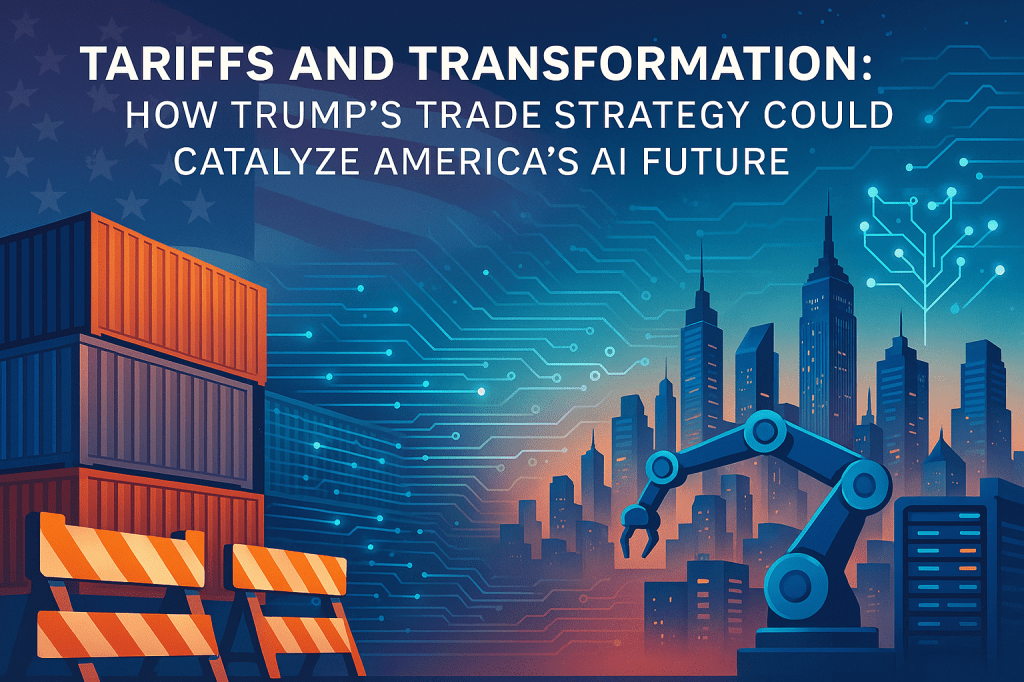
When economic tensions flare, unexpected opportunities emerge. While President Donald Trump’s renewed push for worldwide tariffs has reignited debate over globalization and economic isolation, a contrarian view is quietly gaining traction: Could protectionist trade policies act as an accelerant for American innovation, particularly in Artificial Intelligence (AI)? As access to cheap foreign labor and outsourced manufacturing becomes constrained, the U.S. may be nudged — or forced — into a new industrial renaissance powered by automation, AI, and advanced digital infrastructure.
In this post, we’ll explore how an aggressive trade war scenario may inadvertently lay the foundation for rapid AI adoption, workforce transformation, and strategic repositioning of U.S. economic competitiveness — not in spite of tariffs, but because of them.
Short-Term Ripple Effects: Immediate Catalysts for AI Integration
1. Supply Chain Shock → Automation Investment
- Tariffs on imported goods — particularly from manufacturing hubs like China — immediately raise the cost of parts, electronics, and finished products.
- To combat increased costs, U.S. manufacturers may invest in robotic process automation (RPA), AI-driven predictive maintenance, and computer vision for quality control, reducing reliance on human labor and global inputs.
Example: An American electronics company previously sourcing sensors from Asia might now use AI to optimize domestic additive manufacturing (3D printing) operations, cutting turnaround time and offsetting tariff costs.
2. Labor Cost Rebalancing
- With offshore labor becoming less cost-effective due to tariffs, the cost parity between human workers and AI solutions narrows.
- Companies accelerate deployment of AI-powered customer support, logistics optimization, and AI-enhanced B2B services.
Example: SMBs adopt platforms like UiPath or Microsoft Power Automate to streamline finance and HR workflows, reducing the need for outsourced back-office functions in India or the Philippines.
3. Energy and Commodities Realignment
- Tariffs on materials like rare earth metals or lithium may hamper hardware-dependent industries, incentivizing a pivot to software-first innovation.
- U.S. firms may double down on software-defined infrastructure, AI-driven simulation, and synthetic data generation to reduce dependence on imported physical components.
Example: In response to tariffs on imported rare earth metals, U.S. energy firms may accelerate investment in AI-driven material discovery and recycling technologies to secure domestic alternatives and reduce dependency on foreign supply chains.
Mid to Long-Term Scenarios: Strategic AI Acceleration
1. Re-Industrialization Through AI-First Infrastructure
As tariffs insulate domestic industries:
- Federal and state incentives (similar to the CHIPS Act) may emerge to promote AI innovation zones in Rust Belt regions.
- Legacy factories get retrofit with digital twins, AI-powered supply chain orchestration, and IoT-based production analytics.
- AI talent clusters emerge in places like Detroit, Pittsburgh, and Milwaukee, rejuvenating local economies.
Long-Term Outcome:
The U.S. begins to compete not on low-cost goods, but high-efficiency, AI-integrated advanced manufacturing.
2. Defense and National Security-Driven AI Growth
A tariff-fueled standoff with nations like China may escalate:
- U.S. defense agencies double down on autonomous systems, cybersecurity AI, and quantum AI research.
- Public-private partnerships with defense contractors and startups accelerate dual-use AI innovations (e.g., drones, AI threat detection, digital war gaming).
Long-Term Outcome:
AI becomes a core pillar of national resilience, similar to how the space race galvanized aerospace R&D.
3. Higher Education & Workforce Realignment
As industries shift to domestic AI-first operations:
- Trade schools, community colleges, and universities modernize programs to teach AI integration, ML operations, low-code automation, and ethical AI use.
- Federal workforce reskilling programs (akin to the GI Bill) are introduced to support mid-career transitions.
Example:
A 52-year-old logistics manager in Ohio completes a certificate in AI-driven supply chain tools and pivots into a role coordinating digital freight platforms.
Opportunities for New Workforce Entrants
🧠 AI-First Entrepreneurism
- Tariffs reconfigure global pricing dynamics — creating white space opportunities for AI startups to solve new domestic pain points in manufacturing, agriculture, and logistics.
- Young entrepreneurs can build lean AI-driven businesses targeting newly re-domesticated industries.
💼 Entry-Level Talent Floodgates Open
- The surge in demand for AI system maintenance, prompt engineering, data labeling, and ML model tuning opens doors for tech-savvy but non-degreed workers.
- Apprenticeship programs and AI bootcamps become more valuable than 4-year degrees for many roles.
Upskilling Pathways for Stable-Career Professionals
📈 Business Leaders and Analysts
- Professionals in stable sectors (e.g., retail, finance, insurance) can future-proof by learning AI analytics, customer segmentation AI, and LMM-enhanced decision intelligence.
- MBAs and strategists gain value by adding AI fluency and toolkits like Tableau+Einstein AI or Snowflake Cortex to their profiles.
🏭 Operations & Manufacturing Roles
- Engineers and managers shift into AI-integrated plant operations, robotics orchestration, and digital twin strategy roles.
- Experienced technicians transition into AI-powered maintenance via platforms like Avathon or Uptake.
Conclusion: A New Kind of American Resilience
While protectionism has long been painted as anti-innovation, we may be witnessing a rare inversion of that narrative. If U.S. businesses are pushed away from cheap global sourcing and back toward domestic self-reliance, AI may emerge as the only economically viable way to bridge the gap. This shift can usher in not only a smarter economy but a more inclusive one — if policymakers, educators, and enterprises act quickly.
By viewing tariffs not merely as a cost, but as a forcing function for digital transformation, the U.S. has a window to reindustrialize with intelligence — quite literally.
Please listen to us discuss this topic on Spotify

 De Lio Tech Trends