
Introduction
In the rapidly evolving landscape of artificial intelligence, the introduction of text-to-video AI technologies marks a significant milestone. We highlighted the introduction and advancement of OpenAI’s product suite with their introduction of Sora (text-to-video) in our previous post. Embedded in these products, and typically without a lot of marketing fanfare are the technologies that continually drive this innovation and specifically one of them, Gaussian splatting, has emerged as a pivotal technique. This blog post delves into the intricacies of Gaussian splatting, its integration with current AI prompt technology, and its crucial role in enhancing content creation through text-to-video AI. Our aim is to provide a comprehensive understanding of this technology, making it accessible not only to seasoned professionals but also to junior practitioners eager to grasp the future of AI-driven content creation. Additionally, a companion technology is often discussed hand-in-hand with Gaussian splatting and that is called, Neural Radiance Fields (NeRF) and we will dive into that topic in a future post.
Understanding Gaussian Splatting
Gaussian splatting is a sophisticated technique used in the realm of computer graphics and image processing. It involves the use of Gaussian functions to simulate the effects of splatting or scattering light and particles. This method is particularly effective in creating realistic textures and effects in digital images by smoothly blending colors and intensities.
In the context of AI, Gaussian splatting plays a fundamental role in generating high-quality, realistic images and videos from textual descriptions. The technique allows for the seamless integration of various elements within a scene, ensuring that the generated visuals are not only convincing but also aesthetically pleasing.
Gaussian splatting, as a technique, is integral to many advanced computer graphics and image processing applications, particularly those involving the generation of realistic textures, lighting, and smooth transitions between visual elements. In the context of AI-driven platforms like OpenAI’s Sora, which is designed to generate video content from text prompts, Gaussian splatting and similar techniques are foundational to achieving high-quality, realistic outputs.
Is Gaussian Splatting Automatically Embedded?
In products like Sora, Gaussian splatting and other advanced image processing techniques are typically embedded within the AI models themselves. These models are trained on vast datasets that include examples of realistic textures, lighting effects, and color transitions, learning how to replicate these effects in generated content. This means that the application of Gaussian splatting is automatic and integrated into the content generation process, requiring no manual intervention from the user.
Understanding the Role of Gaussian Splatting in AI Products
For AI-driven content creation tools:
- Automatic Application: Advanced techniques like Gaussian splatting are embedded within the AI’s algorithms, ensuring that the generated images, videos, or other visual content automatically include these effects for realism and visual appeal.
- No Manual Requirement: Users do not need to apply Gaussian splatting or similar techniques manually. The focus is on inputting creative prompts, while the AI handles the complex task of rendering realistic outputs based on its training and built-in processing capabilities.
- Enhanced Quality and Realism: The integration of such techniques is crucial for achieving the high quality and realism that users expect from AI-generated content. It enables the creation of visuals that are not just technically impressive but also emotionally resonant and engaging.
Expanding on Gaussian Splatting
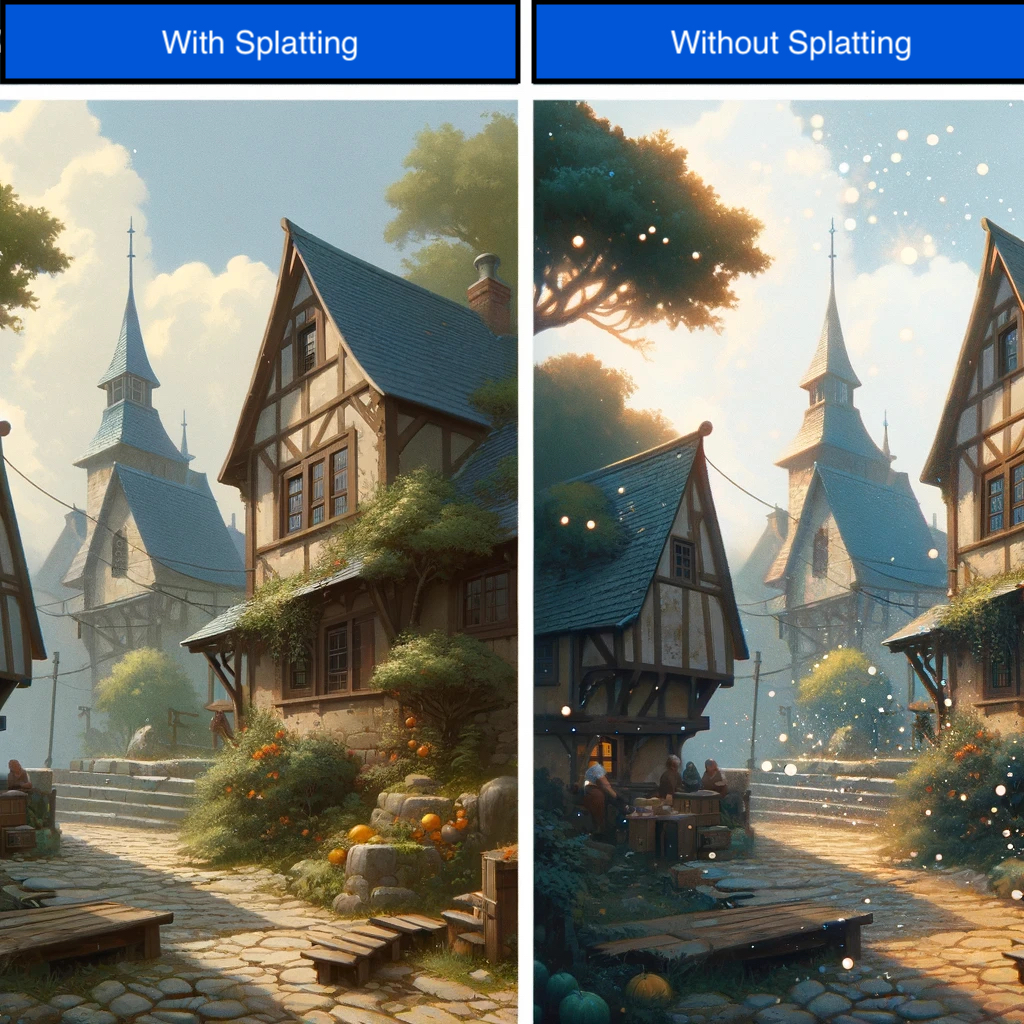
Visually Understanding Gaussian Splatting
To deepen your understanding of Gaussian splatting, let’s examine an illustrative comparison. This illustration contrasts a scene with Gaussian splatting against one where Gaussian splatting is not applied. In the later, you’ll notice harsh transitions and unrealistic blending of elements, resulting in a scene that feels disjointed and artificial. Conversely, the scene employing Gaussian splatting showcases smooth color transitions and realistic effects, significantly enhancing the visual realism and aesthetic appeal.
Example: Enhancing Realism in Digital Imagery
Consider a sunset beach scene where people are walking along the shore. Without Gaussian splatting, the sunlight’s diffusion, shadows cast by the people, and the blending of the sky’s colors could appear abrupt and unnatural. The transitions between different elements of the scene might be too stark, detracting from the overall realism.
Now, apply Gaussian splatting to the same scene. This technique uses Gaussian functions to simulate the natural diffusion of light and the soft blending of colors. The result is a more lifelike representation of the sunset, with gently blended skies and realistically rendered shadows on the sand. The people walking on the beach are integrated into the scene seamlessly, with their outlines and the surrounding environment blending in a way that mimics the natural observation of such a scene.
This visual and example highlight the significance of Gaussian splatting in creating digital images and videos that are not just visually appealing but also convincingly realistic. By understanding and applying this technique, content creators can push the boundaries of digital realism, making artificial scenes indistinguishable from real-life observations.

The Advent of Text-to-Video AI
Text-to-video AI represents the next leap in content creation, enabling users to generate complex video content from simple text prompts. This technology leverages deep learning models to interpret textual descriptions and translate them into dynamic visual narratives. The process encompasses a wide range of tasks, including scene composition, object placement, motion planning, and the rendering of realistic textures and lighting effects.
Gaussian splatting becomes instrumental in this process, particularly in the rendering phase, where it ensures that the visual elements are blended naturally. It contributes to the realism and dynamism of the generated videos, making the technology invaluable for content creators seeking to produce high-quality visual content efficiently.
Integration with AI Prompt Technology
The integration of Gaussian splatting with AI prompt technology is a cornerstone of text-to-video AI systems. AI prompt technology refers to the mechanisms by which users can instruct AI models using natural language. These prompts are then interpreted by the AI to generate content that aligns with the user’s intent.
In the case of text-to-video AI, Gaussian splatting is employed to refine the visual output based on the textual prompts. For example, if a prompt describes a sunset scene with people walking on the beach, Gaussian splatting helps in creating the soft transitions of the sunset’s colors and the realistic blending of the people’s shadows on the sand. This ensures that the final video output closely matches the scene described in the prompt, with natural-looking effects and transitions.
OpenAI’s Sora: A Case Study in Innovation
OpenAI’s Sora stands as a testament to the potential of integrating Gaussian splatting with text-to-video AI. Sora is designed to offer content creators a powerful tool for generating high-quality video content directly from text descriptions. The platform utilizes advanced AI models, including those trained on Gaussian splatting techniques, to produce videos that are not only visually stunning but also deeply engaging.
The significance of Gaussian splatting in Sora’s technology stack cannot be overstated. It allows Sora to achieve a level of visual fidelity and realism that sets a new standard for AI-generated content. This makes Sora an invaluable asset for professionals in marketing, and digital content creation, who can leverage the platform to create compelling visual narratives with minimal effort.
Key Topics for Discussion and Understanding
To fully appreciate the impact of Gaussian splatting in text-to-video AI, several key topics warrant discussion:
- Realism and Aesthetics: Understanding how Gaussian splatting contributes to the realism and aesthetic quality of AI-generated videos.
- Efficiency in Content Creation: Exploring how this technology streamlines the content creation process, enabling faster production times without compromising on quality.
- AI Prompt Technology: Delving into the advancements in AI prompt technology that make it possible to accurately translate text descriptions into complex visual content.
- Applications and Implications: Considering the broad range of applications for text-to-video AI and the potential implications for industries such as marketing, entertainment, and education.
Conclusion
Gaussian splatting represents a critical technological advancement in the field of text-to-video AI, offering unprecedented opportunities for content creators. By understanding this technology and its integration with AI prompt technology, professionals can harness the power of platforms like OpenAI’s Sora to revolutionize the way visual content is created and consumed. As we look to the future, the potential of Gaussian splatting in enhancing digital transformation and customer experience through AI-driven content creation is immense, promising a new era of creativity and innovation in the digital landscape.

 De Lio Tech Trends